Person
Herod Agrippa II
Agrippa II, King Agrippa, Marcus Julius Agrippa, Herod Agrippa the Younger, Agrippa the younger, Agrippa (Acts 25)Intro
Herod Agrippa II was the last king of the Herod family. He is the "King Agrippa" who heard Paul's defense at Caesarea and said, "With but little persuasion thou wouldest fain make me a Christian."
He was the great-grandson of Herod the Great. Rome gave him a kingdom in the north of the land and control over the temple in Jerusalem, including the right to choose the high priest. When the Jewish revolt broke out in AD 66 he begged the people not to go to war, and then fought on Rome's side. Coins struck in his name survive in large numbers.
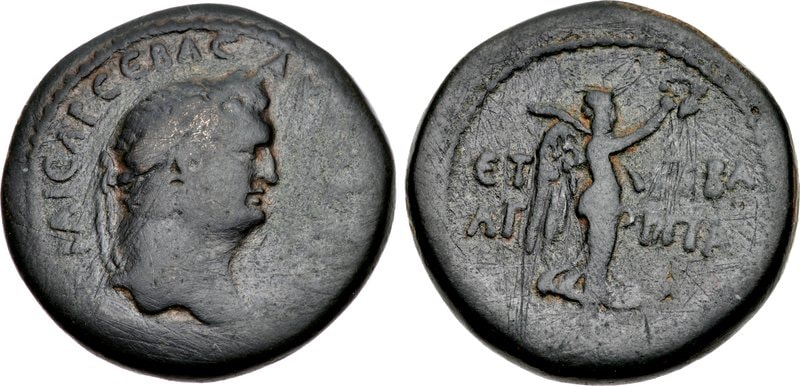
Bronze coin of Agrippa II honoring Titus, struck at Caesarea Paneas, dated to his 26th regnal year (AD 74/75). Photo: Classical Numismatic Group, CC BY-SA 2.5, via Wikimedia Commons, resized.

See this page's graph and discover linked topics
In full
Marcus Julius Agrippa, known as Agrippa II, was the son of Herod Agrippa I, the king who killed James the son of Zebedee and imprisoned Peter (Acts 12:1-3). He was seventeen and in Rome when his father died in AD 44, and Claudius judged him too young to inherit the kingdom (Josephus, Antiquities 19.354, 19.360-362).
His territories grew in stages:
- Chalcis, c. AD 50. After the death of his uncle Herod of Chalcis, Claudius gave him that small kingdom in Lebanon, along with oversight of the temple and the right to appoint high priests (Antiquities 20.104, 20.222).
- Philip's tetrarchy, AD 53. Claudius took Chalcis back and "bestowed upon Agrippa the tetrarchy of Philip, and Batanea," the lands northeast of the Sea of Galilee (Antiquities 20.138).
- Galilee and Perea, under Nero. "Cesar also bestowed upon Agrippa a certain part of Galilee," including Tiberias and Taricheae, and Julias in Perea (Antiquities 20.159). He renamed Caesarea Philippi "Neronias" in Nero's honor (Antiquities 20.211).
- High priests. He appointed and removed high priests several times. Around AD 59 he replaced Ananias with Ishmael son of Phabi (Antiquities 20.179), and in AD 62 he deposed Ananus son of Ananus for convening the Sanhedrin to execute James, the brother of Jesus (Antiquities 20.200-203).
- The war. In AD 66 he made a long speech in Jerusalem urging the people not to fight Rome, with his sister Bernice placed where the crowd could see her; "both he and his sister wept" (Jewish War 2.344-407). The rebels later burned his palace in Jerusalem (Jewish War 2.426). He sided with Rome throughout the war and was wounded at the siege of Gamala (Jewish War 4.14).
- Josephus's patron. Josephus says Agrippa wrote him sixty-two letters vouching for the accuracy of his history of the war (Life 364-367; compare Against Apion 1.51).
In the Bible
Agrippa appears in Acts 25:13 to 26:32.
- Arrival. "Now when certain days were passed, Agrippa the king and Bernice arrived at Cæsarea, and saluted Festus" (Acts 25:13, ASV). Festus explains Paul's case, and Agrippa says, "I also could wish to hear the man myself" (Acts 25:22, ASV).
- The hearing. "So on the morrow, when Agrippa was come, and Bernice, with great pomp" (Acts 25:23, ASV). Paul addresses him as one "expert in all customs and questions which are among the Jews" (Acts 26:3, ASV) and tells the story of his conversion (Acts 26:4-23).
- The challenge. "King Agrippa, believest thou the prophets? I know that thou believest. And Agrippa said unto Paul, With but little persuasion thou wouldest fain make me a Christian" (Acts 26:27-28, ASV). The KJV renders the reply "Almost thou persuadest me to be a Christian."
- The verdict. After withdrawing with Festus and Bernice, the officials agree: "This man doeth nothing worthy of death or of bonds. And Agrippa said unto Festus, This man might have been set at liberty, if he had not appealed unto Cæsar" (Acts 26:31-32, ASV).
Family and lineage
- Great-grandfather: Herod the Great, through Aristobulus, Herod's son by the Hasmonean princess Mariamne I.
- Father: Herod Agrippa I, king of Judea AD 41-44 (Acts 12:1, Acts 12:20-23).
- Mother: Cypros, a granddaughter of Herod the Great's brother Phasael.
- Sisters: Bernice, who lived with him for long periods; Mariamne; and Drusilla, wife of Antonius Felix (Antiquities 18.132; 19.354).
- Great-uncle and aunt: Herod Antipas was his great-uncle, and Herodias, his father's sister, married Antipas.
- Children: none recorded. He was the last Herodian king.
Historical and archaeological evidence
| Source | What it says | Date | Where it is now | Grade |
|---|---|---|---|---|
| Josephus, Antiquities 19-20, Jewish War 2-7, Life | His grants of territory, control of the temple, appointments of high priests, his speech against the war, his loyalty to Rome, his letters to Josephus | written c. AD 75-100 | manuscript tradition | contemporary witness who knew him personally, strong |
| Coins of Agrippa II | Many bronze issues naming King Agrippa, dated by his regnal eras, several honoring Nero, Vespasian, Titus and Domitian | c. AD 54 to the 90s | finds at Masada, Meiron and elsewhere; museum collections | direct material evidence |
| Latin inscription from Berytus (Beirut) | "Queen Berenice" and "great King Agrippa" restore a building their great-grandfather King Herod had built (AE 1928, 82) | later 1st century AD | National Museum of Beirut | direct epigraphic evidence |
| Photius, Bibliotheca codex 33, summarizing Justus of Tiberias | Agrippa died in the third year of Trajan (AD 100) | 9th-century summary of a 1st-century source | manuscript tradition | late, debated |
Lawrence Mykytiuk counts Agrippa II among the confirmed New Testament political figures, citing Josephus and his coins from Masada and Meiron ("New Testament Political Figures Confirmed," Biblical Archaeology Review 43:5, 2017).
Scholarly consensus
- Identity. The "King Agrippa" of Acts 25-26 is universally identified with Agrippa II. His presence with Bernice at Caesarea, his ties to the Roman governor and his knowledge of Jewish custom all match Josephus.
- Date of death. Disputed. Photius, citing Justus of Tiberias, places it in AD 100. Many historians prefer about AD 92/93, because no coins or inscriptions clearly attest him later and Josephus's Life (359-360), written in the 90s, speaks of him as already dead. The question remains open.
- Coin chronology. His coins use more than one regnal era, and numismatists disagree on the starting years; the dated coins are nonetheless secure evidence of his reign.
- Acts and Roman procedure. Luke's picture of a governor consulting a Jewish client king on a religious charge before writing to the emperor fits Roman practice. See Acts as History (Ramsay's Verification).
Theological significance
- The prophets and the resurrection. Paul's defense before Agrippa is the fullest statement in Acts of his claim that the gospel is what "the prophets and Moses did say should come; how that the Christ must suffer, and how that he first by the resurrection of the dead should proclaim light both to the people and to the Gentiles" (Acts 26:22-23, ASV). He appeals to Agrippa as a Jew who believes the prophets.
- "Not done in a corner." Paul tells Festus that the king knows these things, "for this hath not been done in a corner" (Acts 26:26, ASV). The events of the gospel were public, and the highest Jewish authority in the region knew of them.
- "Almost." Agrippa's reply has been read two ways. The KJV's "Almost thou persuadest me" makes it a confession of near-conviction. The Greek en oligō ("in a little") is more often taken today as ironic: "In such a short time you think you can make me a Christian?" Either way, Paul answers that he wishes every hearer "whether with little or with much" might become as he is (Acts 26:29).
- Fulfilment of a promise. At Paul's conversion the Lord said he would bear His name "before the Gentiles and kings" (Acts 9:15, ASV). The hearing before Agrippa is that word fulfilled.
Church Fathers
- John Chrysostom, Homilies on Acts 52, on Acts 25:23-26:29, notes that "from his great desire to hear, the king permits him to speak," and discusses the phrase en oligō, which he takes in the sense of "with little effort."
See also
- Paul the Apostle, who made his defense before him
- Bernice, his sister and companion at the hearing
- Drusilla, his younger sister, wife of Felix
- Porcius Festus, the governor who arranged the hearing
- Herod the Great, his great-grandfather
- Herod Antipas, his great-uncle
- James the Brother of Jesus, whose execution led Agrippa to depose the high priest
- Josephus, the historian he supported
- Olivet Discourse and AD 70, the war in which he sided with Rome
- Biblical Figures Confirmed by Archaeology, Mykytiuk's list of confirmed persons
- People of the Bible, the hub of attested biblical people by book
Common questions this page answers
Q: Who was King Agrippa in Acts 26?
He was Herod Agrippa II, son of Herod Agrippa I and great-grandson of Herod the Great. Rome made him king of territories north and east of Galilee and gave him control over the Jerusalem temple. He heard Paul's defense at Caesarea with his sister Bernice and the governor Festus.
Q: What did Agrippa mean by "almost thou persuadest me to be a Christian"?
The KJV reading suggests he was nearly convinced. Many modern translators take the Greek en oligō as ironic, "with but little persuasion thou wouldest fain make me a Christian" (ASV), meaning he would not be won over so quickly. Paul's answer works either way: he wished Agrippa would become a believer whether "with little or with much."
Q: Is King Agrippa II mentioned outside the Bible?
Yes. Josephus knew him personally and describes his reign in detail, coins struck in his name survive in large numbers, and a Latin inscription from Beirut names him with his sister Queen Berenice.
Q: What happened to Agrippa II during the Jewish revolt?
He urged the Jews of Jerusalem not to go to war with Rome in AD 66, and when they did, he fought on the Roman side and was wounded at Gamala. He kept his kingdom after the war and died around AD 92/93 or, by one ancient report, about AD 100.