Person
Herod Agrippa I
Agrippa I, Marcus Julius Agrippa, King Agrippa I, Herod the king (Acts 12), Agrippa the GreatIntro
Herod Agrippa I was a grandson of Herod the Great who, after years of debt and a spell in a Roman prison, became king over almost all of his grandfather's realm. He ruled from AD 37 to 44, the last Jewish king to govern Judea. Acts calls him simply "Herod the king." He executed the apostle James, son of Zebedee, with the sword and imprisoned Peter, who was freed by an angel. Soon afterward, at Caesarea, the crowd hailed his speech as "the voice of a god, and not of a man," and he died suddenly.
The Jewish historian Josephus describes the same death at the same city: Agrippa appeared at a festival in a robe of silver, flatterers called him a god, he did not rebuke them, and he was seized with violent pain in his belly and died five days later. Coins struck in his name survive in large numbers.
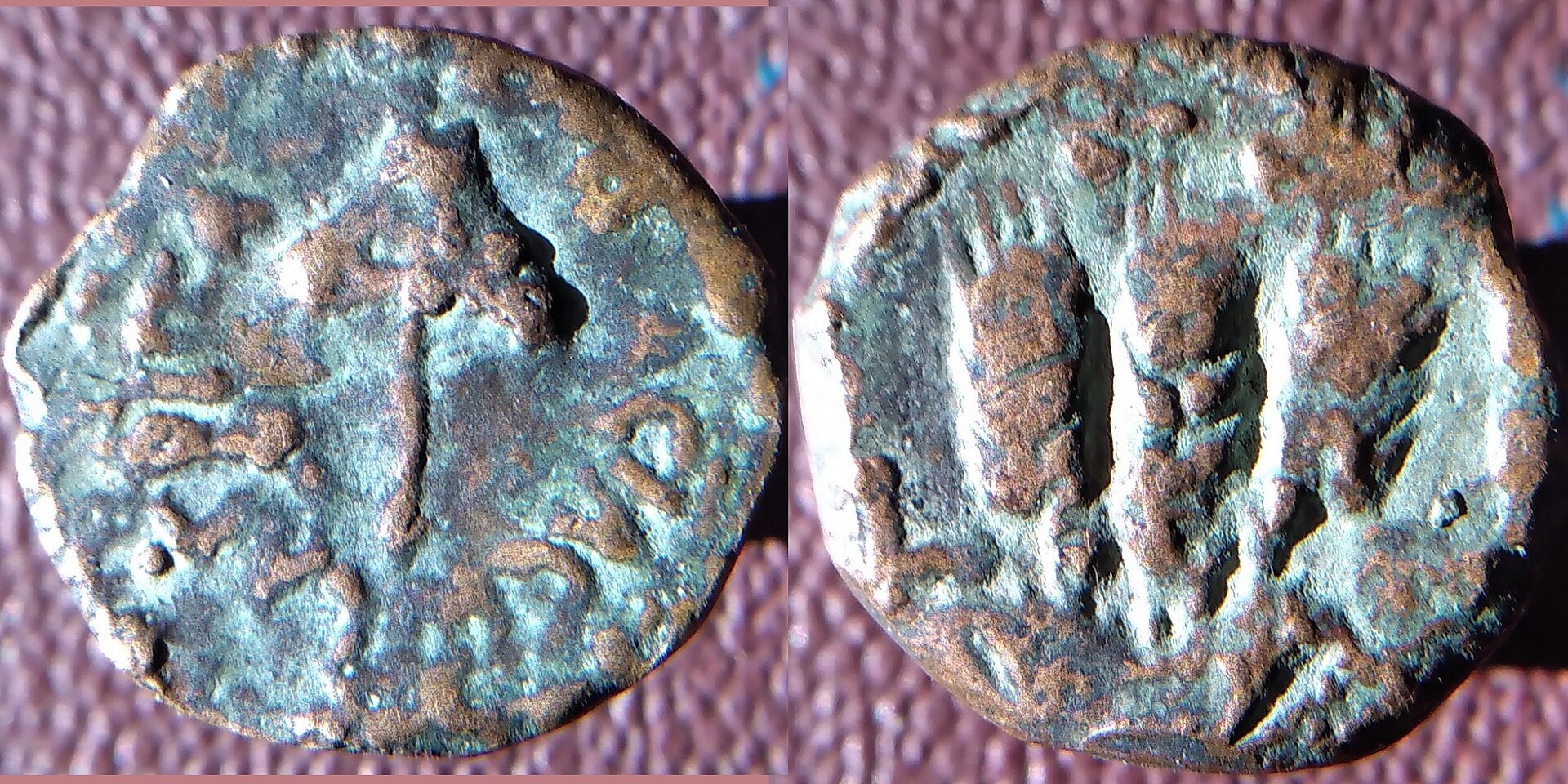
A bronze prutah of Agrippa I, struck in Jerusalem in year 6 of his reign (AD 41/42): a royal canopy with the legend "of King Agrippa," and three ears of barley. Photo: Maxime Cambreling, CC BY-SA 4.0, via Wikimedia Commons, resized.

The 30-second version:
Herod Agrippa I, grandson of Herod the Great, grew up at the imperial court in Rome, fell into debt and prison, and was made king by his friend Caligula in AD 37. Claudius, whom he helped to the throne, gave him Judea in AD 41. To please his Jewish subjects he killed James and arrested Peter (Acts 12). In AD 44 at Caesarea he accepted acclaim as a god and died within days. Acts and Josephus tell that death independently, and his own coins name him king.
See this page's graph and discover linked topics
In full
Marcus Julius Agrippa was the son of Aristobulus IV, whom his father Herod the Great executed in 7 BC, and of Berenice, Herod's niece. Through his grandmother Mariamne he had Hasmonean blood, which made him popular with Jewish subjects. Educated at Rome alongside Drusus son of Tiberius and the future emperor Claudius, he ran up huge debts, was imprisoned by Tiberius for wishing aloud that Gaius would soon be emperor, and was freed and crowned when Gaius (Caligula) succeeded in AD 37 (Antiquities 18.143-237). Gaius gave him the former tetrarchy of Philip, then in AD 39/40 the Galilee and Perea of his exiled uncle Herod Antipas. In AD 41 Claudius added Judea and Samaria, so that Agrippa ruled roughly the kingdom of Herod the Great (Ant. 19.274-275). He cultivated the Jewish population of Jerusalem with conspicuous piety while building and holding games in Greek cities. Acts 12 records his execution of James, his arrest of Peter, his quarrel with Tyre and Sidon, and his death at Caesarea in AD 44, which Josephus independently describes (Ant. 19.343-350). His kingdom then reverted to direct Roman rule under procurators.
In the Bible
- Acts 12:1-3, the persecution. "Now about that time Herod the king put forth his hands to afflict certain of the church. And he killed James the brother of John with the sword. And when he saw that it pleased the Jews, he proceeded to seize Peter also" (ASV).
- Acts 12:4-19, Peter's escape. Agrippa puts Peter under four squads of soldiers, "intending after the Passover to bring him forth to the people" (12:4, ASV). An angel releases him; Agrippa has the guards executed and goes down to Caesarea (12:19).
- Acts 12:20-23, his death. The cities of Tyre and Sidon, dependent on his territory for food, sue for peace. "And upon a set day Herod arrayed himself in royal apparel, and sat on the throne, and made an oration unto them. And the people shouted, saying, The voice of a god, and not of a man. And immediately an angel of the Lord smote him, because he gave not God the glory: and he was eaten of worms, and gave up the ghost" (12:21-23, ASV).
- Acts 12:24. "But the word of God grew and multiplied" (ASV), Luke's comment on the persecutor's end.
- Acts 11:30-12:25 frames the episode with the famine relief from Antioch, dating it to the reign of Claudius. See Claudius.
Family and lineage
- Grandfather. Herod the Great.
- Father. Aristobulus IV, son of Herod and the Hasmonean princess Mariamne, executed by Herod in 7 BC.
- Mother. Berenice, daughter of Herod's sister Salome.
- Siblings. Herod of Chalcis; Herodias, wife of Herod Antipas, who brought about the death of John the Baptist; Aristobulus; and Mariamne.
- Uncles. Herod Antipas and Herod Archelaus among them.
- Wife. Cypros, his cousin.
- Children. Agrippa II, before whom Paul spoke (Acts 25:13-26:32); Bernice, who sat with him at that hearing; Drusilla, wife of the governor Felix (Acts 24:24); and Mariamne (Ant. 18.132; 19.354).
Historical and archaeological evidence
Josephus on his death, Antiquities 19.343-350
At Caesarea, during shows held for the emperor's welfare, "he put on a garment made wholly of silver, and of a contexture truly wonderful; and came into the theater early in the morning." The sunlight on the silver dazzled the crowd, and "presently his flatterers cried out... that He was a God... Upon this the King did neither rebuke them, nor reject their impious flattery." He looked up, saw an owl, which he took as an omen of death, and "a severe pain also arose in his belly." He said, "I, whom you call a god, am commanded presently to depart this life." After "five days, he departed this life. Being in the fifty fourth year of his age, and in the seventh year of his reign" (Ant. 19.344-350, Whiston).
Agreement with Acts. The city (Caesarea), the occasion (a public assembly), the royal robe, the acclamation as a god, his failure to refuse it, sudden abdominal agony, and death shortly after. Acts attributes the blow to an angel; Josephus records an omen and the king's own confession that providence was reproving him. The two accounts are independent; neither depends on the other.
Other Josephus material
- His youth at Rome, his debts and imprisonment under Tiberius, and his release and crowning by Gaius (Ant. 18.143-237).
- His intervention with Gaius to stop the placing of the emperor's statue in the temple (Ant. 18.289-301).
- His role in securing the throne for Claudius in AD 41, and the grant of Judea and Samaria (Ant. 19.236-247, 274-275).
- His piety in Jerusalem and the start of a new northern ("third") wall, halted by Claudius on the advice of the Syrian legate (Ant. 19.326-327; War 5.147-152).
Coins
Agrippa I struck a large issue of bronze prutot in Jerusalem dated to year 6 of his reign (AD 41/42), showing a royal canopy with the Greek legend "of King Agrippa" and three ears of barley, designs without human images for use in Judea. At mints outside the Jewish heartland, such as Caesarea and Paneas, he issued coins bearing his own portrait and those of the emperors, and one coin celebrates his treaty with Claudius. These name him directly. A coin of Agrippa I was found in a skull in the tomb that held the Caiaphas Ossuary.
Philo
Philo of Alexandria describes how, when Agrippa passed through Alexandria in AD 38 on his way to his new kingdom, a mob mocked him by dressing a madman named Carabas as a king (Against Flaccus 25-39), and preserves a long letter attributed to Agrippa pleading with Gaius over the temple statue (Embassy to Gaius 276-329).
The Mishnah
The Mishnah remembers "King Agrippa" reading the Torah at the festival of Booths; when he reached "thou mayest not put a foreigner over thee, who is not thy brother" (Deuteronomy 17:15, ASV) he wept, and the people called out, "You are our brother" (Sotah 7:8). Most scholars refer this to Agrippa I, though some prefer Agrippa II.
Grade. Direct. Coins struck in his name, plus Josephus and Philo. Mykytiuk counts him among the 30 confirmed New Testament persons.
Scholarly consensus
- Identification. Acts calls him only "Herod the king," but the date (between the famine relief of the 40s and the reign of Claudius), the place of death and the details make the identification with Agrippa I certain. Josephus calls him Agrippa; Acts uses the dynastic name Herod, as it does for Antipas.
- The death accounts. Historians accept that both Acts and Josephus preserve a genuine event. Medical guesses (peritonitis from a perforated appendix, intestinal obstruction, poisoning) are speculative. Luke's "eaten of worms" uses a stock description of the deaths of tyrants and persecutors in ancient literature (compare 2 Maccabees 9:5-9 on Antiochus IV); that it is a literary topos does not make the death itself unhistorical.
- Eusebius' "angel." When Eusebius quotes Josephus' account, his text says Agrippa saw "an angel sitting above his head" where our manuscripts of Josephus read an owl (Church History 2.10.6). Most scholars think the change entered Eusebius' text or quotation, not Josephus' original.
- Motive for the persecution. Acts says he arrested Peter "when he saw that it pleased the Jews." This fits Josephus' portrait of a king who courted the favor of the Jerusalem establishment.
Theological significance
- The persecutor struck down. Acts 12 sets two scenes side by side: the church praying for Peter in prison and the king glorying in a crowd that calls him divine. The prisoner walks free; the king dies. The chapter ends, "But the word of God grew and multiplied" (12:24).
- Glory belongs to God. Luke states the reason plainly: "because he gave not God the glory" (12:23). Agrippa's sin in Acts is accepting worship, the same line Paul and Barnabas refuse to cross at Lystra (Acts 14:14-15).
- The first apostle martyred. James son of Zebedee is the first of the Twelve whose death the New Testament records, fulfilling Jesus' word that he would drink his cup (Mark 10:39). See James the Greater.
Church Fathers
- Eusebius devotes a chapter to the agreement of Acts and Josephus: "We must admire the account of Josephus for its agreement with the divine Scriptures in regard to this wonderful event" (Church History 2.10.2, NPNF translation), and he quotes the Josephus account in full. In the preceding chapter he records the death of James under this king (2.9).
See also
- Herod the Great, his grandfather
- Herod Antipas, his uncle, whose territory he received
- James the Greater, the apostle he executed
- Peter the Apostle, whom he imprisoned
- Claudius, the emperor he helped to power and who enlarged his kingdom
- Caiaphas Ossuary, the tomb in which one of his coins was found
- Josephus and Philo of Alexandria, the ancient writers who describe him
- Acts as History (Ramsay's Verification), Luke's checkable details
- Biblical Figures Confirmed by Archaeology, where Agrippa I stands on Mykytiuk's list
- People of the Bible, every person on the list, by book of first mention
Common questions this page answers
Q: Which Herod killed James and imprisoned Peter in Acts 12?
Herod Agrippa I, grandson of Herod the Great, who ruled Judea as king from AD 41 to 44. Acts calls him "Herod the king."
Q: How did Herod Agrippa I die?
At Caesarea in AD 44, after the crowd hailed him as a god. Acts says an angel struck him because he did not give God the glory and he was "eaten of worms" (Acts 12:23). Josephus independently says he wore a silver robe, accepted the flattery, was seized with violent pain in his belly, and died five days later.
Q: Is there archaeological evidence for Herod Agrippa I?
Yes. Many coins struck in his name survive, including the common Jerusalem prutah of AD 41/42 with a royal canopy and three ears of barley. Josephus and Philo also describe him at length.
Q: How is Herod Agrippa I related to the other Herods?
He was the grandson of Herod the Great, nephew of Herod Antipas, brother of Herodias, and father of Agrippa II, Berenice and Drusilla, who appear later in Acts.