Person
Hebrew Israelites
Hebrew Israelites, Black Hebrew Israelites, BHI, 1West, Black Israelites, Israelite Church of God in Jesus Christ, ICGJC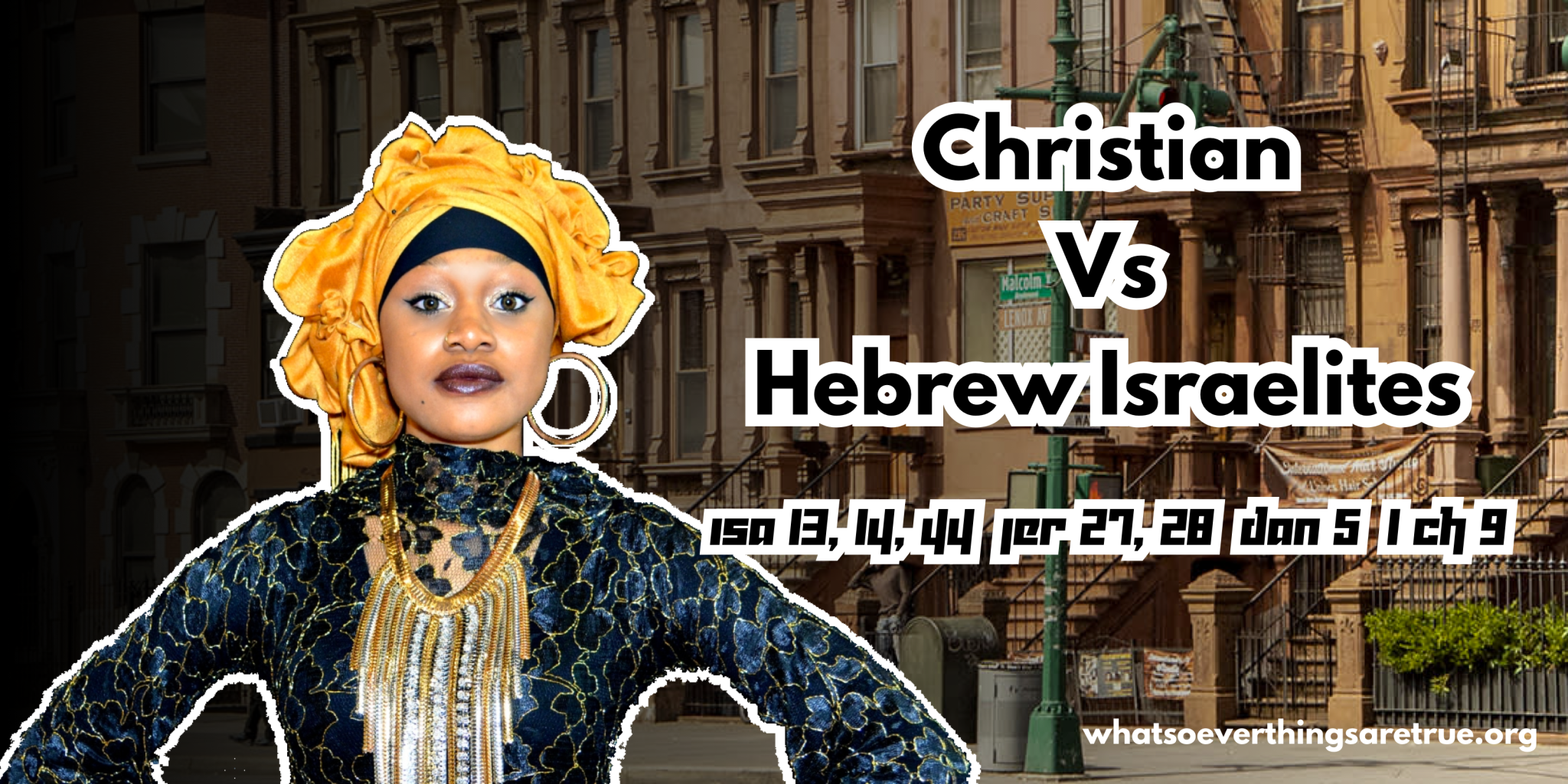
The Hebrew Israelite movement (also Black Hebrew Israelites, BHI) is a heterogeneous African-American religious tradition that emerged in the late 19th-century United States and holds, as its core distinctive teaching, that African Americans (and in some branches Native Americans, Latin Americans, and other peoples of color) are the literal biological descendants of the biblical Israelites, and that European-descended Jews ("Ashkenazim") are not. The movement comprises dozens of distinct congregations and street-preaching schools spanning Hebrew-only, Hebrew-Christian-hybrid, and explicitly anti-Christian variants. Its most publicly visible expressions are the 1West (One West Camp) and ISUPK / Israelite Church of God in Jesus Christ street-preaching ministries based originally in Harlem and now across major US cities. The movement is engaged extensively in ris3n's Africa and the Bible cluster as a primary apologetic interlocutor.
Historical background
Origins (late 19th, early 20th century)
- 1886, Frank S. Cherry founded the Church of the Living God, the Pillar and Ground of the Truth for All Nations in Chattanooga, Tennessee; taught that Adam, Eve, and Jesus were Black, and that European Jews were impostors
- 1896, William Saunders Crowdy founded the Church of God and Saints of Christ in Lawrence, Kansas, generally regarded as the founding institutional moment of the modern movement
- 1900s-1920s, Movement spread through black migration to Northern cities; teachings drew on the Hamitic Hypothesis / Ethiopianism then current in African and African-American religious thought; engaged with Garveyism (the Marcus Garvey "back to Africa" movement)
- 1919, Wentworth Arthur Matthew founded the Commandment Keepers in Harlem, the most institutionally durable early branch
- 1960s-1970s, Ben Ammi Ben-Israel led ~400 followers from Chicago to Liberia, then to Dimona in Israel's Negev (1969), founding the African Hebrew Israelites of Jerusalem; recognized eventually as permanent residents of Israel
Late 20th century, the street-preaching variant
- 1969, Eber ben Yomin (Abba Bivens) founded the Israelite Church of God in Jesus Christ (ICGJC) in NYC, splitting from the Commandment Keepers
- 1980s-1990s, Rise of the 1West / Sicarii / ISUPK / GMS (Great Millstone) and other street-camp ministries on Harlem's 125th Street and 1 West 125th, the visible "men in robes" preaching variant
- 2018, National prominence after the Covington Catholic incident at the Lincoln Memorial brought a Hebrew Israelite contingent into mainstream news coverage
- 2019, A New Jersey kosher-market shooting and a Monsey Hanukkah stabbing carried out by perpetrators with Hebrew Israelite associations brought further mainstream scrutiny
See this page's graph and discover linked topics
Core teachings (as held by mainstream branches)
1. Ethnic / lineage claim
African Americans (and often Native Americans and indigenous peoples of the Americas) are the literal physical descendants of the twelve tribes of Israel, dispersed via Deut 28:68 (the Mosaic curse: "the LORD shall bring thee into Egypt again with ships... and there ye shall be sold unto your enemies for bondmen and bondwomen"), interpreted as a prophecy fulfilled in the trans-Atlantic slave trade. The standard 12-tribes mapping (varies by branch) assigns specific African-American, Caribbean, and Latin-American populations to specific tribes (e.g., African Americans = Judah; Native Americans = Gad; Puerto Ricans = Ephraim; etc.).
2. European-Jewish status
European-descended ("Ashkenazi") Jews are typically held to be converts, impostors, or Edomites (descendants of Esau), not biological Israelites. Genesis 25-27 and the prophetic anti-Edom passages (Obadiah, Malachi 1:2-3) are read as a polemic against modern European Jewry.
3. Law-keeping
Most branches teach that the Mosaic Law remains binding for biological Israelites: Sabbath observance (Saturday), the dietary laws of Leviticus 11, the festivals of Leviticus 23, avoidance of pagan-named days. Hebrew-Christian hybrid branches add Jesus / Yahawashi / Yeshua as Messiah but retain the law for Israelites.
4. Soteriology
Salvation is variously framed as restoration of Israel under the law-Messiah; some branches teach explicit exclusion of Gentiles from salvation; others teach that Gentiles can join Israel by repentance and submission. Hybrid branches affirm Christ's sacrifice but require law-keeping for Israelites.
5. KJV-only / sacred-name preferences
Most branches use the KJV exclusively (often the only true Bible) and use Hebrew transliterations of the divine names (Yahawah, Yahawashi, Ahayah) rather than English translations.
Branches and schools
- Commandment Keepers (Harlem; oldest continuous body)
- Church of God and Saints of Christ (Crowdy lineage; primarily Southern)
- African Hebrew Israelites of Jerusalem (Dimona, Israel; led by Ben Ammi until his death in 2014)
- Israelite Church of God in Jesus Christ (ICGJC) (Hebrew-Christian hybrid; "messianic")
- Israelite School of Universal Practical Knowledge (ISUPK) (1West-derived street ministry)
- Sicarii / Great Millstone (GMS) (street-preaching)
- Many others
The theological diversity across branches is wide, some are practically a form of Black Judaism, others are KJV-only Christian fundamentalist sects with an ethnic-identity overlay, others are explicitly anti-Christian. Apologetic engagement should specify which branch is in view.
Contested historical / genetic claims
The movement's historical claims have been the subject of academic engagement:
- Lemba people of Zimbabwe, geneticist Trefor Jenkins (1996) found ~50% Y-chromosome markers of Semitic origin in the Lemba population, supporting some African Jewish ancestry; this is sometimes cited by Hebrew Israelites as confirmation of the broader thesis, though it strictly only identifies a single specific population (the Lemba) as having partial Jewish ancestry
- Falashas (Beta Israel) of Ethiopia, genetic testing has shown the Falashas to be primarily Cushitic/African in ancestry rather than ancient Israelite, despite their ancient Jewish religious tradition; cited against the broader Hebrew Israelite mass-descent claim
- Trans-Atlantic slave-trade demographics, historians (Patrick Manning, Paul Lovejoy, David Eltis) document that enslaved Africans were taken from a wide range of West African societies (Igbo, Yoruba, Akan, Bantu, Wolof, etc.), most of which have no traceable connection to ancient Israelite populations
Why Christian apologetics engages the movement
The Hebrew Israelite movement is a particularly important interlocutor for African-American Christian apologetics for several reasons:
- Aggressive street-evangelism approach, Hebrew Israelite camps directly challenge passers-by, including Christians, in public; many young African-American men encounter them first
- Use of the same scriptures, Hebrew Israelites are KJV-readers and biblical literalists; the dispute is internal to a shared canon, requiring scriptural rather than philosophical arguments
- Identity stakes, the movement's framing addresses the genuine pain of Black American history; a Christian response cannot dismiss the question of Black biblical identity but must offer a fuller account (see ris3n's note for the Christian counter-construction)
- Soteriological consequence, branches teaching Gentile-exclusion or law-required-salvation are at direct odds with the Pauline gospel (Rom 3-4, Gal 3, Eph 2:8-9)
Connection to codex concepts (added 2026-04-28 bulk extraction)
The 2026-04-28 §5.4 extraction built the dedicated BHI concept hub plus several adjacent hubs that engage the movement. References:
- Black Hebrew Israelite Doctrine, the dedicated concept hub: catalogues the constellation of camps (Israel United in Christ, Sicarii, Israel of God), the six-step doctrinal core (lineage / curse-of-Deuteronomy-28 / Khazar displacement / Mosaic-law observance), the Lemba and Falasha genetic data, and the central counter-texts (Rom 2:28-29; Gal 2:16; Eph 2:8-9; Acts 13, 15, 17)
- Justification by Faith, engages justification in the Hebrew Israelite debate; BHI Mosaic-law observance collides with the Pauline gospel
- Grace vs Law, names Apologetics BHI as the second anchor note for grace-vs-law; BHI engagement is one of the live applications
- Mosaic Law, Mosaic Law in the Hebrew Israelite debate; the binding-vs-fulfilled question is the soteriological pivot
Matt 15:24 / John 17:14 deployment kit
Added 2026-05-12 in response to I Threw EVERY Religious Argument At GodLogic (Lecrae 2026). Contemporary street apologist Avery Austin (God Logic) regularly encounters Hebrew Israelite challengers deploying Matt 15:24 ("I was not sent except to the lost sheep of the house of Israel") to argue that Jesus is exclusively for ethnic Israel and that the Pauline mission to Gentiles is a European fabrication that distorts the original Israelite gospel. This subsection captures the two-step defeater Austin uses on the street; the full doctrinal engagement is at Black Hebrew Israelite Doctrine and in ris3n's Africa and the Bible cluster.
The BHI challenge
Matthew 15:24, Jesus says, 'I was not sent except to the lost sheep of the house of Israel.' So when the Bible says 'the world,' it means the nation of Israel. The 'gospel for the world' is the gospel for Israel, meaning the Black and Brown peoples who are the real biological Israelites. White European Christianity is an invention that hijacked an ethnically-restricted message.
The two-step defeater
Step 1, Reductio via John 17:14.
I have given them your word, and the world has hated them because they are not of the world, just as I am not of the world. (John 17:14)
If "world" means Israel (as the BHI reading requires for Matt 15:24), then Jesus and his disciples being "not of the world" makes them non-Israelite. This is absurd on its face: the disciples are unambiguously Israelite by both ethnicity and covenant. Jesus is Israelite by lineage (cf. Matthew 1.1-16; Romans 9:5). The BHI reading of "world" therefore cannot be sustained across the Johannine corpus, which uses the term consistently to denote the fallen creation under sin / opposed to God, not the Gentile nations distinct from Israel. The reductio is decisive against the lexical move that drives the whole BHI argument from Matt 15:24.
Step 2, Context of Matt 15.
The BHI deployment of Matt 15:24 typically extracts the verse from its immediate narrative context. The setting is Tyre and Sidon (Matt 15:21), Gentile territory, where Jesus encounters a Canaanite woman (15:22) whose daughter is demon-possessed. The full pericope (15:21-28):
- Jesus initially answers her with the Israel-first statement of v. 24: his earthly ministry is targeted to Israel.
- He then says: "It is not good to take the children's bread and throw it to the dogs" (v. 26), the children (Israel) are fed first; the dogs (Gentiles, in the rhetorical idiom of the day) come second.
- The Canaanite woman replies: "Yes, Lord; but even the dogs feed on the crumbs which fall from their master's table" (v. 27).
- Jesus's response: "O woman, your faith is great; it shall be done for you as you wish" (v. 28). Her daughter is healed.
The pericope's load-bearing point is not that Jesus excludes Gentiles; the point is that Jesus accepts the faith of a Gentile woman in the very chapter that contains the "Israel-only" verse. The "Israel-only" statement of v. 24 is bracketed within a narrative that demonstrates Jesus extending the kingdom to Gentiles through the faith-response. Austin's gloss: "He says, 'Let me feed the children first, then the puppies, but notice, the children and the puppies are in the same house. Israel first, then the Gentiles.'"
The salvation-historical sequence Jesus enacts in Matt 15 (Israel first, then Gentiles) is then universalized at Matt 28:19, "make disciples of all nations." The structural pattern of Pauline mission (cf. Rom 1:16 "to the Jew first, and also to the Greek") is rooted in Jesus's own ministry, not invented by Paul. The BHI claim that Christianity is a European hijacking of an ethnically-restricted message collapses under the canonical witness.
Tactical notes
- Lead with John 17:14, not Matt 15. The reductio is faster and unambiguous; the Matt 15 context-restoration follows naturally once the lexical move is blocked.
- Don't fight the "dogs" / "puppies" tonal question on the street. Some BHI deployments will try to charge Jesus with ethnic slur by quoting the "dogs" line out of context. The defense is the narrative outcome: Jesus grants the Gentile woman's request and commends her faith. Whatever the rhetorical idiom of v. 26, the pericope's resolution is Gentile-inclusion through faith, not ethnic exclusion.
- Pair with Matt 28:19 + Rom 1:16. The Israel-first-then-Gentiles sequence is the salvation-historical structure, not a contradiction. BHI exegesis tends to flatten the sequence; the restoration is to expose the structure.
- Acknowledge the legitimate pain. Austin and the codex's existing Black Hebrew Israelite Doctrine engagement both emphasize that the BHI movement addresses real African-American historical grief. The Christian counter-construction is not dismissal of the question of Black biblical identity (cf. ris3n's note) but a fuller account that does not require ethnic exclusivism.
See also (deployment context)
- Black Hebrew Israelite Doctrine, the structured concept hub
- Avery Austin (God Logic), contemporary street-deployment source
- Justification by Faith / Grace vs Law, the soteriological framework into which the BHI engagement opens
- Imago Dei, Austin's pastoral framing of opponents ("the only Jesus they may see is you")
See also
- African Christianity Pre-Colonial, pre-colonial African Christian identity
- Frederick Douglass, historical African-American Christian voice
- Afonso I of Kongo, early African Christian king
- Ezana of Axum, Ethiopian Christian king
- David, central to the lineage-and-promise debate
- Solomon, Edomite-context arguments draw on his reign
- Hubs Roadmap