Concept
Hartle-Hawking No-Boundary Proposal
Hawking-Hartle No-Boundary Proposal, No-Boundary Proposal, Hartle-Hawking State, No-Boundary Proposal (Hawking), imaginary time, Hawking imaginary time, Hawking sphere analogy, universe has no boundary, finite but no beginningIntro
The no-boundary proposal is a 1983 idea from the physicists James Hartle and Stephen Hawking about how the universe started. Instead of a sharp starting point where the laws of physics break down, they pictured the earliest universe as smoothly rounded off, like the bottom of a bowl or the North Pole of a globe.
Hawking liked to explain it with the Earth. The surface of the Earth is finite, yet you can walk around it forever and never fall off an edge. In the same way, he suggested, space and time together could be finite without a hard edge at the start. People sometimes take this to mean "the universe has no beginning, so it needs no Creator."
Hawking himself drew a more careful line. The smooth rounding happens in what he called imaginary time, a mathematical tool. In the ordinary time we live in, he said in his 1996 lecture The Beginning of Time, "real time would still have a beginning," and he closed that lecture with the words "the universe has not existed forever." And even a universe with no edge at all still leaves the deeper question open: why is there a universe there in the first place?
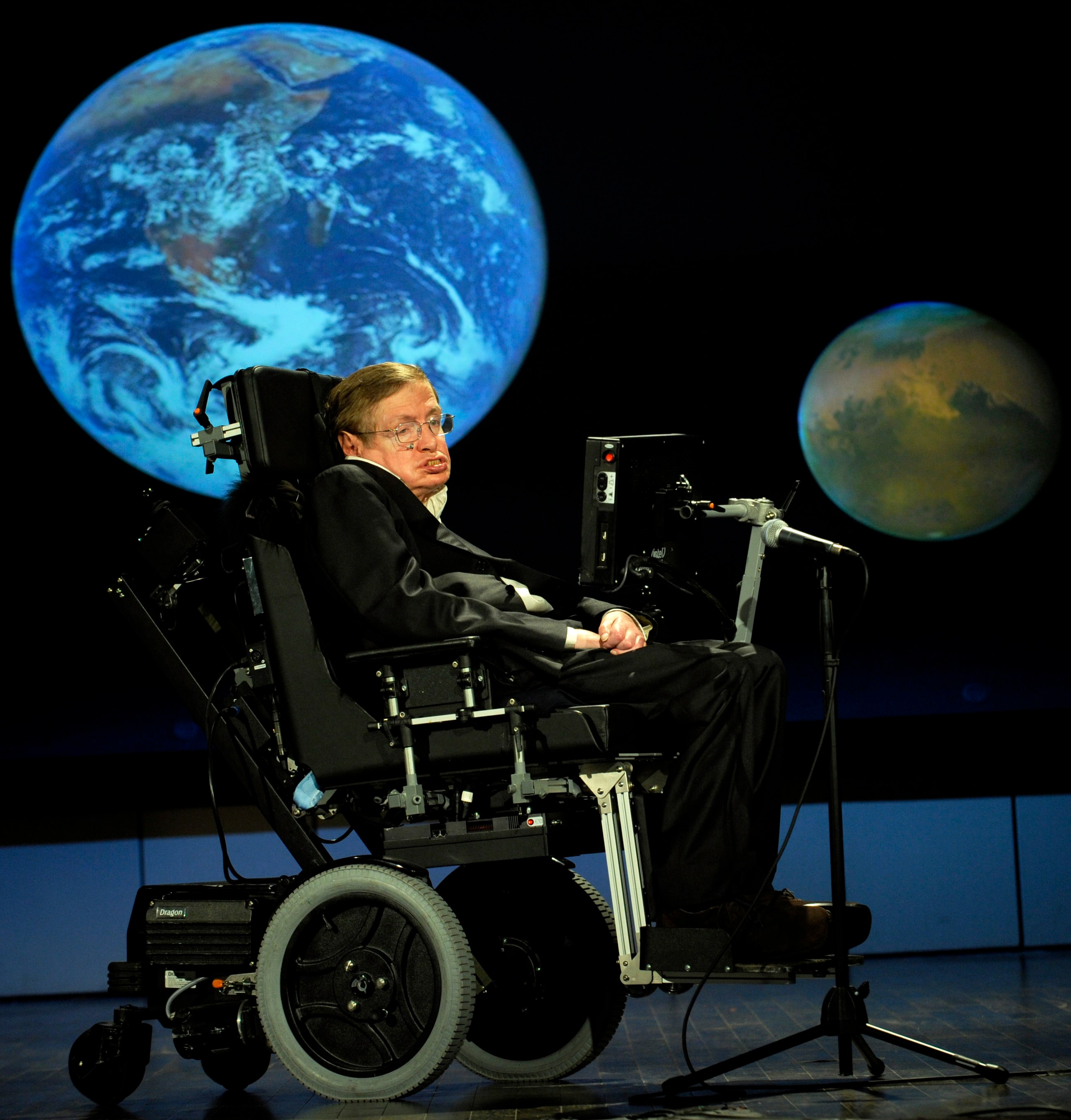
Stephen Hawking delivering a lecture for NASA's 50th anniversary, Washington, D.C., 21 April 2008. Photo: NASA/Paul Alers, public domain, via Wikimedia Commons.
See this page's graph and discover linked topics
In full
The no-boundary proposal (J. B. Hartle and S. W. Hawking, "Wave function of the Universe," Physical Review D 28, 1983) is a prescription for the quantum state of the universe in quantum cosmology. The wave function of the universe is defined by a Euclidean path integral over compact four-geometries whose only boundary is the present three-geometry; "no boundary" means there is no initial boundary surface on which separate initial conditions must be imposed. To make the integral tractable the time coordinate is Wick-rotated (t → iτ), so that near the origin the geometry is Euclidean, four-dimensional and rounded off like a four-sphere, with no singular point. Three distinct questions are routinely run together in popular use. Physics: whether the proposal is correct and well defined, which remains disputed (Feldbrugge, Lehners and Turok, "No Smooth Beginning for Spacetime," Physical Review Letters 119, 2017, argued that the relevant path integral does not yield the smooth, stable beginning claimed; Hartle, Hertog and collaborators replied with alternative contour choices). Interpretation: whether imaginary time is physically real or a calculational device; Hawking's 1996 lecture affirms that in real time the universe still has a beginning, with "some sort of Big Bang singularity," while his 1988 popular presentation drew the theological moral that a self-contained universe "would simply be." Metaphysics: whether the absence of an initial boundary, even granted, removes the need for an explanation of the universe's existence. The codex's line is that the proposal, on its author's own account, leaves the finite past of real time intact (so it does not defeat the beginning premise of the Kalam Cosmological Argument), and that no geometry of spacetime, bounded or unbounded, answers the contingency question pressed by the Contingency Argument.
Real time and imaginary time
- Real time is the time of clocks, history and experience. Events are ordered one after another, and the observable universe has a finite expansion history of about 13.8 billion years (see Age of the Universe and Expansion of the Universe).
- Imaginary time is time multiplied by the imaginary number i. Physicists use the substitution as a mathematical technique in quantum field theory and statistical mechanics. In the no-boundary proposal it turns the geometry near the origin from Lorentzian (with a time direction) into Euclidean (with four space-like directions), which can close off smoothly.
- Hawking's own wording. In The Beginning of Time (1996) Hawking called imaginary time "not the kind of time we normally experience" and added that "in a sense, it is just as real" as real time. He then stated the consequence plainly: "One would still expect some sort of Big Bang singularity in real time. So real time would still have a beginning."
The sphere analogy
Hawking's illustration runs as follows. The surface of the Earth "is finite in extent, but it doesn't have any boundaries or edges"; "I have been round the world, and I didn't fall off." The proposal says space and imaginary time together are like the Earth's surface "with two more dimensions": finite in extent, without boundary. The universe would "start at a single point, like the North Pole of the Earth," but that point "wouldn't be a singularity, like the Big Bang"; it would be an ordinary point, the way the North Pole is an ordinary point on the globe.
Three features of the analogy matter in debate.
- It illustrates a possibility. A finite surface without an edge is mathematically coherent. Whether physical spacetime has that shape is a separate question that the analogy itself cannot settle.
- The North Pole still marks a start. On the globe, nothing lies north of the North Pole. The image Hawking chose places the universe's history wholly to one side of a first point.
- A boundary and a beginning differ. A boundary is a geometric edge; a beginning is an earliest moment, or a finite past. A finite past can lack a first instant (the interval 0 < t ≤ 10 has finite length and no earliest member), and an unbounded past can be infinite. The no-boundary proposal removes an edge, and the finite past remains.
Two presentations by the same author
Hawking presented the proposal with two different emphases.
- 1988, theological. In A Brief History of Time (Bantam, 1988, pp. 140-141) he wrote: "So long as the universe had a beginning, we could suppose it had a creator. But if the universe is really completely self-contained, having no boundary or edge, it would have neither beginning nor end: it would simply be. What place, then, for a creator?"
- 1996, physical. In The Beginning of Time he wrote that "real time would still have a beginning" and concluded: "The conclusion of this lecture is that the universe has not existed forever."
William Lane Craig answered the 1988 argument in "'What Place, then, for a Creator?': Hawking on God and Creation" (British Journal for the Philosophy of Science, 1990), pressing the point that a realist reading of the model keeps a finite past while the imaginary-time reading is an instrumental device. The 1996 lecture concedes the physical half of that reply in Hawking's own voice.
Critiques from the theistic side
- The finite past survives. On Hawking's own account, real time has a beginning. The proposal reshapes the description of the first moment and leaves the beginning in place. See Argument from the Creation of Time and Big Bang.
- A calculational device. Imaginary time is a calculational substitution. Reading a change of variables as a discovery that the past has no start draws metaphysics out of a mathematical technique.
- The mathematics needs an application. Stephen Meyer (Return of the God Hypothesis, 2021) presses two points: converting back from imaginary to real time restores the singular start, and a mathematical description that applies "before" any physical universe exists is a description in search of a mind that holds it. The second point connects to Mathematical Intelligibility of Nature.
- Description leaves existence unexplained. A wave function assigns probabilities to geometries; it does not say why there is any universe for it to describe, or why that law rather than none. This is the contingency question, and it applies to a universe with or without an edge. See Contingency Argument and Necessary vs Contingent Being.
Where it stands
- Physicists who hold it treat it as one of the leading proposals in quantum cosmology, developed further by Hartle, Hawking and Thomas Hertog (Hawking's last paper, "A smooth exit from eternal inflation?", Journal of High Energy Physics, 2018, co-written with Hertog, works within this framework).
- Physicists who doubt it point to the 2017 Feldbrugge-Lehners-Turok analysis and to rival proposals such as Alexander Vilenkin's tunnelling wave function.
- Philosophers on both sides agree on the distinction this page turns on: whether time has an edge and whether the universe needs an explanation are separate questions.
Tensions
- Hawking's two emphases. The 1988 book argues that a self-contained universe "would simply be," with no place for a creator, while the 1996 lecture affirms a beginning in real time. Popular appeals to the proposal usually quote the first and omit the second. The codex reports both and builds on the 1996 statement because it is the later and more technical of the two.
- Kalam versus contingency framing. Kalam defenders use the proposal's finite real-time past as support for a cosmic beginning. Contingency defenders hold that the beginning question can be bracketed, since a beginningless universe would still need an explanation. The two lines are compatible: the first answers the physics, the second answers the metaphysics.
Scholarship
Published academic works this page draws on, each matched to a publisher, index or library catalog record.
- Job Feldbrugge, Jean-Luc Lehners and Neil Turok, "No Smooth Beginning for Spacetime," Physical Review Letters 119 (2017). doi:10.1103/physrevlett.119.171301 PubMed 29219427
- J. B. Hartle and S. W. Hawking, "Wave function of the Universe," Physical Review D 28 (1983). doi:10.1103/physrevd.28.2960
- Stephen Hawking, A Brief History of Time (stephen hawking, 1988). Open Library
- S. W. Hawking and Thomas Hertog, "A smooth exit from eternal inflation?" Journal of High Energy Physics 2018 (2018). doi:10.1007/jhep04(2018)147 open access
See also
- Stephen Hawking, the proposal's co-author, and his late metaphysical claims
- Spacetime Means the Universe Is Eternal Objection Defeater, the debate-ready reply to "the universe is spacetime, so it is eternal" and "finite but no beginning, like a sphere"
- Kalam Cosmological Argument, where the proposal is raised against the beginning premise
- Argument from the Creation of Time, time itself as a created reality
- Borde-Guth-Vilenkin Theorem, the separate result that an expanding universe has a past boundary
- Big Bang, the observational case for a finite past
- Contingency Argument, why the existence of any spacetime calls for explanation
- Infinity, the senses of "infinite" and "beginning" the debate turns on
- Fred Hoyle, whose steady-state universe was the earlier attempt at a beginningless cosmos
Common questions this page answers
Q: What is the Hartle-Hawking no-boundary proposal?
It is a 1983 proposal by James Hartle and Stephen Hawking for the quantum state of the universe. Using imaginary time, it describes the earliest universe as smoothly rounded off, with no sharp initial edge, the way the surface of the Earth is finite but has no edge.
Q: Did Stephen Hawking say the universe had no beginning?
He said two things. In A Brief History of Time (1988) he argued that a universe with no boundary "would simply be," leaving no place for a creator. In his 1996 lecture The Beginning of Time he stated that "real time would still have a beginning" and concluded that "the universe has not existed forever."
Q: What is imaginary time?
Imaginary time is ordinary time multiplied by the imaginary number i, a substitution physicists use to make certain calculations work. In the no-boundary proposal it lets the geometry near the origin close off smoothly. It is distinct from the real time measured by clocks, in which Hawking said the universe still has a beginning.
Q: Does the no-boundary proposal disprove God?
No. On Hawking's own account the universe still has a finite past in real time. And even a universe with no edge would still leave open why any universe exists at all, which is the question the contingency argument asks.
Q: How do you answer "the universe is finite but has no beginning, like a sphere"?
Grant that a finite shape without an edge is mathematically coherent, then ask two questions. What evidence shows physical time has that shape? And even if it does, what explains why that edgeless spacetime exists rather than nothing?