Concept
Grand Canyon Formation
Grand Canyon, How the Grand Canyon Formed, Grand Canyon Origin, Grand Canyon and the Flood, Origin of the Grand Canyon, Age of the Grand Canyon, Did the Flood Carve the Grand CanyonIntro
The Grand Canyon is about 277 river miles long, up to 18 miles wide and about a mile deep. Its walls show a stack of rock layers from the dark basement rock at the river to the pale limestone at the rim. Almost everyone who stands at the edge asks the same question: how did this happen, and how long did it take?
Two main answers are on the table.
The mainstream geological account says the layers built up over hundreds of millions of years, and the Colorado River cut down through them much later, mostly within the last five to six million years. Geologists still argue about the details, including whether parts of the canyon are far older than that.
The Flood-model account, held by young-earth creationist geologists such as Steven Austin, Andrew Snelling and John Whitmore and popularized by Ken Ham's Answers in Genesis, says most of the layers were laid down quickly during Noah's Flood, and the canyon was cut quickly as the waters drained away, perhaps when a vast lake behind a natural dam broke through.
The two sides share more than people expect. Both agree that water can carve rock very fast under the right conditions. A 2002 flood in Texas cut a canyon about 7 meters deep in three days. Both now agree that a lake spilling over probably played a part in the Grand Canyon's history. Where they part ways is timing: how long the layers took to form, and how long ago the cutting happened.
This page sets out the evidence each side relies on, what each must explain, and where the debate stands, without declaring a winner.
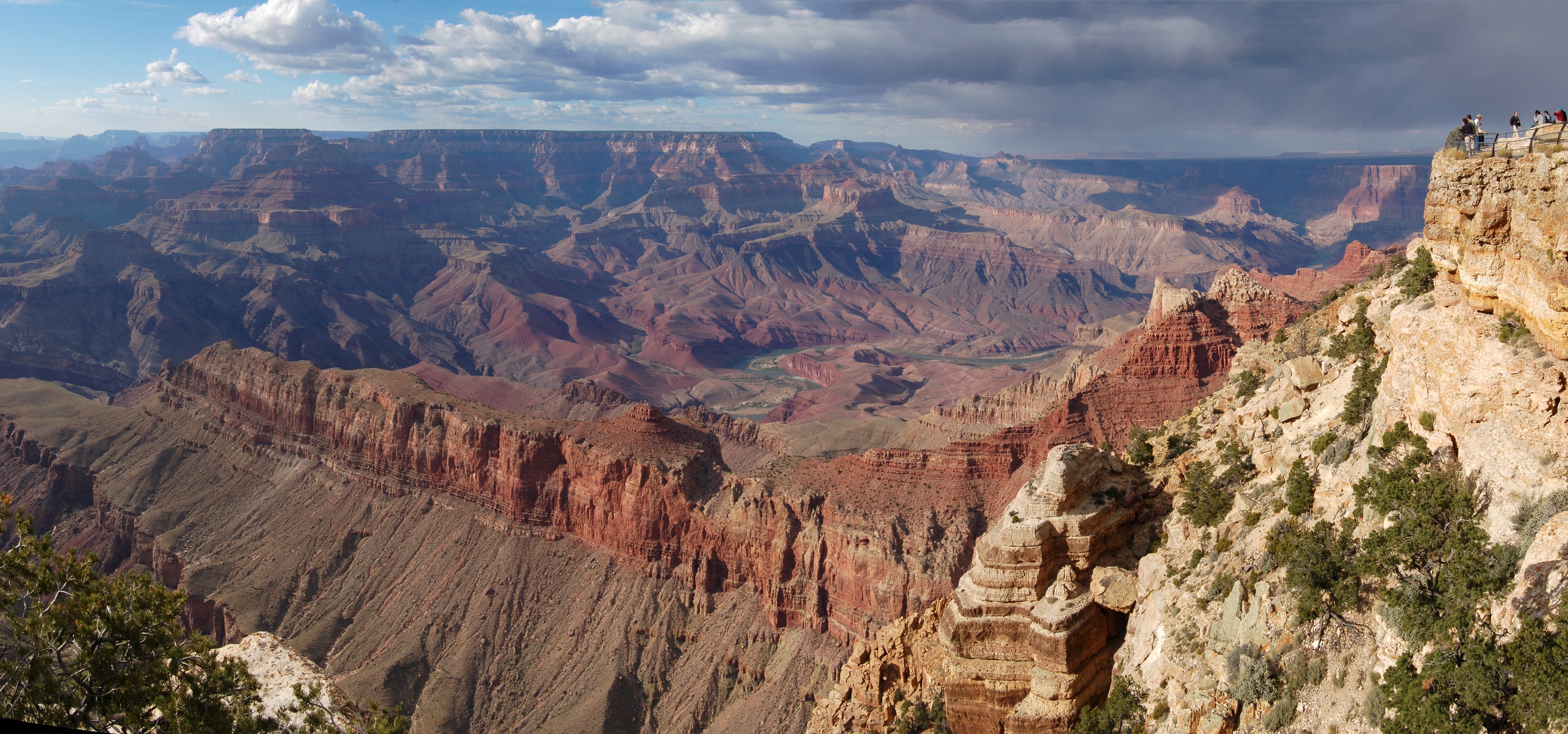
The Grand Canyon from Lipan Point, South Rim, with the Colorado River near Unkar Delta below. Photo: Grand Canyon National Park (NPS), public domain, via Wikimedia Commons, resized.
See this page's graph and discover linked topics
In full
The formation of the Grand Canyon involves two distinct questions that are often run together: (1) how and when the sedimentary layers exposed in the walls were deposited, and (2) how and when the canyon was eroded through them. Mainstream geology dates the exposed rocks from roughly 1.7 billion years at the river (Vishnu basement rocks) to about 270 million years at the rim (Kaibab Formation), and holds that the Colorado River integrated its present course and carved most of the canyon within the last five to six million years, possibly by linking older canyon segments, with an active minority arguing for a much older western canyon. Flood geology holds that the Paleozoic sedimentary layers were deposited during the year of Noah's Flood and that the canyon was carved rapidly by draining Floodwater, with the breached-dam or lake-spillover model as one leading proposal and a channelized-runoff model as its main rival within creationist geology. Both frameworks accept catastrophic erosion as a real process, documented at Canyon Lake Gorge (Texas, 2002), the Channeled Scablands (Washington) and Mount St. Helens (1980 to 1982). The live dispute concerns deposition rates, the timing of erosion, and how to read radiometric, thermochronological and sedimentological evidence.
The two questions
Most confusion about the Grand Canyon comes from mixing up two questions.
| Question | Mainstream geology | Flood geology |
|---|---|---|
| How were the layers laid down? | Over hundreds of millions of years, in seas, shorelines, rivers and deserts | Mostly in one year, during Noah's Flood |
| When were they laid down? | Roughly 525 to 270 million years ago for the main Paleozoic layers | About 4,350 years ago |
| How was the canyon cut? | Mainly by the Colorado River, with help from lake spillover and changing landscape | By draining Floodwater, perhaps through a breached natural dam |
| When was it cut? | Mainly within the last 5 to 6 million years; some segments may be older | Late in the Flood year or shortly after |
Showing that one layer formed quickly does not settle how the whole canyon was cut, and showing that a canyon can be cut quickly does not settle when the layers formed. Both sides make this distinction in their own literature.
Position 1, the mainstream geological account
The layers
On the standard reading, the canyon walls record a long sequence of changing environments. The Tapeats Sandstone, Bright Angel Shale and Muav Limestone (the Tonto Group) record a sea spreading over the land in the Cambrian period; the Redwall Limestone records a later shallow sea; the Coconino Sandstone, with its giant sloping cross-beds and fossil trackways, is read as a field of wind-blown dunes, an interpretation going back to Edwin McKee's 1934 study; the Kaibab Formation at the rim records another sea. The National Park Service gives the range of exposed rock as about 1.7 billion years old at the river near Phantom Ranch to about 270 million years old at the rim.
The canyon
The National Park Service describes the canyon as geologically young, carved by the Colorado River within the last six million years, while noting that its full history "is the subject of active research and intense scientific debate."
- The young-canyon view. Karl Karlstrom and colleagues (Nature Geoscience 7, 2014) used several thermochronology methods on four of five canyon segments. They concluded that the two end segments are young and some middle segments much older, and that the Colorado River carved the Grand Canyon, beginning five to six million years ago, by integrating older "palaeocanyons" into one system.
- The old-canyon view. Rebecca Flowers and Kenneth Farley (Science 338, 2012), using apatite helium dating, argued that the western Grand Canyon had been carved close to its modern depth around 70 million years ago. Brian Wernicke has long defended an "old canyon." The two camps obtained similar dates for the westernmost canyon and read them very differently.
- The lake-spillover view. A USGS-led study (He, Crow and colleagues, Science, published 16 April 2026) dated zircon grains in the deposits of ancient Lake Bidahochi, east of Flagstaff, and matched them to known early Colorado River sediments. It found that the river was feeding sand into the lake from about 6.6 million years ago, which the authors take as support for the idea that the lake later spilled over and helped set the river's course through the canyon. The USGS summarized the result as showing that "multiple natural processes, including lake spillover, river incision, and changes in regional topography" likely worked together. In press coverage, some outside geologists, including old-canyon advocate Rebecca Flowers, said the study makes a strong case that the river filled the basin without proving the spillover itself.
Its key evidence
- Radiometric dating of the basement rocks, of volcanic ash beds, and of lava flows that poured into the canyon after much of it was cut.
- Thermochronology, which tracks when buried rock cooled as erosion brought it near the surface.
- Ancient river and lake sediments upstream and downstream, whose ages and mineral signatures constrain when the river took its present course.
- Sedimentary features read as requiring time or dry conditions: dune-scale cross-beds and trackways in the Coconino, ancient soils and erosion surfaces between some layers, and an orderly fossil sequence.
Position 2, the Flood-model account
The layers
Flood geologists read the Paleozoic layers as Flood deposits. Andrew Snelling's Earth's Catastrophic Past (2009) and the Answers in Genesis literature argue that the layers are laterally extensive across continents, contain marine fossils far inland, and show features of rapid deposition. Two research programs bear directly on the canyon.
- Folded strata (Snelling). In the Tonto Group, layers bend sharply in several folds. Snelling argues they were bent while still soft and wet, not long after deposition. After a lawsuit secured a sampling permit, he collected 53 rock samples on a 2017 river trip, from fold hinges, from the adjacent limbs and from the same beds miles away, and had them analyzed by X-ray diffraction, thin section and electron microscope at a commercial laboratory in Calgary. He published the petrology and the individual folds in Answers Research Journal from 2021 to 2024 and summarized the project in "The Grand Canyon Was Formed Rapidly" (Answers in Genesis, 4 February 2025). His conclusions: no metamorphic change in the folded rocks, no evidence of the plastic deformation hard rock would need, and cement that formed after the folding. See Folded Strata Without Fracturing Argument.
- The Coconino Sandstone (Whitmore). John Whitmore and colleagues published a detailed petrology of the Coconino (Answers Research Journal 7, 2014) and argue that its cross-beds, grain features and mineral content (including mica in almost every thin section) fit large underwater sand waves better than desert dunes.
The canyon
- Steven Austin, editor of Grand Canyon: Monument to Catastrophe (Institute for Creation Research, 1994), developed the case that the canyon was cut rapidly by catastrophic drainage. With Edmond Holroyd and David McQueen he argued in "Remembering spillover erosion of Grand Canyon" (Answers Research Journal 13, 2020) that ancient lakes, including Lake Bidahochi (also called Hopi Lake), breached their natural dams and cut the canyon quickly.
- The breached-dam model in its general form: after the Flood laid down the layers, water stood in large lakes on the high plateau behind natural barriers, and a breach released it to carve the canyon in a short time. Answers in Genesis presents this model in its popular materials.
- A rival creationist model. Not all Flood geologists accept the dam breach. Michael Oard, once a supporter, argued in "A dam breach unlikely for the origin of Grand Canyon" (Creation Research Society Quarterly 57, 2021) that the field evidence does not support it, citing the lack of expected lake-bottom sediments and the difficulty of explaining the long side canyons, and favors carving by retreating Floodwater (see his A Grand Origin for Grand Canyon, 2016).
The method
Ken Ham stresses that everyone reads the rocks through starting assumptions about Earth's history, so the dispute is about competing frameworks for interpreting the same evidence, not science against faith. Flood geologists also point to:
- Flat contacts between some layers that mainstream geology places millions of years apart, with little sign of erosion between them.
- Observed rapid processes, especially at Mount St. Helens (below).
- Scripture's account of a Flood that broke open "all the fountains of the great deep" (Genesis 7:11, ASV) and waters that "returned from off the earth continually" (Genesis 8:3, ASV). Some Flood geologists also read The mountains rose, the valleys sank down (Psalm 104:8, ASV) as describing the Flood's retreat.
Common ground, catastrophic erosion is real
Both sides now accept that water can cut rock canyons in days, not ages, under the right conditions.
- Canyon Lake Gorge, Texas. In the summer of 2002 floodwater pouring over a dam spillway cut a bedrock gorge about 2.2 kilometers long and up to about 7 meters deep in roughly three days, mostly by plucking out blocks of rock. Michael Lamb and Mark Fonstad documented it with before-and-after aerial photographs and flow measurements ("Rapid formation of a modern bedrock canyon by a single flood event," Nature Geoscience 3, 2010) and noted that a canyon's shape alone may not reveal how fast it formed.
- The Channeled Scablands, Washington. In 1923 J Harlen Bretz argued that a vast flood, not slow erosion, had cut the channels, dry falls and giant ripples of eastern Washington. Most geologists rejected the idea for decades, until it was tied to the repeated draining of glacial Lake Missoula, an idea first suggested by Joseph Pardee. The Geological Society of America gave Bretz its highest award, the Penrose Medal, in 1979.
- Mount St. Helens. The 1980 eruption and its aftermath laid down thick layered deposits in hours and days, and on 19 March 1982 a mudflow from the volcano breached and eroded a debris dam in the Toutle River valley. Steven Austin and other creationist geologists describe the canyon cut through the fresh deposits as up to about 140 feet deep and call it the "Little Grand Canyon of the Toutle River." Critics note that it was cut through loose volcanic deposits, not hard rock.
Critiques each way
Critiques of the Flood model
- The Grand Canyon, Monument to an Ancient Earth (eds. Carol Hill, Gregg Davidson, Tim Helble and Wayne Ranney, Kregel, 2016), written by eleven contributors, many of them Christians, argues that the canyon's rocks record many distinct environments and long spans of time that a single Flood year cannot accommodate.
- On the folds, Stephen Mitchell and Kennen Tillman (Peaceful Science, 2024) argue that the Tonto Group folds have planar limbs and sharp hinges rather than the shapes of soft sediment, and that faults, fractures crossing beds, twinned calcite, crushed grains and cement cut by fractures show the rock was already hard when it was bent. That is a direct dispute with Snelling's reading of the same kind of evidence.
- On the timing, critics point to the radiometric ages of lava flows that cascaded into an already deep canyon, to thermochronology, and to dated river and lake sediments, all of which place the erosion over millions of years.
- Within creationism, Oard's critique of the breached-dam model shows the Flood model itself has competing versions.
Critiques of the mainstream account
- Unsettled history. Mainstream geologists still disagree, sometimes sharply, about whether the canyon is about 6 million or about 70 million years old in places, and about the role of lake spillover. Flood geologists argue this shows how much the conventional story depends on interpretation.
- Rapid processes underrated. The Scablands, Canyon Lake Gorge and Mount St. Helens show that catastrophic erosion can do in days what was once assumed to take ages. Flood geologists argue that the canyon's size alone is not evidence of great age.
- The folds and contacts. Snelling's samples and the flat contacts between some layers are, on the Flood reading, features that slow deposition and deep-time folding struggle to explain.
- Starting assumptions. Radiometric dating depends on assumptions about starting conditions and constant decay rates. Mainstream geologists reply that independent dating methods cross-check one another; Flood geologists reply that the methods share assumptions.
What each side must explain
The mainstream account must explain:
- the Tonto Group folds Snelling studied, and whether his samples rule out deformation of hardened rock;
- why some layers placed millions of years apart meet along flat contacts with little visible erosion;
- the exact sequence by which the river crossed the Kaibab upwarp, a question its own specialists still dispute.
The Flood model must explain:
- the radiometric ages of the basement rocks, ash beds and the lava flows that cascaded into the canyon;
- the thermochronology data, which records rock cooling over long periods;
- the Coconino trackways and cross-beds, which mainstream geology reads as desert dunes;
- the orderly fossil sequence and the many distinct environments the layers appear to record;
- the long side canyons and, for the dam-breach version, the missing lake-bottom sediments its own critics point to.
Why it matters for apologetics
The Grand Canyon is one of the most visible test cases in the debate over the age of the earth, and both young-earth and old-earth Christians treat it seriously. The cumulative case for God does not depend on how this canyon formed. The Kalam Cosmological Argument, the Fine-Tuning Argument and the design evidence of life run the same on either chronology, and the canyon's own beauty and scale belong to the case from awe whatever its age. The age question is an in-house discussion among Christians, carried on with evidence, while the larger argument stands on its own. See Genesis Interpretation Spread, Young Earth Creationism and Old Earth Creationism.
Tensions
- The lake-spillover convergence. Austin, Holroyd and McQueen (2020) argued for spillover erosion from ancient lakes including Lake Bidahochi; the USGS-led 2026 study supports a spillover role for the same lake. The overlap is real on mechanism and complete disagreement on timing: the 2026 study places the river's arrival at about 6.6 million years ago.
- Snelling versus his critics on cement. Snelling reports cement that formed after the folding; Mitchell and Tillman report cement cut by fractures and conclude it formed before. Both claim support from thin-section evidence. The codex records both readings.
- Dam breach versus channelized runoff. Creationist geologists disagree among themselves about the mechanism (Austin versus Oard).
Scholarship
Published academic works this page draws on, each matched to a publisher, index or library catalog record.
- R. M. Flowers and K. A. Farley, "Apatite 4 He/ 3 He and (U-Th)/He Evidence for an Ancient Grand Canyon," Science 338 (2012). doi:10.1126/science.1229390 PubMed 23196906
- Karl E. Karlstrom et al., "Formation of the Grand Canyon 5 to 6 million years ago through integration of older palaeocanyons," Nature Geoscience 7 (2014). doi:10.1038/ngeo2065
- Michael P. Lamb and Mark A. Fonstad, "Rapid formation of a modern bedrock canyon by a single flood event," Nature Geoscience 3 (2010). doi:10.1038/ngeo894
- Stephen Mitchell and Kennen Tillman, "Examining Young Earth Creation Claims About the Grand Canyon" (2024). doi:10.54739/tyet
- Andrew A. Snelling, Earth's Catastrophic Past (2009). Open Library
See also
- Flood Geology, the parent framework
- Folded Strata Without Fracturing Argument, the folding argument in debate-prep form
- Global Flood Evidence, the wider evidential case for a global Flood
- Genesis Flood, the biblical account
- Young Earth Creationism, the position the Flood model belongs to
- Old Earth Creationism, the principal Christian alternative
- 20 Arguments for Old Earth, the old-earth case including geological arguments
- Marine Fossils on Mountains Argument, marine fossils in the canyon's layers
- Andrew Snelling, the Tonto Group folds
- Steven A. Austin, Grand Canyon: Monument to Catastrophe and the spillover model
- John Whitmore, the Coconino Sandstone
- Ken Ham, Answers in Genesis
- Genesis Interpretation Spread, the Christian readings of Genesis
Common questions this page answers
Q: How was the Grand Canyon formed?
Mainstream geology says the rock layers built up over hundreds of millions of years and the Colorado River carved the canyon through them, mostly within the last five to six million years, with help from lake spillover and changes in the landscape. Young-earth creationist geologists say most layers were laid down during Noah's Flood and the canyon was cut quickly as the Floodwaters drained, possibly when a natural dam broke.
Q: How old is the Grand Canyon?
The National Park Service describes it as carved within the last six million years, but geologists still debate the details: Karlstrom and colleagues (2014) argued for a young canyon built by linking older segments, while Flowers and Farley (2012) argued parts of the western canyon are about 70 million years old. Flood geologists place the carving about 4,350 years ago.
Q: Did Noah's Flood carve the Grand Canyon?
That is the view of young-earth geologists such as Steven Austin, Andrew Snelling and John Whitmore, who point to folded layers they read as bent while soft, rapid erosion seen in modern catastrophes, and evidence of large lakes that spilled over. Mainstream geologists point to radiometric dates, cooling histories and dune-like sandstones that they read as requiring millions of years. Creationists also disagree among themselves about the mechanism.
Q: Can a canyon form quickly?
Yes. In 2002 floodwater in Texas cut Canyon Lake Gorge, about 2.2 kilometers long and up to 7 meters deep, in about three days, as documented by Lamb and Fonstad in Nature Geoscience (2010). The Channeled Scablands of Washington were cut by enormous glacial floods, as J Harlen Bretz argued in 1923.
Q: What did the 2026 USGS study on Lake Bidahochi find?
A USGS-led study published in Science on 16 April 2026 matched zircon grains in Lake Bidahochi's deposits to early Colorado River sand, showing the river was feeding the lake from about 6.6 million years ago. The authors take it as support for the lake later spilling over and helping set the river's course through the canyon.
Q: What did Andrew Snelling find in his 53 Grand Canyon rock samples?
Snelling reports that the folded Tonto Group layers show no metamorphic change and no plastic deformation of hard rock, and that their cement formed after the folding, which he reads as evidence the layers were bent while still soft. Critics argue the same rocks show fractures and crushed grains indicating they were already hard when folded.