Argument
God Lied by Omission in Eden Objection Defeater
God Lied by Omission, God Lied by Omission Objection, Lie of Omission in the Garden, did God lie in the garden, God withheld information from Adam, God didnt tell Adam his eyes would be opened, Who told thee that thou wast nakedIntro
Some critics grant that God did not tell a flat lie in the Garden of Eden. Their charge is subtler: God lied by leaving something out. He told Adam that eating from the tree would bring death, but He never mentioned that it would also open their eyes and give them the knowledge of good and evil. The serpent told them that part. So, the argument goes, God hid the upside and the serpent was the honest one.
The answer starts with what lying by omission actually is. Leaving something out is only a lie when you owe the other person that information and you leave it out to make them believe something false. A parent who says "don't drink what's under the sink, it can kill you" has not lied because he did not add that it might taste sweet first. He told the child the one thing the child needed to know.
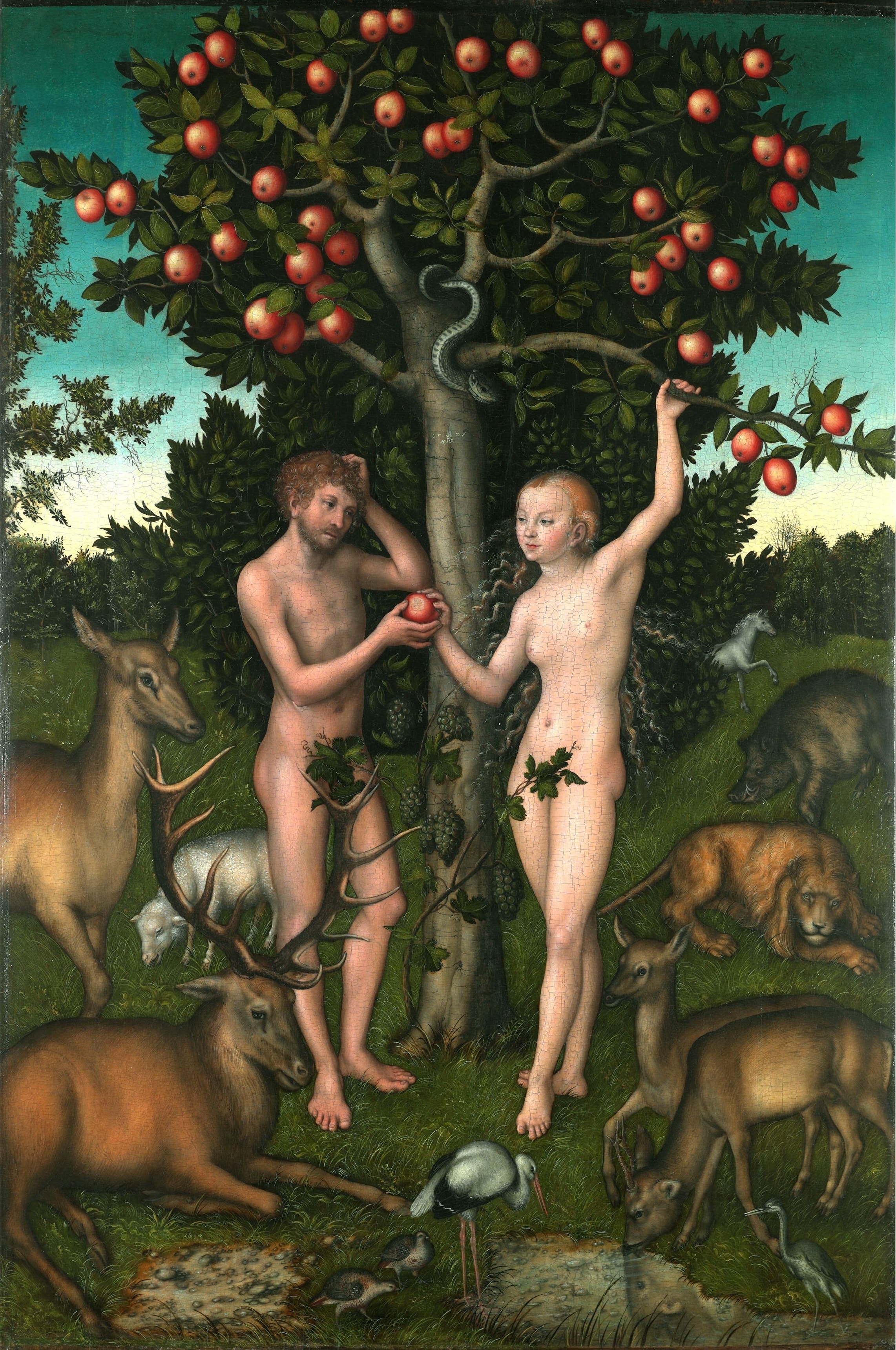
Adam and Eve, Lucas Cranach the Elder, 1526, Courtauld Gallery, London. Image: public domain, via Wikimedia Commons.
And God did not even leave the knowledge out. He named the tree "the tree of the knowledge of good and evil" in the very sentence that forbade it. The serpent's big reveal, "ye shall be as God, knowing good and evil," was God's own words handed back with a lie attached: "Ye shall not surely die."
Then look at what the opened eyes actually showed them. Before they ate, they were naked and not ashamed. After they ate, they were still naked, but now they were ashamed, afraid and hiding. God's question, "Who told thee that thou wast naked?", exposes the whole trade. The serpent promised to make them like God. What it gave them was shame. If anyone in the garden left out the part that mattered, it was the serpent.
See this page's graph and discover linked topics
Cheatsheet
The 30-second reply:
Leaving something out is only a lie when you owe someone that information and you hide it to make them believe something false. God told Adam the one thing he needed: this tree is forbidden, and eating it brings death. He even named it the tree of the knowledge of good and evil, so the knowledge was never hidden. The serpent added nothing new except a direct lie, "you shall not surely die." And notice what the opened eyes gave them: shame, fear and hiding. If you want a liar by omission in that story, it is the one who promised godhood and left out the death.
The fast facts:
- Omission is not automatically deception. It becomes deception only with a duty to disclose and an intent to create a false belief.
- The knowledge was disclosed. God called it "the tree of the knowledge of good and evil" in the command itself (Genesis 2:17, and 2:9 before it).
- The serpent's "new" information is God's own wording. "Knowing good and evil" (Genesis 3:5) repeats the tree's name. What the serpent added was "ye shall be as God" and the flat denial "Ye shall not surely die."
- Both consequences came true. Their eyes were opened (Genesis 3:7), and death entered: exile from the tree of life, the return to dust (Genesis 3:19), and in time "he died" (Genesis 5:5).
- The opened eyes saw shame. Naked and unashamed at Genesis 2:25; naked and hiding at Genesis 3:7-10. "Who told thee that thou wast naked?" (Genesis 3:11).
- The serpent is the real omitter. He left out death, shame, exile, the curse and the broken relationship with God.
The 3 strongest counter-moves:
- "Why was God obligated to tell them their eyes would be opened?" Make the objector state the duty. Without a duty to disclose, there is no lie by omission.
- "What was the tree called?" The knowledge of good and evil. "So God disclosed its link to knowledge?" Yes. "Then where is the false impression?"
- "Does every truthful warning have to list every effect, including the pleasant ones?" A doctor, a parent and a judge would all be liars on that standard.
Reciprocal concessions (grant the small point, then collect a bigger one):
- Grant: God did not spell out "your eyes will be opened." Now collect: then by your own standard the serpent, who left out death, shame and exile, is the far greater liar by omission, and Genesis says so (John 8:44 calls him a liar from the beginning).
- Grant: the serpent said something that came true. Now collect: a half-truth used to produce a false conclusion is the classic form of deception, and that is exactly what "your eyes shall be opened, ye shall not surely die" was.
- Grant: knowing the outcome might have changed their choice. Now collect: the outcome that would have changed it was death, and that is the one thing God did tell them.
The closing line:
God told them the truth that mattered. The serpent told them a truth that did not matter and a lie that did. That is what lying by omission looks like, and it was not God doing it.
In full
The objection alleges deception by nondisclosure: God's prohibition in Genesis 2:16-17 specified death as the consequence of eating but did not mention the epistemic consequence later announced by the serpent (Genesis 3:5) and confirmed by the narrator (3:7) and by God (3:22). The defeater has three parts. First, moral philosophy and law alike treat omission as deceptive only where there is a duty to disclose and the omission creates or sustains a false belief; neither condition is met, because the command disclosed the decision-relevant consequence and the tree's name disclosed its connection to da'at tov wara'. Second, the objection's implicit standard, that a truthful warning must enumerate every consequence including the attractive ones, proves too much, rendering every ordinary warning a lie. Third, the text itself identifies the deceiver: the serpent's speech repeats God's own description of the tree, frames it as a hidden advantage, and flatly negates the warning, while the narrative of Genesis 2:25 to 3:11 shows the "opened eyes" producing shame, fear and concealment, an ironic fulfilment that exposes the serpent's framing as the true omission.
Grammar and hermeneutics
The omission charge needs the knowledge to have been hidden. The wording of Genesis 2-3 shows it was named, warned about and then distorted by someone else.
- The tree is named before it is forbidden, and named again in the prohibition. Genesis 2:9 introduces "the tree of the knowledge of good and evil," and the command at Genesis 2:17 forbids it under the same name. A command that identifies its object by its effect has disclosed that effect. On the sense of the phrase, a fixed idiom for the power to determine good and evil, see Tree of Knowledge Objection Defeater.
- The serpent's promise reuses the tree's own words. At Genesis 3:5 the offer is "ye shall be as God, knowing good and evil." "Knowing good and evil" is the tree's name turned into a verb. The only content the serpent adds is the comparison "as God" and the denial of death. The supposed disclosure is a repackaging, not new information.
- The serpent negates God's exact warning. God's sentence at Genesis 2:17 ends "thou shalt surely die," the doubled-verb construction mot tamut. The serpent's reply at Genesis 3:4, "Ye shall not surely die," repeats that construction and puts a negative on it. The text records a word-for-word contradiction, which is assertion, not omission.
- The fulfilment formula is ironic, and the irony is built into the vocabulary. Genesis 3:5 promises "your eyes shall be opened," and Genesis 3:7 reports in the same verb, "the eyes of them both were opened." The very next words are "and they knew that they were naked." The promised enlightenment is recorded as happening, and its first content is shame. Genesis 2:25 had said they "were both naked... and were not ashamed," and the narrator has already played on the sound of "naked" in calling the serpent "subtle" at Genesis 3:1. The narrative is built to show the promise kept in letter and broken in substance.
- God's questions are interrogation, not requests for information. "Where art thou?" (Genesis 3:9) and "Who told thee that thou wast naked?" (Genesis 3:11) follow the pattern of Genesis 4:9, "Where is Abel thy brother?" In each case the speaker already knows; the question invites confession. Genesis 3:11 asks where the new consciousness came from and answers itself in the next clause: "Hast thou eaten of the tree, whereof I commanded thee that thou shouldest not eat?" The physical condition had not changed. The perception had.
- The death clause is a sentence, not a timestamp. Whether "in the day" requires same-day physical death is a separate objection, answered at entry 6 of Top 20 Adam and Eve Objections and Their Defeaters. For the omission charge it is enough that the narrative records both consequences: eyes opened (3:7) and death set in motion, with exile from the tree of life (3:22-24), the sentence of return to dust (3:19), and Adam's death recorded at Genesis 5:5.
- Hermeneutic: the narrator is reliable, the serpent is not. Genesis 3:1 introduces the serpent as "more subtle than any beast of the field," and his first words misquote God. A reading that trusts the serpent's framing over the narrator's report has reversed the story's own signals before any theology is invoked.
On the tree's name, the reuse of that name in the serpent's offer, the negated warning, the ironic fulfilment of "opened eyes," and the interrogative force of God's questions, the omission charge fails on the text alone.
Argument structure
| Premise | Notes | |
|---|---|---|
| P1 | An omission is a lie only if the speaker had a duty to disclose and the omission creates a false belief | Standard in moral philosophy and in law (fraud by nondisclosure) |
| P2 | God disclosed the decision-relevant facts: the prohibition, the consequence of death, and the tree's link to the knowledge of good and evil | Genesis 2:9, 2:16-17 |
| P3 | The objection's standard, that every true warning must list every consequence, proves too much | Doctor, parent and judge examples |
| P4 | The serpent, not God, created the false belief, by reframing God's own words and denying the warning | Genesis 3:1-5; John 8:44; 2 Corinthians 11:3 |
| P5 | The narrative shows what the opened eyes produced: shame, fear and hiding, so the "withheld benefit" was not a benefit | Genesis 2:25; 3:7-11 |
| C | God did not lie by omission in Eden; the charge has no duty, no false impression, and the wrong defendant |
Master objections to the whole argument
MO1: "Adam had never seen death or evil. Warnings about 'death' and 'knowledge of good and evil' were meaningless words to him, so God effectively told him nothing."
- Then the serpent told him nothing either, because the serpent used the same words: "knowing good and evil" and "die." The objection cannot hold that God's words were empty while the serpent's identical words were informative. And a command does not need full experiential understanding to be truthful. A child who has never seen poison can understand "this will kill you" well enough to obey.
MO2: "God knew they would become 'as one of us' (Genesis 3:22) and kept that quiet. Hiding a real upgrade is manipulative."
- Genesis 3:22 is a lament that ends in a broken-off "lest" clause, not a congratulation. Becoming "as one of us, to know good and evil" in the sense the idiom carries means claiming the right to decide good and evil for oneself. That is not an upgrade God withheld; it is the rebellion He warned against. See Tree of Knowledge Objection Defeater and entry 5 of Top 20 Adam and Eve Objections and Their Defeaters.
MO3: "Informed consent requires full disclosure. God denied Adam informed consent."
- Informed consent obliges disclosure of material risks, not of the attractions of a forbidden act. God disclosed the material risk, death. The objection inverts informed consent: it faults God for not advertising the upside of disobedience.
Premise 1, An omission is a lie only with a duty to disclose and a false impression
Affirmative case
- Lying is assertion aimed at a false belief. Augustine in De mendacio and Aquinas in Summa Theologiae II-II, q. 110, a. 1 locate the wrong of lying in speaking against one's mind with the will to deceive. Silence about a fact is not an assertion at all.
- Omission becomes deception only in two conditions. The listener is owed the fact (a duty to disclose), and its absence makes what was said misleading (a false impression). Law tracks the same structure: nondisclosure is fraud where there is a duty to speak and the silence misleads.
- Half-truths are the clearest case. A true statement arranged to produce a false conclusion is deception by omission. That is a test the objection must apply evenly.
Anticipated objections
- "Any omission that could change someone's decision is deceptive."
- "God is not a human speaker. He knows everything, so He has a duty to share everything relevant."
Rebuttals
- That standard abolishes truthful speech. Nearly every fact could change someone's decision. If omitting any of them is lying, no warning, instruction or contract is ever honest. Failure mode: a definition of lying under which everyone always lies.
- Omniscience increases what could be said, not what is owed. If knowing more created a duty to say more, God would owe every creature every fact at every moment, and no finite mind could receive it. The relevant duty is to tell the truth that the listener's choice turns on. God did that. Failure mode: confusing capacity with obligation.
Premise 2, God disclosed the decision-relevant facts
Affirmative case
- The boundary. "Of the tree of the knowledge of good and evil, thou shalt not eat of it" (Genesis 2:17).
- The consequence. "For in the day that thou eatest thereof thou shalt surely die" (Genesis 2:17).
- The tree's nature. Its name, given at Genesis 2:9 and repeated in the command, identifies it with the knowledge of good and evil. The connection to knowledge was public before the serpent spoke.
- The generosity around it. "Of every tree of the garden thou mayest freely eat" (Genesis 2:16). The prohibition sits inside an abundant grant, which rules out reading the command as a trick.
Anticipated objections
- "The name is just a label. Adam could not know it described what would happen to him."
- "God told them about death but they did not die that day, so the disclosure was misleading anyway."
Rebuttals
- The serpent relied on the label's meaning to make his pitch. "Knowing good and evil" only works as a temptation if the phrase meant something to the hearer. The objection needs the words to be meaningless when God says them and meaningful when the serpent says them. Failure mode: special pleading on identical words.
- That is a different objection with its own answer. The doubled-verb mot tamut pronounces a sentence, and the narrative carries it out through exile and mortality; see entry 6 of Top 20 Adam and Eve Objections and Their Defeaters. Even granting the objector's timing worry, it would make God's warning inaccurate, not omissive. Failure mode: swapping charges mid-argument.
Premise 3, The objection's standard proves too much
Affirmative case
- The doctor. "Smoking raises your risk of cancer" would be a lie unless the doctor also listed every pleasant effect of nicotine.
- The parent. "Don't run into traffic, you could die" would be a lie unless the parent described every experience the child might have while crossing.
- The judge. "If you break probation, you can go to jail" would be a lie unless every secondary consequence were itemized.
Anticipated objections
- "Those warnings are about harms. God hid a benefit, which is different."
- "Those speakers have limited time. God does not."
Rebuttals
- Every one of those warnings also omits benefits. Nicotine relaxes, crossing the road gets you somewhere, breaking probation may feel like freedom. None of the warnings is a lie for leaving that out, because the warning's job is to state the cost. Failure mode: treating the attractions of a forbidden act as information a warning owes.
- The issue is not time but relevance. A warning that buries the decisive fact among a hundred others is less truthful, not more. Failure mode: equating exhaustiveness with honesty.
Premise 4, The serpent created the false belief
Affirmative case
- He opens with a misquotation. "Yea, hath God said, Ye shall not eat of any tree of the garden?" (Genesis 3:1) turns "every tree but one" into "no tree."
- He contradicts the warning outright. "Ye shall not surely die" (Genesis 3:4) is a direct denial, not an omission.
- He reframes a true feature as a hidden advantage. "God doth know that in the day ye eat thereof, then your eyes shall be opened, and ye shall be as God" (Genesis 3:5) presents the knowledge as something God is jealously keeping from them, which is the false impression the objection now repeats.
- The New Testament names him. Jesus calls the devil "a liar, and the father thereof" (John 8:44); Paul says "the serpent beguiled Eve in his craftiness" (2 Corinthians 11:3).
Anticipated objections
- "But the serpent's prediction came true. Their eyes were opened."
- "You are reading later Christian theology about Satan back into a story about a snake."
Rebuttals
- A true clause in service of a false conclusion is a half-truth, which is the textbook lie by omission. The serpent's eyes-opened clause was true; his conclusion, that eating was safe and elevating, was false, and he left out everything that would have shown it. Failure mode: grading a speaker by his true clauses rather than by the belief he aimed to produce.
- The deception is in Genesis itself, before any later identification. The misquotation, the negation and the "God doth know" insinuation are all in Genesis 3:1-5, and the woman says so at Genesis 3:13: "The serpent beguiled me, and I did eat." Failure mode: treating the narrator's verdict as later theology.
Premise 5, The opened eyes saw shame
Affirmative case
- Same bodies, new perception. Naked and "not ashamed" at Genesis 2:25; naked and covering themselves at Genesis 3:7. Nothing about their bodies changed. Their knowledge of their condition did.
- The first fruits of the knowledge. Fig-leaf aprons (3:7), hiding among the trees (3:8), fear (3:10), blame passed to the woman and to God (3:12), and to the serpent (3:13).
- God's question names the change. "Who told thee that thou wast naked?" (Genesis 3:11). God had always known they were unclothed. The question asks where this new, shamed awareness came from, and immediately ties it to the tree.
- The irony answers the omission charge. The serpent made "your eyes shall be opened" sound like the advantage God was hiding. Genesis then shows what it meant: humanity wanting to cover itself and hide from God.
Anticipated objections
- "Shame is just a social emotion. Gaining self-awareness is growth, even if it is uncomfortable."
- "This is a moralizing reading of a folk tale about the origin of clothing."
Rebuttals
- The text does not present it as growth. The awareness comes with fear of God and concealment from Him, and it ends in exile. A narrative that pairs the new knowledge with hiding from the Creator is describing alienation, not maturity. Failure mode: importing a modern self-actualization frame the text resists.
- Even as a folk tale, the structure stands. The argument here does not depend on genre. On any reading the story contrasts "naked and not ashamed" with "naked and afraid," and places the serpent's promise between them. That contrast is the story's own commentary on the serpent's offer. Failure mode: changing the subject from what the text says to where it came from.
Conclusion
The omission charge needs three things: a duty God failed, a false impression God created, and a benefit God hid. Genesis supplies none of them. God named the tree, stated the cost and surrounded the one prohibition with abundance. The serpent misquoted, contradicted and reframed, and the knowledge he advertised turned out to be shame. The lie of omission in Eden is real. It was told by the serpent.
Tactical opening / closing
- Opening: "Let's define the charge first. When is leaving something out a lie? Only when you owe the information and leaving it out makes someone believe something false. Agreed?"
- Closing: "God told Adam the one thing his choice turned on, and named the tree for what it was. The serpent sold them the knowledge as a prize and left out the price. If you are looking for a liar by omission in Genesis 3, you have found him. He is just not the one you accused."
Connection to Scripture
- Genesis 2:9, 2:16-17, the named tree, the generous grant and the warning
- Genesis 2:25, naked and not ashamed
- Genesis 3:1-5, the misquotation, the denial and the reframing
- Genesis 3:7-13, opened eyes, shame, hiding, interrogation, confession of deception
- Genesis 5:5, "and he died"
- John 8:44, the devil as liar from the beginning
- 2 Corinthians 11:3, the serpent's craftiness
- Hebrews 4:13, "all things are naked and laid open before the eyes of him with whom we have to do," the Garden's question answered at the canon's scale
Patristic / scholarly note
- Augustine, De mendacio (c. 395): a lie is a false signification made with the will to deceive. Silence and nondisclosure are not lies in themselves.
- Thomas Aquinas, Summa Theologiae II-II, q. 110, a. 1: the formal wrong of lying is the intention to say what is false; deception is its effect.
- Gordon Wenham, Genesis 1-15 (WBC, 1987), and Victor Hamilton, The Book of Genesis 1-17 (NICOT, 1990): standard commentary on the serpent's distortion of the command and on the naked/subtle wordplay bridging Genesis 2:25 and 3:1.
Live-cite kit
Scripture:
- Genesis 2:17 ("of the tree of the knowledge of good and evil, thou shalt not eat of it: for in the day that thou eatest thereof thou shalt surely die")
- Genesis 3:4 ("Ye shall not surely die")
- Genesis 3:11 ("Who told thee that thou wast naked?")
Scholarly:
- Aquinas, Summa Theologiae II-II, q. 110, a. 1, on what makes a statement a lie
- Augustine, De mendacio, on the will to deceive
Aphorism:
- "God told them the price. The serpent sold them the prize."
- "Their eyes were opened, and the first thing they saw was their own shame."
- "A warning is not a lie because it leaves out how good the poison tastes."
Tactical notes
- Order of deployment. Define lying by omission first (Premise 1) and get agreement. Then ask what the tree was called (Premise 2). Then turn the standard on the serpent (Premise 4). Close with the nakedness irony (Premise 5), which is memorable and lands emotionally.
- Force-commit move. "Name the duty. What exactly was God obligated to disclose, and why?" If the objector cannot state it, the charge has no premise.
- Watch for the swap. Pressed on omission, objectors often switch to "God lied about dying that day." Name the switch and answer it separately; it is a commission charge with its own reply.
- What NOT to defend. Do not claim Adam understood everything about evil before he ate. The argument does not need it, and it invites the "meaningless words" objection. The point is that God told the truth that mattered, in the same words the serpent later used.
- Pastoral pivot. The question behind this objection is often "can I trust what God tells me?" The answer the story gives is that God's warnings are for our good, and that the voice which says "you will not surely die" is still the one to distrust.
See also
- Top 20 Adam and Eve Objections and Their Defeaters, the parent set, including "God lied and the serpent told the truth"
- Tree of Knowledge Objection Defeater, on what "knowledge of good and evil" means
- God Showed No Love in Eden Objection Defeater, the sibling charge about Eden
- God Lied About the 120 Year Lifespan Objection Defeater, another "God lied" charge from Genesis
- Original Sin, what followed from the choice
- Satan, the serpent's identity in the wider canon
- Bible Contradictions Objection Defeater, for the general method
- Arguments, master index
Common questions this page answers
Q: Did God lie to Adam and Eve by omission?
No. Leaving something out is only a lie when there is a duty to disclose it and the silence creates a false belief. God told Adam the decisive fact, that eating would bring death, and named the tree "the tree of the knowledge of good and evil," so its link to knowledge was never hidden.
Q: Why didn't God tell Adam and Eve their eyes would be opened?
He effectively did, by naming the tree for the knowledge of good and evil. The serpent's line "knowing good and evil" repeated God's own words. What the serpent added was "ye shall be as God" and the lie "ye shall not surely die."
Q: Was the serpent telling the truth in Genesis 3?
Only in part, and a half-truth used to produce a false conclusion is a form of deception. Their eyes were opened, but the serpent denied the death God warned of and left out the shame, fear and exile that followed.
Q: What does "Who told thee that thou wast naked?" mean?
It is an interrogation, not a request for information. Adam and Eve had always been unclothed and unashamed (Genesis 2:25). God's question in Genesis 3:11 asks where their new shame came from, and the next sentence answers it: from eating the forbidden tree.
Q: Why were Adam and Eve ashamed of being naked after eating the fruit?
Their bodies did not change; their perception did. The knowledge the serpent advertised as godlike first showed itself as shame, fear and the urge to hide from God, which is the story's own verdict on the serpent's promise.