Argument
God Has No Image Objection Defeater
God doesn't have an image, God has no image, how can God have an image if he is spirit, made in God's image but God is invisible, if God is spirit how are we made in his image, image of God contradiction, God is invisible so how can he have an image, does God have a body because we are made in his image, made in his image objection, Genesis 1:26 contradiction John 4:24Intro
The objection is short. The Bible says God made man "in our image." But the Bible also says God is spirit and nobody can see Him. A spirit has no shape, and what nobody can see has no picture. So either "made in God's image" means nothing, or God secretly has a body, and either way the Bible contradicts itself.
The first half is true, and the Bible said it first. God is spirit. When Israel stood at Mount Sinai they "saw no form" (Deuteronomy 4:12, ASV), and that is why they were told not to carve one.
The mistake is in the word "image." The objection hears it as a photograph, a copy of how something looks. In the ancient world an image was more often a stand-in. A king would set up his statue in a city far from his palace, and the statue told everyone whose land it was. The statue did not show that the king was made of stone. It showed that he ruled there. Genesis uses that word, and then says what the image is for: "let them have dominion" (Genesis 1:26, ASV). People are God's living statues, placed in the world to stand for Him.
And the Bible does not leave it there. It says the invisible God really does have a perfect image of His own: the Son. Hebrews calls Him "the very image of his substance" (Hebrews 1:3, ASV). The Greek word is charaktēr, the mark a seal leaves in wax, an exact match of the original. Paul calls Him "the image of the invisible God" (Colossians 1:15, ASV), with "image" and "invisible" in the same breath. When the Son became a man, He could say, "he that hath seen me hath seen the Father" (John 14:9, ASV). So "God has no image" is the one thing the Bible flatly denies.
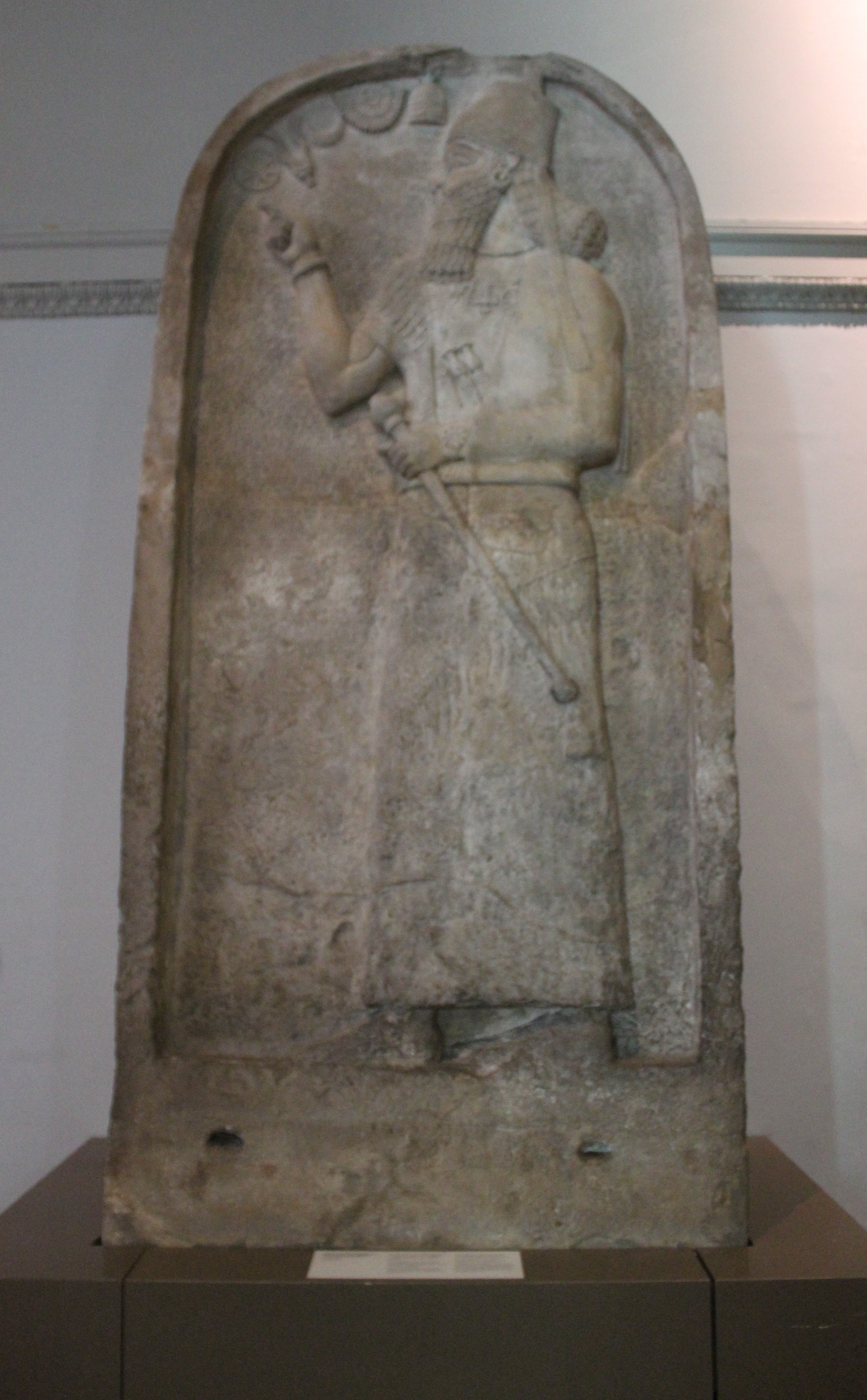
Stele of the Assyrian king Ashurnasirpal II (9th century BC) from Nimrud, now in the British Museum. Assyrian kings set up their own images in temples and in conquered lands to stand for their presence and rule. Photo: 14GTR, CC0, via Wikimedia Commons, resized.
See this page's graph and discover linked topics
In full
The objection runs: (1) God is spirit, invisible and without bodily form (John 4:24; Deuteronomy 4:12, 4:15-16; 1 Timothy 1:17; Colossians 1:15); (2) an image is a visible copy of an original's appearance; (3) so God has no image, and Genesis 1:26-27 is either empty or implies divine corporeality.
The defeater grants (1) and attacks (2), then denies (3) on the Bible's own terms:
- Grant the true half (P1). God is spirit and was seen in no form. Deuteronomy 4 makes that the stated reason for the ban on carved images, in the same Torah that opens with Genesis 1.
- "Image" is equivocal (P2). Hebrew tselem (H6754 - tselem) names a representative likeness, often a statue, that makes an absent sovereign present. Ancient Near Eastern kings set up their images where they did not personally appear; the Aramaic text of the Tell Fekheriye statue calls one royal statue by the cognates of both tselem and demuth. Clines concludes that the image is "the visible corporeal representative of the invisible, bodiless God."
- The image is a status and a vocation (P3). Genesis attaches dominion to the image in the same sentence (Genesis 1:26-28), and later texts ground human dignity on it (Genesis 9:6). Every major account of what the image consists in, whether representation, relationship, or rational and moral likeness, is met without God having a body.
- God does have an image of His own: the Son (P4). He is the charaktēr of God's hypostasis (Hebrews 1:3; G5481 - charakter), the eikōn of the invisible God (Colossians 1:15; 2 Corinthians 4:4; G1504 - eikon). Humanity is renewed "after the image of him that created him" (Colossians 3:10) and conformed "to the image of his Son" (Romans 8:29).
- In the incarnation the image became visible (P5). "The Word became flesh" (John 1:14); "he that hath seen me hath seen the Father" (John 14:9). Invisibility and image are not in conflict: the invisible God is made known through His image.
Argument structure
| Premise | Notes | |
|---|---|---|
| P1 | God is spirit, invisible, and was seen in no form | Grant. John 4:24; Deuteronomy 4:15-16; 1 Timothy 1:17 |
| P2 | Tselem means a representative likeness that makes an absent ruler present; it does not require a visible or bodily original | Royal images; Tell Fekheriye; von Rad; Clines |
| P3 | The image of God in humanity is a status and a vocation (representing God, relating to God, ruling under God), not a copy of a divine shape | Genesis 1:26-28; Psalm 8:5-6; Genesis 9:6 |
| P4 | The invisible God has an exact image of His own, the Son, after whom humanity is patterned and into whom it is renewed | Hebrews 1:3; Colossians 1:15; 2 Corinthians 4:4; Romans 8:29; Colossians 3:10 |
| P5 | In the incarnation the invisible God's image became visible, so invisibility and image do not conflict | John 1:14; John 1:18; John 14:9 |
| C | "God has no image" is false on the Bible's own terms, and "made in God's image" never implied that God has a body |
Form
Defensive, built on the equivocation pattern. The objection needs "image" to mean a visual copy of an original's appearance. Scripture uses it of a representative likeness, and in the case of the Son, of an exact impress of God's very being. The reply grants the objection's true premise, exposes the equivocation, and then adds a positive claim the objector did not expect: the Bible's answer to "what does God's image look like?" is a Person.
| Sense of "image" | What it means | Needs a visible original? | Where it is used |
|---|---|---|---|
| A. Visual copy | A picture of how something looks: a photograph, a portrait | Yes | The objection |
| B. Representative likeness | A stand-in that bears the owner's authority and makes him present: a royal statue, a seal's impression, an envoy | No | Genesis 1:26-27 (humanity); Hebrews 1:3 and Colossians 1:15 (the Son, who also shares the nature He represents) |
Cheatsheet
The 30-second reply (read aloud). You are right that God is spirit and nobody has seen His shape. The Bible says so. But "image" in Genesis does not mean a photo. In the ancient world a king set up his statue in a far-off city to show it was his. The statue did not prove the king was stone; it proved he ruled there. God made people to be His living statues, and the same verse says why: "let them have dominion." And the Bible says the invisible God really does have a perfect image of His own: the Son, "the very image of his substance," the exact stamp of who God is. Paul calls Him "the image of the invisible God," both words in one line. Jesus said, "he that hath seen me hath seen the Father." So God is not without an image. You are looking at Him when you look at Jesus.
The 5 fast facts:
- The Bible says God is invisible and has an image in the same verse. "Who is the image of the invisible God" (Colossians 1:15, ASV). Whatever else the objection is, it is not a contradiction the authors failed to notice.
- Hebrew tselem is a statue word. It is used of idols and carved images (Numbers 33:52; 2 Kings 11:18) and of Nebuchadnezzar's golden image (Daniel 3, the Aramaic cognate). A statue represents; it does not prove its owner is made of stone.
- Kings set up their images where they were absent. Assyrian kings "set up their statues in territories they had conquered" (Clines, 1968). Von Rad drew the parallel to Genesis: "just as powerful earthly kings, to indicate their claim to dominion, erect an image of themselves in the provinces of their empire where they do not personally appear," so humanity is placed on earth as God's image.
- Hebrews uses a seal word for the Son. Charaktēr, used once in the New Testament (Hebrews 1:3), is a die or stamp and the mark it leaves. Thayer: "precise reproduction in every respect (cf. facsimile)." See G5481 - charakter.
- Humanity is patterned on that image. Believers are "renewed unto knowledge after the image of him that created him" (Colossians 3:10, ASV) and "conformed to the image of his Son" (Romans 8:29, ASV).
The 3 strongest counter-moves:
- "Is a king's statue made of the same stuff as the king?" No. Then an image does not have to share the original's material or shape to be his image.
- "What does Colossians 1:15 call the Son?" "The image of the invisible God." So the author held both claims at once. Show me where he contradicts himself.
- "If God has no image, who did Jesus say Philip was looking at?" "He that hath seen me hath seen the Father" (John 14:9).
Reciprocal concessions (grant the small point, then collect a bigger one):
- Grant: God is spirit and has no bodily shape. Now collect: that is in the Torah itself. Deuteronomy 4:15-16 says Israel "saw no manner of form," and the same five books open with man made in God's image. The authors who wrote both did not think "image" meant "shape." You need them to have meant your sense of the word, and the text shows they did not.
- Grant: some readers, Latter-day Saints among them, take Genesis 1:26 to mean God has a body. Now collect: that reading has to overrule John 4:24 and Deuteronomy 4:12. A reading that contradicts the rest of the book is evidence against the reading, not against the book.
- Grant: the Old Testament never describes what God's image looks like. Now collect: the New Testament does, and its answer is a Person. If you want to know what the invisible God's image is like, the Gospels are a four-part description of it.
The closing line. You are right that nobody has seen God's shape. The Bible's claim is stronger than you thought: God has an image, the Son, and He came close enough to be seen.
Grammar and hermeneutics
The objection turns on a handful of texts. Read closely, they settle it before any theology is called in.
-
"In our image": the preposition. Genesis 1:26 reads bə-tsalmēnu ki-dmutēnu, "in our image, after our likeness," with the preposition bə- on tselem and kə- on demuth. Genesis 1:27 repeats bə-tsalmō, "in his image." Two readings of bə- are argued:
- "After the pattern of" (a beth of norm), like Moses making the tabernacle furnishings "after their pattern" (Exodus 25:40).
- "As" or "to be" (a beth essentiae), the use grammarians accept in Exodus 6:3, "I appeared ... as God Almighty." Clines argued for this reading: Genesis 1:26 "is to be translated 'Let us make man as our image' or 'to be our image'," so that man "does not have the image of God, nor is he made in the image of God, but is himself the image of God" (Clines, 1968).
Neither reading requires God to have a body. On the first, the pattern is God's own character and rule; on the second, humanity is the image, a representative, and nothing is being copied at all.
-
The prepositions trade places. Genesis 5:1 says God made man bi-dmut, "in the likeness" of God, and Genesis 5:3 says Adam begat Seth bi-dmutō kə-tsalmō, "in his own likeness, after his image," with the prepositions reversed from 1:26. Interpreters weigh that differently, but it means no argument can rest on one preposition alone.
-
Tselem and demuth together. Tselem is the concrete word (statue, image, carved figure); demuth the more abstract (likeness, resemblance, pattern). Used together they describe one intention, not two gifts. Outside the Bible the Aramaic text of the Tell Fekheriye statue (a statue of the ruler Hadad-yith'i, found in 1979 and usually dated to the 9th century BC) uses the cognates of both words for the same royal statue. Clines reads demuth in Genesis as "an amplification and specification of the meaning of the image": the representative also genuinely resembles the one he represents.
-
Dominion follows in the same breath. Genesis 1:26 runs straight from "in our image" to "and let them have dominion," and Genesis 1:28 repeats the commission. The text itself attaches the image to what humans are appointed to do, which is the royal-representative sense, not the visual-copy sense.
-
The form texts are about idols. Deuteronomy 4:12 and 4:15-16 deny that Israel saw any temunah, "form," and draw the conclusion: so do not "make you a graven image in the form of any figure." The point is that humans may not manufacture a likeness of God. That is consistent with God Himself appointing one. Isaiah 40:18 asks "what likeness (demuth) will ye compare unto him?" in a passage about idols cast by craftsmen (Isaiah 40:18-20), and Paul makes the same move at Athens: "Being then the offspring of God, we ought not to think that the Godhead is like unto gold, or silver, or stone, graven by art and device of man" (Acts 17:29, ASV). The living image rules out the carved one.
-
"God is spirit." John 4:24 reads pneuma ho theos, with "spirit" placed first and without an article; the ASV and KJV render it "God is a Spirit," most modern versions "God is spirit." Either way it describes what kind of being God is. It is a statement about God's nature, and it says nothing about whether God can have a representative.
-
Charaktēr and apaugasma in Hebrews 1:3. The Son is apaugasma tēs doxēs, "the effulgence of his glory," and charaktēr tēs hypostaseōs autou, "the very image of his substance" (ASV). Both nouns occur only here in the New Testament. Charaktēr is "die, stamp" and then the "impress, stamp on coins and seals" (LSJ); Thayer glosses its applied sense "precise reproduction in every respect (cf. facsimile)." Apaugasma is disputed between "radiance" and "reflection." The verse opens with ōn, a present participle ("who being"), for what the Son is, and switches to aorist verbs for what He did ("made purification ... sat down"). Being God's exact impress is stated as the Son's standing identity, not a role He acquired.
-
Eikōn in Colossians 1:15. Hos estin eikōn tou theou tou aoratou: "who is the image of the invisible God," present tense, with aoratos, "invisible," attached to God in the same phrase. Paul uses the same adjective in Colossians 1:16 ("things visible and things invisible") and in 1 Timothy 1:17. The grammar puts the invisibility on God and the image on the Son, and asserts both together. 2 Corinthians 4:4 repeats it: "Christ, who is the image of God."
Verdict on grammar alone. None of the texts the objection cites says God cannot have an image. They say God has no visible form, that humans must not carve one, and that God is spirit. The texts that use "image" attach it to representation and rule (Genesis) and to the Son's identity with God (Hebrews, Colossians). The contradiction exists only if "image" is forced into a sense none of these authors used.
P1, God is spirit, invisible, and was seen in no form
Affirmative case
- Jesus says it directly. "God is a Spirit: and they that worship him must worship in spirit and truth" (John 4:24, ASV).
- Moses makes it the reason for the image ban. "Ye saw no manner of form on the day that Jehovah spake unto you in Horeb ... lest ye corrupt yourselves, and make you a graven image" (Deuteronomy 4:15-16, ASV).
- Paul calls God invisible twice. "The King eternal, immortal, invisible" (1 Timothy 1:17, ASV); "the image of the invisible God" (Colossians 1:15, ASV).
- The church held the same. Early readers who took the image to mean a divine body (the "Anthropomorphites") were rejected; see Anthropomorphism. The codex's position is the classical one: God has no body (Divine Simplicity, Classical Theism).
Anticipated objections
- "Then you admit God has no shape. So there is nothing for an image to copy."
- "The Old Testament describes God's hands, face and arm. Your 'invisible' God is a later philosophical cleanup."
Rebuttals
- "Nothing to copy" assumes the copy sense of "image." That is the equivocation. A representative image does not copy a shape; P2 shows that is the sense Genesis uses.
- The denials are in the same books as the imagery. Deuteronomy 4 states that no form was seen, as a proposition, and argues from it. The bodily language is figurative and the text says so; see Anthropomorphism.
P2, Tselem is a representative likeness and does not require a visible original
Affirmative case
- The word's ordinary use is "statue." Tselem names idols and carved figures (Numbers 33:52; 2 Kings 11:18; Ezekiel 7:20) and, in Aramaic, Nebuchadnezzar's golden image (Daniel 3). See H6754 - tselem.
- Royal images stood in for absent kings. Clines: "We do know that Assyrian kings set up their statues in territories they had conquered," and "the king puts his statue in a conquered land to signify his real, though not his physical, presence there" ("The Image of God in Man," Tyndale Bulletin 19, 1968).
- Old Testament scholars read Genesis against that background. Gerhard von Rad (Genesis, Old Testament Library): "just as powerful earthly kings, to indicate their claim to dominion, erect an image of themselves in the provinces of their empire where they do not personally appear," so humanity is set on earth as God's image. J. Richard Middleton (The Liberating Image, 2005) argues that Genesis takes this royal idea and extends it to every human being.
- An extra-biblical statue uses both Genesis words. The Tell Fekheriye statue's Aramaic inscription calls the ruler's statue by the cognates of tselem and demuth. A stone statue is the image and likeness of a man of flesh: it plainly does not share his material, and it is still his image.
- Clines draws the conclusion for God. "What makes man the image of God is not that corporeal man stands as an analogy of a corporeal God; for the image does not primarily mean similarity, but the representation of the one who is imaged in a place where he is not." His summary: man is "the visible corporeal representative of the invisible, bodiless God."
Anticipated objections
- "A statue of a king still looks like the king. So an image of God would have to look like God."
- "Some scholars think Genesis did mean God's physical form."
- "The royal-statue idea is pagan. You are reading Babylon into the Bible."
Rebuttals
- Resemblance is part of the image, but not bodily resemblance. Clines grants that demuth assures "man is an adequate and faithful representative of God." The likeness is in what humans are and do: persons who know, will, love, speak and rule. Those are the features of God the image reflects; a shape is not one of them, because God has none (Deuteronomy 4:15).
- That view exists and does not help the objection. Clines records that Hermann Gunkel, reading Genesis 1:26 through Genesis 5:3, took the image to refer "in the first place to the body." But if Genesis meant a physical form, the objection's charge becomes "Genesis contradicts Deuteronomy and John," which is a different argument and has to answer the fact that the same Torah denies any form was seen. And the physical reading is a minority position; the representative reading is widely held.
- Borrowing a word is not borrowing a theology. Genesis turns the royal-image idea around: in Egyptian and Mesopotamian texts the one called a god's image is usually the king (Clines surveys these texts); in Genesis every human is, male and female (Genesis 1:27). See Genesis ANE Myth Borrowing Objection Defeater.
P3, The image is a status and a vocation, not a copy of a divine shape
Affirmative case
- The commission is in the same sentence. "Let us make man in our image, after our likeness: and let them have dominion" (Genesis 1:26, ASV); "Be fruitful, and multiply, and replenish the earth, and subdue it" (Genesis 1:28, ASV).
- Psalm 8 reads it as royalty. "Thou hast made him but little lower than God, And crownest him with glory and honor. Thou makest him to have dominion over the works of thy hands" (Psalm 8:5-6, ASV).
- The image grounds worth, not appearance. Murder is forbidden "for in the image of God made he man" (Genesis 9:6, ASV). The verse would make no sense if the image were a shape; it makes perfect sense if it is a status every human holds.
- Every classic account works without a divine body. Christians have located the image in reason and moral capacity (Augustine), in relationship (Barth), and in representative rule (the functional reading). Each one is a likeness to God's mind, God's love, or God's rule. None needs God to have a face. See Imago Dei.
Anticipated objections
- "'Representative' is just a way of saying the words don't mean anything."
- "Animals are in the world too. What makes humans the image and not a lion?"
Rebuttals
- A representative is a definite thing. An ambassador is not vague; he carries his nation's authority and speaks for it. The image gives humans a definite standing (dignity, Genesis 9:6) and a definite task (stewardship, Genesis 1:28).
- Genesis answers that. Animals are made "after their kind"; only humans are made in God's image and given dominion over the others (Genesis 1:24-28). See Argument from Human Exceptionalism.
P4, The invisible God has an exact image of His own: the Son
Affirmative case
- The impress of God's being. "Who being the effulgence of his glory, and the very image of his substance" (Hebrews 1:3, ASV). Charaktēr is the mark a die leaves: LSJ "impress, stamp on coins and seals"; Thayer "precise reproduction in every respect (cf. facsimile)." See G5481 - charakter.
- The image of the invisible God. "Who is the image of the invisible God, the firstborn of all creation" (Colossians 1:15, ASV); "Christ, who is the image of God" (2 Corinthians 4:4, ASV). See G1504 - eikon.
- Humanity is renewed into that image. "Foreordained to be conformed to the image of his Son" (Romans 8:29, ASV); "the new man, that is being renewed unto knowledge after the image of him that created him" (Colossians 3:10, ASV); "transformed into the same image from glory to glory" (2 Corinthians 3:18, ASV); "we shall also bear the image of the heavenly" (1 Corinthians 15:49, ASV). Colossians 3:10 echoes the creation language of Genesis: the image is restored by the One who created it.
- The earliest Christian writers joined the two. 1 Clement says God formed man "in the impress of His own image" (1 Clement 33:4, Lightfoot), using the same word Hebrews uses of the Son.
- So the premise "God has no image" is false on the Bible's terms. The Bible's claim is not that God lacks an image but that He has exactly one perfect image, the Son, and that humanity bears a derived image patterned on Him.
Anticipated objections
- "If the Son is God's image, then the Son is a copy, less than the original."
- "This is just the New Testament rescuing an Old Testament problem."
- "An image of an invisible God would still be invisible, so what use is it?"
Rebuttals
- Hebrews blocks that with its other word. The Son is also the apaugasma, the radiance of God's glory. Radiance is never later than its light and never a different kind of thing from it. Charaktēr says the Son is distinct and shows the Father exactly; apaugasma says He shares the Father's nature. See Eternal Generation and Trinity vs Oneness vs Modalism vs Arianism.
- There was no Old Testament problem to rescue. P2 and P3 answer the objection from Genesis alone. P4 is not a patch; it is the fuller answer to a question Genesis left open (what is God's own image like?), given by authors who quote Genesis.
- The image of the invisible God became visible. That is P5.
P5, In the incarnation the image became visible
Affirmative case
- The Word became flesh. "And the Word became flesh, and dwelt among us (and we beheld his glory, glory as of the only begotten from the Father)" (John 1:14, ASV).
- The unseen God is made known. "No man hath seen God at any time; the only begotten Son, who is in the bosom of the Father, he hath declared him" (John 1:18, ASV).
- Seeing the Son is seeing the Father. "He that hath seen me hath seen the Father" (John 14:9, ASV); "he that beholdeth me beholdeth him that sent me" (John 12:45, ASV).
- The incarnation adds a human nature without making God a body. The Son took a human nature; the divine nature did not turn into flesh. See Incarnation and Hypostatic Union. So the visible image does not make God corporeal, which is exactly what the objection fears.
Anticipated objections
- "Then God does have a body: Jesus's."
- "John 1:18 says no one has seen God. John 14:9 says Philip has. That is a contradiction."
Rebuttals
- The Son has a body; the divine nature does not. Christians confess one Person with two natures. The human nature of the Son is truly bodily; the divine nature, shared by Father, Son and Spirit, is spirit (John 4:24). See God Is Not a Man Objection Defeater for the same distinction against a different objection.
- The two verses say the same thing from two sides. John 1:18 itself goes on: the Son "hath declared him." No one has seen God in His own nature; the Son makes Him known. Philip sees the Father by seeing the Son, which is what John 1:18 says will happen.
Master objections to the defeater
MO1: "You are redefining 'image' to escape the problem."
- No. The representative sense is the ordinary ancient sense, attested in the Bible's own use of tselem for statues and outside it in royal statues and inscriptions. The photograph sense is the modern one being read back.
MO2: "If humans are God's image, then God looks like a human, which is anthropomorphism."
- The Christian claim runs the other way: humans are like God because God made them so, not God like humans because humans imagined Him. See Anthropomorphism.
MO3: "Isaiah says nothing can be compared to God, so Genesis is wrong to say man is His likeness."
- Isaiah 40:18 asks "what likeness (demuth) will ye compare unto him?" about idols made by craftsmen (40:19-20). It forbids people manufacturing a likeness of God. Genesis records God making one. The two do not collide.
Honest limits and tensions
- Clines says "God has no image of His own." His summary reads: "Man is created not in God's image, since God has no image of His own, but as God's image." He means that Genesis presents no visible divine form after which man was patterned, which is P1 and P2 of this page. He is writing about Genesis 1 on its own; in the same article he notes that in the New Testament Christ "in a sensus plenior is God's 'one' representative on earth." This page's P4 is a whole-Bible reading: Genesis says humanity is God's image, and the New Testament says God's own perfect image is the Son. The two claims answer different questions.
- The preposition is debated. Clines's "as our image" reading is argued, not settled. The defeater does not depend on it; P2 and P3 hold on either reading.
- Accounts of the image differ. Christians disagree about whether the image is chiefly reason, relationship or rule, and many combine them. The defeater only needs what all of them share: none requires God to have a body.
Tactical opening / closing
- Opening. "You're right that God is spirit. The Bible says that, and it says it in the same books that say we're made in His image. So the authors didn't think those clash. Let's find out what they meant by 'image.'"
- Closing. "You asked how an invisible God could have an image. The Bible's answer is a Person: 'the image of the invisible God.' If you want to know what God is like, look at Jesus."
Tactical notes
- Lead with Colossians 1:15 against a quick-fire objector. "Image" and "invisible" in one clause ends the "contradiction" charge in a sentence.
- Lead with the king's statue with a thoughtful questioner. It reframes the word before any verse is quoted.
- Do not defend a physical reading of Genesis 1. It loses to Deuteronomy 4:15-16 and John 4:24, and the objection is built to exploit it.
- Do not overstate the Hebrew. The beth essentiae reading is a strong scholarly argument, not a settled fact. Use it as support, not as the main beam.
- Force-commit move. "Does a statue have to be made of the same material as the king it represents?" If no, the objection's premise about images is gone.
Connection to Scripture
- Humanity as image: Genesis 1:26-28; Genesis 5:1, 5:3; Genesis 9:6; Psalm 8:5-6; James 3:9
- God as spirit and unseen: John 4:24; Deuteronomy 4:12, 4:15-16; Exodus 33:20; 1 Timothy 1:17; John 1:18
- No man-made likeness: Isaiah 40:18-20; Acts 17:29; Romans 1:23
- The Son as image: Hebrews 1:3; Colossians 1:15; 2 Corinthians 4:4; John 14:9; John 12:45
- Renewal into the image: Romans 8:29; 2 Corinthians 3:18; Colossians 3:10; 1 Corinthians 15:49
Live-cite kit
Scripture (strongest first):
- Colossians 1:15, "the image of the invisible God"
- Hebrews 1:3, "the very image of his substance"
- John 14:9, "he that hath seen me hath seen the Father"
- Genesis 1:26, "in our image ... and let them have dominion"
- Deuteronomy 4:15-16, "ye saw no manner of form"
Scholarly:
- D. J. A. Clines, "The Image of God in Man," Tyndale Bulletin 19 (1968): man as "the visible corporeal representative of the invisible, bodiless God"
- Gerhard von Rad, Genesis (Old Testament Library): kings "erect an image of themselves in the provinces of their empire where they do not personally appear"
- J. Richard Middleton, The Liberating Image: The Imago Dei in Genesis 1 (Brazos, 2005): the royal image extended to all humanity
- Thayer, Greek-English Lexicon of the New Testament, on charaktēr: "precise reproduction in every respect (cf. facsimile)"
- 1 Clement 33:4: God formed man "in the impress of His own image"
Aphorism:
- "A king's statue isn't made of king. It's still his image."
- "God isn't without an image. He has one perfect one, and His name is Jesus."
- "Same verse: image, invisible. Paul saw no contradiction."
Cross-examination
Round 1, Agree first
- Q: "You'd say God is spirit and has no shape?" A: "Yes." Q: "So does the Bible, in the same books that say we're His image. So what do you think they meant by 'image'?"
Round 2, The statue
- Q: "When an Assyrian king set up his statue in a conquered city, was it his image?" A: "Yes." Q: "Was the king made of stone?" A: "No." Q: "Then an image doesn't have to share its owner's body."
Round 3, The Son
- Q: "Who does Colossians 1:15 say is 'the image of the invisible God'?" Q: "And who does Jesus say Philip has seen, in John 14:9?" Q: "So does the Bible say God has no image?"
Dodge table
| Dodge | Reply |
|---|---|
| "That's apologetics spin on the word." | It is the word's ordinary use in Hebrew, for statues and idols, and the reading of mainstream Old Testament scholarship. |
| "The Bible also says God has hands." | And it says no one saw any form of Him. The same author tells you which statements are figures. |
| "Jesus being God's image is just doctrine." | It is the plain sense of Hebrews 1:3 and Colossians 1:15. Your objection is about what the Bible says, and that is what it says. |
Patristic and scholarly note
Early church:
- 1 Clement 33:4 (late first century): God formed man "in the impress of His own image," using charaktēr for humanity's relation to God's image
- Ignatius, To the Magnesians 5:2: "two coinages, the one of God and the other of the world," each with "its proper stamp"
- Letter 38 in the correspondence of Basil of Caesarea (often assigned to Gregory of Nyssa), 38.8: on Hebrews 1:3 read with John 14:9, "the idea of the image would be lost were it not to preserve throughout the plain and invariable likeness"
Modern:
- D. J. A. Clines, "The Image of God in Man," Tyndale Bulletin 19 (1968): 53-103, the representative reading and the beth essentiae argument
- Gerhard von Rad, Genesis: A Commentary (Old Testament Library), the royal-image parallel
- J. Richard Middleton, The Liberating Image: The Imago Dei in Genesis 1 (Brazos, 2005)
- The Tell Fekheriye bilingual statue (Akkadian and Aramaic, 9th century BC), first published 1981-1982 (Abou-Assaf, Bordreuil and Millard)
Scholarship
Published academic works this page draws on, each matched to a publisher, index or library catalog record.
- D. J. A Clines, "The Image of God in Man," Tyndale Bulletin 19 (1968). doi:10.53751/001c.30671 open access
- J. Richard Middleton, The Liberating Image (2005). Open Library
See also
- Imago Dei, the doctrine of humanity in God's image
- G5481 - charakter, charaktēr, the exact impress, in Hebrews 1:3
- G1504 - eikon, eikōn, image, in Colossians 1:15
- H6754 - tselem, tselem, image, the statue word of Genesis 1
- H1823 - demuth, demuth, likeness
- G5287 - hypostasis, hypostasis, the being whose impress the Son is
- Anthropomorphism, why Scripture's bodily language about God is figurative
- Incarnation, how the image of the invisible God became visible
- Hypostatic Union, one Person, two natures
- Eternal Generation, the Son's eternal relation to the Father
- God Is Not a Man Objection Defeater, the sister objection from Numbers 23:19
- Christianity Is Idolatry Objection Defeater, why worshiping the Son is not worshiping an image
- Genesis ANE Myth Borrowing Objection Defeater, borrowing a word is not borrowing a theology
- Argument from Human Exceptionalism, why humans differ in kind
- Equivocation, the fallacy at the center of the objection
- Atheism, master hub
Common questions this page answers
Q: If God is spirit, how can we be made in His image?
Because "image" in Genesis does not mean a picture of God's shape. The Hebrew word tselem was used for statues, and ancient kings set up their statues in distant lands to stand for their rule. Genesis says God made humans His image and in the same sentence says "let them have dominion" (Genesis 1:26). People represent God in the world; they do not copy a body God does not have.
Q: Does being made in God's image mean God has a body?
No. The same Torah that says man was made in God's image says Israel "saw no manner of form" when God spoke (Deuteronomy 4:15), and Jesus says "God is a Spirit" (John 4:24). The image is a status and a calling: representing God, relating to Him, and ruling under Him.
Q: Does God have an image?
Yes, according to the New Testament. The Son is "the image of the invisible God" (Colossians 1:15) and "the very image of his substance" (Hebrews 1:3). Humanity is made after that image and is being renewed into it (Colossians 3:10; Romans 8:29).
Q: What does "express image" mean in Hebrews 1:3?
It translates the Greek charaktēr, the mark a seal or coin die leaves, which matches the die line for line. Thayer's lexicon glosses it "precise reproduction in every respect (cf. facsimile)." Hebrews uses it once, of the Son, to say He bears the exact stamp of God's being.
Q: How can Jesus be the image of an invisible God?
Colossians 1:15 says both in one line: the Son "is the image of the invisible God." God's nature is unseen, and the Son makes Him known: "he that hath seen me hath seen the Father" (John 14:9). In the incarnation the Son took a human nature, so the image of the invisible God became visible without God's nature becoming a body.
Q: Isn't saying humans are like God just anthropomorphism?
The Christian claim runs the other way. Humans resemble God because God made them to, not God humans because humans imagined Him. The resemblance is in knowing, willing, loving and ruling, not in shape.