Argument
God Breaks His Own Rules Objection Defeater
God breaks his own rules, does God break his own rules, God is a hypocrite, God doesn't follow his own commandments, God says do not kill but kills, God commands thou shalt not kill then kills, is God bound by his word, is God bound by his own law, God double standard, rules for thee but not for me God, can God break his promisesIntro
The objection sounds simple. God says "Thou shalt not kill", and then God floods the world, strikes down Egypt's firstborn and commands wars. God says "Thou shalt not steal", and yet He takes what He likes. So God does not follow His own rules, and a being who forbids others what He does Himself is a hypocrite.
The reply starts with a question about the word "rule". Some of God's words are commands He gives to people: do not kill, do not steal. Others are promises He makes about Himself: I will not lie, I will keep my covenant, I will judge justly. The objection treats the first kind as if it were the second.
Think of a parent who tells a child, "Never take money out of my wallet." When the parent takes money out of the wallet, no rule has been broken, because the rule was about the child's relation to something that belongs to the parent. "Thou shalt not steal" works the same way. It forbids taking what belongs to someone else, and Scripture says "The earth is Jehovah's, and the fulness thereof" (Psalm 24:1, ASV). Life itself is His gift: "Jehovah gave, and Jehovah hath taken away" (Job 1:21, ASV).
The rules God really does bind Himself to are the ones about His own character: He "cannot lie", He "cannot deny himself", He will "do right". Those He has never broken, and the cross is where He kept them at the highest cost.
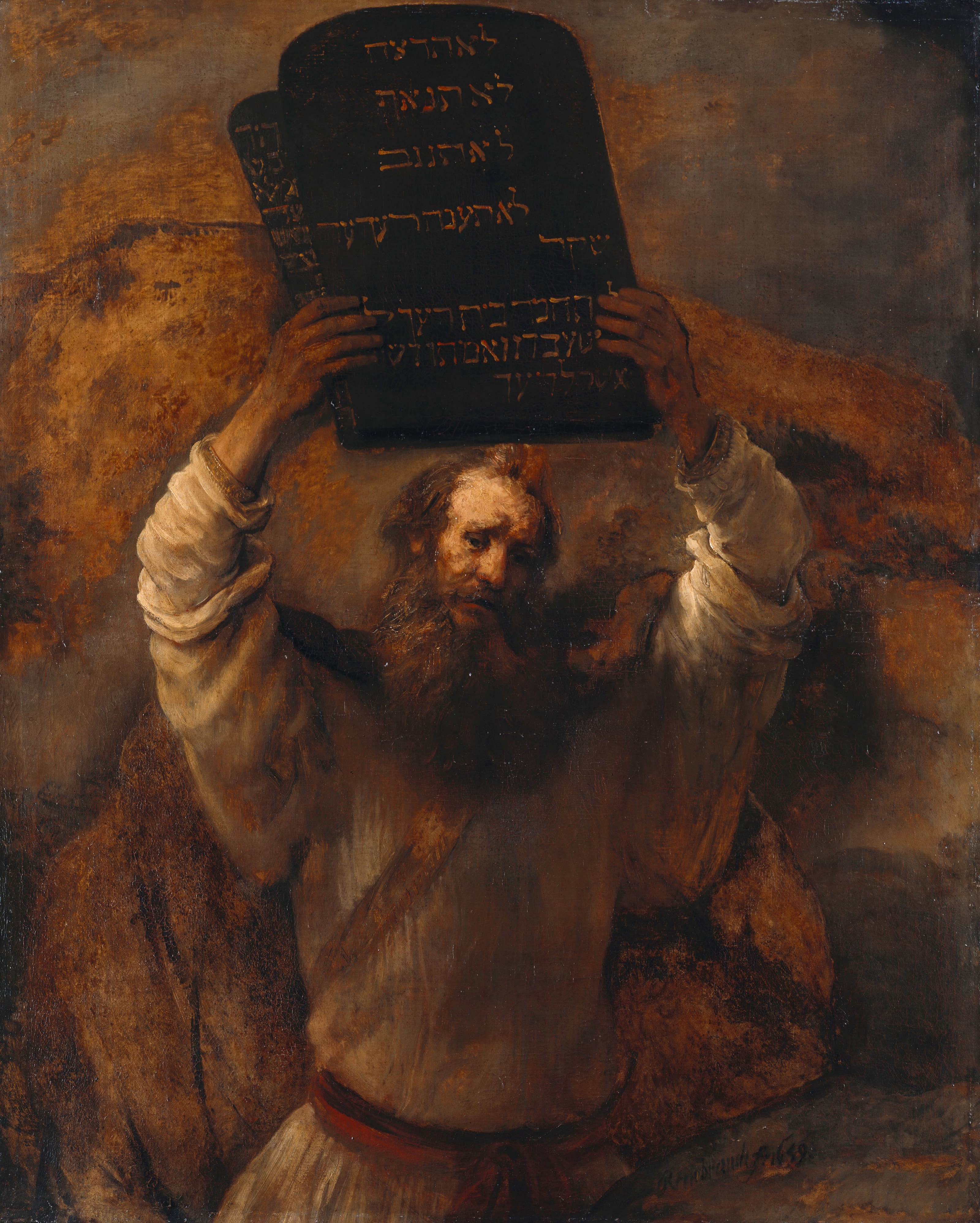
Rembrandt, Moses with the Ten Commandments (1659), Gemäldegalerie, Berlin. The tablets carry commands addressed to Israel; the covenant they belong to opens with who gave them: "I am Jehovah thy God, who brought thee out of the land of Egypt" (Exodus 20:2, ASV). Image: public domain, via Wikimedia Commons.
See this page's graph and discover linked topics
Cheatsheet
The 30-second reply:
A rule only binds the person it is addressed to, under the conditions it names. "Thou shalt not kill" forbids a creature taking a life that is not his; "Thou shalt not steal" forbids taking what belongs to another. Neither describes the Owner of all life and property. The rules God does bind Himself to are His promises: He cannot lie, cannot deny Himself, and will do right. Name one of those He has broken. At the cross He kept His own justice even to save us.
Fast facts.
- The sixth commandment's verb is ratsach. It names unlawful homicide inside the community. God's own self-description, "I kill, and I make alive" (Deuteronomy 32:39), uses a different verb, muth in its causative form. See H7523 - ratsach.
- The commands are addressed. The Decalogue opens "I am Jehovah thy God, who brought thee out of the land of Egypt" (Exodus 20:2, ASV). The "thou" is Israel, the redeemed vassal, speaking to its Redeemer's terms.
- God binds Himself by oath. "Since he could swear by none greater, he sware by himself" (Hebrews 6:13, ASV); "it is impossible for God to lie" (Hebrews 6:18, ASV).
- Scripture invites the test. "Shall not the Judge of all the earth do right?" (Genesis 18:25, ASV). "Is not my way equal? are not your ways unequal?" (Ezekiel 18:25, ASV).
- Augustine answered this in the fifth century. Those who kill at God's express command, or as public authority executing just laws, have not broken "Thou shalt not kill" (City of God I.21).
Counter-moves.
- Ask which rule. "Name the command, show that it is addressed to God, and show where He broke it." General charges dissolve when made specific.
- Split the two kinds of rule. Commands addressed to creatures; promises God makes about Himself. Draw the table on a napkin if you have to.
- Use the ownership test. Stealing and murder are defined by taking what belongs to another. Ask who the "another" is when the one acting is the Creator.
- Turn to the promises. Bring the conversation to the rules God does bind Himself to, and ask for a broken one.
- Land on the cross. Romans 3:26: God set forth Christ "that he might himself be just, and the justifier". He did not suspend His own justice even to save.
Concessions to grant.
- God does things He forbids creatures to do. Say so plainly; the defense does not deny the data.
- Some divine acts in the Old Testament are morally hard, and a reasonable person can ask whether they fit perfect goodness. That is a fair question, and it is answered case by case on the pages listed under Tactical notes, not by this page's distinction alone.
- "Whatever God does is good by definition" would make the defense circular. This page does not argue that.
Closing line. You have caught God doing what He told you not to do. What you have not found is God breaking a promise He made about Himself, and at the cross He kept His justice at a price no one else would have paid.
In full
The objection charges God with inconsistency: He prohibits killing, taking and the like, and performs acts of the same physical description Himself. Its form is an inference from God forbids creatures to do X and God does X to God violates His own rule.
This defeater denies the inference by surfacing an equivocation on "rule". A command is a directive addressed to an agent in a relation, binding that agent under the conditions it specifies. A self-commitment is a promise, oath or declaration in which God binds Himself. The objection needs every command to be also a self-commitment. Three considerations show otherwise. First, the prohibitions in question are defined by relations that do not hold between God and creatures: murder is the unlawful taking of a life the killer has no right to take, theft the taking of what belongs to another, and God is the giver of every life and owner of all things. Second, the Hebrew of the Decalogue and its covenant frame mark the commands as addressed to Israel, and Scripture's own descriptions of God's sovereignty over death use distinct vocabulary. Third, the self-commitments Scripture does attribute to God (truthfulness, faithfulness to covenant and oath, justice in judgment) are exactly the ones Scripture insists He keeps, and the atonement is presented as God keeping His own justice at cost to Himself.
The conclusion is limited. It defeats the general charge of hypocrisy and moves the debate to specific cases, where the question is whether a particular act is consistent with God's goodness, justice and truthfulness. It does not settle each case, and it does not claim that God's authority makes any act good regardless of its content. See Euthyphro Dilemma Objection Defeater for why goodness is grounded in God's nature and not in arbitrary will.
Grammar and hermeneutics
The objection usually rests on an English Bible. On the Hebrew and the covenant setting alone, its main example falls apart before any theology is needed.
- The verb of the sixth commandment. "Thou shalt not kill" (Exodus 20:13) is lo tirtsach: the negative lo with the imperfect of ratsach, the standard Hebrew form of a permanent prohibition. Ratsach is the vocabulary of homicide inside the community, the killing Israel's homicide law existed to judge. It is never used of war, and the same law that gives the commandment also prescribes capital penalties (Exodus 21:12-14). So the commandment cannot mean "no life may ever be taken by anyone". See H7523 - ratsach for the full range.
- God's own verb is different. "I kill, and I make alive; I wound, and I heal" (Deuteronomy 32:39, ASV) and "Jehovah killeth, and maketh alive" (1 Samuel 2:6, ASV) use muth, "to die", in its causative stem, "to cause to die", paired with "to make alive". The texts that describe God's authority over death speak in the vocabulary of the Giver of life, not in the vocabulary of the homicide law.
- Second person, addressed to a people. The Ten Commandments are spoken in the second person singular to Israel, and they follow a self-introduction that names the addressee's relation to the speaker: "I am Jehovah thy God, who brought thee out of the land of Egypt, out of the house of bondage" (Exodus 20:2, ASV). In form they are the stipulations of a covenant between a redeeming Lord and a redeemed people. A covenant's stipulations bind the party they are addressed to.
- The grounds clauses. When the law gives a reason for the protection of life, the reason is creaturely: "for in the image of God made he man" (Genesis 9:6, ASV). Human life is protected from other humans because it bears God's image. That rationale is about the relation between image-bearers; it cannot be turned against the One whose image they bear.
- Commands that change with the covenant. Noah is given every moving thing for food (Genesis 9:3); Israel is restricted (Leviticus 11), with a stated covenant purpose, "be ye holy; for I am holy" (Leviticus 11:44, ASV); and the New Testament lifts the restriction (Mark 7:19; Acts 10:15). These are changes in the terms given to different people for different purposes. Reading them as God contradicting Himself treats a covenant stipulation as a timeless description of God.
- Where Scripture does describe God binding Himself, the language changes again. Here the vocabulary is oath and inability: God "sware by himself" (Hebrews 6:13; Genesis 22:16), "God, who cannot lie" (Titus 1:2, ASV), "he cannot deny himself" (2 Timothy 2:13, ASV). The text itself marks which rules apply to God.
Argument structure
| # | Premise |
|---|---|
| P1 | "Rule" is ambiguous between a command addressed to creatures and a self-commitment God makes about Himself; the objection needs every command to be a self-commitment. |
| P2 | The prohibitions the objection cites (murder, theft) are defined by relations, a life or a thing that belongs to another, which do not hold between the Creator and His creatures. |
| P3 | The self-commitments Scripture attributes to God (truthfulness, faithfulness to oath and covenant, justice) are the ones it insists He keeps, and no counterexample has been produced. |
| P4 | Distinguishing the Creator's prerogatives from creatures' obligations is principled, so the charge of special pleading fails. |
| C | The inference from "God does what He forbids us" to "God breaks His own rules" is invalid; the real question is whether particular acts fit God's character, and that is settled case by case. |
Two senses of "rule"
| Command to creatures | Self-commitment of God | |
|---|---|---|
| Addressed to | A creature, in a relation to God and to others | God Himself |
| Grounded in | The creature's place: image-bearer, neighbour, steward | God's own nature: truthful, faithful, just |
| Can it vary? | Yes, with covenant and circumstance (Genesis 9:3; Leviticus 11; Mark 7:19) | No (Numbers 23:19; Hebrews 6:18) |
| Examples | "Thou shalt not kill"; "Thou shalt not steal" | "God, who cannot lie"; "he cannot deny himself"; "the Judge of all the earth" will "do right" |
| Does God keep it? | It does not address Him | Always; the objection has to produce a counterexample |
Form
Defensive, built on the equivocation-defeater pattern. P1 surfaces the two senses. P2 shows that the commands the objection cites are the first kind by their own definitions. P3 supplies the positive case, so the reply does more than deflect: there are rules God binds Himself to, and He keeps them. P4 blocks the standard counter, that the distinction is invented to protect God. The conclusion is modest by design. It removes the general charge and hands each hard case to the place where it belongs.
P1, "Rule" has two senses
Affirmative case
- Commands are relational. A command has an addressee and conditions. A sign reading "Staff only beyond this point" is not broken when the staff walk through. Whether an act violates a command depends on whom the command addresses, not on the physical description of the act.
- Scripture marks the difference. The Decalogue is spoken to "thee", Israel, the people brought "out of the house of bondage" (Exodus 20:2). God's self-commitments are spoken as oaths and as statements of what He cannot do (Hebrews 6:13-18; Titus 1:2; 2 Timothy 2:13).
- The objector accepts the distinction everywhere else. A judge who forbids citizens to imprison one another does not break that law by sentencing a convicted kidnapper. Lawful authority over life, liberty and property is the ordinary condition of every legal system.
Anticipated objections
- "A good law applies to everyone, including the lawgiver. That is the rule of law."
- "You are just redefining the commandments so God escapes them."
Rebuttals
- The rule of law means the lawgiver does not exempt himself from the laws that address him. It does not mean every officer must obey every rule addressed to private citizens; a police officer may detain and a private citizen may not. And the self-commitments in P3 are exactly the "laws" that address God, which He keeps.
- The definitions come from the texts themselves: the verb of the sixth commandment is the homicide-law verb (see Grammar and hermeneutics), and theft by definition is taking what is another's. No redefinition is needed; only reading.
P2, The prohibitions are defined by relations God does not stand in
Affirmative case
- Theft needs an owner other than the taker. "The earth is Jehovah's, and the fulness thereof; The world, and they that dwell therein" (Psalm 24:1, ASV); "every beast of the forest is mine, And the cattle upon a thousand hills" (Psalm 50:10, ASV). Nothing God takes belongs to someone else in the sense theft requires. Aquinas makes the point with the spoiling of Egypt: when Israel took the Egyptians' goods at God's command, it was not theft, because the goods were due to them by the sentence of God (ST I-II q.100 a.8 ad 3).
- Murder needs a life the killer has no right to. Every life is lent: "Jehovah gave, and Jehovah hath taken away" (Job 1:21, ASV). Aquinas: all people alike, guilty and innocent, die by the decree of God, so by God's command death may be inflicted without injustice (ST I-II q.94 a.5 ad 2). Every death in history, including every peaceful one, is God taking back what He gave.
- Augustine drew the line in the same place. In City of God I.21 he argues that the commandment against killing is not broken by those who act at God's express command, or who as public authority put criminals to death under just laws; the one who acts as an instrument of lawful authority is not the killer the commandment forbids.
Anticipated objections
- "So God can kill anyone, at any time, for any reason, and it is fine? That is a might-makes-right deity."
- "Owning someone does not give you the right to kill them. We abolished slavery for a reason."
- "This makes God's commands to kill (the conquest, the Amalekites) unanswerable. You have just given a blank cheque to every holy war."
Rebuttals
- No. Authority answers whether God may take a life; His character answers how He uses that authority. Scripture insists He does so justly and without delight: "I have no pleasure in the death of the wicked" (Ezekiel 33:11, ASV); "all his ways are justice" (Deuteronomy 32:4, ASV). The authority is necessary for the defense; it is not offered as the whole of it. See Euthyphro Dilemma Objection Defeater.
- Human ownership of humans is wrong because one creature claims over another a lordship only the Creator has. The objection's own moral intuition presupposes the distinction this page draws: humans may not do to one another what belongs to God alone.
- The prerogative is God's, and any human claim to act on it needs the kind of direct, public, prophetic warrant the Old Testament cases carry and no later claimant can supply. Those cases are argued individually on Canaanite Conquest Objection Defeater and Amalekite Genocide Objection Defeater. And the New Testament gives no such command to the church (Christians Not Under Mosaic Law).
P3, God keeps every rule He binds Himself to
Affirmative case
- Truthfulness. "God is not a man, that he should lie, Neither the son of man, that he should repent: Hath he said, and will he not do it? Or hath he spoken, and will he not make it good?" (Numbers 23:19, ASV); "God, who cannot lie" (Titus 1:2, ASV).
- Oath and covenant. "Since he could swear by none greater, he sware by himself" (Hebrews 6:13, ASV), so that "by two immutable things, in which it is impossible for God to lie, we may have a strong encouragement" (Hebrews 6:18, ASV). "My covenant will I not break, Nor alter the thing that is gone out of my lips" (Psalm 89:34, ASV).
- Faithfulness even toward the faithless. "If we are faithless, he abideth faithful; for he cannot deny himself" (2 Timothy 2:13, ASV). God's faithfulness to His word is faithfulness to Himself.
- Justice, kept at the cross. Paul says God set forth Christ as a propitiation "to show his righteousness... that he might himself be just, and the justifier of him that hath faith in Jesus" (Romans 3:25-26, ASV). The problem of the atonement is precisely that God would not set aside His own justice even to forgive. A God who bent His rules for His own convenience would not have needed a cross.
Anticipated objections
- "God lied. He told Adam he would die the day he ate the fruit, and he lived 930 years."
- "God sent a lying spirit to deceive Ahab (1 Kings 22). That is God breaking 'do not lie'."
- "God tempted Abraham, but James says God tempts no one."
Rebuttals
- The death announced in Genesis 2:17 began that day: cut off from God and from the tree of life, Adam and Eve began to die, and "all the days that Adam lived were nine hundred and thirty years: and he died" (Genesis 5:5, ASV). See Tree of Knowledge Objection Defeater and, for the related charge of lying by omission, God Lied by Omission in Eden Objection Defeater.
- The scene is a prophetic vision of the divine council, and the vision is itself told to Ahab by Micaiah as a warning, which means God disclosed the deception to the one being deceived. See The Lying Spirit and Divine Council Theology.
- The Hebrew of Genesis 22:1 is "God did prove Abraham" (ASV), a test of faithfulness, which is the opposite of an enticement to sin; James 1:13 forbids the second. See Akedah.
P4, The distinction is principled, so the special-pleading charge fails
Affirmative case
- What special pleading is. Special Pleading applies a standard to others while exempting oneself without a relevant difference. The fallacy is the unprincipled exemption, not exemptions as such.
- The relevant difference is stated in advance. The distinction between Creator and creature is not invented when the objection is raised; it is the first article of the faith (Genesis 1:1) and the ground of every command (the image of God in Genesis 9:6). The commands flow from it.
- The distinction cuts both ways. It exempts God from the creaturely commands, and it binds Him by His own nature to more than any creature can promise: He cannot lie at all, cannot fail at all, cannot judge unjustly at all. A merely self-serving exemption would not come with stricter obligations attached.
- Obligation in the strict sense may not even apply. William Alston argued that God is not under moral obligations in the way creatures are, because obligation presupposes a possible pull toward doing otherwise, while God's goodness is His nature ("Some Suggestions for Divine Command Theorists", 1990). On that view the charge misunderstands what it would mean for God to be "bound": He is bound by what He is.
Anticipated objections
- "Every tyrant claims to be the exception. 'I am the source of law' is what tyrants say."
- "If God is not under obligation, then praising Him for keeping promises is empty."
Rebuttals
- Tyrants claim to be the source of law and then break their own word. The test of the claim is the record. Scripture invites the test ("Shall not the Judge of all the earth do right?", Genesis 18:25; "Is not my way equal?", Ezekiel 18:25, ASV) and points to the cross as the evidence.
- Praise for God's faithfulness is praise for what He is: reliable without the possibility of failure. That deserves more praise, in the same way a friend's loyalty is most admired when betrayal was never a live option for him.
Cross-examination
Round 1, name the rule. "Which rule? Give me the verse." Most of the time the answer is "Thou shalt not kill". Now ask the second question.
Round 2, who is it addressed to? "Is that command addressed to God, or to Israel?" Read Exodus 20:2. If they say "a good rule applies to everyone", move to Round 3.
Round 3, what does it forbid? "Does it forbid every taking of life? The same law commands capital punishment two chapters later." (Exodus 21:12). Now it is unlawful killing, which requires a life one has no right to take.
Round 4, whose life? "Whose life is it?" Job 1:21. The objection now has to argue that a creature's life belongs to the creature in a way that excludes the Creator.
Round 5, the rules God does bind Himself to. "Here are the rules God says He binds Himself to: He cannot lie, He keeps His oath, He judges justly. Give me one He has broken."
Dodge table
| Dodge | What it does | Response |
|---|---|---|
| "He kills babies in the Flood" | Moves from inconsistency to cruelty | That is a different charge, about goodness. See Flood Genocide Objection Defeater and God and the Killing of Children |
| "He's jealous but forbids coveting" | Equivocates on jealousy | God's jealousy is covenant zeal for what is rightly His; coveting desires what belongs to another. See Divine Jealousy Is Covenantal Zeal |
| "Whatever God does you call good" | Charges circularity | Goodness is grounded in God's unchanging nature, which arbitrary decree could not alter. See Euthyphro Dilemma |
| "Bible contradicts itself on food laws" | Treats covenant terms as timeless claims | Different covenants, stated purposes. See Christians Not Under Mosaic Law |
| "God lies in 1 Kings 22" | Picks a vision as a counterexample | The deception is disclosed to Ahab. See The Lying Spirit and Divine Council Theology |
Live-cite kit
Scripture.
- Exodus 20:2, the Decalogue's addressee named before a single command is given.
- Deuteronomy 32:39, "I kill, and I make alive", God's authority over life in the vocabulary of the Giver.
- Job 1:21, "Jehovah gave, and Jehovah hath taken away."
- Psalm 24:1, "The earth is Jehovah's, and the fulness thereof."
- Hebrews 6:13-18, God swears by Himself; "it is impossible for God to lie."
- 2 Timothy 2:13, "he cannot deny himself."
- Genesis 18:25, "Shall not the Judge of all the earth do right?"
- Romans 3:26, "that he might himself be just, and the justifier."
Scholarly.
- Augustine, City of God I.21, on killing at God's command and the sixth commandment.
- Thomas Aquinas, Summa Theologiae I-II q.94 a.5 ad 2 (God as Lord of life and death) and q.100 a.8 ad 3 (the spoiling of Egypt was not theft).
- William Alston, "Some Suggestions for Divine Command Theorists" (1990), on why God is not under obligation as creatures are.
- Robert Adams, Finite and Infinite Goods (Oxford, 1999), goodness grounded in God, obligation in His commands.
Aphorism.
- "A command binds the one it is spoken to."
- "God cannot steal; there is nothing that is not already His."
- "Name the promise He broke."
- "He did not bend His own justice even to save us. That is what the cross is."
Tactical notes
- Get specific fast. The general charge is rhetorically strong and logically weak. Every concrete example has its own page; the general charge has none.
- Do not argue that God's authority makes any act good. That is the circularity the objector is waiting for. Authority answers whether God may act; His character answers how.
- Concede the hard cases are hard. The conquest, the Flood and the plagues are real objections about goodness. Move them to their own pages instead of trying to settle them with this distinction.
- Use the positive case. The most persuasive part of the reply is that God binds Himself to stricter rules than any human could keep, and kept them at the cross.
- What not to defend. Do not claim the Old Testament commands are timeless descriptions of God, and do not claim that human beings may act on God's prerogative over life without His express word.
Scholarship
Published academic works this page draws on, each matched to a publisher, index or library catalog record.
- Robert Merrihew Adams, Finite and infinite goods (1999). Open Library
See also
- Divine Command Theory, where obligation comes from and why God is not a creature under it
- Euthyphro Dilemma Objection Defeater, goodness grounded in God's nature
- H7523 - ratsach, the verb of the sixth commandment
- Special Pleading, what the fallacy is and is not
- Divine Omnipotence, why God's "cannot lie" is a perfection
- Canaanite Conquest Objection Defeater and Amalekite Genocide Objection Defeater, the hardest cases argued on their own terms
- OT Atrocities Descriptive vs Prescriptive Objection Defeater, what the narratives report and what the law commands
- Mosaic Capital Punishment, the penalties the same law prescribes
- The Lying Spirit and Divine Council Theology, the 1 Kings 22 vision
- Akedah, the testing of Abraham
- Bible Contradictions Objection Defeater, the general method
- The Will of God, God's decree, His commands and His desire
- Arguments, the master index
Common questions this page answers
Q: Does God break His own rules?
The commands God gives to people, like "Thou shalt not kill" and "Thou shalt not steal", are addressed to creatures and defined by taking what belongs to someone else. God is the giver of every life and the owner of all things, so those commands do not describe Him. The rules God binds Himself to are His promises: He cannot lie (Titus 1:2), cannot deny Himself (2 Timothy 2:13), and will do right (Genesis 18:25). Scripture insists He has kept every one.
Q: If God says "thou shalt not kill", how can God kill?
The Hebrew verb in Exodus 20:13, ratsach, names unlawful homicide within the community, and the same law prescribes capital punishment. God's authority over death is described with different words: "I kill, and I make alive" (Deuteronomy 32:39). Augustine and Aquinas both held that taking life at God's command is not the killing the commandment forbids, because every life is God's gift and His to take back (Job 1:21).
Q: Is God bound by His word?
Yes, by His own nature. "God is not a man, that he should lie" (Numbers 23:19), and when He made a promise to Abraham "he sware by himself" (Hebrews 6:13), so that "it is impossible for God to lie" (Hebrews 6:18). Nothing outside God binds Him; His faithfulness to His word is faithfulness to Himself (2 Timothy 2:13).
Q: Isn't it special pleading to say God is the exception?
Special pleading is an exemption with no relevant difference. The difference between Creator and creature is relevant and stated from the first verse of the Bible, and it binds God to more: He cannot lie or judge unjustly at all. An exemption that comes with stricter obligations attached is not self-serving.
Q: Did God break His own justice by forgiving sinners?
Paul says the cross answers exactly this. God set forth Christ as a propitiation "that he might himself be just, and the justifier of him that hath faith in Jesus" (Romans 3:26). God forgives by satisfying His justice Himself, at His own cost.