Concept
Garima Gospels
Abba Garima Gospels, Garima 1, Garima 2, Abba Garima ManuscriptsIntro
The Garima Gospels are two very old handwritten books of the four Gospels in Ge'ez, the ancient language of Ethiopia. They belong to the monastery of Abba Garima in the mountains of northern Ethiopia, where the monks have kept them for well over a thousand years. For a long time Western scholars guessed they were made around 1100. Then radiocarbon tests on tiny fragments of their parchment showed they are far older: the earlier book most likely dates to between AD 390 and 570.
That makes the Garima Gospels the oldest known Ethiopian manuscripts of any kind, and the earlier one is thought to be the oldest surviving complete illustrated Christian book in the world. They prove that African Christians were copying and painting the Gospels in their own language in late antiquity, long before Europeans came anywhere near the Horn of Africa.
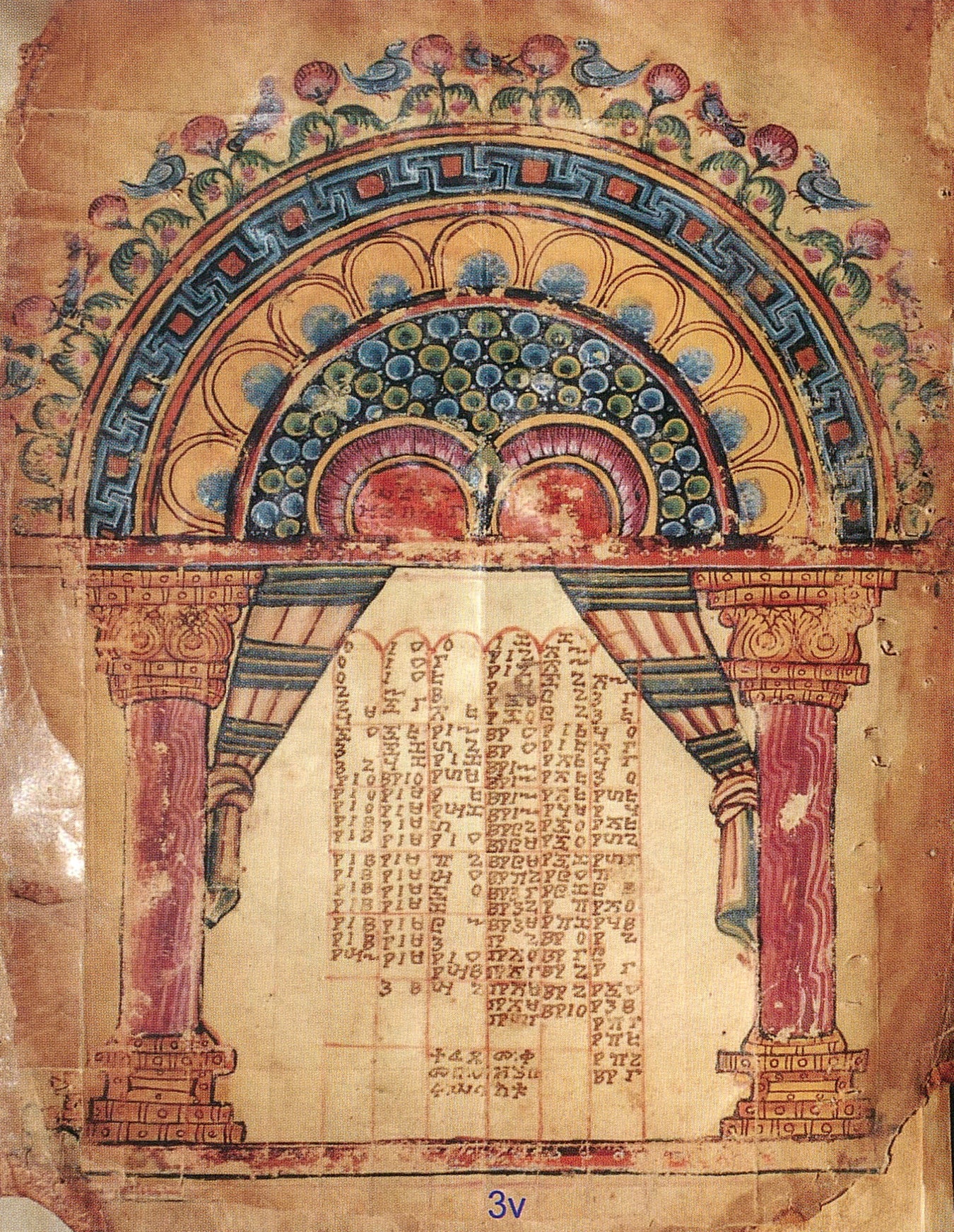 An illuminated canon-table page (folio 3v) from the Garima Gospels, painted under an arcade in the late antique style. Public domain, via Wikimedia Commons.

See this page's graph and discover linked topics
In full
The Garima Gospels are two illuminated Ge'ez Gospel books, now designated Garima 1 and Garima 2 (in older literature Garima I and Garima III), kept at the monastery of Abba Garima near Adwa in Tigray, Ethiopia. A third, much later Gospel book (probably fourteenth century, formerly Garima II) had been bound together with one of them and was separated during conservation. Monastic tradition attributes the books to Abba Garima, one of the Nine Saints, said to have arrived in Ethiopia in the late fifth century. Palaeographic estimates by Western scholars had placed them around 1100 or later. Radiocarbon analysis arranged by the French art historian Jacques Mercier, first on two detached fragments taken to the Oxford Radiocarbon Accelerator Unit in 2000 and then on samples collected under controlled conditions during conservation, gave dates of c. 390-570 for Garima 2 and c. 530-660 for Garima 1, results presented at an Oxford conference in November 2013. Garima 2 is therefore likely older than the Syriac Rabbula Gospels (dated by colophon to 586) and is widely described as the earliest surviving complete illuminated Christian manuscript. The books were conserved in place by the Ethiopian Heritage Fund from 2006 and remain at the monastery.
What the books are
| Garima 1 | Garima 2 | |
|---|---|---|
| Older designation | Garima I | Garima III |
| Radiocarbon date | c. 530-660 | c. 390-570 |
| Surviving pages | 348 | 322 |
| Decoration | Eleven illuminated canon tables under arcades | Seventeen illuminated pages, including four Evangelist portraits, a portrait of Eusebius of Caesarea before his canon tables, and a domed building often identified as the Temple or the Fountain of Life |
| Scribe | One hand | A different hand |
Notable details:
- Mark on the throne of Alexandria. In Garima 2, Matthew, Luke and John are painted frontally, but Mark is shown in profile seated on an episcopal throne, a likely nod to the tradition that Mark founded the church of Alexandria, the mother church of Ethiopia. See Mark the Evangelist and Church at Alexandria.
- Eusebian apparatus. Both books carry the Eusebian canon tables and the Letter to Carpianus that explains them, the standard cross-referencing system of Greek Gospel books. Garima manuscripts also preserve a Ge'ez version of a harmony discourse attributed to Ammonius of Alexandria.
- No colophon. Neither book names its scribe or date. The later Gospel book once bound with them carries historical notes, edited and translated by Getatchew Haile.
Where they are now
The Gospels are kept at Abba Garima monastery near Adwa, Tigray, and are not known ever to have left it. They were listed in the catalogue of the 1993-1996 American exhibition African Zion: The Sacred Art of Ethiopia but were not lent. Because women are not admitted to the monastery, some outside visitors, such as the art historian Beatrice Playne in 1950, saw them only when monks carried them outside. Conservation by the Ethiopian Heritage Fund, with the bookbinder Lester Capon doing the work, separated and rebound the volumes and restored misplaced leaves.
How they are dated
- Older palaeography. Jules Leroy in the 1960s proposed about 1100; Donald Davies suggested the eighth to tenth centuries; Rochus Zuurmond judged them no later than the thirteenth century and probably a century or two earlier.
- Art history. Marilyn Heldman argued that the classical architecture of the canon tables and the furniture in the Evangelist portraits pointed to the sixth century.
- Radiocarbon. Mercier's first two samples (2000) gave 330-540 and 430-650. Fuller sampling during conservation gave the now-standard ranges of 390-570 for Garima 2 and 530-660 for Garima 1 (some Ethiopian Heritage Fund reports give 550-660 for Garima 1).
Radiocarbon dates the death of the animal whose skin became the parchment, not the moment of writing, but parchment was normally used soon after preparation, and the art-historical and textual evidence point the same way.
Why they matter
For the history of African Christianity
- They are the oldest surviving Ethiopian manuscripts of any kind and physical proof of a Christian book culture in the Kingdom of Aksum in late antiquity.
- Mercier argued that the same ruled grid underlies both text and pictures, so both were produced in Ethiopia, implying a working scriptorium and painting school in Aksumite times. Earlier, some scholars had thought the pictures might have been imported from Syria or Egypt.
- Recent scholarship finds the text was translated from Greek, and the art looks to Egypt, which weakens the older view that the Nine Saints came from Syria and brought a Syriac-based Gospel.
For the text of the New Testament
- Zuurmond used Garima 1 as the base for his critical edition of the Ethiopic Gospels and classed the Garima text as the oldest form of the Ethiopic version, close to the original translation and earlier than a thirteenth-century revision that brought later manuscripts closer to Greek and Arabic.
- He classed that text as early Byzantine, while noting that in John it often departs from the later Greek Majority Text.
- Curt Niccum, revising this work in 2013, accepted the radiocarbon dates and argued that most of the New Testament was likely translated into Ge'ez before the end of the fourth century.
For apologetics this places the Gospels in an African language within a few centuries of their composition, one more independent line in the manuscript tradition. See Bible Manuscript Reliability and Manuscript Variants Bible Corruption Objection Defeater.
Tensions
- Tradition and science. Monastic tradition says Abba Garima wrote the Gospels in a single day while God held back the sunset. The radiocarbon date for Garima 2 fits the traditional era of Abba Garima broadly, but scholarship has moved away from other parts of the tradition, notably the Syrian origin of the Nine Saints. The monks regard the books as relics of their founder rather than as antiquities, and the codex records both readings without dismissing either community.
- "Oldest illuminated Christian book." The claim is "oldest surviving complete illuminated" manuscript; fragments of earlier illustrated Christian books exist elsewhere.
Scholarship
Published academic works this page draws on, each matched to a publisher, index or library catalog record.
- Sergey Kim, "New Studies of the Structure and the Texts of Abba Garima Ethiopian Gospels," Afriques 13 (2022). doi:10.4000/afriques.3494
See also
- Kingdom of Aksum, the kingdom in which the books were made
- Ethiopian Orthodox Church, the church that has kept them
- Kaleb of Aksum, a contemporary king whose inscriptions quote the same Gospel text
- Ezana Stone and Aksumite Coins, earlier physical evidence of Aksumite Christianity
- Bible Manuscript Reliability, the wider manuscript case
- Missionary Translation and African Languages, how Scripture entered African tongues
- Biblical Archaeology, the codex's archaeology hub
- Africa and Christianity, master hub
Common questions this page answers
Q: What are the Garima Gospels?
Two illuminated Gospel books in Ge'ez kept at the Abba Garima monastery in northern Ethiopia. Radiocarbon tests date them to late antiquity, making them the oldest known Ethiopian manuscripts and among the oldest illustrated Christian books in the world.
Q: How old are the Garima Gospels?
Radiocarbon dating gives about AD 390-570 for the older book (Garima 2) and about 530-660 for the younger (Garima 1). Before the tests, Western scholars had dated them to around 1100.
Q: Are the Garima Gospels the oldest illustrated Bible?
The older Garima book is widely described as the earliest surviving complete illuminated Christian manuscript, probably older than the Rabbula Gospels of 586. Fragments of earlier illustrated Christian books survive elsewhere, so the claim is about a complete book.
Q: Where are the Garima Gospels kept?
At the Abba Garima monastery near Adwa in Tigray, Ethiopia, where they have been kept for centuries. They were conserved by the Ethiopian Heritage Fund but have not left the monastery.
Q: What language are the Garima Gospels written in?
Ge'ez, the classical language of the Kingdom of Aksum and still the liturgical language of the Ethiopian and Eritrean Orthodox churches. The translation was made from Greek.
Q: Why do the Garima Gospels matter for Christianity in Africa?
They are hard physical evidence that Africans were translating, copying and illustrating the Gospels in their own language in late antiquity, centuries before European contact, and that the kingdom of Aksum had its own manuscript workshop.