Person
Galileo Galilei
Galileo, Galilei, Galileo affair, Galileo trial, Trial of GalileoIntro
Galileo Galilei (1564-1642) was an Italian astronomer, physicist and mathematician, and one of the founders of modern science. In 1609 and 1610 he turned a telescope he had built himself toward the night sky and saw what no one had reported before: mountains on the Moon, four moons circling Jupiter, and, a few months later, the planet Venus going through phases like the Moon. These discoveries made the old picture of an Earth-centered universe much harder to hold, and Galileo became the most famous defender of the idea, first set out by Copernicus, that the Earth moves around the Sun.
He was also a lifelong Catholic. He believed the Bible was the Word of God, he argued from Scripture and from the Church Fathers, and his elder daughter became a nun. In 1633 the Roman Inquisition condemned him as "vehemently suspected of heresy" for teaching that the Earth moves. He was made to renounce the view and spent his last nine years under house arrest near Florence. He was not burned, he was not thrown into a dungeon, and the evidence is that he was not tortured. The famous line "And yet it moves" first appears in print more than a century after the trial.
The Galileo affair is the most cited example of "science versus religion." Historians who have studied the documents tell a more complicated story: a believing scientist, a Church that confused one reading of the Bible with the Bible itself, a science that was not yet settled, and a good deal of personal and political conflict.
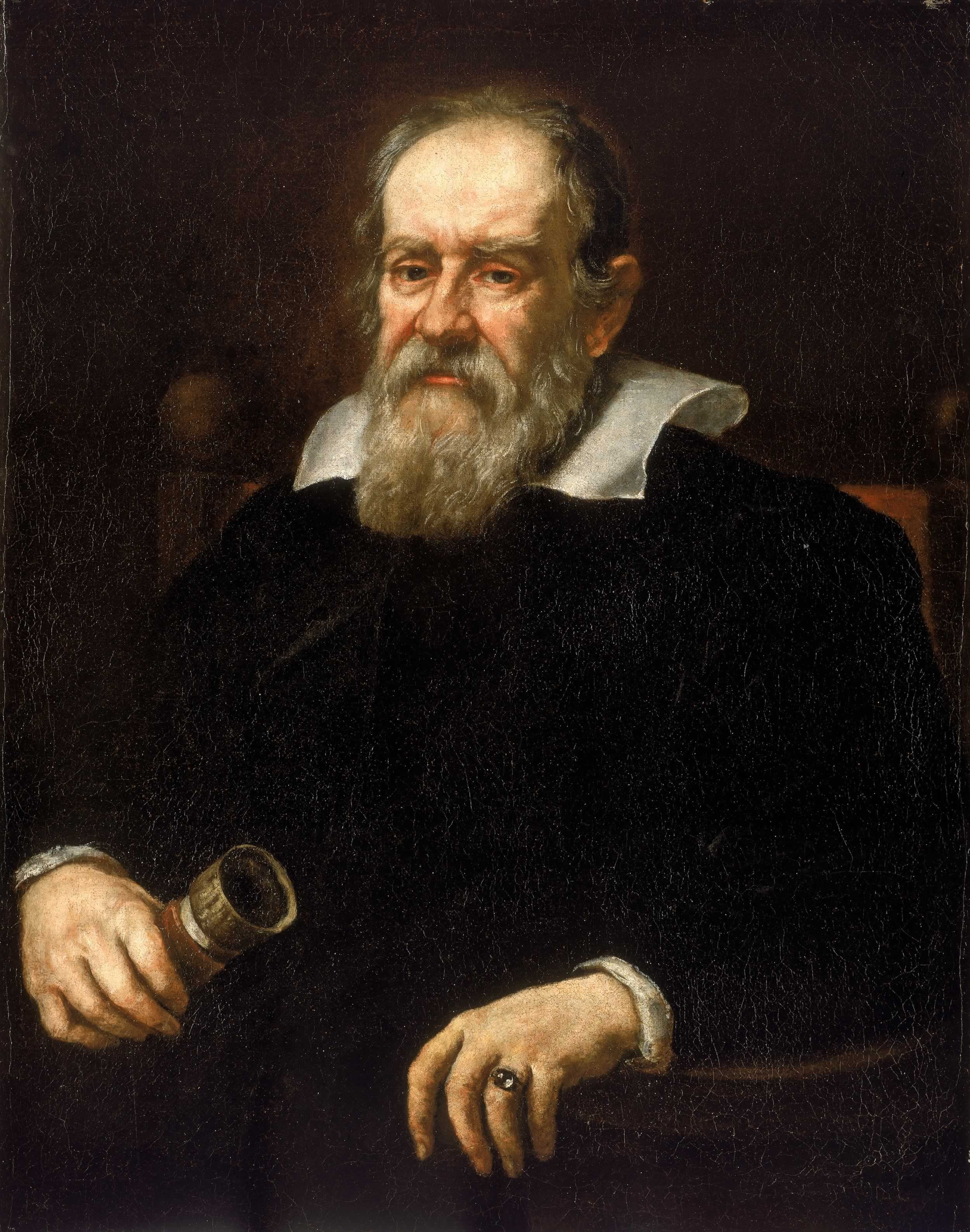
Galileo Galilei in old age, holding a telescope. Justus Sustermans, between 1636 and 1640, National Maritime Museum, Greenwich. Public domain, via Wikimedia Commons.
See this page's graph and discover linked topics
In full
Galileo Galilei (born Pisa, 15 February 1564; died Arcetri, near Florence, 8 January 1642) held chairs of mathematics at Pisa (1589) and Padua (1592-1610) before becoming Chief Mathematician and Philosopher to the Grand Duke of Tuscany in 1610. His work in mechanics (the law of falling bodies, the parabolic path of projectiles, an early form of the principle of inertia) and his telescopic astronomy made him a central figure of the Scientific Revolution. His insistence that nature is "written" in the language of mathematics, set out in The Assayer (1623), shaped the method of modern physics.
The "Galileo affair" ran in two stages. In 1616 the Congregation of the Index suspended Copernicus' On the Revolutions of the Heavenly Spheres until it was corrected, and Cardinal Robert Bellarmine privately told Galileo that the Copernican system could not be held or defended. In 1633, after the publication of his Dialogue Concerning the Two Chief World Systems (1632), the Roman Inquisition tried him, found him vehemently suspected of heresy, required him to abjure, banned the Dialogue, and sentenced him to imprisonment, which was carried out as house arrest at his villa at Arcetri.
The affair is the foundational story of the nineteenth-century "conflict thesis," the claim that science and religion have always been at war. Modern historians of science reject that thesis as a reading of the evidence. The more defensible lesson, and the one Galileo himself drew in his Letter to the Grand Duchess Christina (1615), is hermeneutical: an interpretation of Scripture is not Scripture, and a reading that makes the Bible teach astronomy it does not intend to teach should give way to what careful study of nature shows.
His faith
- A practising Catholic throughout his life. Galileo never left the Catholic Church, and nothing in his writings or letters suggests he lost his faith. He wrote as a believer arguing within the Church about how the Church should read the Bible, not as an outsider attacking it.
- His daughters. Galileo had three children with Marina Gamba, whom he never married. His elder daughter Virginia (1600-1634) entered the Poor Clare convent of San Matteo at Arcetri and took the name Sister Maria Celeste; her sister Livia became Sister Arcangela in the same house. More than a hundred of Maria Celeste's letters to her father survive. They show a warm, devout relationship: she prayed for him, cared for his household affairs, and after his sentence asked to take on the penance of reciting the seven penitential psalms in his place. Her death in 1634, a few months after he arrived at Arcetri, devastated him.
- He argued from Scripture and the Fathers. The Letter to the Grand Duchess Christina is a theological essay. It quotes Augustine at length, especially The Literal Meaning of Genesis, and argues that the Church's own tradition already taught caution about tying the faith to disputed claims about nature.
- Faith and reason as allies. Galileo held that Scripture and the natural world both come from God, so that the two, rightly read, cannot contradict each other. His quarrel was with a particular reading of certain biblical verses, not with the Bible, the Church, or God.
The telescopic discoveries (1609-1613)
- The telescope. In 1609, hearing of a Dutch spyglass, Galileo built his own and steadily improved it to about twenty times magnification.
- Sidereus Nuncius (The Starry Messenger, March 1610). A short book that reported:
- the Moon has mountains, valleys and craters, so it is not the perfect, unblemished sphere of Aristotelian physics;
- the Milky Way resolves into a great number of individual stars;
- four moons orbit Jupiter. Galileo named them the Medicean Stars after the Medici; they are now called the Galilean moons. They showed that not everything in the heavens circles the Earth, and that a moving planet can carry its moons with it.
- The phases of Venus (late 1610). Galileo observed Venus pass through a full set of phases, from crescent to nearly full. That is impossible in Ptolemy's arrangement, where Venus always stays between the Earth and the Sun, and it fits a Venus that orbits the Sun.
- Sunspots (1612-1613). His Letters on Sunspots (1613) argued that the spots lie on the Sun's surface and move with its rotation, another blow to the idea of changeless heavens.
What the discoveries did and did not prove matters for the rest of the story. They refuted the Ptolemaic system. They did not by themselves prove the Copernican one, because a rival system explained them too (see below).
The Letter to the Grand Duchess Christina (1615)
When opponents began to argue that the moving Earth contradicted Scripture, Galileo answered first in a letter to his former student Benedetto Castelli (December 1613) and then in a much longer letter to Christina of Lorraine, the Grand Duke's mother. The Letter to the Grand Duchess Christina circulated in manuscript and was first printed in 1636. Its main arguments:
- Scripture cannot err, but its interpreters can. The Bible is true, but readers who insist on the bare literal sense of every phrase will make it say false and even heretical things, such as that God has hands and feet or feels anger as humans do.
- Scripture accommodates its language to ordinary people. Where the Bible speaks of the Sun moving or the Earth standing still, it speaks as things appear to the common reader, because its purpose is salvation, not instruction in astronomy.
- Its purpose is salvation. Galileo reports a saying he attributes, in a marginal note, to Cardinal Cesare Baronius: "the intention of the Holy Ghost is to teach us how one goes to heaven, not how heaven goes" (Galileo, Letter to the Grand Duchess Christina, 1615, tr. Stillman Drake).
- God gave us senses and reason to use. "I do not feel obliged to believe that the same God who has endowed us with senses, reason, and intellect has intended us to forgo their use" (Galileo, Letter to the Grand Duchess Christina, 1615, tr. Stillman Drake).
- Demonstrated truths about nature guide interpretation. Where something about nature has been proved by sense experience and demonstration, theologians should seek the true meaning of the passages that seem to contradict it, because two truths cannot contradict each other.
- The Fathers taught the same caution. Following Augustine, Galileo urges that Christians should not commit the faith to a disputed reading of nature, lest unbelievers who know better hold the Scriptures in contempt.
The verses at issue were texts such as Joshua 10:12-13, where Joshua says "Sun, stand thou still upon Gibeon" and "the sun stayed in the midst of heaven, and hasted not to go down about a whole day" (Joshua 10:12-13, ASV), and Psalm 104:5, which speaks of God, "Who laid the foundations of the earth, That it should not be moved for ever" (Psalm 104:5, ASV). Galileo argued that such language is the language of appearance, the same language astronomers still use when they speak of sunrise. See Joshua's Long Day Objection Defeater.
One weakness in the letter, often pointed out, is that Galileo demanded a level of proof from his opponents that he could not yet meet himself, while in practice treating Copernicanism as already demonstrated.
The 1616 events
- The theological opinion of February 1616. At the Pope's request, consultants of the Holy Office assessed two propositions. They judged the claim that the Sun is the motionless center of the world "foolish and absurd in philosophy" and formally heretical, and the claim that the Earth moves as at least erroneous in faith.
- Bellarmine's warning (26 February 1616). Cardinal Robert Bellarmine, on instructions from Pope Paul V, met Galileo and told him that the Copernican opinion could not be held or defended. A file note in the Inquisition records adds a stricter injunction, delivered by the Commissary of the Holy Office, that he must not hold, teach or defend it "in any way whatever." Whether that stricter injunction was properly given is still disputed, and it became central to the 1633 trial.
- The Index decree (5 March 1616). The Congregation of the Index suspended Copernicus' On the Revolutions (1543) "until corrected." The corrections, issued in 1620, were limited: a handful of passages were altered so that the book presented the Earth's motion as a calculating hypothesis rather than as physical fact. A book by the Carmelite Paolo Antonio Foscarini, which argued that Copernicanism agreed with Scripture, was banned outright.
- No condemnation of Galileo personally. Galileo was not tried or punished in 1616. Bellarmine later gave him a certificate stating that he had not been made to abjure, only informed of the decree.
- Bellarmine's own position. In a 1615 letter to Foscarini, Bellarmine conceded that if there were a true demonstration that the Sun is at the center and the Earth moves, the Church would have to reinterpret the passages that seem contrary and admit that it had not understood them. He did not believe such a demonstration existed. On the science, at that date, he was not wrong.
The Dialogue (1632) and the trial (1633)
- A friendly pope. In 1623 Cardinal Maffeo Barberini, an admirer of Galileo, was elected Pope Urban VIII. Galileo dedicated The Assayer to him and, in audiences in 1624, came away believing he could write about the Copernican system as long as he treated it as a hypothesis and did not claim it was proven.
- Dialogue Concerning the Two Chief World Systems (1632). Published in Florence with Church licences, the book stages a four-day conversation among three characters: Salviati, who argues for Copernicus; Sagredo, an intelligent layman who is quickly persuaded; and Simplicio, a defender of Aristotle and Ptolemy who loses nearly every exchange. Its framing as an even-handed discussion was thin, and the book read as an argument for the moving Earth.
- Simplicio and the Pope. At the close of the book, Urban's own favourite argument, that God in His omnipotence could produce the same effects by means we cannot imagine, so no physical theory can be called certain, is put in Simplicio's mouth. Whether Galileo intended an insult is debated, but enemies presented it to Urban as one, and the Pope felt betrayed. Urban was also under heavy political pressure at the time, accused by Spanish cardinals of being soft on heresy during the Thirty Years' War. Sales of the Dialogue were halted in the summer of 1632.
- The trial. Galileo, nearly seventy and unwell, was summoned to Rome and examined by the Inquisition between April and June 1633. The prosecution rested mainly on the 1616 injunction: by writing the Dialogue he had disobeyed an order not to teach Copernicanism in any way.
- The verdict (22 June 1633). The sentence found him "vehemently suspected of heresy," that is, of having held and believed that the Sun is the center of the world and does not move, and that the Earth moves. He was required to abjure, curse and detest those errors, which he did on his knees. The Dialogue was prohibited, he was sentenced to formal imprisonment at the Inquisition's discretion, and he was ordered to recite the seven penitential psalms once a week for three years. Seven of the ten cardinals on the tribunal signed the sentence.
- House arrest. The imprisonment was commuted almost at once. Galileo stayed first at the Tuscan embassy in Rome and then with the Archbishop of Siena, and from December 1633 he lived under house arrest at his villa at Arcetri, near his daughters' convent. There he wrote Discourses and Mathematical Demonstrations Relating to Two New Sciences (published at Leiden in 1638), his most important work in physics. He went blind in his last years and died at Arcetri in January 1642, attended by his disciples Vincenzo Viviani and Evangelista Torricelli.
Two myths stated carefully
- Was Galileo tortured? No, on the evidence. In his last examination (21 June 1633) he was formally threatened with torture, a standard procedure in an Inquisition "rigorous examination," and he maintained that he had not held the Copernican opinion since 1616. The record shows no torture being applied, and the consensus of historians is that it was not. Inquisition practice generally spared the old and infirm, and Galileo was nearly seventy and in poor health.
- Did he say "Eppur si muove" ("And yet it moves")? There is no evidence that he did. No record of the trial or of his years at Arcetri contains the phrase. It first appears in print in Giuseppe Baretti's The Italian Library (London, 1757), more than a century after the trial. A Spanish painting that carries the words and was once dated to the 1640s has been suggested as earlier evidence, but its date and its reading are both disputed. The line is best treated as legend.
The real complexities
The popular version is that the evidence was all on Galileo's side and the Church simply refused to look. The historical record is more interesting.
The state of the science in 1633
- No stellar parallax. If the Earth orbits the Sun, nearby stars should appear to shift slightly against more distant ones over a year. No such shift could be detected with the instruments of the day. Copernicans had to assume the stars were immensely far away. Stellar parallax was first measured by Friedrich Bessel in 1838.
- Tycho's model fit the new observations. The Danish astronomer Tycho Brahe (1546-1601) proposed a system in which the planets orbit the Sun while the Sun orbits a stationary Earth. It explains the phases of Venus and the moons of Jupiter just as well as Copernicus does. Many Jesuit astronomers adopted it. Galileo's telescope refuted Ptolemy, not Tycho.
- Galileo's chief physical proof was wrong. Day Four of the Dialogue argues that the tides are caused by the combined motions of the Earth's daily rotation and its yearly orbit. The argument fails; tides are caused mainly by the Moon's gravity. Galileo dismissed the lunar explanation, which Johannes Kepler had favoured, as occult.
- He ignored Kepler's ellipses. Galileo kept the circular orbits of Copernicus, although Kepler had shown in 1609 that elliptical orbits fit the observations far better. The Copernican system as Galileo defended it was not, in its details, the one that won.
- When the proof came. Direct observational evidence of the Earth's motion came with James Bradley's discovery of the aberration of starlight (1729) and Bessel's parallax (1838). Newton's physics (1687) had by then made the Sun-centered system overwhelmingly the best explanation.
None of this makes the 1616 and 1633 decisions right. It does mean that in 1633 the question of the Earth's motion was a live scientific dispute, not a case of clear proof being suppressed.
Personality and politics
- Galileo's temperament. He was brilliant, combative and sarcastic, and he made powerful enemies, including Jesuit astronomers who had once honoured him. His controversy with the Jesuit Orazio Grassi over comets (1618-1623), in which Galileo was also mistaken, cost him important allies.
- Simplicio and Urban VIII. The perceived mockery of the Pope's argument turned a patron into a prosecutor. Many historians judge that, without the personal breach, a book like the Dialogue might have been censored or revised rather than ending in a trial.
- Disciplinary authority. The Counter-Reformation Church, after the Council of Trent, had claimed the right to judge the interpretation of Scripture and was alert to laymen interpreting it independently. Part of the offence was that a mathematician was telling theologians how to read the Bible.
- The European setting. The trial came at a low point of the Thirty Years' War, when Urban VIII was accused of failing to defend Catholic orthodoxy. A public display of firmness had political value.
The aftermath
- Gradual lifting of the bans. The Church permitted an edition of Galileo's works including the Dialogue (with a preface) in 1744. The general prohibition of books teaching the Earth's motion was dropped from the 1758 Index, publication of books treating the Earth's motion as physical fact was approved in 1822, and the 1835 edition of the Index no longer listed the Dialogue or Copernicus' book.
- John Paul II's call (1979). On 10 November 1979, in an address to the Pontifical Academy of Sciences marking the centenary of Einstein's birth, Pope John Paul II said that Galileo had suffered at the hands of men and institutions of the Church, and called for a fresh, honest study of the case by theologians, scientists and historians. A commission was set up in 1981.
- The 1992 address. On 31 October 1992, receiving the commission's conclusions, John Paul II acknowledged that the theologians who condemned Galileo failed to distinguish between Sacred Scripture and their own interpretation of it, and so wrongly carried a question of science into matters of faith. He described the affair as a "tragic mutual incomprehension" and observed that Galileo, a sincere believer, had shown himself more perceptive on the interpretation of Scripture than the theologians who opposed him.
- What it did not do. The 1992 address was not a juridical annulment of the 1633 sentence; that verdict was never formally reversed. It was an acknowledgement of error and a reflection on its causes. Some historians criticised the commission's report for spreading the blame and for repeating the claim that Galileo had not proved his case. "Rehabilitation" is a common shorthand for 1992, but it overstates the formal act.
The "conflict thesis" myth
- Its origin. The image of a permanent war between science and religion was popularised by two nineteenth-century books: John William Draper's History of the Conflict between Religion and Science (1874), aimed chiefly at the Catholic Church, and Andrew Dickson White's A History of the Warfare of Science with Theology in Christendom (1896). Both used Galileo as a central exhibit, and both are now regarded by historians as polemical works that misused their sources.
- The modern verdict. Historians of science largely abandoned the conflict thesis during the twentieth century. John Hedley Brooke's Science and Religion: Some Historical Perspectives (1991) argued that the relationship has been complex, varying by period and question, rather than either warfare or harmony. Ronald Numbers' edited volume Galileo Goes to Jail and Other Myths about Science and Religion (Harvard University Press, 2009) collects essays by specialists correcting popular myths; its chapter on Galileo, by Maurice Finocchiaro, corrects the claims that he was imprisoned in a cell and tortured. Finocchiaro's The Galileo Affair: A Documentary History (1989) puts the main trial documents in English.
- The pattern of the Scientific Revolution. Copernicus was a cleric of the cathedral chapter of Frombork and dedicated his book to Pope Paul III. Kepler was a devout Lutheran who regarded his astronomy as a way of honouring the Creator. Newton wrote at least as much on theology and biblical prophecy as on physics. The leading figures of the revolution Galileo helped begin were, overwhelmingly, believers. See Faith and Reason.
- The Galileo case cuts both ways. It is a real example of Church authorities misusing their power to settle a scientific question by decree. It is not an example of Christianity as such opposing science: the dispute was among Catholics, on both sides, about how to read the Bible and what the evidence showed.
Apologetic use
- Galileo as a believing scientist. The man most often cited as a martyr of science against faith was a believer who argued that faith and science, rightly understood, cannot conflict. Citing him for the conflict thesis is citing a witness who testified the other way.
- The lesson is about interpretation. The error of 1616 and 1633 was to identify a reading of Scripture with Scripture. Galileo's principle, which John Paul II endorsed in 1992, is that the Bible's purpose is to teach "how one goes to heaven, not how heaven goes," and that its language about nature is the language of appearance. This is the same principle that answers most "scientific errors in the Bible" objections today. See Bible Scientific Errors Objection and Bible Scientific Errors Objection Defeater.
- The lesson applies to everyone. Galileo's warning was against binding the faith to a disputed reading of nature. That warning applies just as much to readings that would tie Christianity to a particular scientific theory as to readings that would set it against one. Christians who disagree about the age of the earth or the mechanisms of biology can learn from it on all sides.
- The record should be stated accurately. The apologetic case is not served by minimising what happened. Galileo was silenced, his book was banned, and he lived his last years under confinement for a scientific view that was true. The honest reply concedes this and then corrects the myths: no execution, no dungeon, no torture, no "Eppur si muove," a science that was not yet settled, and a Church that eventually acknowledged its theologians' error.
- Answering "the Church opposed science." The Galileo affair is one case, widely remembered because it is unusual. For centuries the Catholic Church was a major patron of astronomy (the Gregorian calendar reform of 1582 was an astronomical project, and churches such as San Petronio in Bologna housed meridian lines used as solar observatories), and Jesuit astronomers were among the most capable observers of Galileo's own day. See Inquisition and Counter-Reformation.
Scholarship
Published academic works this page draws on, each matched to a publisher, index or library catalog record.
- Guiseppe Baretti, The Italian Library (1757). Open Library
- John William Draper and Nicolás Salmerón y Alonso, History of the conflict between religion and science (1874). Open Library
- Ronald L. Numbers, Galileo Goes to Jail and Other Myths about Science and Religion (Harvard University Press, 2009). Open Library
- Andrew Dickson White, A history of the warfare of science with theology in Christendom (1896). Open Library
See also
- Faith and Reason, the harmony tradition Galileo argued from and the historians' verdict on the conflict thesis
- Bible Scientific Errors Objection, where Galileo's interpretive principle does most of its apologetic work
- Bible Scientific Errors Objection Defeater, the debate-prep version of the same answer
- Joshua's Long Day Objection Defeater, the passage at the center of the 1613-1615 letters
- Inquisition, the Roman Inquisition that tried him in 1633
- Counter-Reformation, the church setting of the 1616 decree and the trial
- John Paul II, the pope who reopened the case in 1979 and addressed it in 1992
- Augustine, whose Literal Meaning of Genesis Galileo quoted for his hermeneutics
- Inerrancy, the doctrine that Scripture is true in what it intends to teach
- Methodological Naturalism, the modern debate over science's method and its limits
- Louis Pasteur, another Catholic scientist often enlisted on the wrong side of the conflict story
Common questions this page answers
Q: Was Galileo a Christian?
Yes. Galileo was a Roman Catholic all his life. He believed the Bible was the inspired Word of God, argued from Scripture and from Augustine in his letters, and never left the Church even after it condemned him. His elder daughter became a Poor Clare nun, Sister Maria Celeste, and their surviving letters show a devout family.
Q: Why was Galileo put on trial?
In 1633 the Roman Inquisition tried him for defending the view that the Earth moves around the Sun in his Dialogue Concerning the Two Chief World Systems (1632), after he had been told in 1616 not to hold or defend it. The case turned on that earlier order, on the theologians' belief that the moving Earth contradicted verses such as Joshua 10:12-13, and on Pope Urban VIII's anger at seeing his own argument put in the mouth of the book's losing character, Simplicio.
Q: Was Galileo tortured or imprisoned in a dungeon?
No. He was formally threatened with torture during his final examination, a standard step in Inquisition procedure, but the evidence and the consensus of historians is that it was not carried out. His sentence of imprisonment was commuted to house arrest, which he served from late 1633 until his death in 1642 at his own villa at Arcetri, near Florence.
Q: Did Galileo really say "And yet it moves"?
There is no evidence that he did. The phrase Eppur si muove does not appear in any record of the trial or his later years. It first appears in print in Giuseppe Baretti's The Italian Library, published in London in 1757, more than a century after the trial, and it is best treated as legend.
Q: Did the Catholic Church apologise to Galileo?
In 1979 Pope John Paul II called for the case to be re-examined, and in 1992, after a commission's study, he acknowledged that the theologians who condemned Galileo had confused Scripture with their interpretation of it, calling the affair a "tragic mutual incomprehension." It was an acknowledgement of error, not a formal legal reversal of the 1633 sentence, which was never annulled.
Q: Does the Galileo affair prove that religion and science are at war?
No. The "conflict thesis" comes mainly from two nineteenth-century polemical books, by John William Draper (1874) and Andrew Dickson White (1896), and modern historians of science have largely abandoned it. The Galileo affair was a dispute among Catholics about how to read the Bible and what the evidence showed, at a time when the science was not yet settled. It shows the danger of treating an interpretation of Scripture as Scripture, not a war between faith and science.
Q: What did Galileo mean by "how one goes to heaven, not how heaven goes"?
In his Letter to the Grand Duchess Christina (1615), Galileo quoted a saying he attributed to Cardinal Baronius: the Holy Spirit's intention in Scripture is to teach how one goes to heaven, not how heaven goes. He meant that the Bible's purpose is salvation, and that when it speaks of the Sun rising or standing still it uses the ordinary language of appearance rather than teaching astronomy.
Q: Was the evidence for heliocentrism conclusive in Galileo's time?
Not yet. His telescope disproved the Ptolemaic system, but Tycho Brahe's model, in which the planets circle the Sun while the Sun circles the Earth, fit the same observations. No stellar parallax could be detected, and Galileo's main physical argument, from the tides, was wrong. Decisive evidence for the Earth's motion came later, with Newton's physics (1687), Bradley's discovery of stellar aberration (1729) and Bessel's measurement of parallax (1838).