Lexicon
G5481 - charakter
charakter, charaktēr, χαρακτήρ, G5481, express image, exact representation, exact imprint, very image of his substance, the stamp of God's natureStrong's: G5481 · BLB lookup Pronunciation: khar-ak-tare' Part of speech: masculine noun Root: from χαράσσω (charassō), "to engrave, cut into" NT occurrences: 1, Hebrews 1:3 only (a New Testament hapax legomenon) English descendant: "character," which kept the sense of a distinctive mark before it came to mean a person's moral make-up
The 30-second version. Charaktēr is first the tool that cuts a design, a die or a stamp, and then the mark that tool leaves: the impression pressed into a coin or a lump of sealing clay. An impression is not a loose resemblance. Every line of the die shows up in it. Hebrews uses this word once, of the Son: He is "the very image of his substance" (Hebrews 1:3, ASV), the exact impress of who God is. Thayer's lexicon glosses it as "precise reproduction in every respect" and adds "(cf. facsimile)". So the invisible God is not without an image. The Son is that image, and humanity was made after it.
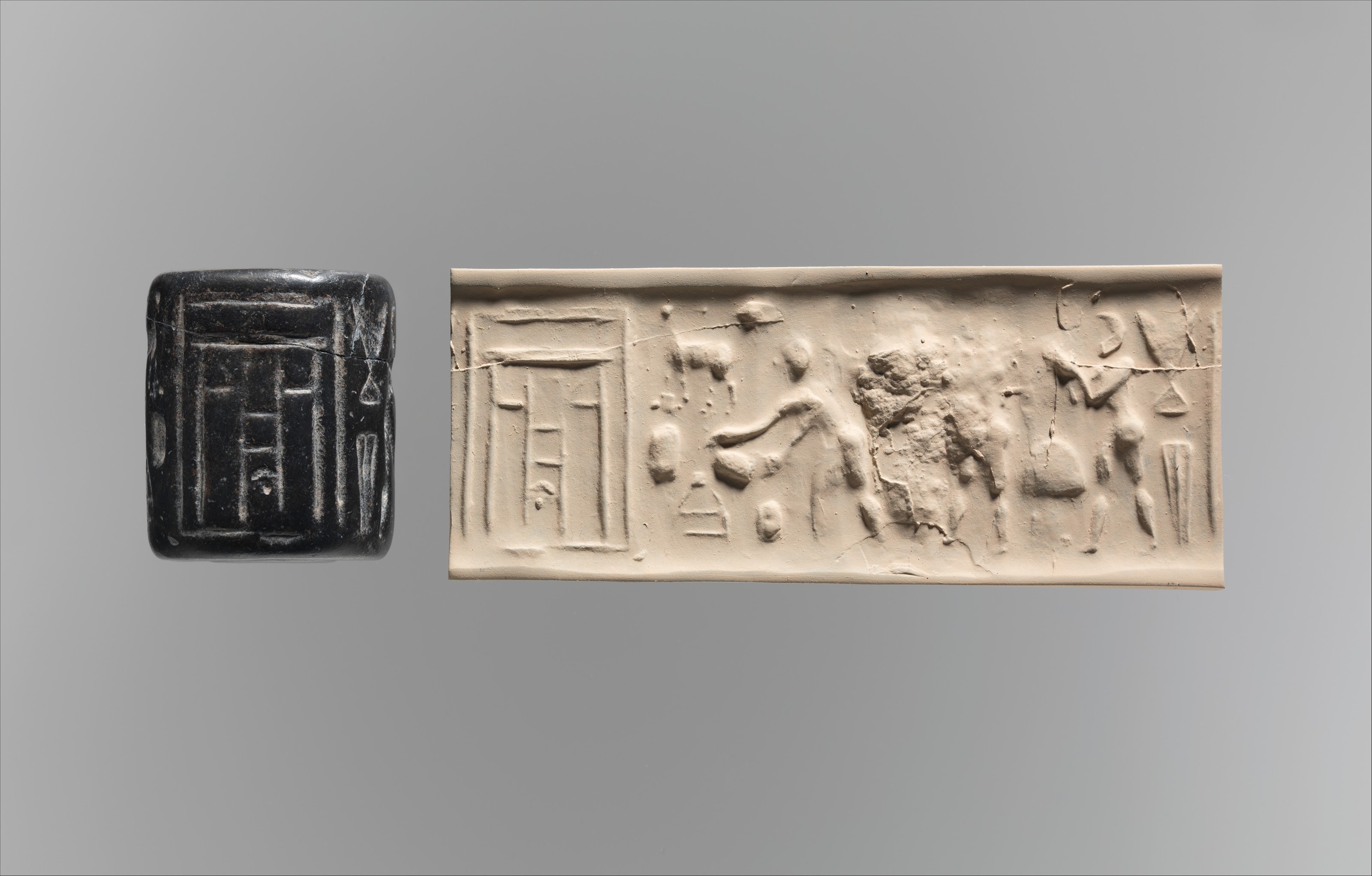
A stone cylinder seal (left) and a modern clay impression rolled from it (right). The seal is the die; the impression reproduces every line of it, which is the picture behind charaktēr. Metropolitan Museum of Art, CC0, via Wikimedia Commons, resized.
Semantic range
The word moves from the tool, to what the tool makes, to the distinctive look that results.
Liddell-Scott-Jones (LSJ) lists:
- The maker or the instrument. "Engraver"; "graving tool"; "die, stamp"; "branding-iron."
- The mark it makes. "Mark engraved, impress, stamp on coins and seals" (Euripides, Plato, Aristotle and others).
- Distinctive mark or token, and from there a type, character or style (Herodotus, Sophocles, Plato; later of literary style in Dionysius of Halicarnassus).
- "Impress, image", the sense under which LSJ files Hebrews 1:3.
Thayer (1889) gives two senses:
- "Properly, the instrument used in engraving or carving," comparing it to "our 'stamp' or 'die'."
- "The mark (figure or letters) stamped upon that instrument or wrought out on it," a mark burned in (he cites the Greek Old Testament at Leviticus 13:28, the mark of a burn) or stamped on, "an impression; the exact expression (the image) of any person or thing, marked likeness, precise reproduction in every respect (cf. facsimile)." He applies this sense to Christ in Hebrews 1:3.
Thayer also notes a derived sense, a distinguishing peculiarity, and cites 2 Maccabees 4:10, where Jason draws his countrymen over to the Greek "character," that is, the Greek way of life.
Strong's gives "a graver (the tool or the person), i.e. (by implication) engraving," and from there "the figure stamped, i.e. an exact copy or (figuratively) representation." The KJV renders it "express image."
How the English versions render it in Hebrews 1:3:
| Version | Rendering |
|---|---|
| KJV | "the express image of his person" |
| ASV | "the very image of his substance" |
| WEB | "the very image of his substance" |
Modern translations commonly use "exact representation" or "exact imprint."
See this page's graph and discover linked topics
Theological force
1. An image that matches its original line for line
A die and its impression correspond feature for feature. That is the force of the word, and it is why the older lexicons reach for "precise reproduction in every respect" and "facsimile." Hebrews could have said the Son resembles God. It chose the word for the mark a seal leaves, where nothing in the original is missing from the copy.
2. Paired with apaugasma: same nature, distinct person
Hebrews 1:3 sets charaktēr beside apaugasma (ASV "effulgence," KJV "brightness"), also a New Testament hapax. Interpreters divide over whether apaugasma means light streaming out from a source (radiance) or light given back (reflection); Thayer leans toward "reflected brightness," and notes that some interpreters hold to "effulgence or radiance." Either way the two words do complementary work:
- Radiance is never separate from its source and never later than it. It stresses that the Son shares the Father's nature.
- Impress is distinct from the die that makes it. It stresses that the Son is not the Father, yet shows Him exactly.
Read together, the two images guard against both errors the early church had to answer: a Son who is less than God, and a Son who is simply the Father under another name. See Eternal Generation and Trinity vs Oneness vs Modalism vs Arianism.
3. "Of his substance," the hypostasis
The impress is "of his substance" (ASV), tēs hypostaseōs autou. Hypostasis here means God's underlying reality, His very being, and the KJV's "person" reflects the later Trinitarian use of the word. The claim is not that the Son copies God's appearance (God has no body to copy) but that He bears the stamp of what God is.
4. The present participle: what the Son is, not what He became
The clause opens hos ōn, "who being," a present participle, and then turns to aorist verbs for what the Son did: "when he had made purification of sins, sat down" (ASV). The grammar keeps the identity statements (radiance, impress) in the ongoing present and the saving acts in the completed past. Being the exact impress is not presented as something the Son achieved; it is what He is.
5. The answer to "God has no image"
The objection that God is spirit and invisible, and so cannot have an image, meets this word head on. The invisible God has an exact impress of His being: the Son. Paul says the same with eikōn: the Son is "the image of the invisible God" (Colossians 1:15, ASV) and "the image of God" (2 Corinthians 4:4, ASV). In the incarnation that image became visible: "he that hath seen me hath seen the Father" (John 14:9, ASV). Humanity, made in God's image (Genesis 1:27), is renewed "after the image of him that created him" (Colossians 3:10, ASV) and conformed "to the image of his Son" (Romans 8:29, ASV). The full argument is at God Has No Image Objection Defeater.
Notable verses
- Hebrews 1:3, "who being the effulgence of his glory, and the very image of his substance, and upholding all things by the word of his power" (ASV). The only New Testament use.
Related vocabulary:
- eikōn, "image": Colossians 1:15; 2 Corinthians 4:4; the Septuagint word in Genesis 1:26-27
- charagma, "mark, engraving," from the same root: "graven by art and device of man" (Acts 17:29, ASV) and the mark of the beast (Revelation 13:16)
- morphē, "form" (Philippians 2:6)
- hypostasis, "substance," the thing whose impress the Son is
Patristic note
- 1 Clement (late first century) and Ignatius (early second century) both use the word, and Thayer cites them. Clement says God formed man "in the impress of His own image" (1 Clement 33:4, Lightfoot's translation), joining this word to the creation of humanity in God's image. Ignatius speaks of "two coinages, the one of God and the other of the world," each with "its proper stamp impressed upon it" (To the Magnesians 5:2, Lightfoot).
- Letter 38 in the correspondence of Basil of Caesarea (many scholars assign it to his brother Gregory of Nyssa) works through Hebrews 1:3 at length. It reads "express image of his person" with John 14:9 and argues that "the idea of the image would be lost were it not to preserve throughout the plain and invariable likeness," so that the Father "is known in the form of the Son" (Letter 38.8).
Verses in this codex
See Obsidian's backlinks pane for every page linking here. The only occurrence is Hebrews 1.3.
See also
- G1504 - eikon, eikōn (image), the sister term in Colossians 1:15
- G5287 - hypostasis, hypostasis (substance), the reality the Son impresses
- G1391 - doxa, doxa (glory), what the Son radiates in the same verse
- G3444 - morphe, morphē (form), the "form of God" in Philippians 2:6
- H6754 - tselem, tselem (image), the Hebrew word of Genesis 1:26-27
- God Has No Image Objection Defeater, the objection this word answers most directly
- Imago Dei, the doctrine of humanity in God's image
- Eternal Generation, the Son's eternal relation to the Father
- Hebrews 1.3, the verse