Lexicon
G2315 - theopneustos
theopneustos, θεόπνευστος, G2315, G2315 - theopneustos, God-breathed (Greek), inspired of GodStrong's: G2315 · BLB lookup Pronunciation: theh-op'-nyoo-stos Part of speech: adjective, a verbal adjective ending in -tos Root: theos (G2316 - theos, "God") + a presumed derivative of pneō (G4154, "to breathe, blow"), the verb behind pneuma NT occurrences: 1, a hapax legomenon. Measured on the codex's Strong's-tagged KJV, G2315 is tagged in one verse only, 2 Timothy 3:16, where the KJV renders it "given by inspiration of God" and the ASV "inspired of God".
The 30-second version:
Theopneustos means God-breathed. Paul uses it once, of Scripture, in 2 Timothy 3:16. The English word "inspiration" comes through the Latin inspirata, but the Greek pictures Scripture breathed out by God, the way a word is breathed out by a speaker. B. B. Warfield made the case that the word is passive, "breathed by God", and that reading now dominates. A second question is grammatical: does the verse say "all Scripture is God-breathed and profitable", or "every God-breathed Scripture is also profitable"? On either reading the God-breathed thing is the written text.
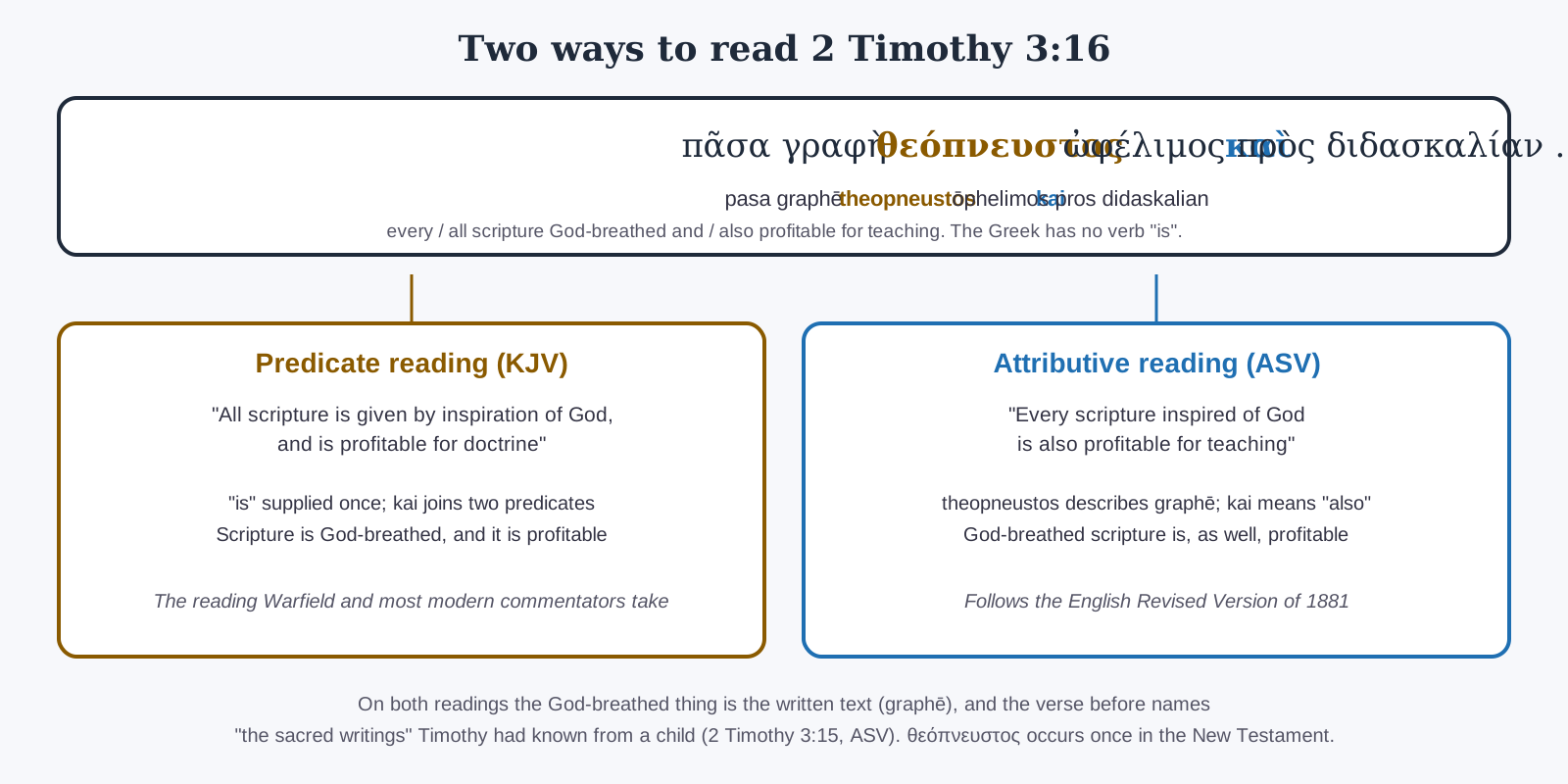
The two grammatical construals of 2 Timothy 3:16, as set out on this page. Diagram drawn for the codex.
Semantic range
The word has one New Testament use, so its sense comes from its formation and from the handful of other Greek texts that use it.
- Formation. Compounds of theo- with a verbal adjective in -tos normally describe something done by God: theodidaktos, "taught of God", in 1 Thessalonians 4:9 (measured: G2312 is tagged in that one New Testament verse) is the nearest New Testament example. On that pattern theopneustos means "breathed by God".
- Usage outside the New Testament. The word is rare in surviving Greek. Warfield gathered the known instances, in pagan and Jewish-Hellenistic writings, and argued that each is best read passively, of something produced or filled by divine breath, such as a God-given dream or a God-given wisdom.
- The New Testament use. Of graphē, written Scripture: "Every scripture inspired of God" (2 Timothy 3:16, ASV).
See this page's graph and discover linked topics
Passive or active: Warfield's case
The active reading. In the nineteenth century some scholars, most influentially the German lexicographer Hermann Cremer in later editions of his Biblico-Theological Lexicon of New Testament Greek, proposed that theopneustos could be active: Scripture "breathing God", filled with and breathing out the divine Spirit. On that reading the word describes Scripture's effect on its readers more than its origin.
Warfield's reply. B. B. Warfield answered Cremer in "God-Inspired Scripture," The Presbyterian and Reformed Review 11 (1900), reprinted in The Inspiration and Authority of the Bible (1948). His case:
- The verbal adjective. Adjectives in -tos compounded with theo- are overwhelmingly passive in sense.
- The extra-biblical uses. Each surviving instance he examined reads naturally as passive.
- The early Christian reception. Greek-speaking Christian writers used the word of Scripture as something given by God.
Warfield's summary, developed in "The Biblical Idea of Inspiration" in the same volume, is that the word speaks of Scripture as breathed out by God, the product of God's creative breath. The English "inspiration" suggests God breathing into a human writer; Warfield argued the Greek locates the breath at the source and calls the text itself God's breathed-out word.
Where the discussion stands. Modern lexicons and most commentators follow the passive sense. The human authorship of Scripture is a separate point, made in 2 Peter 1:21: "men spake from God, being moved by the Holy Spirit" (ASV).
The grammatical question in 2 Timothy 3:16
The Greek runs pasa graphē theopneustos kai ōphelimos pros didaskalian: "every (or all) scripture, God-breathed, and (or also) profitable for teaching." There is no verb "is"; English has to supply it, and where it goes decides the reading.
- Predicate reading. "All scripture is given by inspiration of God, and is profitable for doctrine" (2 Timothy 3:16, KJV). Both adjectives are predicates joined by kai, "and". Warfield and most modern commentators take this reading, noting that two adjectives joined by kai are most naturally parallel.
- Attributive reading. "Every scripture inspired of God is also profitable for teaching" (2 Timothy 3:16, ASV), following the English Revised Version of 1881. Here theopneustos describes graphē, and kai is rendered "also".
- What changes and what does not. The attributive reading is sometimes pressed to imply that some scripture is not God-breathed. The context rules that out: the verse before names "the sacred writings" (2 Timothy 3:15, ASV) that Timothy had known from a child, and graphē in the New Testament refers to sacred Scripture. On either reading the God-breathed thing is the written text. The fuller grammatical treatment is at The Bible Never Claims Inerrancy Objection Defeater.
Theological force
- The origin of Scripture. Theopneustos is the New Testament's one-word statement of where Scripture comes from: God's own breath, which in the Old Testament is the breath of creation and of the prophetic word ("By the word of Jehovah were the heavens made, And all the host of them by the breath of his mouth," Psalm 33:6, ASV). See Inspiration.
- The basis for inerrancy. If the text is God's breathed-out word, its truthfulness rests on the truthfulness of God. That inference, and its limits, are set out at Inerrancy.
- The sufficiency of Scripture for ministry. Paul draws a practical conclusion in the next clause: the God-breathed text is profitable "for teaching, for reproof, for correction, for instruction which is in righteousness: that the man of God may be complete, furnished completely unto every good work" (2 Timothy 3:16-17, ASV).
- Dual authorship. The word stands beside texts that give the human authors a real role (2 Peter 1:21; Luke 1:1-4). Christian theology holds the two together; see Inspiration for the main models.
Notable verse
- 2 Timothy 3:16, the only New Testament occurrence: "Every scripture inspired of God is also profitable for teaching, for reproof, for correction, for instruction which is in righteousness" (ASV); "All scripture is given by inspiration of God, and is profitable for doctrine, for reproof, for correction, for instruction in righteousness" (KJV)
Scholarship
Published academic works this page draws on, each matched to a publisher, index or library catalog record.
- Benjamin Breckinridge Warfield, The inspiration and authority of the Bible (1948). Open Library
See also
- Inspiration, the doctrine this word names
- Inerrancy, the doctrine argued from it
- The Bible Never Claims Inerrancy Objection Defeater, the full grammar of 2 Timothy 3:16 and 2 Peter 1:21
- Canon, which writings count as graphē
- G4151 - pneuma, spirit and breath, from the same root as the second half of the word
- G2316 - theos, God, the first half of the word
- G3056 - logos, the word God speaks