Lexicon
G0728 - arrabon
arrabon, arrabōn, arrhabon, ἀρραβών, G728, G0728, G728 - arrabon, earnest of the Spirit, down payment (Greek)Strong's: G0728 · BLB lookup Pronunciation: ar-hrab-ohn' Part of speech: masculine noun Root: a Semitic loanword, from the Hebrew ʿērābôn (H6162, "pledge"), itself from the verb ʿārab (H6148, "to pledge, to become surety") NT occurrences: 3, all in Paul and all of the Holy Spirit. Measured on the codex's Strong's-tagged KJV, G0728 is tagged in exactly three verses: 2 Corinthians 1:22; 2 Corinthians 5:5; Ephesians 1:14. The KJV and ASV render it "earnest" each time.
The 30-second version:
Arrabōn was a word from the marketplace: the part payment that binds a deal and promises the rest. Greek borrowed it from Semitic traders, and the Hebrew form appears in Genesis 38, where Judah leaves his signet, cord and staff as a pledge. Paul uses it three times, always of the Holy Spirit. God has given believers the Spirit as the first instalment of everything He has promised, so the Spirit's presence now is God's guarantee of the full inheritance later.
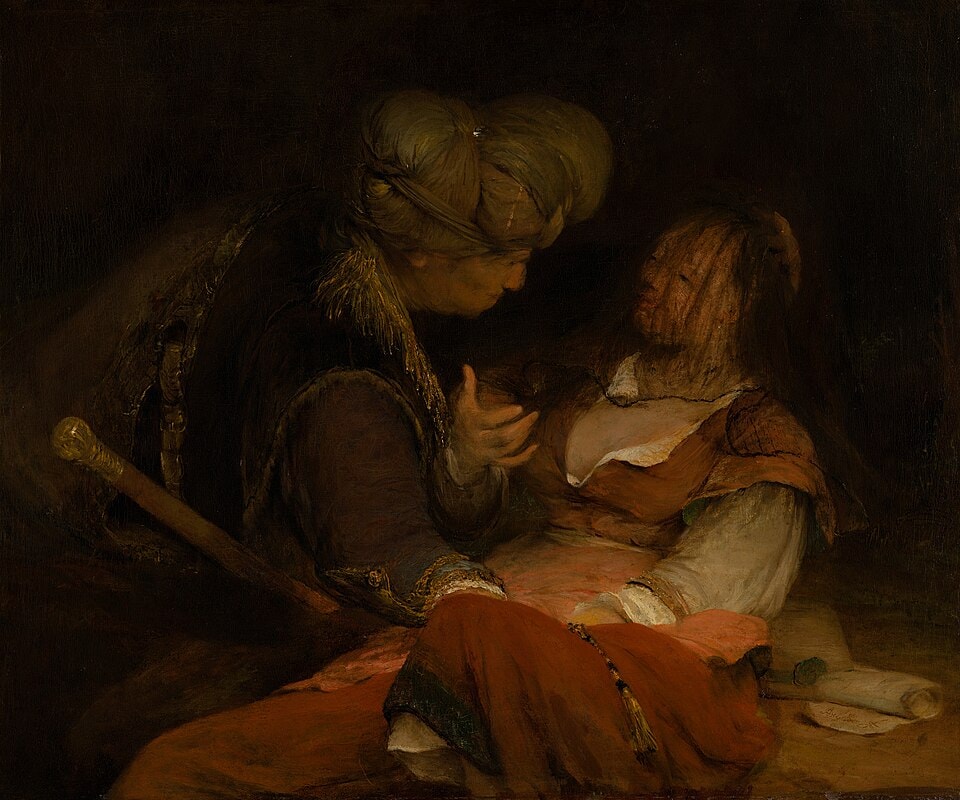
Arent de Gelder, Judah and Tamar, c. 1700, Dordrechts Museum. Judah's staff and cord, part of the pledge (ʿērābôn) of Genesis 38:17-18, lie in the foreground. Public domain, via Wikimedia Commons, resized.

Semantic range
- A pledge or security, something handed over to guarantee a promise. This is the sense of the Hebrew ʿērābôn in Genesis 38, the word's only Old Testament setting: Tamar asks, "Wilt thou give me a pledge, till thou send it?", and Judah gives "thy signet and thy cord, and thy staff" (Genesis 38:17-18, ASV), which he later sends to redeem (Genesis 38:20). Measured on the tagged KJV, H6162 occurs in those three verses only. The Septuagint renders it with arrabōn.
- A first instalment or down payment, part of the price paid in advance as a guarantee that the rest will follow. This is the word's commercial sense in Greek. Strong's glosses it "a pledge, i.e. part of the purchase-money or property given in advance as security for the rest". James Hope Moulton and George Milligan's Vocabulary of the Greek Testament collected papyrus documents in which an arrabōn is the advance payment that binds a sale or a contract of hire.
- An engagement. The word has lived on in Greek: in Modern Greek its descendant arravōnas means a betrothal, the promise of a marriage to come.
The word travelled widely. Lexicographers generally trace the Greek borrowing to Semitic traders, probably Phoenician, and Latin borrowed it in turn as arrabo and arra.
The difference between the two senses. A pledge in the Genesis 38 sense is a separate item, returned when the debt is paid. A down payment is part of the whole, of the same kind as what is still to come. Commentators note that Paul's use fits the second: the Spirit given now is a real share of the life of the age to come, and it is never handed back.
The Hebrew verb behind it. The root ʿārab is the verb of becoming surety. The same Judah who left a pledge with Tamar later offers himself as surety for Benjamin: "I will be surety for him; of my hand shalt thou require him" (Genesis 43:9, ASV; compare Genesis 44:32, where the same verb is tagged).
See this page's graph and discover linked topics
Theological force
Every New Testament use of arrabōn names the Holy Spirit as God's first instalment to believers. Three themes run through them.
- Assurance. "He that establisheth us with you in Christ, and anointed us, is God; who also sealed us, and gave us the earnest of the Spirit in our hearts" (2 Corinthians 1:21-22, ASV). The anointing, the seal and the earnest are three images of one gift, each stressing that God has committed Himself. The seal marks ownership; the earnest promises completion. See Assurance of Salvation and Witness of the Holy Spirit.
- Resurrection. In 2 Corinthians 5:1-5 Paul longs for the "house not made with hands, eternal, in the heavens", the body of the resurrection, and ends: "Now he that wrought us for this very thing is God, who gave unto us the earnest of the Spirit" (2 Corinthians 5:5, ASV). The Spirit who already indwells the believer is the guarantee of the future body. See Resurrection of the Body.
- Inheritance and redemption. Believers "were sealed with the Holy Spirit of promise, which is an earnest of our inheritance, unto the redemption of God's own possession, unto the praise of his glory" (Ephesians 1:13-14, ASV). The earnest runs "unto the redemption", so the full payment is the final redemption at the end of the age. See G0629 - apolytrosis.
The already and the not yet. Arrabōn is a compact statement of Paul's eschatology. The age to come has begun, because its Spirit has been given; it is not yet complete, because what has been given is a first instalment. Paul's agricultural image says the same thing: believers "have the first-fruits of the Spirit" and wait for "the redemption of our body" (Romans 8:23, ASV). See Eschatology and Pneumatology.
Pentecost. The poured-out Spirit of Acts 2 is, in Paul's vocabulary, the down payment of the promised inheritance. See Pentecost.
Patristic note
Irenaeus (Against Heresies 5.8.1) reads Ephesians 1:14 this way. He says believers now receive a portion of God's Spirit, which prepares them for incorruption and accustoms them to receive and bear God, and that the apostle calls this portion an "earnest". If the earnest already makes a person cry "Abba, Father", he reasons, the full grace of the Spirit given at the resurrection will do far more.
Notable verses
- 2 Corinthians 1:22, God "who also sealed us, and gave us the earnest of the Spirit in our hearts" (ASV)
- 2 Corinthians 5:5, "Now he that wrought us for this very thing is God, who gave unto us the earnest of the Spirit" (ASV)
- Ephesians 1:14, the Holy Spirit of promise, "which is an earnest of our inheritance, unto the redemption of God's own possession" (ASV)
- Genesis 38:17-18, the Hebrew ʿērābôn, Judah's pledge to Tamar
Scholarship
Published academic works this page draws on, each matched to a publisher, index or library catalog record.
- James Hope Moulton, The vocabulary of the Greek Testament illustrated from the papyri and other non-literary sources (Hodder and Stoughton, 1914). Open Library
- James Strong, The exhaustive concordance of the Bible (1890). Open Library
See also
- Pneumatology, the doctrine of the Holy Spirit
- Assurance of Salvation, what the earnest guarantees
- Witness of the Holy Spirit, the Spirit's present testimony in the believer
- G0629 - apolytrosis, the redemption the earnest looks toward in Ephesians 1:14
- G4151 - pneuma, the Spirit who is the earnest
- Resurrection of the Body, the future body promised in 2 Corinthians 5
- Pentecost, the giving of the Spirit
- Eschatology, the already and not yet