Argument
Fully God and Fully Man Is a Contradiction Objection Defeater
you cannot be 100% God and 100% man, fully God and fully man is a contradiction, Jesus cannot be both God and man, incarnation is contradictory, the incarnation is a logical contradiction, how can Jesus be 100 percent God and 100 percent man, God cannot become man, square circle objection to the incarnationIntro
"You can't be 100% God and 100% man. That's 200%. And God knows everything while a man doesn't, God can't die while a man can. Put them together and you have a contradiction, like a square circle." Muslims, unitarians and skeptics all press this objection, and Christians sometimes answer with a shrug and the word "mystery."
There is a better answer. "100% God and 100% man" is shorthand for one person who has two complete natures, the way a person can be fully a citizen of one country and fully a citizen of another without being half of each. A real contradiction would be saying something is true and false about the same thing, at the same time, in the same way. Christians say Jesus knows all things as God and grew in knowledge as man. Those are two different ways, so the law of non-contradiction is not broken. The fair challenge back is simple: name the one property that Jesus would have to both possess and lack in exactly the same respect.
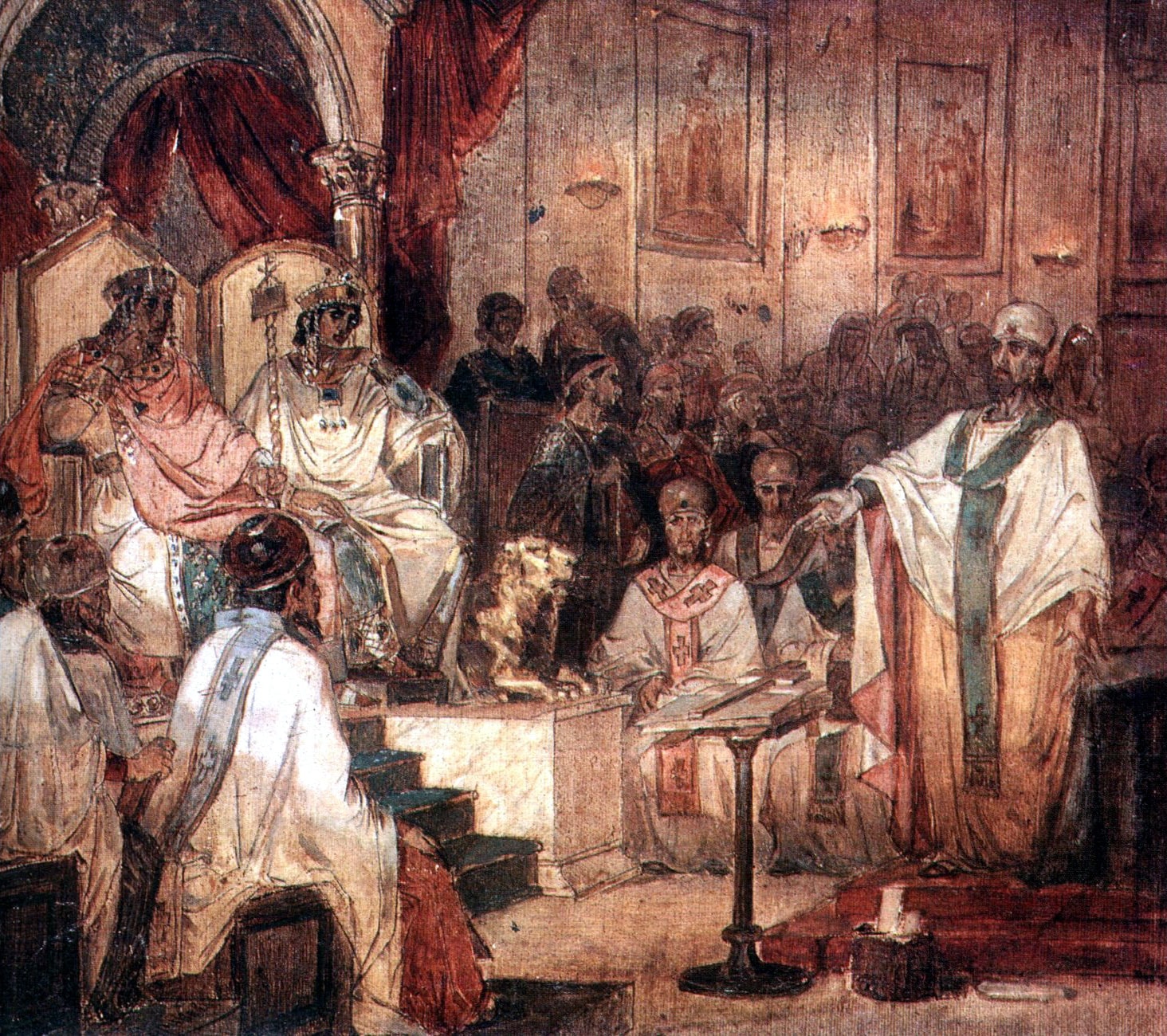
The Council of Chalcedon (451), which defined Christ as one person "in two natures, without confusion, without change, without division, without separation." Study by the Russian painter Vasily Surikov, 1876. Image: public domain, via Wikimedia Commons.
See this page's graph and discover linked topics
Cheatsheet
The 30-second reply:
"100%" describes the completeness of each nature: one Person with a complete divine nature and a complete human nature. A contradiction needs the same property affirmed and denied of the same subject in the same respect. Christians affirm omniscience of the Son according to his divine nature and growth in knowledge according to his human nature. Different respects. Name the property that collides in the same respect, and we can talk about it.
The 60-second answer:
Your argument assumes deity and humanity are like square and circle, shapes that exclude each other because they are the same kind of thing. Divine and human natures are different kinds of nature, and one subject can have two. The properties that look opposite, like "cannot die" and "can die," are each said of the Son according to one nature: he cannot die as God, and he died as man. That matches how the law of non-contradiction is stated, "in the same respect." And look at which human properties you are using. Being created, or being ignorant, are things every other human has; they are not what makes someone human. The Son can be fully human, having everything essential to humanity, without being merely human. So you need to show that some property essential to being human is incompatible with some property essential to being God. That has not been shown.
Fast facts:
- The law states its own qualifier. A thing cannot both be and not be in the same respect at the same time (Aristotle, Metaphysics IV). See Law of Non-Contradiction.
- Chalcedon (451). One Person "in two natures, without confusion, without change, without division, without separation," the property of each nature being preserved.
- Leo's Tome (449). Each nature does what is proper to it, in communion with the other.
- Fully vs merely human. Thomas V. Morris (The Logic of God Incarnate, 1986) distinguishes having all essential human properties from having the limiting properties most humans also have.
- Scripture holds both. "In him dwelleth all the fulness of the Godhead bodily" (Colossians 2:9, ASV); "Jesus advanced in wisdom and stature" (Luke 2:52, ASV).
Counter-moves:
- If they say "that's just a label for a contradiction": ask for the formal contradiction, P and not-P, same subject, same respect.
- If they say "one person, so one mind, so either he knows or he doesn't": see P4; the codex's mainstream reading follows Constantinople III's two wills and two operations.
- If they say "then two persons": no. One subject, the eternal Son, is the bearer of both natures. See Communicatio Idiomatum.
Concessions:
- Granted: "mystery" alone is no answer, and Christians who stop there have not answered.
- Granted: how one Person experiences two natures is not fully comprehensible. Incomprehensibility differs from contradiction.
Closing line:
Show me the actual contradiction: the exact property Jesus must both have and lack, in the same nature, at the same time, in the same respect. Until then you have shown that the incarnation is unique, which Christians already say.
In full
The objection alleges that the conjunction "Christ is fully divine and fully human" entails a formal contradiction, because the divine nature includes properties (omniscience, impassibility, immortality, being uncreated) whose negations belong to human nature. Its standard formulation runs: (1) God is essentially omniscient, (2) humans are essentially limited in knowledge, (3) Christ is essentially both, so (4) Christ is both omniscient and not omniscient.
Two replies answer it, one logical and one metaphysical. The logical reply is reduplicative predication: Christian theology predicates divine properties of the Son qua divine and human properties qua human. Since the law of non-contradiction forbids opposite predicates only in the same respect, the conjunction "omniscient qua God and limited in knowledge qua man" is no formal contradiction. Critics reply that reduplication only relocates the problem, since the person ends up both knowing and not knowing. Hence the second reply.
The metaphysical reply denies premise (2) as stated. Thomas V. Morris argues that properties such as being created, being limited in knowledge, or being mortal are common human properties, possessed by every merely human being, and fall outside what is essential to humanity. Christ is fully human, having every property essential to human nature, without being merely human. The question becomes whether any genuinely essential human property excludes any essential divine property, and no one has shown such a pair.
That leaves the question of Christ's consciousness. The conciliar tradition affirms two natural wills and two natural operations in the one Person (Third Council of Constantinople, 681). Morris develops a two-minds model: the eternal Son has a divine mind and, from the incarnation, a human mind, with the divine mind containing the human and the human having access to the divine as the Son permits. It is one model among several. Thomist accounts speak of the one Person knowing through two intellects; kenotic accounts, which have the Son give up divine attributes, are rejected by the codex in their strong form (see Kenosis). Whichever model one prefers, the coherence claim requires only that some consistent model exist.
Argument structure
| Claim | Support | |
|---|---|---|
| P1 | "100% God and 100% man" means one Person with two complete natures; the fraction reading is an equivocation. | Chalcedon; John 1:14; Colossians 2:9 |
| P2 | A contradiction requires the same property affirmed and denied of the same subject in the same respect, and the incarnation predicates divine and human properties according to distinct natures. | Aristotle, Metaphysics IV; Leo's Tome |
| P3 | The limiting properties in the objection are common human properties, not essential ones; Christ is fully human without being merely human. | Morris 1986; Hebrews 2:14, 17; Hebrews 4:15 |
| P4 | At least one consistent model of Christ's knowledge and will exists. | Constantinople III; Morris's two-minds model; Aquinas, ST III |
| C | The objection has not shown that the incarnation is contradictory. |
Master objections
MO1: "Calling it a 'mystery' is a confession that you can't make it coherent."
- Incomprehensibility and contradiction are two separate charges. A doctrine can exceed full comprehension while containing no P and not-P. The defence on this page makes no appeal to mystery: it gives the respects (P2), the property distinction (P3) and a model (P4).
MO2: "Your answer makes Jesus two persons, Nestorius by another name."
- The one subject of every predicate is the eternal Son. He is the one who knows all things and the one who grew; the natures are that by which he does each. That is the conciliar rule of Communicatio Idiomatum, adopted at Ephesus (431) against exactly this split.
MO3: "God cannot change, and becoming man is a change."
- The incarnation adds a human nature to the Son; it subtracts nothing from the divine nature. Chalcedon's "without change" states it. The change is in what the Son assumes, in the way a person can acquire a new relation without his own nature changing. See Incarnation and Divine Simplicity.
MO4: "Muslims and Jews agree: God is not a man (Numbers 23:19)."
- Numbers 23:19 reads: "God is not a man, that he should lie, Neither the son of man, that he should repent." The verse denies that God has human fickleness; its parallel clauses name lying and repenting. Christians agree that the divine nature is not human nature. The incarnation is the Son taking a human nature, which the verse does not address. See Muslim Objections to the Divinity of Christ.
P1, "100%" names complete natures
Affirmative case
- The two-sense table.
| Term | Sense the objection needs | Sense Christians mean |
|---|---|---|
| 100% God and 100% man | two halves of one quantity summing to 200% | one Person with a complete divine nature and a complete human nature |
| God and man | two competing things | two natures borne by one subject |
- The natures are complete. "In him dwelleth all the fulness of the Godhead bodily" (Colossians 2:9); "he also himself in like manner partook of the same" flesh and blood (Hebrews 2:14).
- Ordinary analogy. A person can be fully a citizen of two countries, or fully a son and fully a father. The analogy shows the logic of "fully X and fully Y" and is offered for that alone; see the analogy warning on Kenosis.
Anticipated objections
- "Natures are not like citizenships. A nature is what a thing is."
- "If he has a complete human nature, he is a human person, so two persons."
Rebuttals
- Granted, and the point holds. A nature is what a thing is; the claim is that the Son is both what God is and what man is. The analogy shows only that "fully X and fully Y" is not arithmetic. P2 and P3 carry the logic.
- A complete human nature need not be a separate person. The Son's human nature has never existed apart from the Son. Conciliar theology calls it enhypostatic: personal in the Son. The objection assumes every complete human nature is its own person, which is the point at issue.
Live-cite kit
- Scripture: John 1:14; Colossians 2:9; Hebrews 2:14.
- Scholarly: Chalcedonian Definition (451).
- Aphorism: Two complete natures, one Person: the arithmetic belongs to natures, and there are two of them.
Tactical notes
- Say "fully God and fully man" rather than percentages. The percentage phrasing invites the fraction joke.
- What not to defend: that the natures mix. Chalcedon's "without confusion" rules that out, and a mixed nature would be neither God nor man.
P2, the law of non-contradiction applies in the same respect
Affirmative case
- The law's own wording. Aristotle states it as the impossibility of the same attribute both belonging and not belonging to the same subject in the same respect (Metaphysics IV.3).
- Reduplicative predication. The Son is omniscient as God and grew in wisdom as man (Luke 2:52). The predicates attach to one subject in two respects.
- The fathers used the rule. Gregory of Nazianzus (Oration 30) sorts the Gospel sayings into those spoken of the Son in his deity and those spoken of him in the flesh he assumed. Leo's Tome: each nature does what is proper to it, in communion with the other.
Anticipated objections
- "'As God' and 'as man' are just labels. The person ends up knowing and not knowing."
- "Show me another case where one person has opposite properties in two respects."
Rebuttals
- Then the objection moves to P3 and P4, which address what the person has and how. The respect distinction has done its work: there is no formal contradiction, and the remaining question is coherence of the model.
- Ordinary cases exist, partially. A man who is a judge may be forbidden as judge to hear his son's case and obliged as father to help him. The analogy is limited (two roles, not two natures) and shows only that "in this respect" is a real logical qualifier. The incarnation is unique, and uniqueness is no defect in logic.
Live-cite kit
- Scripture: Luke 2:52; John 21:17 ("Lord, thou knowest all things").
- Scholarly: Aristotle, Metaphysics IV.3; Leo the Great, Tome to Flavian (449); Gregory of Nazianzus, Oration 30.
- Aphorism: Same subject, same respect. Change either and the contradiction disappears.
Tactical notes
- Ask them to state the contradiction in the form "Jesus is P and Jesus is not P, in respect R." Most cannot fill in R without using two respects.
- See Jesus Didnt Know the Hour Objection Defeater for the knowledge case worked through Mark 13:32.
P3, fully human without being merely human
Affirmative case
- Essential and common properties. Morris distinguishes properties essential to humanity (those without which a being is not human) from properties common to humans (those every merely human being happens to have). Being created as a human person, being sinful, or being ignorant of the future are common properties. Having a human body and a human mind are essential.
- Scripture marks the difference with sin. Christ was "in all points tempted like as we are, yet without sin" (Hebrews 4:15). Every other human sins, so sinfulness is common; Christ is still fully human, so sinfulness is not essential. The same reasoning applies to the other limiting properties.
- What remains to be shown. The objector must produce a property essential to humanity that excludes a property essential to deity. "Created" is a candidate; P3 answers it, since what makes the Son human is the human nature he assumed, and the Son himself is uncreated.
Anticipated objections
- "Being created is essential to being human. Every human was created."
- "Morris's distinction is special pleading invented to save the doctrine."
Rebuttals
- Every human nature is created, including Christ's. The Son's human body and soul are created; the Son himself is not. "Human" is said of the Son because of the nature he assumed, so createdness belongs to that nature and uncreatedness to the Person's divine nature. Two respects again.
- The distinction is general. Philosophers draw the essential and common distinction about many kinds; every human so far has lived on Earth, and living on Earth is not essential to being human. Hebrews 4:15 applies the same logic to sin.
Live-cite kit
- Scripture: Hebrews 2:14, 17; Hebrews 4:15.
- Scholarly: Thomas V. Morris, The Logic of God Incarnate (1986); Oliver Crisp, Divinity and Humanity (2007).
- Aphorism: Fully human, never merely human.
Tactical notes
- Use the sinlessness example first. Most objectors agree Jesus was sinless and human, which concedes the distinction.
- What not to defend: that Christ lacked a human mind or will. That is Apollinarianism, condemned at Constantinople I (381).
P4, a consistent model of Christ's knowledge exists
Affirmative case
- Two wills, two operations. The Third Council of Constantinople (681) affirmed two natural wills and two natural operations in the one Christ. The Hypostatic Union page records the codex's mainstream reading: two operational mind-faculties bound in the one Person of the Son.
- Morris's two-minds model. The eternal Son has a divine mind and, from the incarnation, a human mind with its own developing knowledge. The divine mind fully contains the human; the human has access to the divine as the Son permits. Morris offers it as one model among others, and so does this page.
- Thomist accounts. Aquinas holds that the one Person knows through the divine intellect and, distinctly, through a created human intellect (Summa Theologiae III, qq. 9-12).
- Coherence needs only one model. To defeat a contradiction charge, it is enough that some consistent model exists. The objector must show every model fails.
Anticipated objections
- "Two minds in one person is two persons."
- "If the human mind does not know the hour, Jesus really didn't know. So he isn't omniscient."
- "Kenotic Christians say the Son gave up omniscience. Even your own side admits the problem."
Rebuttals
- A person is the subject who has minds. Morris's model places one subject, the Son, behind both ranges of awareness. Whether persons and minds can come apart is a philosophical question; the model's coherence depends on it, and it has not been shown false.
- The Son knew, in his divine nature. In his human nature he grew (Luke 2:52). See Jesus Didnt Know the Hour Objection Defeater for the patristic and textual handling of Mark 13:32.
- Strong kenotic theories are a minority report. The codex rejects the claim that the Son set aside divine attributes, on the grounds given in Kenosis: the emptying of Philippians 2:7 is described by the participles that follow, "taking the form of a servant, being made in the likeness of men." Kenotic theologians agree that the incarnation is coherent; they disagree about the model.
Live-cite kit
- Scripture: Luke 2:52; John 16:30; John 21:17; Colossians 2:3.
- Scholarly: Third Council of Constantinople (681); Aquinas, ST III qq. 9-12; Morris (1986).
- Aphorism: One knower, two ways of knowing.
Tactical notes
- Present the models as models. Overclaiming one theory of Christ's psychology invites a fight you do not need.
- What not to defend: that you can describe from the inside what it was like to be the incarnate Son. Coherence does not require that.
Tactical opening and closing
Opening line: "Before we discuss whether it's a contradiction, let's write the contradiction down. Jesus is P and Jesus is not P. What is P, and in what respect?"
Closing line: "Christians have never said Jesus is God and not God, or man and not man. They say one Person is God and became man. You may find that astonishing. It is meant to be. And nowhere in it is P affirmed and denied in the same respect."
Scholarship
Published academic works this page draws on, each matched to a publisher, index or library catalog record.
- Oliver D. Crisp, Divinity and Humanity: The Incarnation Reconsidered (Cambridge University Press, 2007). doi:10.1017/cbo9780511805332
- Thomas V. Morris, The logic of God Incarnate (Cornell University Press, 1986). Open Library
See also
- Hypostatic Union, the Chalcedonian doctrine and the codex's reading of two wills and minds
- Communicatio Idiomatum, how divine and human properties are predicated of one Person
- Incarnation, the doctrine as a whole
- Law of Non-Contradiction, the principle the objection appeals to
- Kenosis, why the codex rejects strong kenotic models
- Jesus Didnt Know the Hour Objection Defeater, the knowledge case in detail
- How Can Jesus Be God Objection Defeater, five predication objections, including the two-wills question
- Council of Chalcedon, the definition of 451
- Theandric Activities, acts of the one Christ that involve both natures
Common questions this page answers
Q: How can Jesus be 100% God and 100% man?
The phrase means one Person with two complete natures, divine and human. It describes completeness of each nature, so there is no 200% problem. The Council of Chalcedon (451) put it as one Person "in two natures, without confusion, without change, without division, without separation."
Q: Isn't being both God and man a contradiction?
A contradiction affirms and denies the same thing of the same subject in the same respect. Christians say the Son knows all things as God and grew in knowledge as man (Luke 2:52), which are two respects. No one has produced a property Jesus must both have and lack in one respect.
Q: If Jesus is God, how could he die?
The Son died according to his human nature, which is mortal, and remained immortal according to his divine nature. The one who died is the Son himself, so Scripture can say the Lord of glory was crucified (1 Corinthians 2:8), while the divine nature as such did not die.
Q: Did Jesus have two minds?
The church affirmed two wills and two operations in Christ at the Third Council of Constantinople (681). Some philosophers, such as Thomas V. Morris, develop this as a two-minds model in one Person. It is one model among several, and the coherence of the incarnation requires only that some consistent model exists.
Q: Isn't calling it a mystery just admitting it makes no sense?
Mystery means it exceeds full comprehension. Contradiction means it says P and not-P. The incarnation can be the first without being the second, and Christian theology gives specific answers about respects, natures and models rather than resting on the word "mystery."