Concept
Freemasonry
Freemasons, Masonry, Masonic Lodge, The Lodge, Order of the Eastern Star, Eastern Star, OES, Riding the Goat, Ride the Goat, Prince Hall Freemasonry, Is Freemasonry Compatible with Christianity, Can a Christian Be a Freemason, Great Architect of the UniverseIntro
Freemasonry is a fraternal order of men who meet in lodges, take oaths, and are taught moral lessons through rituals built on the tools and legends of stonemasons. A man joins by petition, must say he believes in a Supreme Being, and moves through three "degrees": Entered Apprentice, Fellow Craft and Master Mason. Masons are known for charity, for secrecy about their rituals, and for symbols like the square and compasses.
The Order of the Eastern Star is a related order that admits women. It was founded in the United States around 1850 by a Mason named Rob Morris and teaches lessons from five women of the Bible.
"Riding the goat" is an old joke about lodge initiations, not a real Masonic or Eastern Star ritual. In the 1800s outsiders joked that new members had to ride a goat, the lodges adopted the joke, and by the 1890s companies sold mechanical goats for comic "side degrees" in many fraternal orders. The goat is not secret devil worship.
Masons say the Lodge is not a religion and does not compete with the church. Many churches have concluded otherwise. The Catholic Church forbids membership, the Orthodox Church of Greece calls it incompatible with Christianity, and Southern Baptists, Anglicans and Methodists have issued serious warnings. The main concerns are worship of a generic "Great Architect" alongside other faiths, bloody oaths, a moral system that teaches entry to the "Celestial Lodge above" through upright living, and the secrecy itself.
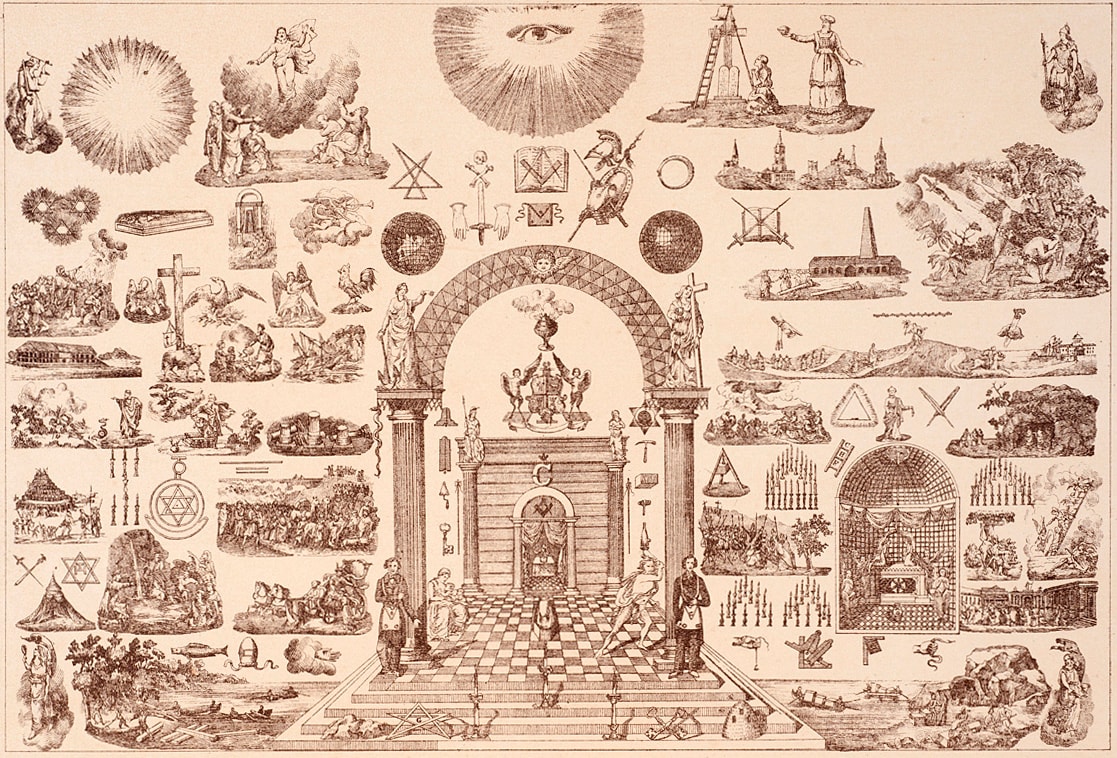 A symbolic Masonic tracing board, engraving published in Rotterdam in the second half of the nineteenth century. The checkered floor, the two pillars, the all-seeing eye, the letter G, the square and compasses and the ladder are standard lodge emblems. Dutch Museum of Freemasonry, photo by Paul Mellaart, public domain (Wikimedia Commons).

See this page's graph and discover linked topics
In full
Freemasonry ("the Craft") is an initiatory fraternity that grew out of the guilds of working stonemasons in Britain and took its modern form with the founding of the Premier Grand Lodge in London, traditionally dated 1717. James Anderson's Constitutions (1723) set its religious posture: a Mason is obliged only "to that Religion in which all Men agree, leaving their particular Opinions to themselves." Regular, Anglo-American Freemasonry requires belief in a Supreme Being and the presence of a "Volume of the Sacred Law" on the lodge altar (a Bible in most Western lodges, another scripture where members hold another faith). Continental "liberal" Masonry broke with this when the Grand Orient de France dropped the requirement of belief in God in 1877.
The Craft's three degrees enact a moral allegory centered on the building of Solomon's Temple. The third degree dramatizes the murder and raising of Hiram Abiff, the master builder, as a lesson in fidelity and immortality. Above the three degrees stand appendant bodies, chiefly the Scottish Rite (to the 32nd degree, with an honorary 33rd) and the York Rite (Royal Arch, Cryptic Masonry and the Knights Templar, the last requiring a profession of Christian faith). Prince Hall Freemasonry, founded when Prince Hall and fourteen other free Black men were initiated in Boston in 1775 and chartered as African Lodge No. 459 by the Grand Lodge of England in 1784, is the historic Black Masonic tradition and remains strong in Black church communities.
The Christian question is not whether Masons are good men or do good works. Many are, and many do. It is whether the Lodge's oaths, prayers and rituals amount to a religious system that a Christian cannot join without compromising exclusive allegiance to Christ (Acts 4:12; 1 Timothy 2:5). Churches that studied the question at length have mostly said yes, it does. Masons answer that the Lodge is a fraternity with religious elements, not a religion, and that it teaches no plan of salvation.
The Order of the Eastern Star
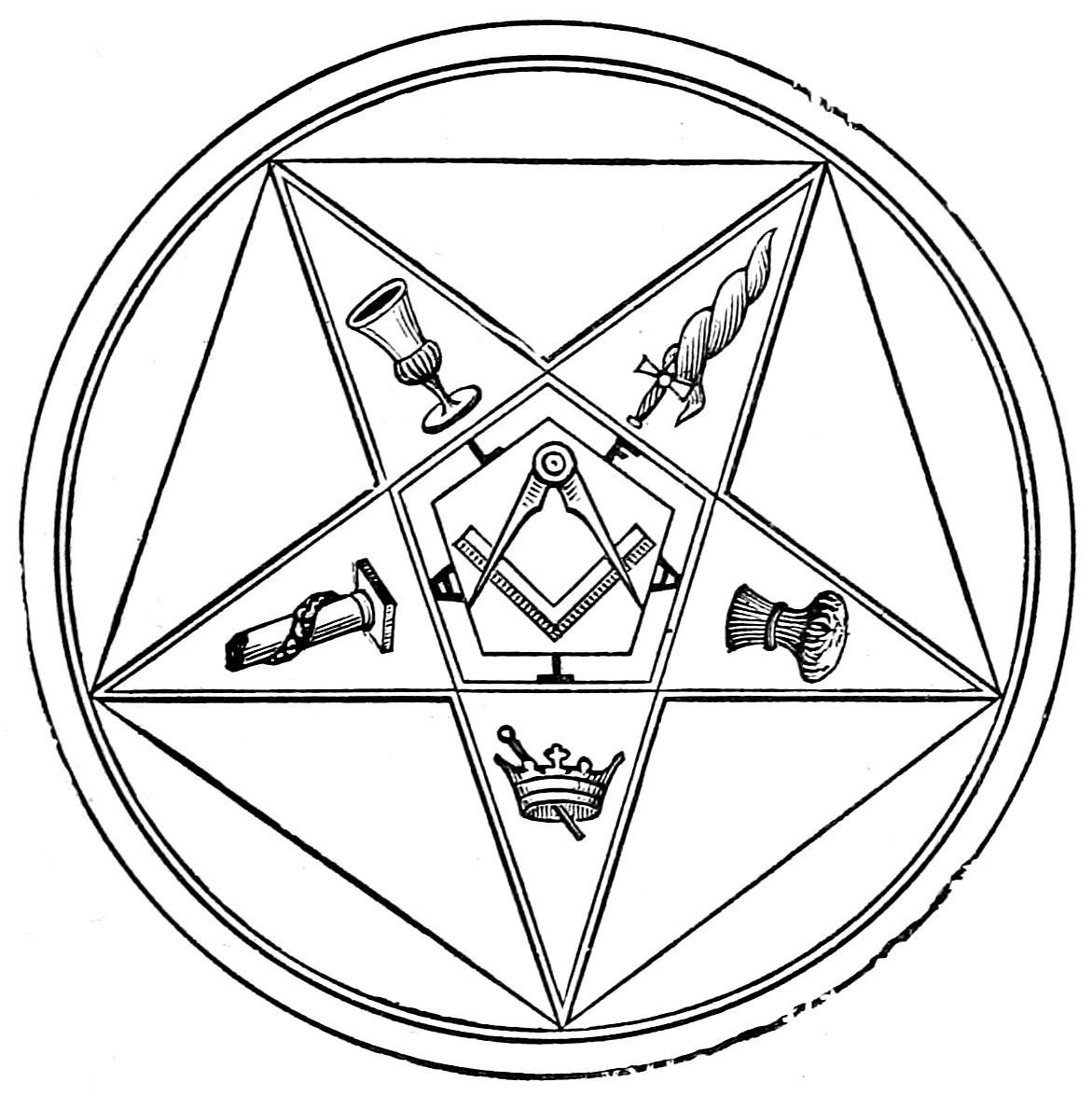 The emblem of the Order of the Eastern Star: a five-pointed star, point downward, with an emblem for each of the five heroines and the square and compasses at the center. From the order's 1921 ritual, public domain (Wikimedia Commons).

- What it is. An appendant body of Freemasonry open to women and men. Historically, women joined through a Masonic relationship (wives, widows, daughters, mothers and sisters of Master Masons), and Master Masons may also join. It is not Freemasonry itself, which in regular lodges admits men only.
- Founder. Rob Morris (1817-1888), a Kentucky educator and prominent Mason, wrote the order's first ritual around 1850. Robert Macoy reorganized it in the late 1860s, and a General Grand Chapter was formed in 1876. Prince Hall-affiliated chapters form a parallel Black tradition.
- The five heroines. The degree work teaches lessons drawn from five women of Scripture: Adah (the name the order gives to Jephthah's daughter, Judges 11), Ruth, Esther, Martha of Bethany, and Electa (identified with "the elect lady" of 2 John 1:1). Each point of the star carries one heroine and a virtue.
- The inverted star. The star points downward, which some critics read as occult. The order takes its name from the star the wise men saw "in the east" (Matthew 2:2). The shape alone proves nothing either way; the theological questions below concern the oaths and the religious content, not the geometry.
"Riding the goat"
The phrase is a joke, and its history is well documented.
- An outsiders' rumor. In the 1840s, critics of the Odd Fellows and the Masons claimed that initiates were made to ride a goat. The goat's old association with the devil gave the rumor its bite.
- Adopted as an in-joke. Fraternal members turned the rumor into humor. "Have you ridden the goat yet?" became a way of asking whether someone had been initiated, and cartoons showed blindfolded candidates on bucking goats.
- Side degrees and mechanical goats. Late in the nineteenth century many fraternal orders (the Modern Woodmen of America among them) added comic "side degrees" for horseplay apart from the formal ritual. Suppliers sold props for them, most famously DeMoulin Bros. & Co. of Greenville, Illinois (founded 1892), whose catalogs offered wheeled and bucking mechanical goats, spanking machines and trick chairs. No live goats were used.
- Not in the ritual. No regular Masonic degree and no Eastern Star ritual prescribes riding a goat. The Eastern Star ritual consists of an obligation, scriptural lessons on the five heroines, signs and lectures.
The historian William D. Moore traces the whole tradition in "Riding the Goat: Secrecy, Masculinity, and Fraternal High Jinks in the United States, 1845-1930," Winterthur Portfolio 41 (2007). The goat is not a coded reference to Baphomet. The goat-headed "Baphomet" image is a drawing by the French occultist Éliphas Lévi in the 1850s, and its link to Masonry was popularized by the Taxil hoax (below).
The fair Christian conclusion is that someone asking about the goat is asking the wrong question. The goat is folklore. The oaths, prayers and teaching of the actual degrees are where a Christian should look.
Christian assessments
| Body | Year | Finding |
|---|---|---|
| Catholic Church | 1738 onward; 1983; 2023 | Pope Clement XII first condemned Masonry in In eminenti (1738). The Congregation for the Doctrine of the Faith's Declaration on Masonic Associations (26 November 1983, signed by Cardinal Joseph Ratzinger) holds that Masonic principles are irreconcilable with the Church's doctrine and that Catholics who enroll are in a state of grave sin and may not receive Holy Communion. The Dicastery for the Doctrine of the Faith reaffirmed the prohibition in November 2023. |
| Church of Greece (Orthodox) | 1933, reaffirmed 1972, 1996, 2014 | The Holy Synod declared Freemasonry incompatible with membership in the Church and directed that unrepentant members be refused communion. |
| Southern Baptist Convention | 1993 | After a Home Mission Board study, messengers adopted a report finding many Masonic teachings, including its bloody oaths and implied salvation by works, "incompatible with Christianity," while leaving membership to personal conscience. The board clarified in 1994 that it did not mean to suggest Baptists could affiliate with such teaching on that basis. |
| Church of England | 1987 | The General Synod commended a working party report, Freemasonry and Christianity: Are They Compatible?, which found "a number of very fundamental reasons" to question the compatibility. |
| Methodist Church of Great Britain | 1985 | The Conference's Guidance to Methodists on Freemasonry advised Methodists not to become Freemasons. A 1996 review noted that some of its statements were overtaken by changes in Masonic practice. |
| Holiness and Lutheran churches | 19th century onward | Charles Finney's The Character, Claims and Practical Workings of Freemasonry (1869) shaped the evangelical and holiness opposition; the Free Methodist Church was founded in 1860 opposing secret societies; the Lutheran Church-Missouri Synod has long treated lodge membership as incompatible with Christian confession. |
The theological concerns, stated fairly
1. The "Great Architect of the Universe." Lodges pray to a God named so that Christians, Jews, Muslims, Hindus and others can pray together without naming Christ. Christians object that prayer which deliberately omits the Son is not neutral: "Whosoever denieth the Son, the same hath not the Father" (1 John 2:23, ASV), and the Father is approached "but by me" (John 14:6, ASV). Critics such as Walton Hannah (Darkness Visible, 1952) also objected to a composite divine name used in English Royal Arch ritual; the United Grand Lodge of England removed it in 1989.
2. The oaths. Candidates historically swore to keep the secrets under symbolic penalties of throat cut, tongue torn out and body mutilated. Christians object both to the penalties and to swearing an oath before knowing its content. Jesus said, "Swear not at all" (Matthew 5:34, KJV), and James adds "let your yea be yea, and your nay, nay" (James 5:12, ASV). Many Christians accept oaths in court, so the point is not every oath, but a binding religious oath to secrets one has not yet heard. Several grand lodges, including the United Grand Lodge of England in 1986, removed the physical penalties from the obligations.
3. Salvation by works. The ritual speaks of the lambskin apron as a reminder of the purity of life needed to gain admission to the "Celestial Lodge above," and the Master Mason degree presents a raising from death in Hiram Abiff without Christ. Critics see a plan of salvation by moral effort. The gospel says "by grace are ye saved through faith; and that not of yourselves: it is the gift of God: Not of works, lest any man should boast" (Ephesians 2:8-9, KJV). See Justification by Faith.
4. Secrecy and esoteric teaching. Jesus said, "in secret spake I nothing" (John 18:20, ASV). The concern is less about privacy than about a graduated path of hidden light, especially in the higher degrees and in writers like Albert Pike (Morals and Dogma, 1871), whose blend of Kabbalah, Hermeticism and comparative religion many Christians find incompatible with the faith once for all delivered (Jude 3).
5. Syncretism. Placing the Bible alongside other scriptures as one "Volume of the Sacred Law" treats Christianity as one expression of a universal religion. That is the pluralist claim the codex answers in Religious Pluralism Objection Defeater and Salvation Exclusivity.
What Masons reply
Fairness requires the Lodge's own answers, which many Christian Masons hold sincerely.
- "Freemasonry is not a religion." It has no sacraments, no clergy, no creed beyond belief in God, and teaches no way of salvation. It supports a man's own religion and sends him back to his church.
- "The Great Architect is simply God." Each Mason prays to God as his own faith understands Him. A Christian Mason prays to the triune God.
- "The penalties are symbolic." They were never carried out, many jurisdictions have removed them, and they express how seriously a man keeps his word.
- "The secrets are only modes of recognition." Rituals have been published for two centuries; the secrecy covers handshakes and passwords, not hidden doctrine.
- "Look at the fruit." Masons point to charity (such as the Shriners Hospitals for Children), to the many clergy and church leaders who have been Masons, and to Prince Hall lodges as pillars of Black communities.
The Christian rejoinder: the Lodge itself sets the terms. If the degrees include prayer, an altar, sacred scripture, oaths before God, a drama of death and resurrection, and the promise of a Celestial Lodge for the upright, then it functions religiously whatever it calls itself. A man can pray to the triune God in his own heart, but the lodge prayer is written precisely so that no one has to name Christ. That is the problem the churches above identified.
Myths to drop
A Christian case is weakened by false charges. Two are common.
- The "Luciferian doctrine" quote. A widely circulated statement attributed to Albert Pike, that the Masonic religion should be maintained "in the purity of the Luciferian doctrine," is a forgery. It comes from the French hoaxer Léo Taxil, who spent the 1890s inventing a Satanic Masonic cult ("Palladism") and then publicly confessed the hoax in Paris in 1897. Pike's real Morals and Dogma contains an ambiguous passage on "Lucifer, the Light-bearer," which is worth discussing honestly, but it is not the forged quotation.
- The riding goat as devil worship. As shown above, it is a joke and a prop.
Use the oaths, the prayers and the official church findings. They are documented and they are enough.
Leaving the Lodge
Former Masons often describe a gradual realization that the Lodge had become a rival devotion. Serge Abad-Gallardo, a Worshipful Master for twenty-three years in the French co-Masonic obedience Le Droit Humain, returned to the Catholic faith in 2012 and wrote several books on why he left. See Serge Abad-Gallardo (Ex-Freemason) and Conversion Testimonies.
Many Christians who leave follow a simple pattern: renounce the oaths before God, return the regalia, and tell the lodge plainly and kindly why. Polemic belongs to the system, not the man. Many Masons joined for brotherhood and charity and never examined the ritual's theology.
Related movements
- Mormonism. Joseph Smith became a Mason in Nauvoo in 1842, weeks before introducing the Latter-day Saint temple endowment, which shares a number of features with Masonic ritual.
- New Age Spiritualism and Spiritualism, where nineteenth-century esotericism and fraternal ritual overlapped.
- Deism, the Enlightenment religion of a distant Creator that shaped the "religion in which all men agree" of 1723.
Scholarship
Published academic works this page draws on, each matched to a publisher, index or library catalog record.
- Charles Grandison Finney, The character, claims, and practical workings of freemasonry (1869). Open Library
- Walton Hannah, Darkness visible (1952). Open Library
- William D. Moore, "Riding the Goat: Secrecy, Masculinity, and Fraternal High Jinks in the United States, 1845-1930," Winterthur Portfolio 41 (2007). doi:10.1086/518920
See also
- Serge Abad-Gallardo (Ex-Freemason), a former Worshipful Master's conversion
- Conversion Testimonies, including the ex-Freemason testimonies
- Religious Pluralism Objection Defeater, answering "all religions lead to God"
- Salvation Exclusivity, why Christ is the only way
- Justification by Faith, grace against salvation by works
- World Religions, the map of religions the codex covers
- Mormonism, the Masonic background of the temple endowment
- Spiritual Warfare, discernment and renouncing former allegiances
Common questions this page answers
Q: What does "riding the goat" mean in Freemasonry or the Eastern Star?
It is an old joke about initiation, not a real ritual. In the 1840s critics claimed initiates had to ride a goat; fraternal members turned it into an in-joke, and from the 1890s companies such as DeMoulin Bros. sold mechanical goats for comic "side degrees" in many lodges. No Masonic degree or Eastern Star ceremony prescribes riding a goat.
Q: Does the goat in Masonic initiation represent Satan or Baphomet?
No reliable evidence shows that. The goat joke grew from nineteenth-century rumor and fraternal humor, and the Baphomet image comes from the occultist Éliphas Lévi and was tied to Masonry by the Taxil hoax of the 1890s. Christian concerns about the Lodge rest on its oaths and prayers, not the goat.
Q: What is the Order of the Eastern Star?
A Masonic-related order open to women, founded by Rob Morris around 1850. Its ritual teaches lessons from five biblical women: Adah (Jephthah's daughter), Ruth, Esther, Martha and Electa. Historically, members were Master Masons and women related to them.
Q: Can a Christian be a Freemason?
Most churches that studied the question say no or warn strongly against it. The Catholic Church forbids membership (1983, reaffirmed 2023), the Church of Greece calls it incompatible with Christianity, and Southern Baptist, Anglican and Methodist studies found core teachings incompatible. The concerns are prayer that omits Christ, bloody oaths, salvation by works and syncretism.
Q: Is Freemasonry a religion?
Masons say no, since it has no sacraments, clergy or plan of salvation. Critics answer that it has an altar, sacred scripture, prayers, oaths before God and a ritual of death and raising, and so functions as a religion whatever it calls itself.
Q: Who is the Great Architect of the Universe?
The name Freemasonry uses for God so that men of different religions can pray together. Christians object that a prayer designed so no one has to name Jesus cannot be prayer to the Father through the Son (John 14:6).
Q: Did Albert Pike say Freemasonry worships Lucifer?
The famous "Luciferian doctrine" quote is a forgery from the Léo Taxil hoax, which Taxil confessed in 1897. Pike's real writings contain esoteric material Christians can fairly criticize, but that quote is not his.