Concept
Frankfurt Silver Inscription
Frankfurt Silver Amulet, Frankfurt Amulet, Frankfurt Inscription, Frankfurter Silberinschrift, Nida Amulet, Praunheim Amulet, Oldest Christian evidence north of the AlpsIntro
In 2018, archaeologists digging a Roman cemetery in Frankfurt, Germany, found a man buried with a tiny silver case under his chin. He had worn it on a cord around his neck. Inside was a rolled-up strip of silver foil too fragile to open. In 2024, scientists scanned it with a CT machine and unrolled it on a computer screen. Scratched into the foil were 18 lines of Latin: a prayer for protection in the name of "Jesus Christ, Son of God," ending with the words of Paul that every knee will bow to Jesus and every tongue confess him.
The man died sometime around AD 230 to 260, on the far northern frontier of the Roman Empire. His amulet is the oldest known physical evidence of Christian faith north of the Alps. It shows that, within two centuries of Paul, a Latin-speaking believer on the edge of the empire looked to Jesus alone, by name and title, for protection.
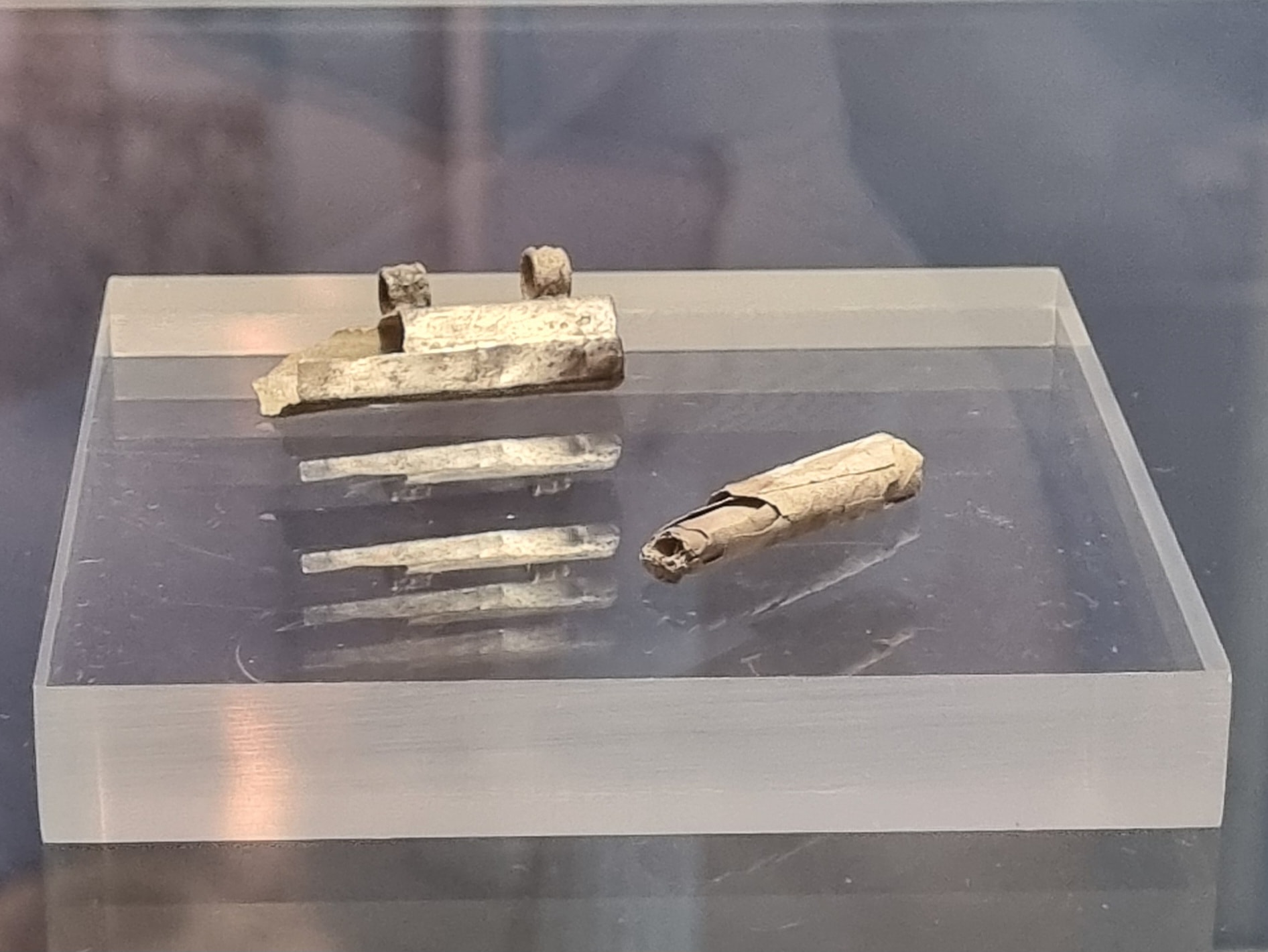
The Frankfurt silver amulet: the capsule with its two eyelets (left) and the rolled silver foil that carries the inscription (right), 3rd century AD, Archaeological Museum Frankfurt. Photo: Hagios397Martin, CC BY-SA 4.0, via Wikimedia Commons.

The 30-second version:
- What: a silver amulet case, 3.5 cm long, holding a silver foil with 18 lines of Latin, worn at the neck by a man of about 35 to 45.
- Where and when: grave 134 of the Heilmannstraße cemetery at Frankfurt-Praunheim, the Roman town of Nida; buried about AD 230 to 260.
- What it says: a prayer in the name of Jesus Christ, Son of God, Lord of the world, for protection and health, closing with Philippians 2:10-11 in Latin.
- Why it matters: the earliest known Christian object north of the Alps, an early witness to the Latin text of Philippians, and a devotion directed to Jesus with no pagan gods mixed in.
- The limits: the foil is damaged, the reading is provisional, and the text tells us more about the person who composed it than about how fully the man who wore it held the faith.
See this page's graph and discover linked topics
In full
The Frankfurt silver inscription is a Latin text incised on a sheet of silver foil, rolled and sealed inside a small silver capsule with two eyelets for a cord or strap. It was excavated in 2018 by the Heritage Office (Denkmalamt) of the City of Frankfurt am Main during work in 2017 and 2018 on the Roman burial ground at Heilmannstraße in Frankfurt-Praunheim, on the northwestern edge of Nida, capital of the civitas Taunensium in the province of Germania Superior. The excavation documented 127 burials in about 500 square meters, 113 of them inhumations. The capsule lay beneath the chin of a man aged about 35 to 45 in grave 134. A censer and a ceramic vessel in the grave support a burial date of about AD 230 to 260, and the abandonment of Nida by about 275 to 280 gives a firm latest date.
Material analysis in 2019 showed the foil carried writing, but it could not be unrolled without destroying it. In May 2024 the Leibniz Centre for Archaeology (LEIZA) in Mainz made high-resolution CT scans and virtually flattened the foil. Markus Scholz, an archaeologist and Latin epigraphist at Goethe University Frankfurt, deciphered the 18 lines, about 9 cm of text, with suggestions from the church historian Wolfram Kinzig of the University of Bonn, who recognized the quotation of Philippians. The City of Frankfurt announced the find in December 2024. Scholz's reading appeared in Bayerische Archäologie 2 (2025); a full philological study with a revised reading was published by Santiago Guijarro of the Pontifical University of Salamanca, "The Frankfurt Amulet: Popular Christianity in the Limes Germanicus," Isidorianum 34/1 (2025), pp. 25-48. Further notes appeared from Harald Buchinger (Heiliger Dienst 78/4, 2025) on the liturgical formula and Eckhard Nordhofen (Merkur 912, 2025) on the abbreviated name of Christ. Kinzig stressed at the announcement that the reading of so fragmentary a text is provisional, and the two published readings differ in places.
The amulet is now in the Archaeological Museum Frankfurt.
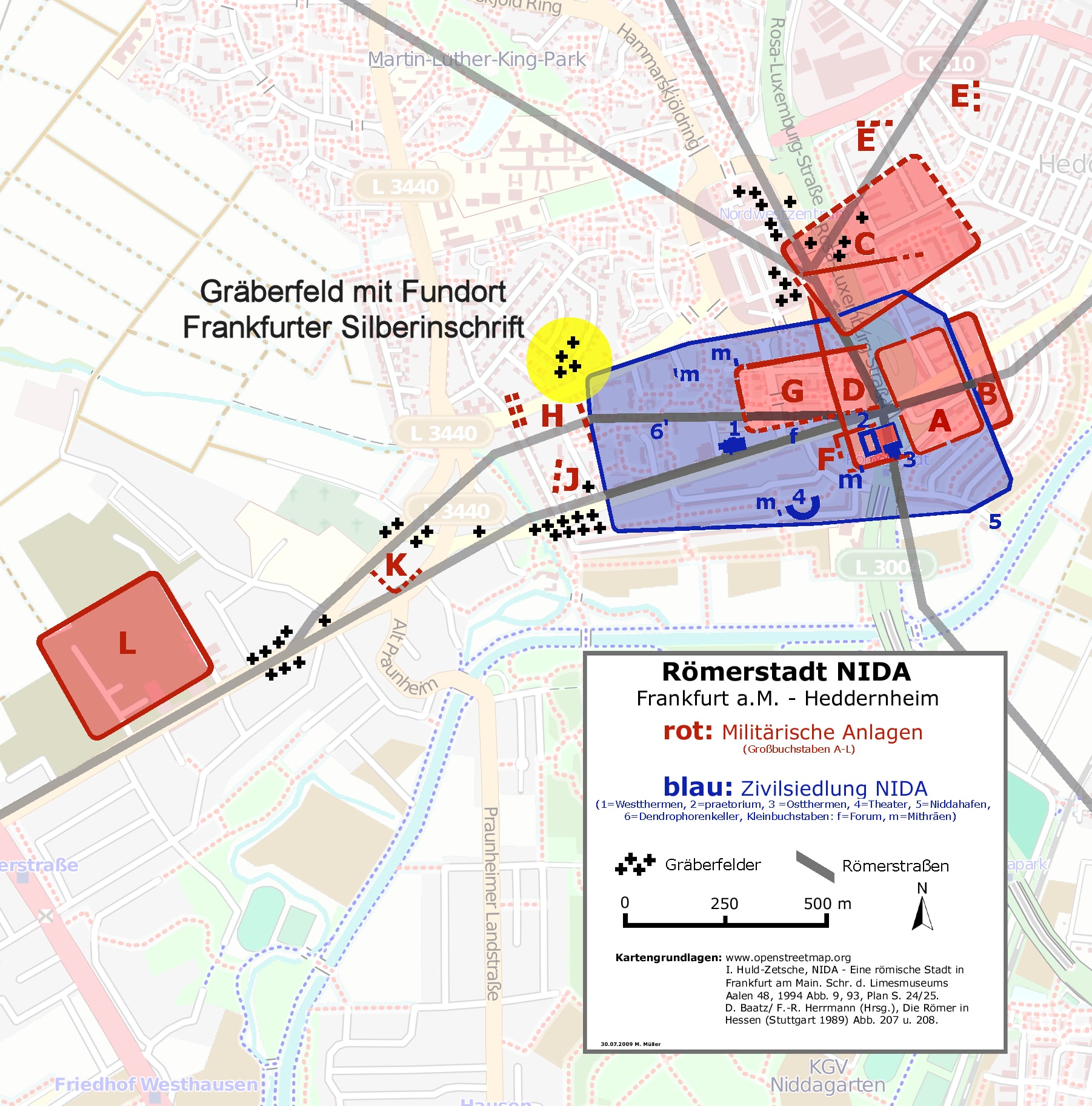
Plan of the Roman town of Nida and its forts in modern Frankfurt-Heddernheim. The yellow circle marks the burial ground where the silver inscription was found (labelled in German "Gräberfeld mit Fundort Frankfurter Silberinschrift"). Map: Haselburg-müller, with OpenStreetMap contributors, CC BY-SA 2.0, via Wikimedia Commons.

The text
The text is written in Latin cursive, mixing capital and small letters as everyday graffiti and curse tablets do. Two features come from Greek: the threefold agios ("holy"), written in Latin letters, and the abbreviated name of Jesus Christ, written IH XP with a line above the letters. That abbreviation is one of the nomina sacra, the reverent short forms for divine names that early Christian scribes used in Greek manuscripts of scripture.
The reading below follows Guijarro's published edition (Isidorianum 34/1, 2025, p. 38). Gaps and uncertain letters are many, especially at the start of lines. The English is the codex's rendering of that reading.
| Line | Latin (Guijarro's reading) | English |
|---|---|---|
| 1 | In nomine sancti Titi. | In the name of Saint Titus. |
| 2 | Agios, agios, agios. | Holy, holy, holy. |
| 3 | In nomine IH XP Dei f(ilii), | In the name of Jesus Christ, Son of God, |
| 4 | mundi dominus, | the Lord of the world |
| 5 | viribus omnibus | with all his strength |
| 6 | incursionibus oponit. | stands against attacks. |
| 7 | Deus valetudinibus | God grants to the sick |
| 8 | salvis accessum | access to |
| 9 | praestat. Haec salus tueat | health. May this salvation protect |
| 10 | hominem, qui se | the man who has |
| 11 | dedit voluntati | given himself to the will |
| 12 | Domini IH XP ti Dei f(ilii). | of the Lord Jesus Christ, Son of God. |
| 13 | Quoniam IH XPo | For to Jesus Christ |
| 14 | omnes genua flec- | all knees shall |
| 15 | tent, caelestes, | bend, those in heaven, |
| 16 | terrestres et | those on earth and |
| 17 | inferi, et omnis lin- | those below, and every |
| 18 | gua confiteatur. | tongue confess. |
Lines 7 to 9 are the hardest; Guijarro's own translation is closer to "God, to the diseases healed, grants access," and both he and Scholz mark the sense as uncertain. Scholz's earlier reading differs in several words of lines 5 to 9 and brackets the start of line 1 as uncertain. The invocation of Jesus Christ, the titles Son of God and Lord, the prayer for protection and the Philippians quotation are common to both readings.
The text falls into four parts:
- Invocation of Titus (lines 1 and 2), probably the companion of Paul to whom the letter to Titus is addressed (Titus 1:4), followed by the threefold "Holy" of Isaiah 6:3 and Revelation 4:8.
- Invocation of Jesus Christ (lines 3 to 9a), naming him Son of God and Lord of the world and crediting him with power against attack and illness.
- The request (lines 9b to 12): that this "salvation" protect the man who has given himself to the will of the Lord Jesus Christ.
- The scripture (lines 13 to 18): Philippians 2:10-11, quoted as the ground of the request.
The Philippians quotation
The amulet closes with the end of the Christ hymn of Philippians 2:6-11:
that in the name of Jesus every knee should bow, of things in heaven and things on earth and things under the earth, and that every tongue should confess that Jesus Christ is Lord, to the glory of God the Father. (Philippians 2:10-11, ASV)
Guijarro draws three observations from the way the amulet quotes it:
- It is introduced as scripture. The amulet joins the quotation with quoniam ("for, because"), where Paul's Greek has hina ("so that") and the Old Latin versions and Novatian (about 250) have ut. A causal "for" is how the New Testament and early Christian writers introduce a cited authority ("for it is written"). Guijarro concludes the writer treated Paul's words as sacred text.
- The plural is universal. "Every knee" becomes "all knees" (omnes genua), stressing that every power in heaven, on earth and below is subject to Christ, which is the point of an amulet against harm.
- The order is reversed. In Philippians, every knee bows because Christ humbled himself to death on a cross and was exalted. The amulet quotes only the exaltation, and Christ's universal lordship becomes the basis of his power to protect.
An early Latin witness. Latin translations of the New Testament circulated in North Africa by the late second century, yet the oldest surviving Latin manuscripts of Paul are much later. Novatian quotes these verses in Rome about the same time, but his works survive only in later copies. The Frankfurt foil is therefore the oldest surviving physical copy of these verses in Latin, written within roughly two centuries of the letter itself.
Paul's verses themselves take the oath of the LORD in Isaiah 45:23, "unto me every knee shall bow, every tongue shall swear" (ASV), and apply it to Jesus. The amulet carries that application to the Rhine frontier.
Significance
- Oldest Christian object north of the Alps. Irenaeus of Lyon (Against Heresies 1.10.2, about 180) already mentions churches "in Germany," so Christians were there earlier in the written record. Until this find, the earliest physical Christian evidence from the region dated to the fourth century. The Frankfurt amulet moves the archaeological record back by about a century.
- Devotion directed to Jesus alone. Many early amulets mix the names of Jesus, angels, Greek gods and magical words. This one invokes only Titus and Jesus Christ, with no pagan deities, demons or nonsense formulas. The excavators' announcement calls it purely Christian, and Guijarro's study agrees that the protective invocation is directed exclusively to Christ.
- High titles in a frontier setting. Jesus is "Son of God" twice, "Lord of the world," and, on Guijarro's reading, "God" in line 7. These titles echoed imperial language, and on a Roman military frontier the amulet gives the title "Lord of the world" to Jesus. This fits the Early High Christology Thesis: worship and invocation of Jesus as divine Lord show up wherever Christians show up, including in ordinary believers' devotion far from any church council.
- Early use of the threefold "Holy." The trisagion of Isaiah 6:3 is not otherwise attested on amulets before the fifth century, and its fixed place in the liturgy dates from the fourth. Buchinger and Guijarro note that the amulet either reflects a liturgical use much older than previously documented, or a direct borrowing from scripture that the liturgy later formalized.
- A Pauline milieu. A Pauline text, a Pauline companion, and the nomina sacra copied from manuscripts read aloud in worship suggest the writer belonged to, or learned from, a community that read Paul's letters.
- The name as reverent. The nomina sacra are used almost as symbols: the writer kept the Greek abbreviations inside a Latin text, apparently to honor the name visually.
What it does not show
- It does not reveal the man's full beliefs. Guijarro stresses that the text reflects the person who composed it more than the person who wore it. The wearer may have been a committed believer, a sympathizer, or someone given the amulet as a gift. In 2026 news coverage of his study, he suggested that in the third century "the boundaries of what we call Christianity were considerably more porous," so that a loosely attached wearer might not have treated obedience to an imperial order to sacrifice, such as Decius's edict of 250, as a betrayal of anything. He raises this as a historical possibility; the grave cannot settle it either way. The burial itself, an inhumation with a censer and a vessel, shows no clear Christian or pagan markers.
- It is a third-century devotional object quoting two verses. It is neither first-century evidence nor a manuscript of the New Testament.
- The reading is not final. The first line, the trisagion's reference, and lines 5 to 9 remain uncertain. Guijarro himself calls the invocation of Titus at the head of the text puzzling, since the invocation of saints was rare before the fourth century.
- Amulets were debated within the church. Later church writers and councils criticized protective amulets; canon 36 of the Council of Laodicea (fourth century) forbade clergy to make them. Robert Matthew Calhoun's survey of patristic opinion shows that amulets carrying only scripture and prayer were often tolerated where magical charms were condemned. The Frankfurt text belongs to the scripture-and-prayer type. It is a witness to everyday popular devotion, and should be read alongside the church's teachers rather than in place of them.
Comparable finds
- Ketef Hinnom Silver Scrolls: two rolled silver amulets from a Jerusalem tomb, late seventh or early sixth century BC, carrying the Priestly Blessing of Numbers 6:24-26. The same form, a scripture text on silver worn for protection, appears a thousand years earlier in Israel.
- Alexamenos Graffito: a hostile Roman cartoon of about AD 200 showing that outsiders knew Christians as worshippers of a crucified god. The Frankfurt amulet is the believer's side of the same period.
Evidential status
Genuine, excavated in context, and dated by grave goods; reading provisional in detail. The object comes from a controlled excavation, which removes the provenance doubts that hang over many artifacts. The core content (Jesus Christ, Son of God, Lord; Philippians 2:10-11) is common to both published readings. In the New Testament Archaeology Evidence Catalog it is graded B: a firm third-century witness to Christian devotion to Jesus and to the Latin text of Philippians, but indirect for the New Testament itself and later than the first century.
Scholarship
Published academic works this page draws on, each matched to a publisher, index or library catalog record.
- Robert Matthew Calhoun, "The Gospel(-Amulet) as God's Power for Salvation," Early Christianity 10 (2019). doi:10.1628/ec-2019-0004
See also
- New Testament Archaeology Evidence Catalog, the graded catalog
- Biblical Archaeology, the parent hub
- Ketef Hinnom Silver Scrolls, the Old Testament silver amulets carrying the Priestly Blessing
- Alexamenos Graffito, the hostile Roman witness from the same era
- Early High Christology Thesis, the case that Jesus was worshipped as divine from the start
- Christs Deity, the doctrine the amulet's titles bear on
- Philippians 2.6-11, the Christ hymn the amulet quotes
- Manuscripts, the manuscript evidence for the New Testament text
- Paul the Apostle, whose letter and companion the amulet invokes
Common questions this page answers
Q: What is the Frankfurt silver inscription?
It is an 18-line Latin prayer scratched on a rolled silver foil, found in a small silver amulet case under the chin of a man buried around AD 230 to 260 in the Roman town of Nida, now Frankfurt, Germany. It prays for protection in the name of Jesus Christ, Son of God, and quotes Philippians 2:10-11.
Q: How did scientists read the Frankfurt amulet without opening it?
The foil was too fragile to unroll. In 2024 the Leibniz Centre for Archaeology in Mainz scanned it with high-resolution CT and flattened it virtually, and Markus Scholz of Goethe University Frankfurt deciphered the letters from the digital images.
Q: Is the Frankfurt amulet the oldest evidence of Christianity in Germany?
It is the oldest known physical evidence of Christianity north of the Alps. Written sources are older: Irenaeus mentions churches in the German provinces around AD 180. Before this find, the earliest Christian objects from the region dated to the fourth century.
Q: What Bible verse is on the Frankfurt amulet?
Philippians 2:10-11, in Latin: all knees in heaven, on earth and below shall bow to Jesus Christ, and every tongue confess. It also uses the threefold "holy" of Isaiah 6:3. It is the oldest surviving physical copy of the Philippians verses in Latin.
Q: Does the Frankfurt amulet prove the man was a Christian?
Not by itself. The prayer is fully Christian, but scholars such as Santiago Guijarro point out that a text tells us most about whoever wrote it. The wearer may have been a committed believer or someone with looser ties to the faith. What the amulet does prove is that, by the mid-third century, someone on the Rhine frontier was writing prayers to Jesus as Son of God and Lord.
Q: What does the Frankfurt amulet say about Jesus?
It calls him Jesus Christ, Son of God (twice), Lord of the world, and, on one reading, God, and it grounds his power to protect in Paul's words that every knee bows to him. It invokes no pagan gods.