Concept
Faras Cathedral Frescoes
Faras Frescoes, Faras Cathedral, Faras Paintings, Faras Gallery, Pachoras Cathedral, Faras Cathedral PaintingsIntro
In the early 1960s, as Egypt prepared to build the Aswan High Dam and flood a long stretch of the Nile valley, archaeologists raced to save what they could. At Faras, on today's border between Egypt and Sudan, a Polish team led by Kazimierz Michałowski dug into a hill and found a buried cathedral. Sand had filled it for centuries and protected its walls. On them were well over a hundred paintings of Christ, Mary, angels, saints, bishops and Nubian kings, painted between roughly the 700s and the 1300s.
The team cut the paintings from the walls before the waters rose. Today about half of the ones removed are in the National Museum in Warsaw and the rest in the Sudan National Museum in Khartoum. The site of Faras itself now lies under Lake Nasser. These paintings are the best surviving window into the Christian kingdoms of Nubia, an African Christian civilization that lasted about a thousand years.
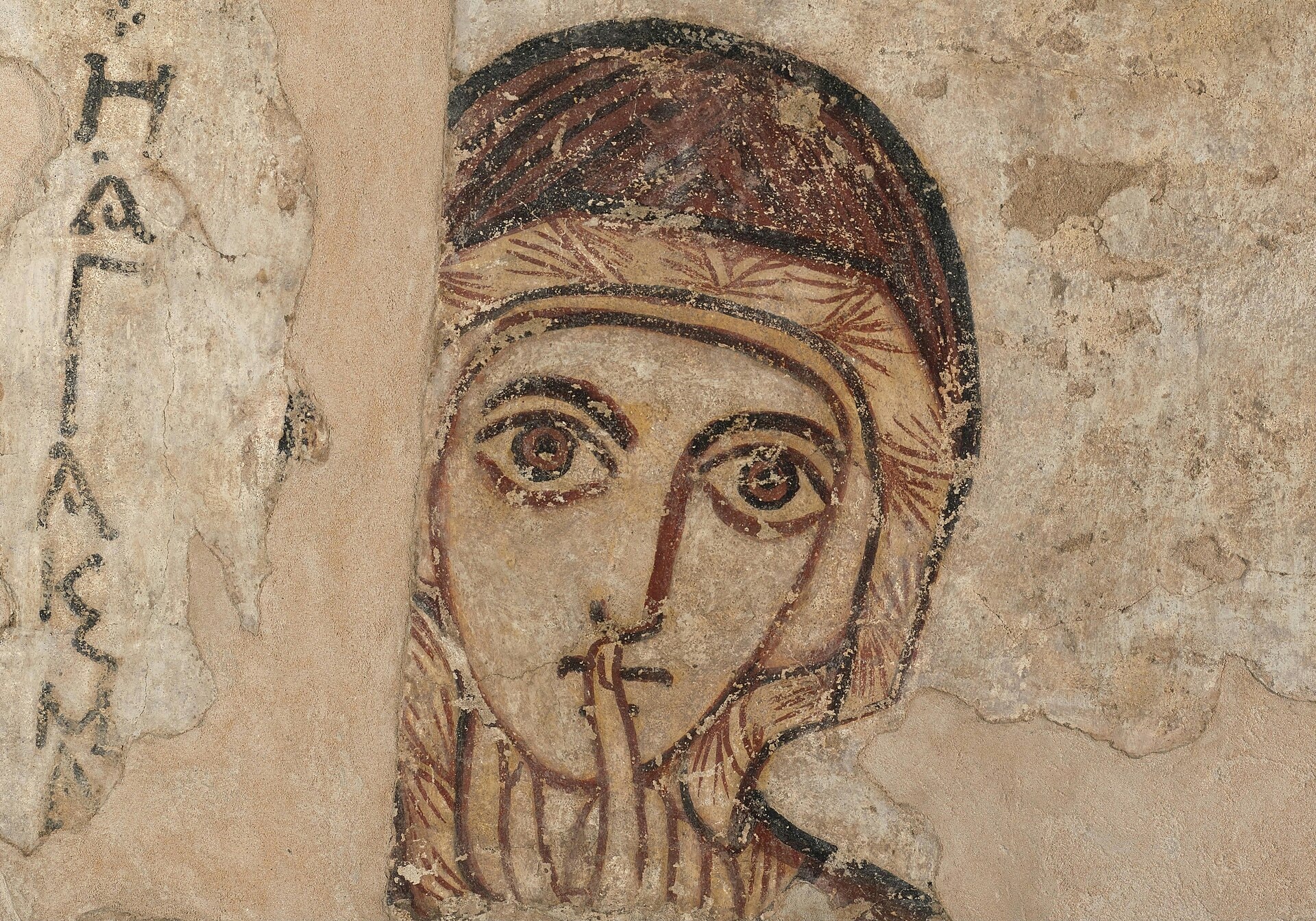 Saint Anne, wall painting from Faras Cathedral, eighth century, now in the National Museum in Warsaw. Public domain, via Wikimedia Commons.

See this page's graph and discover linked topics
In full
The Faras frescoes are the wall paintings of the cathedral of Pachoras (modern Faras), the capital of the Nubian kingdom of Nobadia and later the seat of the eparch of Nobadia within the kingdom of Makuria. The site was excavated from 1961 to 1964 by the Polish Centre of Mediterranean Archaeology of the University of Warsaw under Kazimierz Michałowski, as part of the UNESCO International Campaign to Save the Monuments of Nubia. The cathedral had several building phases: an earlier church of the seventh century, a cathedral associated with Bishop Paulos, whose foundation inscription commemorates work in 707, and a rebuilding under Bishop Petros I in the late tenth century. The paintings, executed in tempera on dry plaster, lie in several overlapping layers dated from the eighth to the fourteenth century. A painted list of the bishops of Faras, together with dated bishops' epitaphs, allowed the excavators to date many of the paintings by the episcopate in which they were made. Of 169 paintings uncovered, about 120 were removed; 66 or 67 (counts differ) went to the National Museum in Warsaw, where they are shown in the Professor Kazimierz Michałowski Faras Gallery (opened 1972, rearranged 2014), and the rest to the Sudan National Museum in Khartoum.
What the paintings show
- Christ and the Virgin. Several images of Mary with the Christ child, including Nubian royal figures under Mary's protection.
- Archangels. Michael is especially prominent, as protector of the kingdom and its rulers.
- Saints. Saint Anne, painted with a finger to her lips, is the best known single image, along with apostles, martyrs and holy monks.
- Bishops. Portraits of the bishops of Faras, among them Bishop Marianos and Bishop Petros with Saint Peter, a record of the church's own leadership.
- Kings and eparchs. Nubian rulers in rich court dress, shown protected by Christ and the saints, a visual theology of Christian kingship.
- Bible scenes. Including the Nativity and the three young men in the fiery furnace (Daniel 3).
Scholars have long noted that the faces of Nubian figures are often painted in darker tones than those of the saints and holy figures, who follow Byzantine and Coptic models. What this convention meant is discussed by art historians; the codex records the observation without building an argument on it.
Where they are now
| Place | Holding |
|---|---|
| National Museum in Warsaw, Faras Gallery | 66 or 67 paintings, plus inscriptions, architectural fragments and bishops' epitaphs |
| Sudan National Museum, Khartoum | The remaining removed paintings |
| Faras | The site is submerged beneath Lake Nasser |
The war in Sudan that began in 2023 has raised international concern for the collections in Khartoum. The codex does not record any specific losses, because none could be verified at the time of writing.
How they are dated
- Stratigraphy. The paintings lie in successive layers of plaster, so a lower layer is older than the one painted over it.
- The bishops' list. A painted list of the bishops of Faras on the cathedral wall, combined with dated epitaphs, gives a chronology of episcopates.
- Inscriptions. The foundation inscription of Bishop Paulos (707) and Greek, Coptic and Old Nubian captions name people and dates.
- Style. Kazimierz Michałowski and his successors grouped the paintings into stylistic phases (often described by dominant colour schemes) that track the building history.
Why they matter for the history of African Christianity
- They make a lost church visible. Without Faras, Christian Nubia would be known mainly from a handful of Greek, Syriac and Arabic texts. The paintings show its theology, worship and leaders.
- They show African Christians in African Christian art. Nubian kings, queens and bishops appear as themselves, alongside Christ and the saints, centuries before European contact.
- They document a self-governing church. The bishop list records a succession of Nubian bishops at one see over several centuries.
- They were saved by international cooperation. The UNESCO Nubia campaign, with Polish, Sudanese and Egyptian partners, preserved them from the dam.
Tensions
- Counts. Sources give 66 or 67 paintings for Warsaw and 1960 or 1961 for the start of work. The codex gives both.
- Interpretation of skin tones. Some writers read the darker rendering of Nubian figures as an expression of identity; others treat it as convention. The codex does not decide.
Scholarship
Published academic works this page draws on, each matched to a publisher, index or library catalog record.
- Stefan Jakobielski, A history of the Bishopric of Pachoras on the basis of Coptic inscriptions (1972). Open Library
See also
- Christian Nubia, the kingdoms whose church the cathedral served
- Coptic Orthodox Church, the Alexandrian church to which the Faras bishops belonged
- Garima Gospels, early Ethiopian Christian art from the same late-antique world
- Rock-Hewn Churches of Lalibela, another treasure of African Christian art and architecture
- Biblical Archaeology, the codex's archaeology hub
- African Christianity Pre-Colonial, the wider pre-colonial picture
- Africa and Christianity, master hub
Common questions this page answers
Q: What are the Faras frescoes?
Medieval Christian wall paintings from the cathedral of Faras in Nubia, on today's Egypt-Sudan border, painted between about the eighth and fourteenth centuries. They show Christ, Mary, angels, saints, bishops and Nubian rulers.
Q: Where are the Faras paintings now?
Divided between the National Museum in Warsaw, which displays 66 or 67 of them in its Faras Gallery, and the Sudan National Museum in Khartoum. The cathedral site lies under Lake Nasser.
Q: Who discovered the Faras Cathedral?
A Polish expedition led by Kazimierz Michałowski, working from 1961 to 1964 as part of the UNESCO campaign to save the monuments of Nubia before the Aswan High Dam flooded the area.
Q: How old are the Faras Cathedral paintings?
They lie in several layers dated from the eighth to the fourteenth century. A painted list of the bishops of Faras and dated inscriptions let scholars date many of them to particular episcopates.
Q: Why are the Faras paintings important?
They are the richest surviving record of Christian Nubia, a black African Christian civilization that lasted about a thousand years, and they show its kings, bishops and saints in its own art.