Concept
Ezana Stone and Aksumite Coins
Ezana Stone, Ezana Inscriptions, Aksumite Coins, Axumite Coins, Ezana Coins, Aksumite CoinageIntro
How do we know an African king became a Christian in the fourth century? Not only because church historians say so. King Ezana of Aksum left his own records in stone and in gold, and they show the change as it happened.
His early inscriptions call him the son of Mahrem, a war god. His later ones thank "the Lord of Heaven," and one Greek inscription invokes the Father, the Son and the Holy Spirit. His early gold coins show the pagan disc and crescent above his head. His later coins show the cross. These objects can still be seen: the inscribed stones stand at Aksum in Ethiopia, and Ezana's coins are held in museums such as the British Museum. Together they are some of the earliest physical evidence anywhere of a ruler publicly turning to Christ.
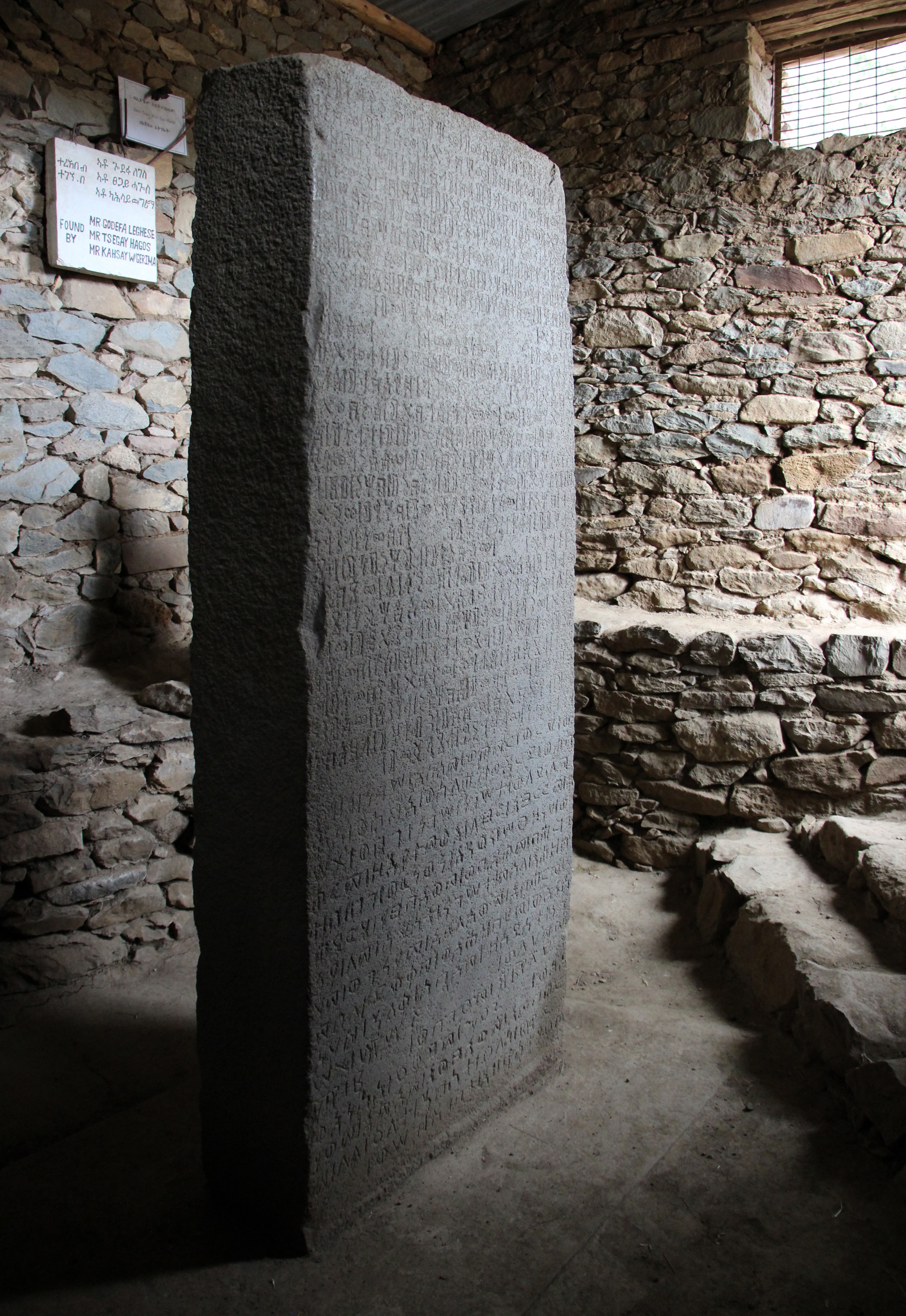 The inscribed Ezana Stone in its shelter at Aksum, Ethiopia. Photo: Sailko, CC BY 3.0 (Wikimedia Commons), resized.

See this page's graph and discover linked topics
In full
"Ezana Stone" is the popular name for the inscribed royal stelae of King Ezana of Axum (ruled c. 320s to c. 360), above all the stone that stands in a small shelter in the town of Aksum and carries a royal text in Greek, Ge'ez and South Arabian (Sabaic) script. Ezana's inscriptions as a group, recorded since the German Aksum Expedition of 1906 and supplemented by later finds, record military campaigns and the king's titles. Read in sequence, they show a religious shift: the earlier texts credit Mahrem (equated in the Greek with Ares) and other gods of the Aksumite pantheon; a Ge'ez inscription commemorating a campaign against the Noba credits "the Lord of Heaven"; and a Greek inscription found at Aksum in 1969 and published in 1970 by Francis Anfray, André Caquot and Pierre Nautin opens with an explicitly Trinitarian confession, in the faith of God and the power of the Father, the Son and the Holy Spirit.
Aksum minted coins from about AD 270 (King Endybis) to the early seventh century, in gold, silver and bronze, mostly with Greek legends. The gold issues of Ezana's early reign carry the disc-and-crescent emblem of the old religion; the later ones replace it with the cross, and crosses appear in the legends. Undated anonymous bronzes of Ezana or a successor introduce the Greek motto "may this please the country." Because coins name their kings, they are also the backbone of Aksumite chronology: of some twenty kings attested on coins, only Ezana and Kaleb of Aksum are also well attested in inscriptions.
What the objects are, and where they are now
| Object | What it is | Where it is now |
|---|---|---|
| The "Ezana Stone" | A large stele with a royal inscription of Ezana in three scripts: Greek, Ge'ez and South Arabian | Standing in a protective shelter in Aksum, Tigray, Ethiopia |
| The Ge'ez Noba campaign inscription | Ezana's account of an expedition against the Noba toward the Nile, thanking the Lord of Heaven | Aksum |
| The Greek Christian inscription | Found at Aksum in 1969; a Trinitarian invocation at the head of a royal text | Aksum (published 1970) |
| Ezana's gold coins | Pre-Christian issues with disc and crescent; Christian issues with the cross | Museum collections, including the British Museum (for example registration numbers 1989,0518.41 with disc and crescent and 1921,0316.1 with cross) |
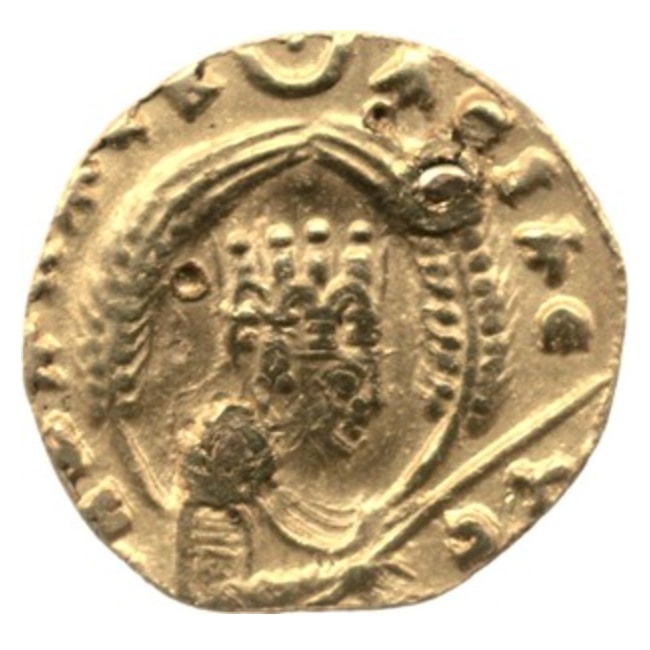 Gold coin of Ezana from before his conversion, with the pagan disc and crescent, c. 300-340. British Museum 1989,0518.41. Photo: Ismoon, CC BY-SA 4.0 (Wikimedia Commons).

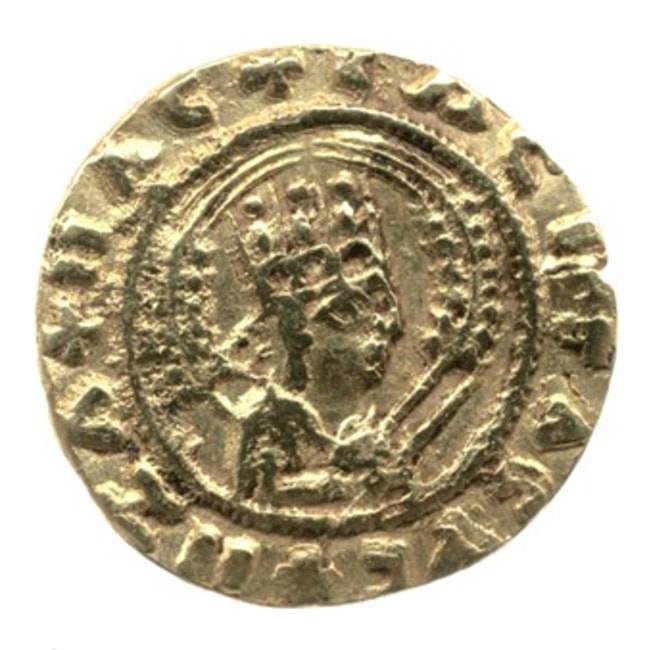 Gold coin of Ezana from after his conversion, with crosses in the legend. British Museum 1921,0316.1. Photo: Ismoon, CC BY-SA 4.0 (Wikimedia Commons).

How they are dated
- The coins are dated by the king's name, by style, and by weight standards. Aksumite gold followed Roman weight reforms, so a change in weight can be tied, roughly, to Roman dates. Some of Ezana's Christian gold matches the pre-324 Roman standard, which has led some numismatists to argue for an early conversion; most historians use the wider window of the 330s or 340s.
- The inscriptions are dated by naming Ezana, by their script and language, and by their link to the coin sequence. They cannot be dated to a single year.
- External anchors: the letter of Constantius II to "Aizanas and Sazanas," preserved by Athanasius (Apology to Constantius 31), fixes Ezana on the throne around 356, and Rufinus's narrative of Frumentius supplies the story of the conversion.
What they show
- A real conversion, publicly announced. The king's own propaganda changes its god. That is the strongest kind of ancient evidence for a royal conversion, because it is what the ruler chose to say to his subjects and to foreign traders.
- A careful transition. The "Lord of Heaven" texts are monotheistic without naming Christ, and some coins of Ezana and his father carry no religious symbol at all. Many historians read this as a deliberate, gradual public move from the old religion, followed by an explicit Christian confession.
- Nicene, Trinitarian faith. The Greek inscription's Father, Son and Holy Spirit formula fits the Athanasian connection of Aksum's first bishop. Some scholars have read its wording as deliberately anti-Arian; that reading is debated.
- The cross on money. Ezana's gold is among the earliest coinage anywhere to carry the cross. Some writers call it the very first; that claim depends on how one classes Constantine's coins with Christian symbols, so the codex says "among the earliest."
- Reach. Aksumite coins have been found in South Arabia, Egypt, the Levant and India, showing a Christian African state trading across the Indian Ocean world.
Why it matters for the history of African Christianity
- It is evidence that does not depend on later church memory or on European sources.
- It places a Christian African kingdom in the fourth century, alongside Constantine's Rome, not after European contact.
- It confirms the literary account of Rufinus at its core: a king named Ezana, a bishop named Frumentius, a switch of allegiance in the 330s or 340s.
See Kingdom of Aksum for the wider history and Christianity Is the White Mans Religion Objection Defeater for the apologetic use.
Tensions
- Which text is "the" Ezana Stone. Popular writing uses the name loosely for different Ezana inscriptions, including the pagan-phase trilingual and the Christian-phase texts. When citing it, name the specific inscription.
- The Noba campaign and Meroë. Some historians read Ezana's Noba inscription and a Ge'ez stela found at Meroë as evidence that Aksum destroyed the kingdom of Kush; others note that Meroë was already declining and that the inscription does not name it. The codex does not take a side.
Scholarship
Published academic works this page draws on, each matched to a publisher, index or library catalog record.
- Francis Anfray, André Caquot and Pierre Nautin, "Une nouvelle inscription grecque d'Ezana, roi d'Axoum," Journal des savants 4 (1970). doi:10.3406/jds.1970.1235 open access
- S. C. Munro-Hay and B. Juel Jensen, Aksumite coinage (1995). Open Library
See also
- Ezana of Axum, the king behind the inscriptions and coins
- Kingdom of Aksum, the kingdom and its conversion
- Frumentius, first bishop of Aksum
- Athanasius, who consecrated Frumentius and preserved the emperor's letter
- Kaleb of Aksum, the other Aksumite king attested in both coins and inscriptions
- Garima Gospels, the next great physical witness to Aksumite Christianity
- Biblical Archaeology, the codex's archaeology hub
- Africa and Christianity, master hub
Common questions this page answers
Q: What is the Ezana Stone?
A fourth-century inscribed stele at Aksum, Ethiopia, carrying a royal text of King Ezana in Greek, Ge'ez and South Arabian script. The name is also used loosely for Ezana's inscriptions as a group, which together record his turn from the old gods to Christianity.
Q: What do Ezana's inscriptions say about Christianity?
Earlier ones call Ezana the son of the war god Mahrem. A later Ge'ez inscription thanks the Lord of Heaven, and a Greek inscription found in 1969 begins with faith in God and the power of the Father, the Son and the Holy Spirit.
Q: Were Aksumite coins the first coins with a cross?
Ezana's gold coins are among the earliest coins anywhere to carry the Christian cross, minted in the mid-fourth century. Whether they are the very first depends on how Constantine's coins with Christian symbols are classed, so "among the first" is the safer claim.
Q: Where can you see Ezana's coins today?
Aksumite coins are held in several museum collections. The British Museum has gold coins of Ezana both from before his conversion, with a disc and crescent, and from after it, with the cross.
Q: How are Ezana's coins and inscriptions dated?
By the king's name, by style and script, and by weight standards that follow Roman reforms, anchored by a letter of Emperor Constantius II from about 356 that names Ezana as king. The conversion is usually placed in the 330s or 340s.
Q: Does archaeology confirm the story of Frumentius?
It confirms the core of it. The coins and inscriptions show Ezana turning to Christianity in the period Rufinus describes, and the emperor's letter preserved by Athanasius names Ezana and Frumentius together.