Argument
Exodus 21 Beating Slaves Objection Defeater
beat slaves, beating slaves, beat your slaves, Bible allows beating slaves, Bible says you can beat slaves, slave beating Bible, can you beat your slave Bible, he is his money, for he is his money, Exodus 21:20-21, Exodus 21:21 objection, beat a slave with a rod, Exodus 21 slavery objection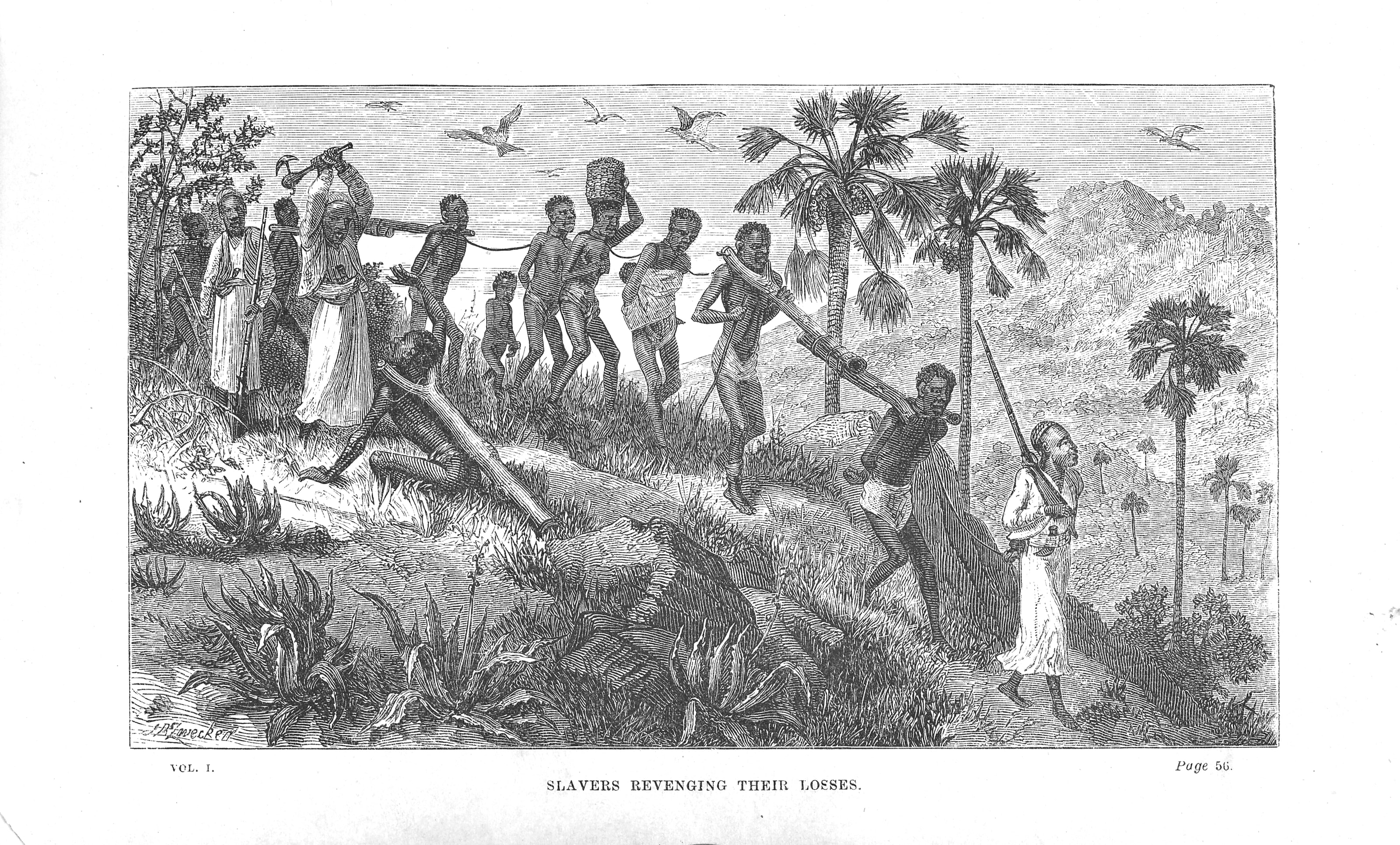
"Slavers Revenging their Losses," a coffle of captives driven toward the East African coast, engraved from David Livingstone's sketches of what he saw in 1866. Seizing and selling a person, the act this picture shows, is a capital crime in the same chapter of Exodus the objection quotes. From Horace Waller, ed., The Last Journals of David Livingstone in Central Africa (London, 1874). Public domain, via Wikimedia Commons.
Intro
"The Bible says you can beat your slave, and as long as he lives a day or two you won't be punished, because he is your money." This is one of the most quoted lines in the case against the Bible, and it comes from Exodus 21:20-21.
Read the whole paragraph and a different picture appears. Exodus 21 is written as case law: "if a man does this, then that follows." A law written that way puts a price on an act. Modern assault laws work the same way, and nobody reads an assault statute as a permission slip.
Here is what the paragraph actually says. If a master strikes his servant and the servant dies, the master "shall surely be punished," with the doubled verb Hebrew uses for a mandatory sentence. If the master destroys his servant's eye or knocks out a tooth, the servant walks out free. A few verses earlier, kidnapping a person to sell him carries the death penalty. And elsewhere in the law, a servant who runs away from his master may not be sent back.
The hard part is verse 21: if the servant survives a day or two, the master is "not punished," "for he is his money." The phrase names the master's loss. The servant's time off work is time the master has paid for, so the master bears the cost, the same way a free man who injures another pays for the lost time in verses 18-19.
The quick reply for live conversation: "Exodus 21 puts penalties on a master's violence: vengeance if the servant dies, freedom for the servant if he loses an eye or a tooth. Reading a penalty clause as a permission is like reading an assault law as a license to hit people."
See this page's graph and discover linked topics
Cheatsheet
The 30-second reply:
Exodus 21 is case law, and case law attaches penalties to acts. A law that says "if you do X, this is your sentence" gives nobody permission to do X, the same way an assault statute gives nobody permission to hit. In this paragraph a master who kills his servant "shall surely be punished," a master who costs his servant an eye or a tooth loses the servant to freedom, and the man who kidnaps a person to sell him is put to death. Verse 21's "he is his money" names the master's own financial loss when the injured servant cannot work.
The fast facts:
- Reading a sanction as a permission is the error (ris3n's lead point). Exodus 21:18-27 is casuistic law, "And if a man smite his servant..." Laws of this form attach a consequence to an act; reading them as grants of permission misreads the genre.
- Killing a servant triggers the doubled verb. "He shall surely be punished" (Exodus 21:20, ASV) doubles the Hebrew verb naqam, "to avenge"; the KJV margin reads "Heb. avenged."
- An eye or a tooth buys the servant's freedom. "He shall let him go free for his eye's sake" (Exodus 21:26, KJV), and the same for a tooth (21:27).
- "His money" is the word for silver. The Hebrew kesef is the same word used for the "thirty shekels of silver" paid for a gored servant in Exodus 21:32.
- The runaway is protected. "Thou shalt not deliver unto his master a servant that is escaped from his master unto thee" (Deuteronomy 23:15, ASV).
The 3 strongest counter-moves:
- "Does an assault statute give you permission to hit anyone who survives?" Make the objector apply his reading rule to a law he knows.
- "Read verse 26 to me." The same paragraph frees a servant for a lost tooth, which no reading of verse 21 as a license to beat can survive.
- "Where else in the ancient world does an injured slave walk free?" The codex's comparative-law hub records Hammurabi paying the owner when another man destroys his slave's eye; Exodus frees the slave whose own master destroys it.
Reciprocal concessions (grant the small point, then collect a bigger one):
- Grant: verse 21 is a hard verse, and it does not treat master and servant as equals. Now collect: the same paragraph gives the servant a legal claim against his own master for an eye or a tooth, so the servant has standing in court, which is the very thing chattel law denied.
- Grant: the survival clause lets the master escape the death-related penalty of verse 20. Now collect: that makes verse 20 a homicide law that binds masters, so the objector's own text proves a master could be punished for killing his servant.
- Grant: "he is his money" is economic language. Now collect: then the clause is about who bears the financial loss, and the Mosaic code consistently puts that loss on the master, all the way up to losing the servant entirely for a tooth.
The closing line:
Exodus 21 prices a master's violence: his servant's death brings vengeance, his servant's eye or tooth costs him the servant. Reading that as a license to beat is reading a sentence as a permission.
In full
Debate-prep defeater for the New-Atheist and evilbible.com reading of Exodus 21:20-21 as divine permission to beat slaves. The defense runs in three layers. First, an argument from legal form, developed by ris3n: the Covenant Code's servant statutes are casuistic case law, and casuistic law attaches sanctions to acts without granting permission to commit them, the same structure as modern criminal statutes. Second, a close reading of the paragraph's own grammar and its neighbors: the doubled verb of verse 20, the forensic and economic sense of verse 21 read against the parallel case of verses 18-19, the injury manumission law of verses 26-27, the capital kidnapping statute of verse 16, and the runaway asylum law of Deuteronomy 23:15-16. Third, a comparative-law check against the Code of Hammurabi as the codex already documents it.
This page is the focused defeater for one text. The full four-pillar case against equating biblical servitude with chattel slavery lives at Biblical Slavery Objection Defeater, and ris3n's paper Defining Chattel Slavery and Biblical Servitude develops the full case, including the treatment of "he is his money" as kesef, the master's financial loss.
Grammar and hermeneutics
The objection turns on a text, so the text settles it before any appeal to history or theology.
- Lead point: the objector reads a sanction as a permission (ris3n's argument from legal form). Exodus 21:18-27 is casuistic case law. Each unit opens with a conditional, "And if men contend..." (21:18), "And if a man smite his servant..." (21:20), "And if a man smite the eye of his servant..." (21:26), and closes with a consequence. A law of that form sets a penalty for an act. Its subject is what happens to the offender. Modern criminal codes are written the same way: an assault statute defines the offense and attaches a penalty, and no court reads it as permission to assault anyone who survives. Verse 20 attaches a sanction to a master's violence when the servant dies; verses 26-27 attach a sanction when the servant loses an eye or a tooth. The objection treats the silence of a penalty clause as approval of the act it penalizes, which is the one reading the legal form rules out.
- Verse 20 uses the doubled verb. "He shall surely be punished" (Exodus 21:20, ASV) is the Hebrew infinitive absolute plus finite verb of naqam, "to avenge" (naqom yinnaqem), which YLT renders "he is certainly avenged" and the KJV margin glosses "Heb. avenged." The doubled construction is Hebrew's mandatory-sentence form, the same grammar as mot yumat, "he shall surely be put to death," in the kidnapping law of 21:16 and the homicide law of 21:12. The paragraph opens by binding masters under homicide law.
- Verse 21 sits in the frame of verses 18-19. Verses 18-19 handle a fight between free men where the injured man survives: the striker is "quit," "only he shall pay for the loss of his time, and shall cause him to be thoroughly healed" (Exodus 21:19, ASV). The KJV margin on "the loss" reads "Heb. his ceasing," the time he cannot work. Verse 21 is the servant version of the same survival case. The lost working time belongs to the master, "for he is his money" (Exodus 21:21, ASV), so the master bears that loss himself. The clause names who pays.
- "His money" is kesef, silver. The word in verse 21 is kesef (Strong's H3701), the ordinary word for silver and money, and the same word appears in "thirty shekels of silver" in Exodus 21:32. ris3n's paper notes the point: the phrase registers the master's financial stake in the servant's labor. The WEB's "for he is his property" is an interpretive rendering; ASV, KJV and YLT all keep "money."
- "Continue a day or two" is the evidentiary line. The verb is amad (Strong's H5975), "to stand"; the KJV and ASV render it "continue" and the WEB "gets up." Verse 20 covers death "under his hand," death during the beating itself, where causation and intent are plain. Verse 21 covers survival, where they are not. The same chapter draws the line between deliberate killing and unintended death in 21:12-14.
- Verses 26-27 make freedom the remedy for injury. "He shall let him go free for his eye's sake" and "for his tooth's sake" (Exodus 21:26-27, KJV). The remedy runs to the servant himself, and it costs the master the whole relationship. A tooth is a small injury, which is the point: the threshold for losing the servant is low.
- The protections carry no ethnic qualifier. Verses 20 and 26-27 say "his servant, or his maid," with no restriction to Israelites, as Israelite Slavery Possession-vs-Ownership Defeater notes.
- The surrounding law closes the escape routes. "And he that stealeth a man, and selleth him, or if he be found in his hand, he shall surely be put to death" (Exodus 21:16, KJV). And the runaway law: "he shall dwell with thee, in the midst of thee, in the place which he shall choose within one of thy gates, where it pleaseth him best: thou shalt not oppress him" (Deuteronomy 23:16, ASV). A servant beaten by his master could leave, and no Israelite could hand him back.
- The hermeneutical rule the objection breaks. Case law regulates a situation the lawgiver finds in place, and a sanction for an act tells you what the act costs. Reading "he shall not be punished" in verse 21 as "he may beat" requires ignoring the genre, the parallel case in verses 18-19, the doubled verb in verse 20, and the manumission law six verses later.
On legal form (the objection reads a sanction as a permission), grammar (the doubled naqam, kesef as silver, amad as survival) and context (verses 18-19, 26-27, 16, and Deuteronomy 23:15-16) alone, "the Bible lets masters beat their slaves" is a reading these verses do not support.
Argument structure
| # | Premise | Status |
|---|---|---|
| P1 | Exodus 21:18-27 is casuistic case law, and case law attaches sanctions to acts without granting permission to commit them | Legal-form argument (ris3n) |
| P2 | Verse 20 subjects a master who kills his servant to mandatory punishment under the doubled verb naqom yinnaqem | Grammar of the text |
| P3 | Verse 21's survival clause, read with verses 18-19, assigns the cost of lost working time to the master, "for he is his money" | Parallel-case reading |
| P4 | Verses 26-27, 16 and Deuteronomy 23:15-16 make injury a ground for freedom, kidnapping a capital crime, and flight a protected act | Surrounding statutes |
| C | Therefore Exodus 21:20-21 penalizes a master's violence and gives no permission to beat a servant | Conclusion |
Master objections to the whole argument
MO1, "Any law that only punishes death or maiming still allows ordinary beating"
The law addresses the cases a court would see: death and lasting injury. The threshold it sets for the servant's freedom is a tooth, which is about as low as a bodily-injury threshold goes. The rest of the law fills in the master's duty: "Thou shalt not rule over him with rigor, but shalt fear thy God" (Leviticus 25:43, ASV), for the Hebrew servant, and for every servant the right to leave and not be returned (Deuteronomy 23:15-16). Job lists despising "the cause of my man-servant or of my maid-servant" among sins, and grounds it in creation: "Did not he that made me in the womb make him?" (Job 31:15, ASV).
MO2, "Joshua Bowen and other credentialed scholars read verse 21 as property language"
Joshua Bowen makes the strongest current version of the objection, and the honest move is to concede that verse 21 values the master's loss and does not equalize the parties, as the codex's passage page on Exodus 21:20-21 already states. The concession does not reach the claim that the verse permits beating. Property language about the cost of an injury sits in a paragraph that also frees the servant for the injury, which is a right no owner's property holds against him.
MO3, "The New Testament keeps the system intact"
Paul tells masters to give up threats: "ye masters, do the same things unto them, forbearing threatening: knowing that your Master also is in heaven; neither is there respect of persons with him" (Ephesians 6:9, KJV). He tells them to "give unto your servants that which is just and equal" (Colossians 4:1, KJV). The New Testament trajectory is developed at Biblical Slavery Objection Defeater.
P1, Exodus 21:18-27 is case law, and case law sanctions acts without permitting them
Affirmative case (second-order arguments)
- The form of the text. Each unit of 21:18-27 opens with "And if" and closes with a consequence. That is the casuistic form of ancient law collections, the form of a court's case book. Its subject is what the offender owes.
- The modern parallel (ris3n). A US assault statute defines assault and attaches a penalty. Nobody reads it as permission to assault anyone who survives. Exodus 21 is built the same way, and the same reading rule applies.
- The moral command sits elsewhere. Israel's law states its absolutes in apodictic form ("Thou shalt not...") and its court cases in casuistic form. The duty toward the servant appears in apodictic form at Leviticus 25:43 and Deuteronomy 23:15-16. The case law prices violations.
- The objector's mistake has a name. Reading a sanction as a permission treats the boundary of a penalty as the boundary of what is allowed. No legal system can be read that way, because every penalty clause has cases it does not cover.
Anticipated objections
- "If God disapproved of beating, the law would say 'do not beat your servant.'"
- "The modern analogy fails, because a modern assault law punishes any assault, while Exodus 21:21 explicitly says 'he shall not be punished.'"
- "Ancient readers would have taken the absence of a penalty as permission."
- "Does Exodus 21 permit masters to beat slaves if they don't die?"
Rebuttals
- The code does say it, in apodictic form. "Thou shalt not rule over him with rigor" (Leviticus 25:43, ASV) and "thou shalt not oppress him" (Deuteronomy 23:16, ASV) are the commands. The case law of Exodus 21 tells a judge what penalty follows when the command is broken.
- Modern law has the same survival distinction. Modern codes grade the same blow differently depending on its result: a death brings a homicide charge, a lesser injury a lesser charge. Exodus 21:21 removes the verse 20 penalty when death does not follow, and verses 18-19 show what remains in survival cases between free men: the striker pays for lost time and healing. For the servant, the master already bears that loss, "for he is his money," and verses 26-27 add the loss of the servant himself for lasting injury.
- Israel's own readers were told the opposite. The same law that contains Exodus 21 says "thou shalt not oppress him" of the runaway servant and grounds the servant laws in Israel's own memory: "thou shalt remember that thou wast a bondman in the land of Egypt, and Jehovah thy God redeemed thee" (Deuteronomy 15:15, ASV).
- The answer is the legal form itself. Verse 21 states when the verse 20 penalty does not apply. It does not create a right to beat; a penalty clause has no power to create one. The master who beats still loses the servant's labor during recovery, loses the servant entirely for an eye or a tooth (21:26-27), and cannot recover a servant who flees (Deuteronomy 23:15-16). The objector is reading a sanction as a permission.
Live-cite kit
- Scripture: Exodus 21:19 (the free-man survival case); Exodus 21:20 (the doubled verb); Leviticus 25:43; Deuteronomy 23:16
- Aphorism: "A sentence is not a permission slip."
Tactical notes
- Lead with the assault-statute analogy. It is the one point the objector can test against a law he already knows.
- Then read verses 18-19 aloud before verse 21. The parallel case does the work.
P2, Verse 20 binds masters under mandatory punishment
Affirmative case
- The doubled verb. Naqom yinnaqem, "he shall surely be punished" (Exodus 21:20, ASV), with the KJV margin "Heb. avenged."
- The same grammar as the capital statutes. The paragraph's other doubled-verb sentences are the death penalties for murder (21:12) and kidnapping (21:16).
- The victim is "his servant, or his maid." The master's own servant is the protected party, so the master's household authority gives him no immunity.
Anticipated objections
- "'Punished' is vague. It could mean a fine."
- "Avenged by whom? A slave has no family to avenge him."
Rebuttals
- The doubled verb rules out a casual reading. Commentators differ on the exact penalty, and the codex does not claim more than the text gives; the text gives a mandatory sanction in the doubled Hebrew form, framed by the homicide law of 21:12-14.
- The law itself guarantees the vengeance. The verb is passive, "he shall be avenged," so the text names no private avenger; the sanction is written into the ordinances Israel's judges administered, and the next case in the same paragraph has the offender pay "as the judges determine" (Exodus 21:22, ASV).
Live-cite kit
- Scripture: Exodus 21:12; 21:16; 21:20
- Aphorism: "The first clause of the verse the objector quotes is a homicide law against masters."
P3, Verse 21 assigns the master's loss to the master
Affirmative case
- The parallel case. Exodus 21:18-19: the free striker pays "for the loss of his time" and the healing.
- The servant version. In 21:21 the lost time is the master's own, "for he is his money," so no payment runs from master to master.
- The word is silver. Kesef, as in the "thirty shekels of silver" of 21:32.
Anticipated objections
- "Calling a person 'money' is dehumanizing regardless of the reason."
- "The WEB and several modern translations say 'property.'"
Rebuttals
- Concede the discomfort, then read the paragraph. The phrase states the master's economic stake, and the codex does not soften it. The same paragraph gives the servant a claim to freedom against the master (21:26-27), a right an object cannot hold.
- The Hebrew says silver. ASV, KJV and YLT render "money"; "property" is a translator's interpretation of kesef, as ris3n's paper argues.
Live-cite kit
- Scripture: Exodus 21:19, 21:21, 21:32
- Aphorism: "'His money' tells you who pays for the lost days."
P4, The surrounding statutes free the injured, kill the kidnapper and shelter the runaway
Affirmative case
- Eye and tooth. Exodus 21:26-27, freedom as remedy.
- Kidnapping. Exodus 21:16, death for stealing and selling a person.
- Asylum. Deuteronomy 23:15-16, the runaway lives where he chooses.
- Comparative law. The codex's ANE Legal Codes, Comparative Context hub records that Hammurabi section 199 treats destroying another man's slave's eye as damage paid to the owner at half the slave's value, and that sections 15-19 punish harboring a fugitive slave. Exodus frees the injured slave and forbids returning the runaway.
Anticipated objections
- "The eye-and-tooth law shows that beating was normal enough to need regulating."
- "Runaway asylum applied only to foreign slaves fleeing into Israel."
Rebuttals
- A law against an act shows the act happened. Every assault statute shows that people assault. What the statute shows about the lawgiver is that he puts a cost on it, here the highest cost a master could pay short of death.
- The scope question is debated, and the text's grammar is plain. Interpreters differ on whether Deuteronomy 23:15-16 covers only fugitives from abroad. On any reading the statute forbids returning a fugitive to his master and gives him the choice of residence, which is the inverse of the Hammurabi rule.
Live-cite kit
- Scripture: Exodus 21:16; 21:26-27; Deuteronomy 23:15-16
- Scholarly: Paul Copan, Is God a Moral Monster? (2011), chapters on slavery; Christopher Wright, Old Testament Ethics for the People of God (2004)
Live-cite kit
Scripture
And if a man smite his servant, or his maid, with a rod, and he die under his hand; he shall surely be punished. (Exodus 21:20, ASV)
if he rise again, and walk abroad upon his staff, then shall he that smote him be quit: only he shall pay for the loss of his time, and shall cause him to be thoroughly healed. (Exodus 21:19, ASV)
And if he smite out his manservant's tooth, or his maidservant's tooth; he shall let him go free for his tooth's sake. (Exodus 21:27, KJV)
Thou shalt not deliver unto his master a servant that is escaped from his master unto thee: (Deuteronomy 23:15, ASV)
Scholarly
- Paul Copan, Is God a Moral Monster? (2011), the systematic apologetic reply to evilbible-style readings of the servant laws.
- Christopher Wright, Old Testament Ethics for the People of God (2004), the evangelical treatment of Israel's servant laws as protection for the vulnerable.
- Defining Chattel Slavery and Biblical Servitude, ris3n's paper, including the kesef reading of verse 21.
Aphorisms
- "A sentence is not a permission slip."
- "Knock out a tooth, lose a servant."
Tactical notes
- Open with the legal form. Ask whether an assault statute gives permission to hit anyone who survives.
- Read verses 18-19 before verse 21. Let the parallel case define "not punished."
- Then verse 20's doubled verb, then verses 26-27. Death brings vengeance; a tooth brings freedom.
- Close with Deuteronomy 23:15-16. A servant could leave a violent master and no one could return him.
What NOT to defend: do not claim verse 21 treats master and servant as equals, and do not claim the codex knows the exact penalty of verse 20. Both overreach, and neither is needed.
Connection to Scripture
- Exodus 21:12-14, homicide and the line between intent and accident
- Exodus 21:16, kidnapping is capital
- Exodus 21:18-19, the free-man survival case
- Exodus 21:20-21, the servant case read in that frame
- Exodus 21:26-27, freedom for an eye or a tooth
- Exodus 21:32, kesef as silver
- Leviticus 25:43, no rule with rigor
- Deuteronomy 15:15, remember Egypt
- Deuteronomy 23:15-16, runaway asylum
- Job 31:13-15, the servant's cause and the common Maker
- Ephesians 6:9; Colossians 4:1, masters under a Master
Scholarship
Published academic works this page draws on, each matched to a publisher, index or library catalog record.
- Paul Copan, Is God a Moral Monster? (2011). Open Library
- Christopher J. H. Wright, Old Testament Ethics for the People of God (2004). Open Library
See also
- Biblical Slavery Objection Defeater, the full four-pillar case and the New Testament trajectory
- Biblical Slavery Objection, the companion concept hub for the objection as a whole
- Defining Chattel Slavery and Biblical Servitude, ris3n's paper developing the full case
- Chattel Slavery vs Biblical Servitude, the lexical and structural distinction
- Slavery, the search-landing page for the broader question
- Israelite Slavery Possession-vs-Ownership Defeater, the possession and ownership distinction, with its own reading of verse 21
- Why Didnt God Ban Slavery Objection Defeater, why the law regulated servitude and banned man-stealing
- Forever Slavery Objection Defeater, the "for ever" servant of Exodus 21:6
- ANE Legal Codes, Comparative Context, Hammurabi and the Covenant Code compared
- Four Pillars of Chattel Slavery, the structural definition behind the test
- Spare the Rod Objection Defeater, the companion defeater on the rod in Proverbs
- Joshua Bowen, the strongest current critic of the biblical servant laws
Common questions this page answers
Q: Does the Bible allow you to beat your slaves?
Exodus 21 is case law that attaches penalties to a master's violence. A master whose servant died under his hand "shall surely be punished," and a master who destroyed a servant's eye or knocked out a tooth had to let the servant go free (Exodus 21:20, 26-27).
Q: Does Exodus 21 permit masters to beat slaves if they don't die?
Exodus 21:18-27 is written in "if a man does X, then Y" form, which sets a penalty for an act and grants no permission, the same way an assault statute gives no one permission to hit people who survive. Verse 21 only says the verse 20 penalty for a death does not apply; the master still bears the lost working time and loses the servant entirely for an eye or a tooth.
Q: What does "for he is his money" mean in Exodus 21:21?
The Hebrew word is kesef, silver or money, the same word as the "thirty shekels of silver" in Exodus 21:32. It names the master's financial stake: the servant's lost working time is the master's own loss, so the master bears it, much as a free man who injures another pays for his lost time in verses 18-19.
Q: Was a master punished for killing his slave in the Old Testament?
Yes. Exodus 21:20 says "he shall surely be punished," using the doubled Hebrew verb naqam, "to avenge," which is the law's mandatory-sentence form. The KJV margin reads "Heb. avenged."
Q: Why does Exodus 21:21 say the master is not punished if the slave survives a day or two?
Verse 20 covers death "under his hand," during the beating itself, where causation is plain; verse 21 covers survival, where it is not. The same chapter draws the line between deliberate and unintended killing in 21:12-14, and verses 18-19 give the parallel survival case between free men.
Q: What happened if a master knocked out a slave's eye or tooth in the Bible?
The servant went free. "He shall let him go free for his eye's sake," and the same for a tooth (Exodus 21:26-27, KJV). The remedy ran to the servant himself and cost the master the whole relationship.
Q: Could a beaten slave run away in ancient Israel?
Yes, and no one could send him back. Deuteronomy 23:15-16 forbids delivering an escaped servant to his master and lets him live "in the place which he shall choose," adding "thou shalt not oppress him."
Q: How does Exodus 21 compare to the Code of Hammurabi on slaves?
As the codex's ANE legal-codes hub documents, Hammurabi section 199 pays the owner half a slave's value when another man destroys that slave's eye, and sections 15-19 punish anyone who harbors a runaway. Exodus frees the injured servant and forbids returning the runaway.
Q: Is Exodus 21:20-21 about the same kind of slavery as the Atlantic slave trade?
The same chapter makes kidnapping a person to sell him a capital crime (Exodus 21:16), which was the defining act of the Atlantic trade. The full four-pillar comparison is at Biblical Slavery Objection Defeater and in ris3n's paper Defining Chattel Slavery and Biblical Servitude.
Q: Does the New Testament let masters mistreat their slaves?
Paul tells masters to forbear "threatening: knowing that your Master also is in heaven; neither is there respect of persons with him" (Ephesians 6:9, KJV), and to give servants "that which is just and equal" (Colossians 4:1, KJV).