Argument
Eve From the Rib of Adam Objection Defeater
Eve from Adam's rib, how could a woman come from a man's rib, how can a female come from a male biologically, Adam's rib, creation of Eve from a rib, do men have one less rib, tsela rib or side, woman made from man's side, Eve rib objectionIntro
"God took a rib out of Adam and made a woman from it. That is biologically impossible." This is one of the most common jokes made about Genesis, and underneath the joke is a fair question: how could a female body come from a male one?
The short answer has three parts. First, the Bible presents this as a direct act of God, in the same chapter where God forms the man from the dust. It never offers a natural process, so the question "which biological process did this?" asks the text something it does not claim. Second, the Hebrew word usually translated "rib" mostly means "side," as in the side of a building or the side of the ark of the covenant, and the point of the story is that the woman shares the man's very nature. Third, when biology does speak to the details, what it says fits the story surprisingly well: a rib is the one bone in the body that grows back when its outer sheath is left in place, and a man's cells already carry the X chromosome a woman's body is built from. Those facts prove nothing about how God worked, but they show the narrative is coherent. And the popular idea that men have one fewer rib than women is simply false, and the Bible never says it.
See this page's graph and discover linked topics
In full
The objection treats Genesis 2:21-22 as a claim about biological mechanism and then finds no mechanism. The text, however, is a wayyiqtol narrative chain whose every main verb has YHWH Elohim as subject: He causes a tardēmāh (deep sleep) to fall, takes one of the man's tsēlā'ōt, closes up the flesh, and builds (wayyiḇen, from bānāh) the tsēlā' into a woman. The account claims divine agency on the same footing as the formation of the man from the ground at Genesis 2:7. A miracle claim is answered by arguing about whether God exists and acts, and that argument is made elsewhere in the codex (Miracles). Within that frame, three further lines close the objection. Lexically, tsēlā' (Strong's H6763) occurs some forty times in the Hebrew Bible and outside Genesis 2 it never denotes an anatomical rib: it is the side of the ark of the covenant, the sides and boards of the tabernacle, the side-chambers of Solomon's and Ezekiel's temples, the leaves of a door and a hillside. Coupled with the building verb, the image is architectural: God builds the woman from a side of the man, and the man's response at Genesis 2:23 ("bone of my bones, flesh of my flesh," with the 'îš/'iššāh wordplay) reads the act as establishing a shared nature. Biologically, two facts illustrate coherence without being offered as proofs: rib bone and cartilage regenerate when the periosteum or perichondrium is preserved (documented clinically and in Srour et al., Journal of Bone and Mineral Research 30, 2015), and the male XY karyotype carries the X from which an XX female genome can be derived, while the reverse would require a Y chromosome a female does not possess. Comparatively, the Sumerian Nin-ti wordplay noted by Samuel Noah Kramer depends on a Sumerian pun (ti, "rib" and "life") that does not exist in Hebrew, which weakens rather than supports a borrowing hypothesis. The "men have one fewer rib" claim is anatomically false (both sexes typically have twelve pairs) and absent from the text, and an acquired loss would not be inherited in any case.
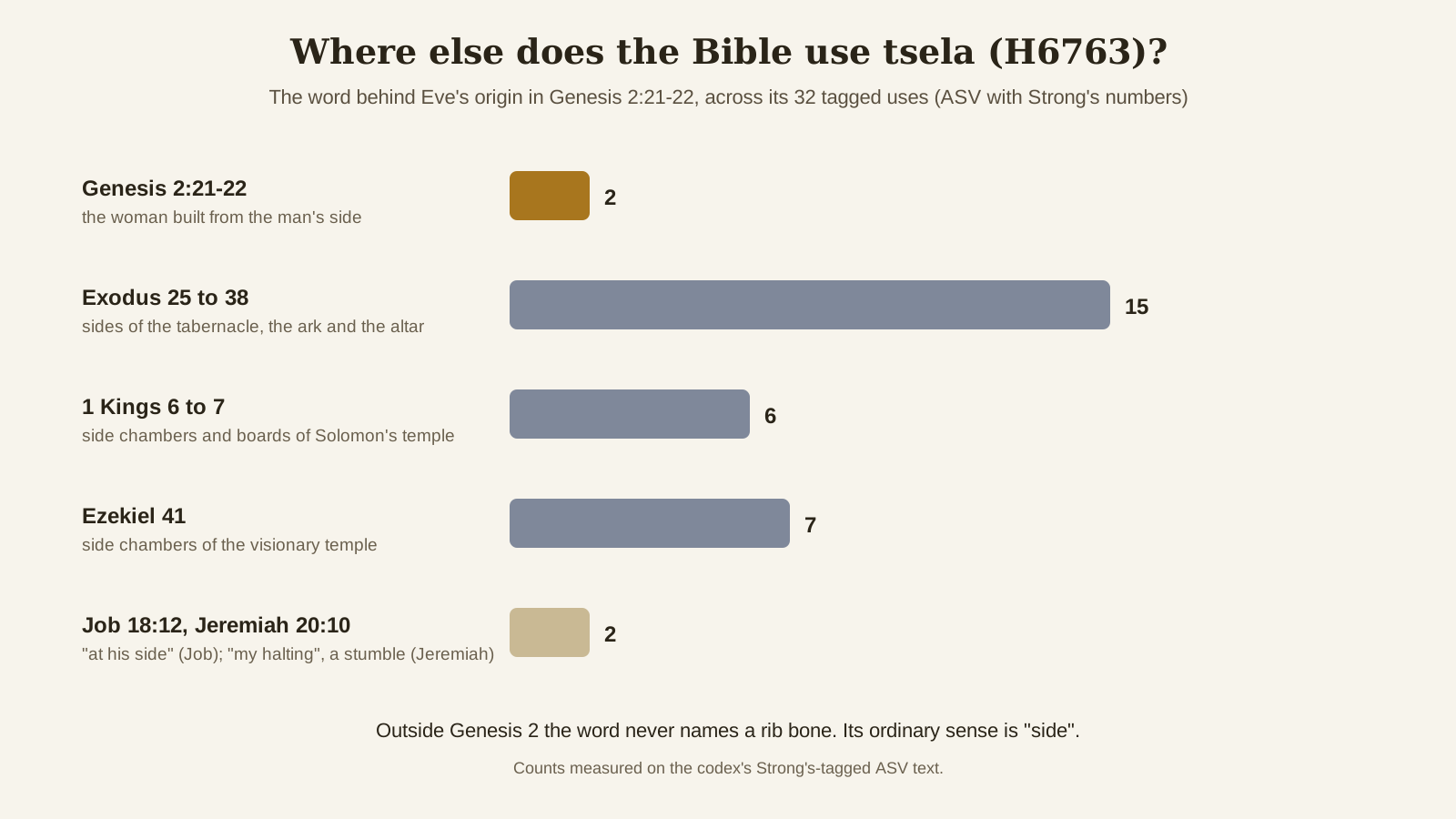
Where the Hebrew word tsela appears: outside Genesis 2 it means a side, most often the side of a sacred building, and once a stumble (Jeremiah 20:10). Counts from the Strong's-tagged ASV text.
Cheatsheet
The 30-second reply:
Genesis does not say a natural process turned a rib into a woman. It says God built her, the same God who formed the man from dust in the same chapter. So the real question is whether God exists and acts, and that is a fair debate to have. On the details: the Hebrew word means "side" far more than "rib," and everywhere else in the Bible it describes the side of a building or of the ark. The point is that she shares his nature: "bone of my bones." And biology fits the picture better than the joke assumes. A rib grows back if its sheath is left, and a man's cells already hold the X chromosome a woman is built from. Men, by the way, do not have one fewer rib. Count them.
Fast facts:
- Tsēlā' (H6763) appears about forty times in the Hebrew Bible. Outside Genesis 2:21-22 it means the side of the ark of the covenant (Exodus 25:12), the sides and boards of the tabernacle (Exodus 26:20, 26:26-27), the side-chambers of the temple (1 Kings 6:5-8; Ezekiel 41:5-11), the leaves of a door (1 Kings 6:34) and a hillside (2 Samuel 16:13). It never elsewhere means a body part.
- The verb at 2:22 is bānāh, "build," the ordinary word for building a house, a city or an altar. God "built the side into a woman."
- "Bone of my bones and flesh of my flesh" is a kinship formula: Laban says it of Jacob at Genesis 29:14, the tribes say it of David at 2 Samuel 5:1.
- Adult men and women both have twelve pairs of ribs. Extra or missing ribs occur in individuals of both sexes. The text never claims otherwise.
- Ribs regenerate: when a section is removed and its periosteum or perichondrium is left, the missing bone or cartilage re-forms (Srour et al., Journal of Bone and Mineral Research 30, 2015, in mice with a matching human case).
- A male (XY) carries an X chromosome; a female is XX. A female genome can be derived from male material. A male genome cannot be derived from female material, which has no Y.
Counter-moves:
- Name the category. "You are asking for a natural mechanism. The text claims a divine act. Is your real objection that miracles cannot happen?"
- Read the word. Show the forty uses of tsēlā'. The "rib" image is a translation choice; "side" is the dominant sense.
- Offer the biology as illustration, never as proof. "I am not saying regeneration or chromosomes explain how God did it. I am saying your 'impossible' is less obvious than it sounds."
- Correct the rib-count myth on the spot. It is the cheapest win available and the objector usually believes it.
Concessions worth granting, each with its return:
- Biology has no natural pathway by which a woman develops from a man's rib. Granted, and the text never claims one. Return: the objection then rests entirely on the premise that God does not act, which is the question under dispute, so the objector must argue it rather than assume it.
- Christians disagree on how literally to read Genesis 2. Granted (Genesis Interpretation Spread). Return: every one of those readings agrees on what the passage teaches, the shared nature and equal dignity of man and woman, which is the point the objection never touches.
- Some Christians have taught that men have one fewer rib. Granted, it is a folk belief. Return: Scripture never says it, and the people who believed it were reading their own assumption into the text, exactly what this page asks the objector not to do.
Closing line: "You asked how a woman could come from a man. The text answers: God built her, from his side, so that she would be his equal and his own flesh. If God cannot act, the story fails at verse 7, before Eve appears. If He can, nothing in biology stands in the way."
Grammar and hermeneutics
The objection falls first to a careful reading of the Hebrew, before any appeal to theology or science.
1. The main verbs are divine actions in a narrative chain. Genesis 2:21-22 is a run of wayyiqtol verbs, the standard Hebrew narrative form, and each has YHWH Elohim as its subject: wayyappēl (He caused to fall), wayyiqqaḥ (He took), wayyisgōr (He closed), wayyiḇen (He built), wayəḇi'ehā (He brought her). The man is asleep and does nothing. Grammatically the passage attributes the whole event to God's agency and assigns no role to any natural process. An objection that asks "what biological process did this?" assigns the text a claim its syntax does not make.
2. Tardēmāh marks a divinely induced state. The "deep sleep" (tardēmāh, H8639) is the same word used when God puts Abram into a deep sleep for the covenant vision at Genesis 15:12. It signals that what follows is God's work, received passively by the human.
3. Tsēlā' is predominantly architectural. Of its roughly forty occurrences, Genesis 2:21-22 are the only ones where English versions render "rib." Everywhere else it is a side or a structural member: the two sides of the ark of the covenant (Exodus 25:12), the sides of the tabernacle (Exodus 26:20, 26:26-27), the side-chambers of the temple (1 Kings 6:5-8; Ezekiel 41:5-11), the planks of its walls and the leaves of its doors (1 Kings 6:15-16, 6:34), and once the side of a hill (2 Samuel 16:13). At 2:21 the form is "one of his tsēlā'ōt" (plural), which fits either "one of his ribs" or "one of his sides." The Septuagint renders it pleura, "side," the same word John uses for the pierced side of Christ at John 19:34. The dominant sense is a side taken from the whole.
4. Bānāh is a builder's verb. The text says God built (wayyiḇen) the tsēlā' into a woman. Bānāh is used for building houses, cities, altars and the temple. Combined with the architectural sense of tsēlā', the image is of God constructing the woman from a side of the man, a deliberate contrast with the potter's verb yātsar ("formed") used for the man at Genesis 2:7. Both are acts of craftsmanship; neither is a description of growth.
5. "He closed up the flesh in its place." The narrator includes the closing of the wound (wayyisgōr bāśār taḥtennāh). The detail places the event in the physical world: the man is not diminished or left open, and what was taken is replaced.
6. The man's speech is a kinship formula and a wordplay. At Genesis 2:23 the man says 'etsem mē'ătsāmay ûḇāśār mibbəśārî, "bone of my bones and flesh of my flesh," the formula of shared family identity used at Genesis 29:14 and 2 Samuel 5:1. He then names her 'iššāh "because she was taken from 'îš," a sound-play that ties her name to his. The emphasis of the verse is identity and correspondence. Nothing in it addresses biological process.
7. The aetiology at 2:24 governs the reading. "Therefore a man shall leave his father and mother and cleave to his wife, and they shall become one flesh" (Genesis 2:24). The narrator states the purpose of the account: it grounds marriage. Jesus quotes this verse with Genesis 1:27 at Matthew 19:4-6, and Paul at Ephesians 5:31. The canonical reading of the passage is about the union and equality of man and woman.
8. Paul's commentary rules out a hierarchy of worth. 1 Corinthians 11:8-12 notes that woman came from man, then immediately adds that "neither is woman independent of man, nor man of woman. For as the woman originates from the man, so also the man has his birth through the woman; and all things originate from God." The derivation runs both ways in Paul's reading, and both point to God as source.
Objections and defeaters
1. "It is biologically impossible for a female to come from a male"
The objection. Every human being develops from a fertilized egg through embryonic growth. There is no biological pathway by which an adult woman forms from a piece of an adult man. The story is therefore false.
The defeater.
- The text claims a miracle, and the objection assumes miracles do not happen. By the same standard, the man formed from dust at Genesis 2:7, the first life, and the resurrection of Jesus are all "biologically impossible," which is the point of calling them acts of God. The objection is a restatement of naturalism, and naturalism is the conclusion the objector needs to argue for.
- The objection proves too much. "No known biological process produces X, so X did not happen" would rule out the origin of the first cell, for which no demonstrated natural pathway exists either (Abiogenesis). The skeptic who accepts an unexplained origin of life cannot treat an unexplained origin of woman as decisive.
- The coherence illustrations. Biology does not explain the event, but it shows the narrative is not arbitrary:
- A man's genome contains what a woman's body needs. Every gene required to build a female body sits on the X chromosome and the autosomes, all of which a male carries. A female genome can in principle be derived from male material by doubling the X and omitting the Y; a male genome cannot be derived from female material, because a female has no Y chromosome and no SRY gene. If one sex was to come from the other, the order in Genesis is the one that works.
- The rib is the bone that grows back. Surgeons have long removed rib segments for grafts while preserving the periosteum, the sheath that regrows the bone. Srour and colleagues (Journal of Bone and Mineral Research 30, 2015) documented large-scale rib regeneration in mice when the sheath was left and tracked the same repair in a human patient. Taking from the side, closing the flesh, and leaving the man whole is consistent with how the body actually heals.
- These points are offered as illustrations of coherence. Neither one describes how God worked, and the argument does not rest on them.
If pressed: "So you admit you are appealing to magic." Reply: a miracle is an act of a personal agent, which is a category the objector uses daily when he explains a building by its architect. Whether such an Agent exists is the real debate, and it is argued on its own merits (Contingency Argument, Kalam Cosmological Argument, Minimal Facts Argument).
2. "Men have one fewer rib than women, and that is what the Bible teaches"
The objection. Usually voiced as a believer's folk claim or a skeptic's gotcha: if Adam lost a rib, men should have one fewer rib, and anatomy shows they do not.
The defeater.
- The anatomy: adult men and women both typically have twelve pairs of ribs. Variants (a cervical rib, a missing twelfth rib) occur in a small fraction of people of both sexes. Andreas Vesalius corrected the folk belief by direct dissection in De humani corporis fabrica (1543).
- The text never says it. Genesis says God took from the man and closed the flesh. It says nothing about Adam's descendants, rib counts, or any lasting deficit, and on a regeneration reading there is no deficit even in Adam.
- Acquired losses are not inherited. A man who loses a finger does not have children missing a finger. Even if Adam had lived rib-short, his sons would have been born with the full set. The myth fails on its own terms.
If pressed: "Then why did Christians believe it?" Because popular belief often runs ahead of the text. The fix is to read the text, which is the method this page recommends for every objection.
3. "The story is borrowed from Sumerian myth, the goddess Nin-ti, 'Lady of the Rib'"
The objection. In the Sumerian myth Enki and Ninhursag, the goddess Ninhursag heals the ailing god Enki by creating deities for each of his aching body parts. The one for his rib is Nin-ti, whose name can mean both "lady of the rib" and "lady who makes live," because Sumerian ti means both "rib" and "life." Samuel Noah Kramer drew attention to this pun (History Begins at Sumer, 1956) and suggested it might lie behind the rib in Genesis and Eve's name, "the mother of all living" (Genesis 3:20).
The defeater.
- The pun does not exist in Hebrew. Hebrew tsēlā' (side, rib) and ḥawwāh / ḥay (Eve, life) share no sound or root. A literary borrowing that rests on a wordplay should carry the wordplay with it. Its absence in the Hebrew is evidence against dependence.
- The stories do different things. Nin-ti is a goddess produced to heal a god's rib. Eve is a woman built from the man's side to be his partner. There is no healing, no pantheon, no catalog of body parts, and no creation of a human from a rib in the Sumerian text.
- Shared imagery reflects a shared world. Ancient Near Eastern texts often use the same vocabulary of clay, breath, and body because they describe the same world. Where Genesis touches those motifs, its theology runs the other way: one God, no rival deities, humanity made with dignity and not as slave labor for the gods. See Genesis ANE Myth Borrowing Objection Defeater.
If pressed: "Kramer was a world authority, and he saw the parallel." He noticed the pun and offered it as a possible explanation, which is a scholarly suggestion. The comparative evidence still has to carry it, and the missing Hebrew pun is where it fails to.
4. "The 'rib' was really Adam's penis bone"
The objection. Developmental biologist Scott Gilbert and Hebrew scholar Ziony Zevit (American Journal of Medical Genetics 101, 2001) proposed that tsēlā' is a euphemism for the baculum, the penis bone most male mammals have and human males lack. On their reading Genesis 2 is a just-so story explaining its absence, and Zevit developed the idea in What Really Happened in the Garden of Eden? (2013).
The defeater.
- No lexical support. Across forty occurrences tsēlā' is never used of the genitals, and Hebrew has its own euphemisms for them (such as bāśār, "flesh," at Ezekiel 16:26). The proposal assigns the word a sense it has nowhere else.
- The plural rules it out. The text says God took "one of his tsēlā'ōt," one of several. A man has many ribs or two sides, but no one has several bacula.
- It reverses the text's own interest. The narrator explains marriage (2:24), not male anatomy. A reading that turns the passage into an anatomical aetiology replaces the purpose the text states with one it never mentions.
If pressed: "It explains a real biological fact." So does the ordinary reading: a rib regenerates, and the side-image grounds equality. An explanation the words cannot bear is no gain.
5. "Being made from the man makes the woman secondary and inferior"
The objection. The man is made first and the woman from him and for him. The story is a charter for male superiority.
The defeater.
- The material makes her his equal. The animals were formed from the ground like the man, and none was a fit partner (Genesis 2:18-20). The woman is made from the man himself so that she shares his nature. Medieval theologians put the point memorably: she was taken from neither his head, to rule over him, nor his feet, to be trampled on, and from his side, to be his equal (Peter Lombard, Sentences II.18; Aquinas, Summa Theologiae I q.92 a.3; popularized by Matthew Henry).
- "Helper" is a word used of God. 'Ēzer kenegdô (Genesis 2:18) uses the noun Scripture most often applies to God as Israel's help. See Top 20 Adam and Eve Objections and Their Defeaters, grammar note 3.
- Paul closes the inference. "As the woman originates from the man, so also the man has his birth through the woman; and all things originate from God" (1 Corinthians 11:11-12). Every man after Adam comes from a woman.
If pressed: "Then why does 1 Timothy 2:13 cite the order?" Order of creation concerns roles in the church, which Christians interpret differently, and it is a separate question from worth. The Genesis text grounds equal dignity, and the Timothy passage is argued on its own page (1 Timothy 2:13-14).
How the Christian readings divide
- Historical-literal reading (young-earth creationists such as Answers in Genesis, and many old-earth creationists): God miraculously formed Eve from Adam's side as a real event in a real first pair. This reading takes the narrative's own grammar, a sequence of past-tense divine acts, at face value, and Jesus' appeal to "the beginning" at Matthew 19:4-6 and Paul's at 1 Corinthians 11:8-12 treat the order of creation as history.
- Historical event with figurative detail: a real creation of the first woman by God, narrated with a craftsman's imagery whose details (side, building) carry theological meaning.
- Archetypal reading (John Walton, The Lost World of Adam and Eve, 2015): the side-taking describes what is true of every woman and man, namely their shared identity, and may depict a visionary experience during the tardēmāh rather than a surgical event.
All three agree that God is the author of woman as of man, that she shares the man's nature fully, and that the passage grounds marriage. The objection addressed on this page fails on each reading. See Genesis Interpretation Spread and Adam and Eve Historicity.
Live-cite kit
- Scripture: Genesis 2:21-23; Genesis 2:24; Matthew 19:4-6; 1 Corinthians 11:8-12; Ephesians 5:31-32
- Scholarly: Gordon Wenham, Genesis 1-15 (WBC, 1987); Victor Hamilton, The Book of Genesis 1-17 (NICOT, 1990); Samuel Noah Kramer, History Begins at Sumer (1956); Marissa Srour et al., Journal of Bone and Mineral Research 30 (2015)
- Aphorism: "She was built from his side so that no one could ever say she was made of lesser stuff."
Tactical notes
- Open with the category question. Almost every version of this objection is the miracle objection in disguise; surface it in the first sentence.
- Use the rib-count myth early. Correcting a false fact the objector believes earns credibility for everything else.
- What not to defend: that chromosomes or rib regeneration explain the event. They illustrate coherence. Pressing them as proof hands the objector a free rebuttal.
- What not to defend: that men have fewer ribs, or that "rib" is the only possible translation.
Connection to Scripture
- Genesis 2:21-22, the deep sleep, the side taken, the flesh closed, the woman built.
- Genesis 2:23, "bone of my bones," the kinship formula and the 'îš/'iššāh wordplay.
- Genesis 2:24, the stated purpose: one flesh.
- 1 Corinthians 11:8-12, woman from man and man through woman, all from God.
- Ephesians 5:25-33, the husband loves his wife as his own body, the union as a picture of Christ and the church. Many of the fathers saw the Church born from the pierced side of Christ (John 19:34) as the new Eve from the side of the new Adam (1 Corinthians 15:45).
Patristic / scholarly note
Classical:
- Augustine, De Genesi ad Litteram IX, treats the formation of the woman as a real divine act and reflects on why God used the man's side.
- Peter Lombard, Sentences II.18, and Thomas Aquinas, Summa Theologiae I q.92 a.3: the woman was fittingly made from the man's side, signifying companionship, neither dominion nor servitude.
Modern:
- Gordon Wenham (WBC, 1987) and Victor Hamilton (NICOT, 1990) on tsēlā' as "side" and the building imagery.
- Samuel Noah Kramer (History Begins at Sumer, 1956) on the Nin-ti wordplay.
- Scott Gilbert and Ziony Zevit (2001) on the baculum proposal, answered above.
- John Walton (2015), the archetypal reading.
Scholarship
Published academic works this page draws on, each matched to a publisher, index or library catalog record.
- Scott F. Gilbert and Ziony Zevit, "Congenital human baculum deficiency: The generative bone of Genesis 2:21-23," American Journal of Medical Genetics 101 (2001). doi:10.1002/ajmg.1387 PubMed 11424148
- Victor P. Hamilton, The Book of Genesis: Chapters 1-17 (Wm. B. Eerdmans Publishing Co, 1990). doi:10.5040/bci-0092
- Kramer Samuel Noah, History Begins at Sumer (University of Pennsylvania Press, 1956). Open Library
- Marissa K Srour et al., "Natural Large-Scale Regeneration of Rib Cartilage in a Mouse Model," Journal of Bone and Mineral Research 30 (2015). doi:10.1002/jbmr.2326 PubMed 25142306
- John H. Walton, The Lost World of Adam and Eve (IVP Academic, 2015). Open Library
- Gordon J. Wenham, Genesis 1-15 (Word, 1987). Open Library
- Ziony Zevit, What really happened in the Garden of Eden? (2013). Open Library
See also
- Top 20 Adam and Eve Objections and Their Defeaters, the full catalog; this page expands its grammar note on tsēlā'
- Adam and Eve Historicity, the historicity question at length
- Genesis Interpretation Spread, the live Christian readings of Genesis
- Imago Dei, the shared image of God in man and woman
- Marriage, the institution Genesis 2:24 grounds
- Miracles, the category this objection actually targets
- Mitochondrial Eve Argument, human genetics and a first mother
Common questions this page answers
Q: How could a woman come from a man's rib biologically?
Genesis presents it as a direct act of God, in the same chapter where God forms the man from dust, so it does not claim a natural biological process. Biology does illustrate that the story is coherent: a man's cells carry the X chromosome a woman's genome is built from, and a rib is a bone that regrows when its outer sheath is preserved.
Q: Does the Hebrew word for "rib" in Genesis 2 really mean rib?
The word tsēlā' (Strong's H6763) usually means "side." Outside Genesis 2 it describes the sides of the ark of the covenant, the sides and boards of the tabernacle, the side-chambers of the temple, and a hillside, and never a body part. The Greek Old Testament renders it pleura, "side." The point of the passage is that the woman shares the man's own nature.
Q: Do men have one less rib than women?
No. Men and women both typically have twelve pairs of ribs, a fact Andreas Vesalius confirmed by dissection in 1543. The Bible never says men have fewer ribs, and a rib lost by one man would not be missing in his children in any case.
Q: Was the story of Eve and the rib copied from Sumerian myth?
Samuel Noah Kramer pointed to the Sumerian goddess Nin-ti, whose name puns on ti, meaning both "rib" and "life." That pun does not exist in Hebrew, where the words for side and for life are unrelated, and the Sumerian story is about healing a god's rib rather than making a woman. The missing pun counts against borrowing.
Q: Does being made from Adam make Eve inferior?
No. She is made from his own substance precisely so that she is his equal, which is why he says "bone of my bones and flesh of my flesh." Paul adds that "as the woman is of the man, so is the man also by the woman; but all things are of God" (1 Corinthians 11:12, ASV).
Q: Why did God make Eve from Adam instead of from the dust?
The text gives the reason in the next verse: "they shall become one flesh" (Genesis 2:24). Making the woman from the man grounds the unity of marriage and the shared nature of man and woman, which Jesus and Paul both build on.