Person
Ethiopian Eunuch
The Ethiopian Eunuch, Ethiopian Official, Eunuch of Candace, Treasurer of Candace, Ethiopian eunuch of Acts 8Intro
In Acts 8, an official from Africa is riding home from Jerusalem in a chariot, reading the prophet Isaiah aloud. He runs the treasury of the Kandake, the queen of the Ethiopians. The Holy Spirit sends Philip the evangelist to him. Philip explains that the passage he is reading, about a lamb led to the slaughter, is about Jesus. The official asks to be baptized at the first water they find, and he goes home rejoicing.
He is the first named convert from outside Israel's land in the book of Acts whose story is told in full, and he comes from Kush, the African kingdom on the Nile in today's Sudan. Church fathers from the second century on say he took the gospel home with him.
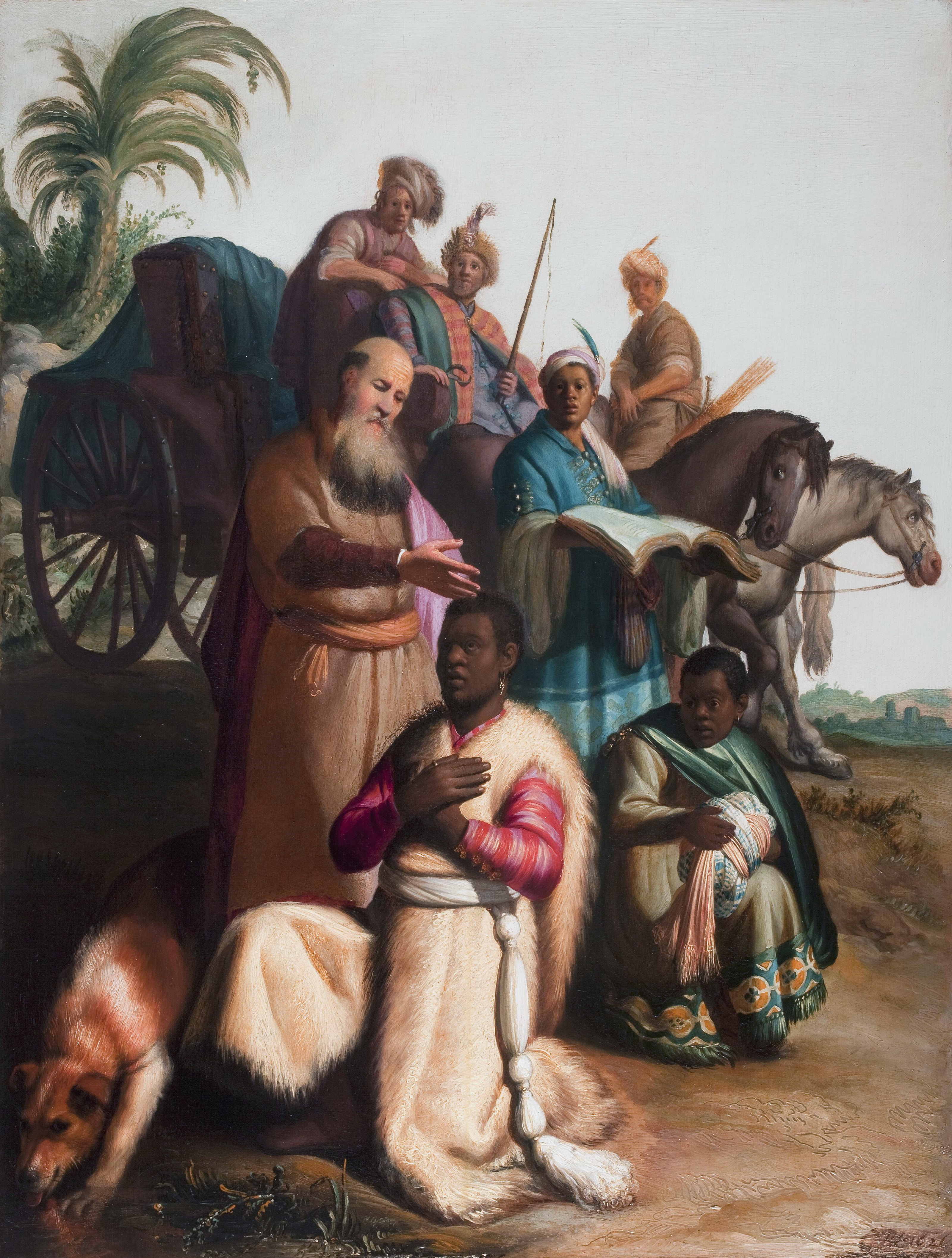 The Baptism of the Eunuch, Rembrandt, 1626, Museum Catharijneconvent, Utrecht. Public domain (Wikimedia Commons), resized.

See this page's graph and discover linked topics
In full
Acts 8:26-40 narrates the conversion of an unnamed high official of the Kushite kingdom of Meroe. Luke introduces him with a deliberate string of descriptions: a man, an Ethiopian (Aithiops), a eunuch, a court official (dynastēs) of the Kandake, queen of the Ethiopians, in charge of all her treasury (Acts 8:27). He had come to Jerusalem to worship and was reading Isaiah 53:7-8 in Greek. Philip, one of the Seven of Acts 6, is sent by an angel and then by the Spirit; he "began at the same scripture, and preached unto him Jesus" (Acts 8:35, KJV). The man is baptized, Philip is taken away, and the official "went on his way rejoicing" (Acts 8:39, KJV).
The episode sits between the Samaritan mission (Acts 8:4-25) and the conversion of Saul (Acts 9), and before Cornelius (Acts 10). It answers the reach of Acts 1:8, "unto the uttermost part of the earth" (KJV), in the direction Greek readers thought of as the edge of the world. Homer had called the Ethiopians "the farthest of men" (Odyssey 1.23).
The text, term by term
- "Ethiopian" (Greek Aithiops, Strong's G128). In Greek and Roman writing Aithiops named the dark-skinned peoples south of Egypt, and the Septuagint uses Aithiopia to translate the Hebrew Kush. In the first century the "Ethiopia" of Greco-Roman writers was the kingdom of Kush with its capital at Meroe, on the Nile north of modern Khartoum. It was not the highland kingdom of Aksum, which later took the name Ethiopia.
- "Kandake" (KJV "Candace"). Not a personal name but a royal title. Meroitic inscriptions use it (kdke) for royal women, queens and queen mothers who held real power. Strabo (Geography 17.1.54) describes a war between Rome and a one-eyed Kandake in the 20s BC, and Pliny the Elder (Natural History 6.186) says the name had passed to the queens of Meroe for many years. Luke's phrase is literally "Kandake, queen of the Ethiopians," title plus office, which fits the Meroitic evidence exactly.
- "Eunuch" (Greek eunouchos, Strong's G2135). The word can mean a castrated man or, by extension, a high court official, since such posts were often held by eunuchs. The Septuagint uses it for Potiphar, who was married (Genesis 39:1), so the title alone does not settle the man's condition. Luke uses both eunouchos and dynastēs, which most commentators take to mean he was literally a eunuch and also a minister of state.
- "In charge of all her treasury." The Greek gaza, treasure, is a Persian loanword. He was a finance minister, a figure of rank.
- What he was reading. Acts 8:32-33 quotes Isaiah 53:7-8 in the Septuagint's wording, which differs slightly from the Hebrew in verse 8. He was reading aloud, as ancient readers usually did, which is how Philip heard him.
- Acts 8:37. The confession "I believe that Jesus Christ is the Son of God" (Acts 8:37, KJV) is absent from the earliest Greek manuscripts and is omitted or bracketed in most modern editions. It is old (Irenaeus seems to know it), but it is not original to Luke. The narrative does not depend on it.
Deuteronomy 23 and Isaiah 56
The Law excluded a man who had been castrated from "the congregation of the LORD" (Deuteronomy 23:1). Isaiah 56:3-5 promises the opposite for the future: eunuchs who keep the covenant will be given "a place and a name better than of sons and of daughters" (Isaiah 56:5, KJV), and foreigners who join themselves to the LORD will be gathered. A man who was both a foreigner and a eunuch, and who had travelled from Africa to worship at a temple whose inner courts he could not enter, is reading from the same scroll a few chapters earlier. Luke does not cite Isaiah 56, but many interpreters see the episode as its fulfillment: the one who could not be admitted is baptized without delay. His question, "what doth hinder me to be baptized?" (Acts 8:36, KJV), uses a verb (kōlyei) that recurs in Acts at the Gentile breakthroughs (Acts 10:47; 11:17).
Was he the first Gentile convert?
Interpreters divide, and the answer depends on how "Gentile" is defined.
- For the first Gentile convert. He is explicitly a foreigner from Africa. If he was a eunuch in the physical sense he could not have become a full proselyte under Deuteronomy 23:1. The early church read him as a Gentile: Eusebius (Church History 2.1.13) calls him the first of the Gentiles to receive the mysteries of the divine word from Philip.
- For Cornelius as first. Luke treats Cornelius (Acts 10-11) as the test case that the Jerusalem church debates and Peter must defend, and the Jerusalem Council (Acts 15:7) looks back to Cornelius, not the eunuch, as the moment God first chose Gentiles. On this reading the eunuch is a God-fearer whose conversion happens privately, on the road, and does not yet raise the community question.
A careful statement: the Ethiopian is the first convert in Acts from beyond Israel's land and people whose story Luke tells in full, and the first African convert the New Testament records. Whether he counts as "the first Gentile" depends on categories Luke himself does not use for him.
Did he found a church?
Acts says only that he went on his way rejoicing. The rest is early tradition:
- Irenaeus of Lyons (Against Heresies 3.12.8, c. AD 180) says he was sent into the regions of Ethiopia to preach what he had believed.
- Eusebius of Caesarea (Church History 2.1.13, early fourth century) says tradition holds he was the first to carry the gospel home and preach it there.
No archaeology yet confirms a first-century church at Meroe. Christianity is securely attested in the Nile kingdoms only from the sixth century, when Christian Nubia took shape, and in the highland kingdom of Aksum from the fourth century, through Frumentius and Ezana of Axum. The Ethiopian Orthodox Church honours the eunuch as the first bearer of the gospel to "Ethiopia," treating Luke's biblical Ethiopia and the later Ethiopian kingdom as one story. Historically they are different kingdoms; theologically the church's claim is that the gospel's first African reception happened here.
Why he matters
- Africa in the first wave of mission. The gospel reaches an African before it reaches a Roman centurion in Luke's sequence.
- Scripture read across cultures. He is reading the Hebrew prophets in Greek, as an African, and asks the hermeneutical question the whole church still asks: "of whom speaketh the prophet this?" (Acts 8:34, KJV).
- Isaiah 53 read as Christ. Philip's answer is the earliest narrative in Acts of the Servant passage read as Jesus.
- A rebuke to "white man's religion." The first African Christian in the record was baptized by a Jewish Christian, in Judea, centuries before any European kingdom converted. See Christianity Is the White Mans Religion Objection Defeater.
Tensions
- The Africans in Scripture Argument says the eunuch's conversion makes "the first organized non-Jewish Christian church in canonical record" African. Acts records his baptism and his rejoicing, not the founding of a church; the church at Meroe is a patristic tradition (Irenaeus, Eusebius), not a canonical record. The stronger, defensible form is that the first African convert and the first gospel carrier toward Africa appear in Acts 8.
- The same page sometimes writes "carrying the gospel back to Ethiopia" without distinguishing Kush (Meroe), which is what Luke's Aithiopia denotes, from Aksum, the later Ethiopian kingdom. This page follows the historical identification and notes the Ethiopian church's tradition separately.
- The argument page states he is the first recorded Gentile convert. That is one side of a real exegetical debate, presented above with the case for Cornelius.
See also
- Africans in Scripture Argument, the cumulative case this figure anchors
- Africa in the Table of Nations, where Cush first appears
- Ebed-melech, the other Cushite court official who trusted the God of Israel
- Queen of Sheba, the other African royal court in Scripture
- Mission Geography (Acts 1-8), where the episode sits in Luke's map of mission
- Ethiopian Orthodox Church, which honours him as its first evangelist
- Christian Nubia, the later Christian kingdoms in the same Nile lands
- Isaiah the Prophet, whose scroll he was reading
- Baptism
- Africa and Christianity
Common questions this page answers
Q: Who was the Ethiopian eunuch in the Bible?
He was the treasurer of the Kandake, queen of the Ethiopians, baptized by Philip on the road from Jerusalem to Gaza in Acts 8:26-40. His "Ethiopia" was the Nile kingdom of Kush, centred on Meroe in today's Sudan.
Q: Who was Candace, queen of the Ethiopians?
Candace (Kandake) was a royal title, not a personal name. The queens and queen mothers of Meroe held it, as Meroitic inscriptions, Strabo and Pliny the Elder all show.
Q: Was the Ethiopian eunuch the first Gentile convert?
Many readers say yes, and Eusebius called him the first Gentile to receive the gospel. Others point out that Acts treats Cornelius as the first Gentile conversion the church officially recognized. He is at least the first African convert the New Testament records.
Q: What was the Ethiopian eunuch reading?
He was reading Isaiah 53:7-8 in Greek, the passage about a sheep led to the slaughter. Philip began from that text and told him about Jesus.
Q: Did the Ethiopian eunuch start the Ethiopian church?
Irenaeus and Eusebius say he preached in his homeland, but Acts does not say so, and no first-century church at Meroe has been found. The Ethiopian Orthodox Church honours him as its first evangelist; its historical founding came in the fourth century under King Ezana.
Q: Why is Acts 8:37 missing from some Bibles?
The verse with the eunuch's confession is absent from the earliest Greek manuscripts, so most modern translations put it in a footnote. The KJV includes it.
Q: Could a eunuch be part of Israel?
Deuteronomy 23:1 excluded castrated men from the assembly, but Isaiah 56:3-5 promised eunuchs and foreigners a lasting name in God's house. Many read the eunuch's baptism as that promise coming true.