Person
Esarhaddon
Esar-haddon, Esarhaddon king of Assyria, Ashur-ahu-iddina, Asshur-aha-iddina, Esarhaddon of AssyriaIntro
Esarhaddon was king of Assyria from 681 to 669 BC, the son who took the throne after Sennacherib was murdered. The Bible names him three times: twice at the end of the story of Sennacherib, "And Esar-haddon his son reigned in his stead" (Isaiah 37:38, ASV), and once when the settlers of Samaria tell the returned exiles that they have worshipped Israel's God "since the days of Esar-haddon king of Assyria, who brought us up hither" (Ezra 4:2, ASV).
Esarhaddon left many inscriptions. One lists "Manasseh king of Judah" among twenty-two western kings who sent building materials to his palace. He conquered Egypt's capital, Memphis, in 671 BC, driving out the Kushite pharaoh Taharqa.
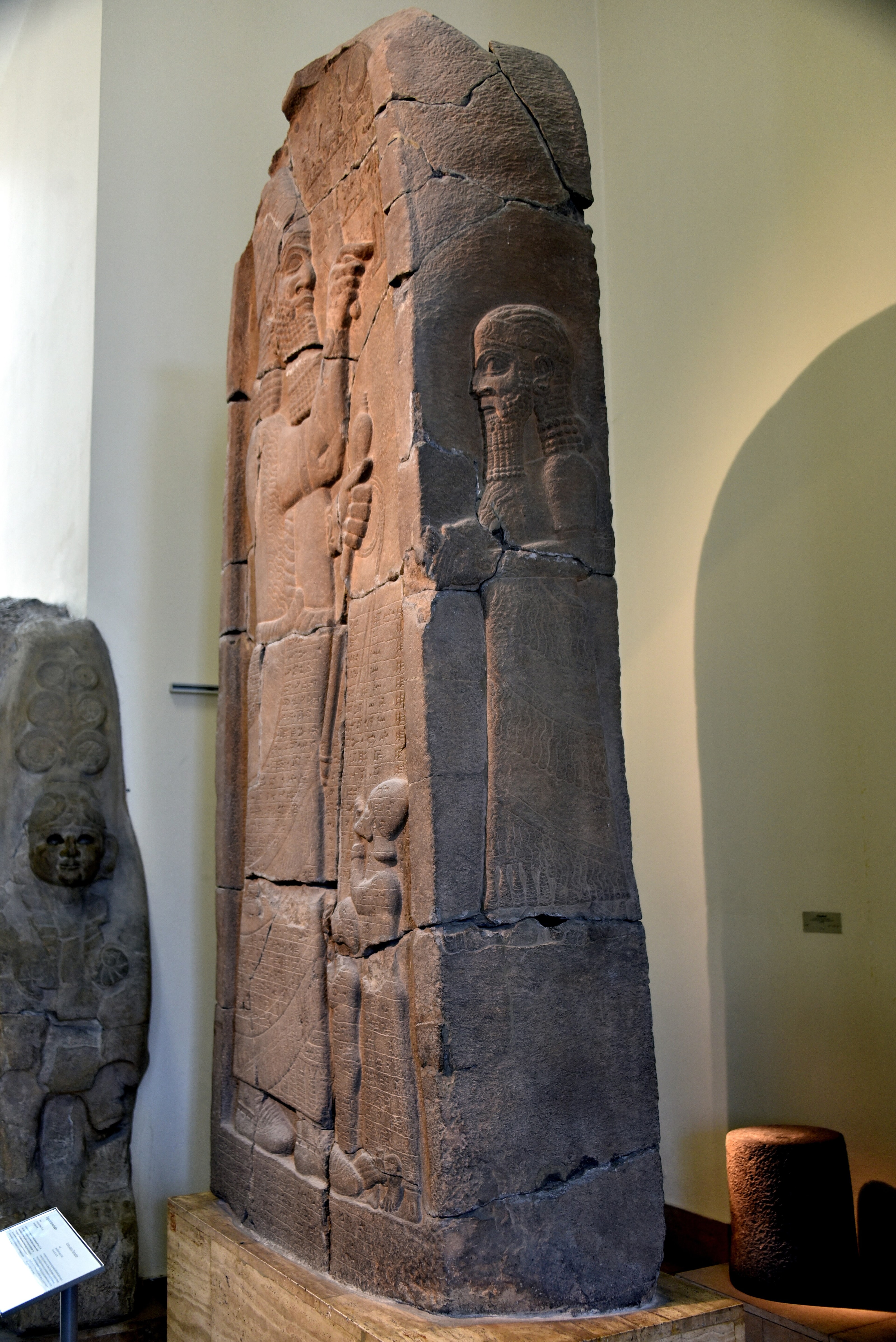 The victory stele of Esarhaddon from Sam'al (Zincirli), 671 BC, Pergamon Museum, Berlin. The king holds two captives on cords, usually identified as Taharqa's son Ushanahuru and a Phoenician king. Photo: Osama Shukir Muhammed Amin FRCP(Glasg), CC BY-SA 4.0, via Wikimedia Commons, resized.

The 30-second version:
Esarhaddon ruled Assyria from 681 to 669 BC after his brothers murdered their father Sennacherib. The Bible notes his accession and says he settled foreigners in Samaria. His own inscriptions tell of the brothers' revolt, list Manasseh of Judah as a vassal, and record his conquest of Egypt from Taharqa. He also imposed a famous loyalty treaty on his vassals to secure the succession of his son Ashurbanipal.
See this page's graph and discover linked topics
In full
Esarhaddon (Akkadian Aššur-aḫa-iddina, "Ashur has given a brother") was a younger son of Sennacherib by Naqi'a. When Sennacherib named him crown prince, his older brothers turned against him, and he withdrew to the western provinces. In 681 BC Sennacherib was murdered; Esarhaddon marched on Nineveh, defeated his brothers' forces in Hanigalbat, and took the throne within weeks, while the conspirators fled to Urartu, the biblical land of Ararat. He reversed his father's policy toward Babylon and rebuilt the city. In 677 he destroyed Sidon. After a failed attack on Egypt in 674, he captured Memphis in 671, taking Taharqa's family and treasury. In 672 he made his vassals and officials swear an oath to uphold the succession of Ashurbanipal in Assyria and Shamash-shum-ukin in Babylon. He died in 669 BC on his way to Egypt to put down a revolt.
In the Bible
- 2 Kings 19:37; Isaiah 37:38. After the murder of Sennacherib, "Esar-haddon his son reigned in his stead" (Isaiah 37:38, ASV).
- Ezra 4:2. The people of the land offer to help rebuild the temple: "we sacrifice unto him since the days of Esar-haddon king of Assyria, who brought us up hither" (ASV). This is the only biblical notice of deportations into Samaria under Esarhaddon.
- 2 Chronicles 33:11 (unnamed). "The captains of the host of the king of Assyria... took Manasseh in chains... and carried him to Babylon" (ASV). The king is not named; it was either Esarhaddon or Ashurbanipal.
- Isaiah 7:8 (possible link). Isaiah's word that "within threescore and five years shall Ephraim be broken in pieces, so that it shall not be a people" (ASV) is often connected with resettlement under Esarhaddon or Ashurbanipal, about sixty-five years after the oracle.
Family and lineage
- Father: Sennacherib (reigned 705-681 BC).
- Mother: Naqi'a, also called Zakutu, who remained powerful at court into her grandson's reign.
- Brothers: Arda-Mulissu, the biblical Adrammelech, and others involved in the revolt.
- Sons: Ashurbanipal, king of Assyria; Shamash-shum-ukin, king of Babylon.
- Grandfather: Sargon II.
Historical and archaeological evidence
| Source | What it says | Date | Findspot and current home | Grade |
|---|---|---|---|---|
| Nineveh A prism | His account of his brothers' hostility, his exile, the murder of his father, and his victory over the rebels | about 673 BC | Nineveh; British Museum | Direct |
| Nineveh prisms listing western vassals (Prism B and parallels) | Lists twenty-two kings of the Hatti land and the coast who supplied timber and stone for his palace, including "Manasseh (Me-na-si-i) king of Judah (Ia-ú-di)" | about 673-672 BC | Nineveh; British Museum | Direct for Manasseh |
| Succession Treaty (Vassal Treaties of Esarhaddon) | Loyalty oaths to protect Ashurbanipal's succession, with long curse lists | 672 BC | Tablets from the temple of Nabu at Nimrud (published by D. J. Wiseman, 1958) and a copy from Tell Tayinat, Turkey (found 2009) | Direct |
| Zincirli victory stele | The king holding two captive rulers on cords after the conquest of Egypt | 671 BC | Zincirli (Sam'al), Turkey; Pergamon Museum, Berlin | Direct |
| Nahr el-Kalb inscription | Rock inscription recording the conquest of Memphis | 671 BC | Dog River, Lebanon, in place | Direct |
| Babylonian Chronicles and the Esarhaddon Chronicle | Record his accession, his Egyptian campaigns of 674 and 671, and his death in 669 | compiled later from records | British Museum | Direct |
| Letters and queries to the sun god | Hundreds of royal letters and oracle queries showing his anxieties about health and conspiracy | 681-669 BC | Nineveh archives; British Museum | Direct |
Grade: direct. Lawrence Mykytiuk lists Esarhaddon among his 53 confirmed Hebrew Bible figures, on the basis of his many inscriptions and his Succession Treaty, and counts Manasseh as confirmed through Esarhaddon's Prism B and Ashurbanipal's inscriptions. The standard edition is Erle Leichty, The Royal Inscriptions of Esarhaddon, King of Assyria (680-669 BC) (RINAP 4, Eisenbrauns 2011). See Biblical Figures Confirmed by Archaeology.
Scholarly consensus
- Accession. His inscriptions, the Babylonian Chronicle and the Bible agree that he succeeded after Sennacherib's murder by a son. Simo Parpola's identification of the murderer as Arda-Mulissu is widely accepted; see Adrammelech.
- The Succession Treaty and Deuteronomy. Since the 1960s scholars such as Moshe Weinfeld have noted close parallels between the curse lists of the treaty and Deuteronomy 28. Some argue that Deuteronomy was shaped in conscious response to Assyrian treaty language in the seventh century; others, notably K. A. Kitchen, argue that Deuteronomy's overall structure matches older second-millennium Hittite treaties more closely. The Tell Tayinat copy, found in a temple in a western province, showed the treaty was displayed in the Levant.
- Manasseh's captivity. 2 Chronicles 33:11 says Manasseh was taken to Babylon. Some historians doubted the episode because Kings omits it. Esarhaddon's vassal lists confirm that Manasseh was a tributary king; that an Assyrian king would summon a vassal to Babylon fits a period when Assyria ruled there, under Esarhaddon or after 648 under Ashurbanipal. The episode itself has no direct Assyrian record.
Theological significance
- The end of the Sennacherib story. The notice of Esarhaddon's accession closes the account of Sennacherib's blasphemy and fall (Isaiah 37:38). The God who delivered Jerusalem outlasts the king who mocked him.
- The roots of the Samaritans. Ezra 4:2 traces the people of the land to Esarhaddon's deportations. Their claim to worship Israel's God, and the refusal of Zerubbabel and Jeshua to build with them, belong to a long story that reaches the woman of Samaria in John 4.
- Manasseh's world. Manasseh reigned for most of the Assyrian peak, as a loyal vassal. Kings records his idolatry; Chronicles adds his captivity and repentance (2 Chronicles 33:12-13). Esarhaddon's inscriptions show the political world in which that story unfolded.
Church Fathers
No verified patristic comment on Esarhaddon as a historical figure is cited here.
See also
- People of the Bible, every person in this series grouped by the book of first mention
- Biblical Figures Confirmed by Archaeology, Mykytiuk's list of confirmed persons
- Sennacherib, his father
- Adrammelech, the brother who murdered their father
- Ashurbanipal, his son and successor
- Manasseh of Judah, the king of Judah his inscriptions list as a vassal
- Taharqa, the Kushite pharaoh he drove out of Memphis
- Nineveh Discovery
Common questions this page answers
Q: Who was Esarhaddon in the Bible?
Esarhaddon was the son of Sennacherib who became king of Assyria after his father was murdered in 681 BC (2 Kings 19:37). Ezra 4:2 says he resettled foreign peoples in the land of Samaria.
Q: Does Esarhaddon mention a king of Judah?
Yes. One of his prism inscriptions lists "Manasseh king of Judah" among twenty-two western kings who supplied materials for his palace at Nineveh.
Q: What is Esarhaddon's Succession Treaty?
A loyalty oath, sworn in 672 BC, binding vassals and officials to support his son Ashurbanipal as heir. Copies were found at Nimrud and at Tell Tayinat in Turkey, and its curses are often compared with Deuteronomy 28.
Q: Did Esarhaddon conquer Egypt?
Yes. After a failed attempt in 674 BC he captured Memphis in 671 BC and drove out the Kushite pharaoh Taharqa, capturing members of his family. His victory stele from Zincirli commemorates the campaign.