Person
Ellen G. White
Ellen White, Ellen Gould White, Ellen G White, Ellen Harmon, Ellen Gould Harmon, Mrs. E. G. White, Sister WhiteEllen Gould White (née Harmon, 1827-1915) was one of the founders of the Seventh-day Adventist Church. Adventists believe the biblical gift of prophecy was manifested in her ministry. She reported visions from late 1844 until near the end of her life, wrote and published prolifically, and shaped the church's doctrine, health message, schools and missions. Steps to Christ, a short devotional book, has been translated into a very large number of languages.
The 30-second version:
Ellen G. White, 1827 to 1915, grew up in the Millerite movement in Maine, reported her first vision two months after the Great Disappointment of October 1844, and with her husband James White helped found the Seventh-day Adventist Church in 1863. Adventists hold that her writings carry prophetic authority under the Bible. Other Christians honour her devotional writing and her church's health and mission work, and ask how a later prophet's authority fits with Scripture as the church's final standard.
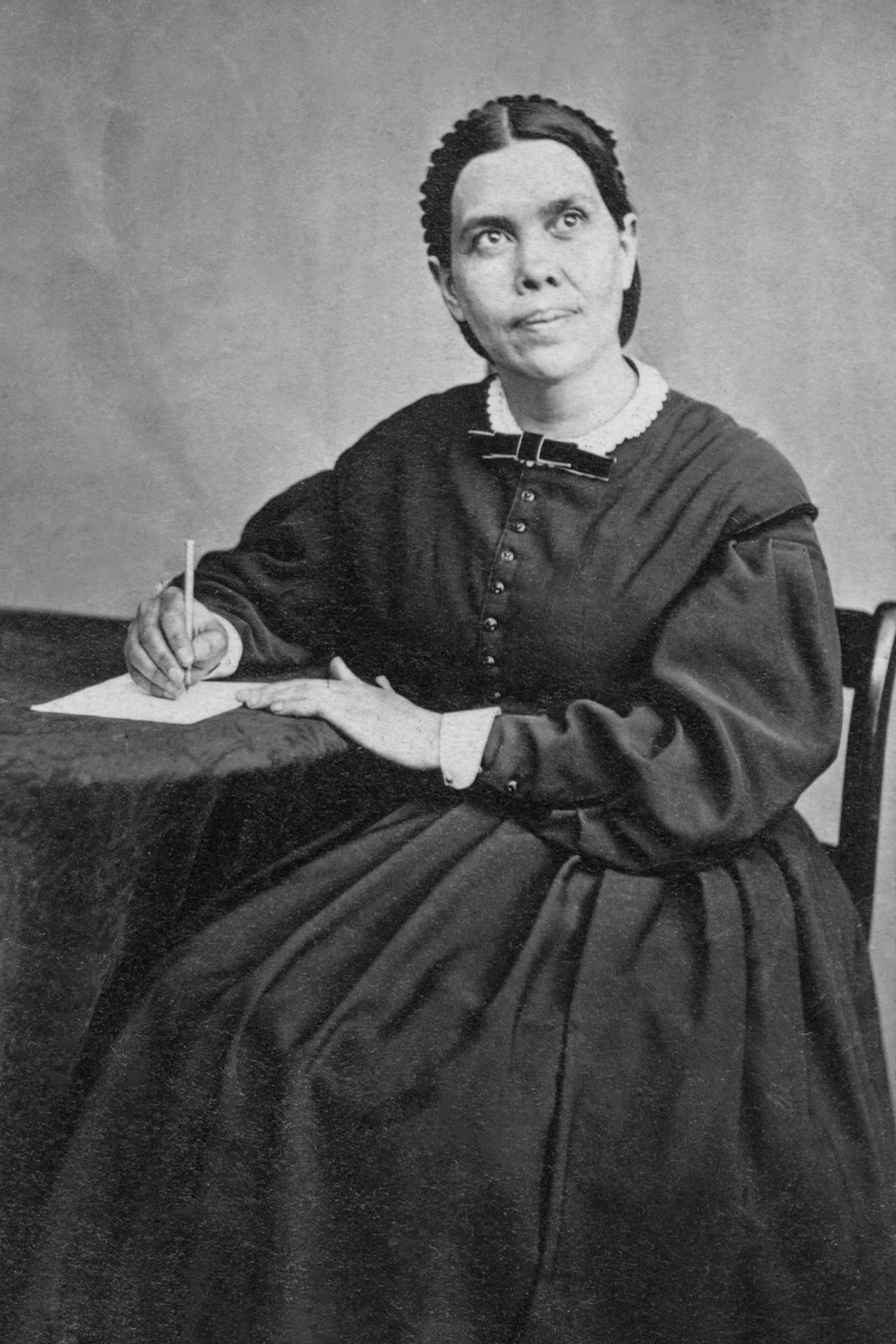
Ellen G. White, about 1864. Photograph by G. W. Loring, New York Gallery, Battle Creek, Michigan. Public domain, via Wikimedia Commons.
Life
Childhood and the Millerite movement
Ellen Harmon and her twin sister Elizabeth were born on November 26, 1827, on a farm near the village of Gorham, Maine. Her family accepted the views of William Miller and his associates, who expected Christ's return in 1843 and then on October 22, 1844. When that date passed, the movement broke apart in what became known as the Great Disappointment.
The first vision
Late in December 1844, two months after the disappointment, she reported her first vision, of the Advent people travelling a path toward the city of God. Over the following years she reported many more and shared them with the scattered Sabbatarian Adventists.
Marriage and the founding of the church
She married James White, an Adventist preacher, in August 1846. The Whites, together with Joseph Bates and others, gathered the believers who accepted the seventh-day Sabbath and the heavenly-sanctuary reading of Daniel 8:14. Their publishing work in Michigan grew into the Review and Herald. The General Conference of Seventh-day Adventists was organized at Battle Creek, Michigan, in May 1863.
Health, schools and missions
From the 1860s she promoted a health message of vegetarian diet, abstinence from alcohol and tobacco, and natural remedies. It gave rise to the Adventist sanitarium at Battle Creek and to the church's later network of hospitals. She encouraged the church's schools and its overseas missions, and lived in Australia during the 1890s.
Later years
She spent her last years at Elmshaven, her home near St. Helena, California, writing and revising her books. She died there on July 16, 1915, at the age of 87.
See this page's graph and discover linked topics
Writings
- The Conflict of the Ages series. A five-volume history of the struggle between Christ and Satan from the fall of Lucifer to the new earth. It includes Patriarchs and Prophets, The Desire of Ages (1898), on the life of Christ, and The Great Controversy, which grew from Spiritual Gifts, vol. 1 (1858) through editions of 1888 and 1911.
- Steps to Christ (1892). A short devotional on coming to Christ, repentance and prayer, widely read outside Adventism.
- Testimonies for the Church. Nine volumes of counsel to the church.
- Health and education. The Ministry of Healing and Education, among others.
Her teaching on Michael
Ellen White identified Michael the archangel with Christ. Writing of the dispute over Moses' body in Jude 9, she said:
Michael, or Christ, with the angels that buried Moses, came down from Heaven, after he had remained in the grave a short time, and resurrected him, and took him to Heaven. (Ellen G. White, Spiritual Gifts, vol. 4a, 1864, p. 57)
In later books she told the same event naming Christ alone: "Christ Himself, with the angels who had buried Moses, came down from heaven to call forth the sleeping saint" (Patriarchs and Prophets, p. 478). She affirmed Christ's full deity, and the church's 1957 statement on Michael explicitly rejects the Jehovah's Witness view that Christ is a created being. See Seventh-day Adventism, section 7.
How Adventists regard her
Fundamental Belief 18 states:
This gift is an identifying mark of the remnant church and we believe it was manifested in the ministry of Ellen G. White. Her writings speak with prophetic authority and provide comfort, guidance, instruction, and correction to the church. They also make clear that the Bible is the standard by which all teaching and experience must be tested. (Fundamental Belief 18, The Gift of Prophecy)
Adventists read her as a messenger who points to the Bible, never a source of new scripture. The Ellen G. White Estate, established under her will, keeps her writings in print and online.
The Christian assessment
Other Christians weigh her ministry on the tests the New Testament gives for prophecy: "Despise not prophesyings; prove all things; hold fast that which is good" (1 Thessalonians 5:20-21, ASV).
- The authority question. Continuationists grant that prophecy can continue in the church. The difficulty they raise is the scope of authority. If her writings "speak with prophetic authority" for the whole church, they function as a binding guide alongside Scripture, and doctrines such as the investigative judgment rest heavily on her confirmation.
- The sources question. In The White Lie (1982), Walter Rea, a former Adventist pastor, charged that she borrowed extensively from other authors without acknowledgment. The General Conference funded a study of The Desire of Ages by Fred Veltman. His report, completed in 1988 and summarized for the church in Ministry in 1990, examined a random sample of 15 of the book's 87 chapters and confirmed that she drew on other writers without acknowledgment, mostly at the level of paraphrase. Adventist scholars reply that she used sources the way many popular religious writers of her day did, and that dependence on other writers for wording does not decide whether her insight was given by God.
- The test of agreement. The deciding test, for most evangelicals, is whether her distinctive teachings agree with Scripture read on its own terms. That is where the disputes over 1844, the Sabbath and the state of the dead are fought. See Seventh-day Adventism.
- What is widely granted. Her devotional writing, especially Steps to Christ, is warmly evangelical, centred on Christ and salvation by grace. Her health counsel anticipated later medical findings on tobacco and diet, and her church's medical and educational work has served millions.
Scholarship
Published academic works this page draws on, each matched to a publisher, index or library catalog record.
- Walter T. Rea, The white lie (M & R Publications, 1982). Open Library
See also
- Seventh-day Adventism, the church she helped found, its beliefs and the disputes over them
- Joseph Smith, another nineteenth-century American founder whose prophetic claims are assessed by the same biblical tests
- Jehovahs Witnesses, the other movement with Adventist roots, which denies Christ's deity
- Sola Scriptura, Scripture as the church's final authority
- Sabbath, the doctrine most associated with her church
- Conditional Immortality, the view of final punishment she taught
Common questions this page answers
Q: Who was Ellen G. White?
Ellen G. White (1827-1915) was one of the founders of the Seventh-day Adventist Church. Adventists believe she had the biblical gift of prophecy. She wrote Steps to Christ, The Desire of Ages and The Great Controversy.
Q: Do Seventh-day Adventists think Ellen White was a prophet?
Yes. Fundamental Belief 18 says the gift of prophecy was manifested in her ministry and that her writings "speak with prophetic authority," while the Bible remains the standard by which all teaching is tested.
Q: Did Ellen White teach that Jesus is Michael the archangel?
Yes. In Spiritual Gifts (1864) she wrote that "Michael, or Christ" raised Moses from the dead. She also taught that Christ is fully God, so she did not hold the Jehovah's Witness view that he is a created angel.
Q: Did Ellen White copy from other authors?
Walter Rea's The White Lie (1982) charged extensive borrowing, and a church-funded study by Fred Veltman (1988) confirmed that The Desire of Ages drew on other writers without acknowledgment, mostly at the level of paraphrase. Adventist scholars answer that this was common practice among popular religious writers of her era and does not settle whether her message was from God.