Concept
Donatist Controversy
Donatism, Donatists, Donatist Schism, Donatist Church, Donatus Magnus, Donatus of Carthage, Circumcellions, Conference of Carthage 411, traditoresIntro
The Donatist controversy was a split in the church of Roman North Africa that lasted for more than a century, from about 311 into the 400s and beyond. It began with a simple question after a brutal persecution: what do you do with church leaders who caved under pressure and handed over the Scriptures to be burned?
One party, later called the Donatists after their leader Donatus, said such leaders had disqualified themselves, and that sacraments performed by them, or by anyone in fellowship with them, were worthless. The other party, the Catholics, said the church is a mixed body of saints and sinners, and that baptism belongs to Christ, not to the purity of the minister. Augustine of Hippo became the leading voice against Donatism, and the debate shaped how Christians everywhere think about the church and the sacraments.
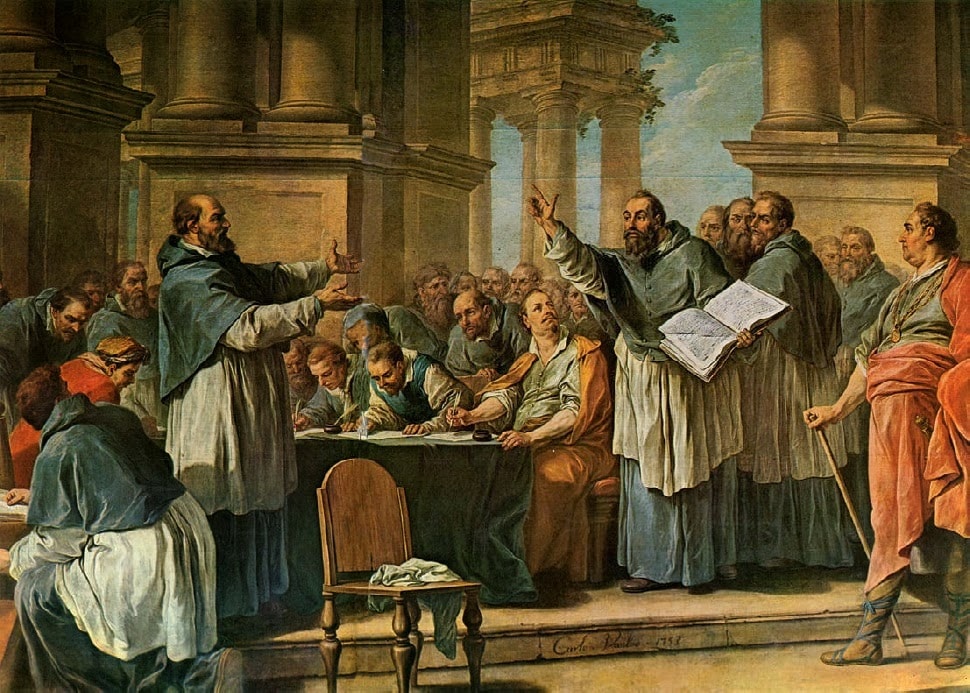 Charles-André (Carle) van Loo, Saint Augustine Disputing with the Donatists (1753), Notre-Dame-des-Victoires, Paris. Public domain (Wikimedia Commons), resized.

See this page's graph and discover linked topics
In full
Donatism was a rigorist schism within the Latin church of Roman Africa (chiefly Africa Proconsularis and Numidia, modern Tunisia and eastern Algeria). It arose from the Great Persecution of Diocletian (303-305), when some clergy surrendered Scriptures and church property to the authorities and were branded traditores ("handers-over"). In about 311 the archdeacon Caecilian was consecrated bishop of Carthage by a consecration in which Felix of Aptunga, alleged to be a traditor, took part. A council of some seventy Numidian bishops rejected him and consecrated Majorinus, who was soon succeeded by Donatus (bishop c. 313-355), from whom the movement took its name. Appeals to Constantine produced rulings for Caecilian at Rome (313), Arles (314) and by the emperor himself (316), followed by periods of coercion and toleration. Donatism was the majority church in much of Numidia for most of the 4th century, produced able theologians (notably Parmenian and Tyconius), and appealed to the authority of Cyprian of Carthage for the rebaptism of those baptized outside the true church. The Catholic case was made by Optatus of Milevis (c. 365-367) and above all by Augustine (391-430). After the Conference of Carthage in 411, presided over by the imperial tribune Marcellinus with nearly 300 bishops present on each side, Donatism was proscribed (412). It survived in diminished form, and Gregory the Great's letters in the 590s still complain of Donatists in Numidia. The controversy produced the classic Western doctrine that the validity of a sacrament does not depend on the moral state of the minister, and Augustine's ecclesiology of the church as a "mixed body" until the final judgment.
Timeline
| Date | Event |
|---|---|
| 303-305 | Great Persecution; some clergy hand over Scriptures (traditores) |
| c. 311 | Caecilian consecrated bishop of Carthage; Numidian bishops elect Majorinus as a rival |
| 313 | Donatus succeeds Majorinus; a council at Rome under Bishop Miltiades rules for Caecilian |
| 314 | Council of Arles upholds Caecilian and rejects rebaptism |
| 316 | Constantine rules personally for Caecilian |
| 317-321 | First imperial coercion against Donatists; then toleration |
| 347 | Imperial commissioners Paul and Macarius suppress the Donatists ("Macarian times"); Donatus exiled, dies c. 355 |
| 362 | Emperor Julian allows Donatist exiles to return |
| c. 365-367 | Optatus of Milevis writes against the Donatist bishop Parmenian |
| 393 | Maximianist split within Donatism; Augustine's Psalm against the Donatist Party |
| 397-398 | Revolt of Gildo, backed by the Donatist bishop Optatus of Thamugadi |
| 405 | Emperor Honorius's Edict of Unity |
| 411 | Conference of Carthage; ruling for the Catholics |
| 412 | Imperial law proscribes Donatism |
| 429-439 | The Vandal invasion overtakes both churches |
| 590s | Gregory the Great still complains of Donatists in Numidia |
The two positions
| Question | Donatist answer | Catholic (Augustinian) answer |
|---|---|---|
| What is the church? | A pure community of saints, the "church of the martyrs" | A mixed body of wheat and tares until the harvest (Matthew 13:24-30) |
| Who is the true minister of a sacrament? | The holy bishop or priest; a traditor cannot give what he lacks | Christ himself; the human minister is an instrument |
| Is baptism outside the true church valid? | No; converts must be rebaptized (following Cyprian) | Valid if given in the Trinitarian form, but fruitful only within the unity of love |
| Where is the church found? | In Africa, where it kept itself pure | Throughout the whole world; Augustine's watchword was securus iudicat orbis terrarum, "the whole world judges securely" |
| Relation to the state | Persecuted minority under Catholic emperors; "what has the emperor to do with the church?" (attributed to Donatus) | Augustine came, after initial reluctance, to accept imperial pressure as remedial discipline |
Augustine's contribution
- Validity and efficacy. Augustine distinguished a sacrament's validity, which comes from Christ and cannot be lost, from its benefit, which requires faith and charity within the church's unity. A schismatic baptism is real, but it does not save the one who stays in schism.
- The mixed church. The visible church contains sinners and hypocrites. Separation in the name of purity is itself a sin against love and unity.
- The universal church. A church confined to one region cannot be the church promised to all nations (Psalm 2:8; Genesis 22:18).
- Coercion. Early on Augustine opposed force. Seeing towns, including his own Hippo, return to unity under pressure, he changed his mind and defended imperial laws as corrective, citing Luke 14:23, "compel them to come in" (KJV) (Letter 93 to Vincentius; Letter 185 to Boniface). This argument was later used to justify coercion in medieval Europe, which many Christians, Catholic and Protestant, now regard as its darkest legacy.
The African dimension
- An African church quarrel. Both sides were Africans. The Donatists and Catholics shared the same language, liturgy and veneration of Cyprian and the martyrs. The dispute was about the identity of the true African church.
- Social and regional readings. W. H. C. Frend (The Donatist Church, 1952) argued that Donatism was strongest in rural Numidia among Berber-speaking peasants and expressed regional and social protest against Roman, urban, Carthaginian dominance. A. H. M. Jones ("Were Ancient Heresies National or Social Movements in Disguise?", 1959) and many since have answered that the participants themselves argued about theology, not ethnicity, and that Donatism had urban bishops and wealthy supporters too. Brent Shaw (Sacred Violence, 2011) treats the conflict as a sectarian struggle shaped by local violence and the language of martyrdom.
- The Circumcellions. Bands of rural ascetic militants associated with the Donatists attacked Catholic clergy and sometimes sought martyrdom. Catholic sources may exaggerate their violence; scholars debate how organized they were and how closely the Donatist bishops controlled them.
- A weakened church. Many historians count the century of division among the reasons the Latin church of North Africa was less able to withstand the Vandals and later the Arab conquest. See Decline of North African Christianity.
Tensions
- Who was the "true" church? The Donatists were not heretics in doctrine; they held the same creed. Modern Catholic, Orthodox and Protestant historians generally side with Augustine's theology of the sacraments while acknowledging that the Donatist protest against compromised leaders had a moral point.
- Coercion. Augustine's defense of state pressure is widely criticized, including by Christians who otherwise follow his theology. Defenders note the violence of the Circumcellions, the protection of Catholic clergy, and that Augustine opposed the death penalty for Donatists.
- Frend's thesis. The social-protest reading of Donatism remains influential but contested, as above.
- Protestant echoes. Some Free Church and Anabaptist writers have seen the Donatists as early champions of a pure, separated church against a state church. Most Reformers, including Luther and Calvin, sided with Augustine on the validity of sacraments and the mixed visible church.
Scholarship
Published academic works this page draws on, each matched to a publisher, index or library catalog record.
- W. H. C. Frend, The Donatist Church: a movement of protest in Roman North Africa (1952). Open Library
- A. H. M. Jones, "Were Ancient Heresies National Or Social Movements In Disguise?" The Journal of Theological Studies X (1959). doi:10.1093/jts/x.2.280
- Brent D. Shaw, Sacred Violence: African Christians and Sectarian Hatred in the Age of Augustine (Cambridge University Press, 2011). doi:10.1017/cbo9780511762079
See also
- Augustine, the chief anti-Donatist theologian
- Cyprian of Carthage, whose teaching on rebaptism both sides claimed
- Constantine, the first emperor drawn into the dispute
- Baptism, the sacrament at the center of the controversy
- Perpetua and Felicity, martyrs of the Carthaginian church whose memory both parties honored
- Decline of North African Christianity, the longer story of the African church
- Augustine-Pelagius Controversy, Augustine's other great African-era controversy
- Africa and Christianity, the master hub
Common questions this page answers
Q: What was Donatism?
A schism in the North African church, beginning around 311, whose members held that clergy who had betrayed the faith in persecution could not validly administer sacraments, and that only their own pure church was the true church.
Q: Why was it called Donatism?
After Donatus, the rival bishop of Carthage from about 313 to 355, who led the party that rejected Bishop Caecilian.
Q: What did Augustine teach against the Donatists?
That sacraments belong to Christ, so their validity does not depend on the holiness of the minister; that the visible church is a mixed body of good and bad until the final judgment; and that the true church is spread across the whole world, not confined to Africa.
Q: Were the Donatists heretics?
Not in their creed, which was the same as the Catholics'. They were treated as schismatics who broke the church's unity, and their teaching on rebaptism and sacramental validity was rejected.
Q: Who were the Circumcellions?
Rural militant ascetics associated with the Donatist movement, who attacked Catholic clergy and property and sometimes sought death as martyrs. How organized they were and how much Donatist bishops controlled them is debated.
Q: Did Augustine support using force against the Donatists?
At first he opposed it, but later he defended imperial laws pressing Donatists to return to unity, citing "compel them to come in" (Luke 14:23, KJV). He opposed executing them. His argument was later used to justify religious coercion, which is widely criticized today.
Q: Was Donatism an African protest movement against Rome?
W. H. C. Frend argued that it expressed rural Numidian and Berber resentment of Roman and Carthaginian dominance. Critics such as A. H. M. Jones reply that the sources show a theological dispute among Africans on both sides. The question is still debated.
Q: When did Donatism end?
It was outlawed in 412 after the Conference of Carthage, but it survived for centuries in reduced form. Gregory the Great still mentions Donatists in Numidia in the 590s.