Argument
DMT Explains Near-Death Experiences Objection Defeater
DMT Causes Near-Death Experiences, NDEs Are Just DMT, Dying Brain DMT Objection, Near-Death Experiences Are Hallucinations ObjectionIntro
"Near-death experiences aren't glimpses of anything. When you die, your brain floods with DMT, and you hallucinate the tunnel and the light."
It sounds scientific, and part of it is. DMT is a real psychedelic, and people who take it in a lab often describe something that looks a lot like a near-death experience. But the objection needs much more than that. It needs proof that the dying human brain actually releases DMT, in large enough amounts to trip on, and that this release is what causes the experience. None of those three steps has been shown.
And there is a deeper problem. Even if a drug can copy an experience, that does not prove the original was nothing but the drug. A good recording of a voice does not prove nobody ever spoke.
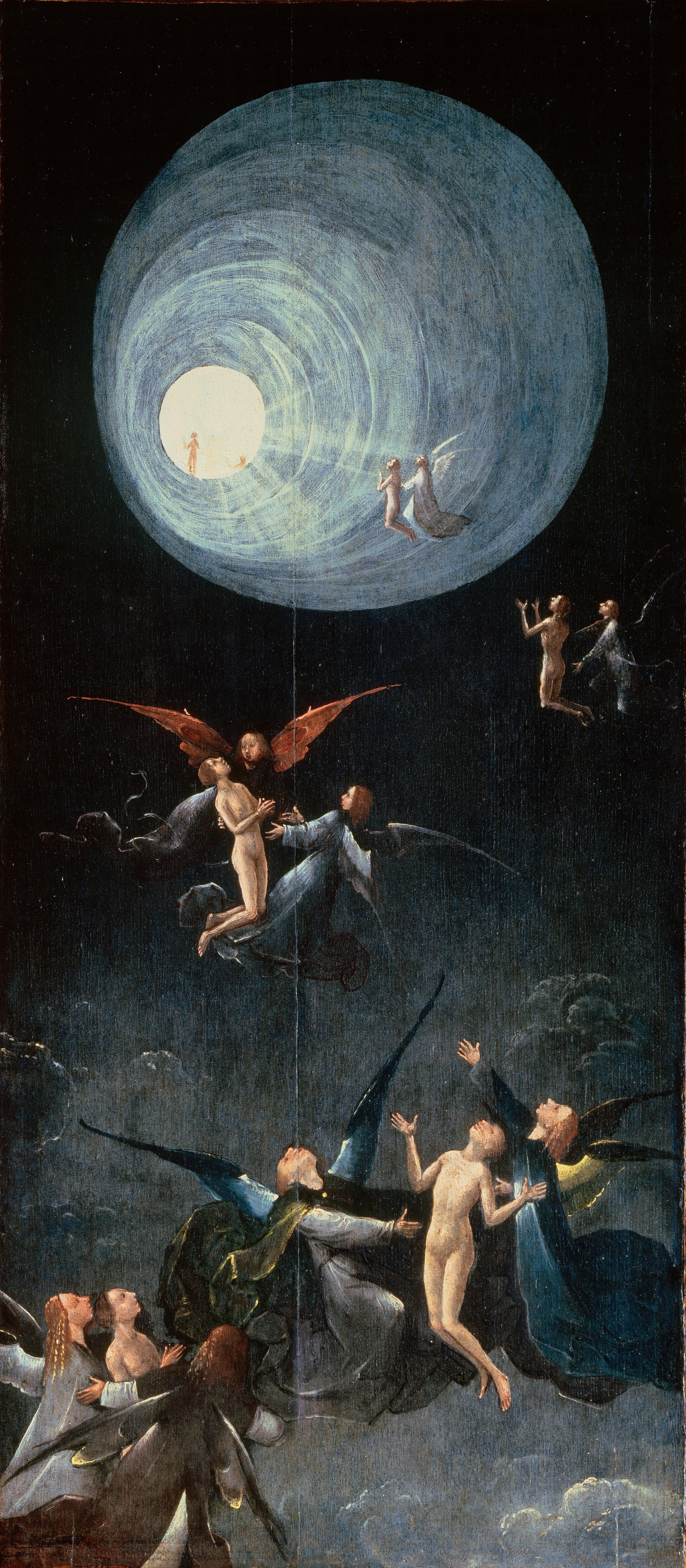
Hieronymus Bosch, Ascent of the Blessed, one panel of Visions of the Hereafter (c. 1505-1515), Gallerie dell'Accademia, Venice. Five centuries before anyone studied DMT, Bosch painted the tunnel and the light. Image: public domain, via Wikimedia Commons.
See this page's graph and discover linked topics
Cheatsheet
30-second reply. "I agree DMT can produce experiences that look like near-death experiences. That's been shown in the lab. But your claim needs three more things: that the dying human brain releases DMT, that it releases enough to cause a trip, and that this is what produces the NDE. Can you show me a human study that demonstrates any of those? The best-known study found DMT rising in rats, not people. And even if a chemical can imitate an experience, that doesn't prove the experience is nothing but the chemical."
Fast facts.
- Timmermann et al. (2018): 13 healthy volunteers given DMT scored significantly higher than on placebo on Greyson's NDE scale, and their reports overlapped heavily with those of a matched group of 13 people who had real NDEs.
- Martial et al. (2019): about 15,000 drug-experience reports (165 substances) compared with 625 NDE accounts. Ketamine, not DMT, came out closest.
- Dean, Borjigin et al. (2019): DMT rose in the visual cortex of rats after induced cardiac arrest. No human measurement.
- Nichols (2018): a psychedelic dose is around 25 mg; the pineal gland weighs under 0.2 g, and DMT is broken down quickly by MAO.
- Xu, Borjigin et al. (2023): a gamma-wave surge in 2 of 4 dying patients taken off life support. Neither survived to report anything.
- Michael, Luke and Robinson (2025): DMT trips and NDEs share broad themes but diverge in detailed content.
Concessions, and what each collects.
- Grant: DMT can produce NDE-like experiences. Collect: a model is not a cause. Ketamine models NDEs even better, and nobody claims the dying brain floods with ketamine.
- Grant: the brain is active during dying and chemistry affects experience. Collect: that shows mind and brain interact, which every dualist already holds. It does not show mind is brain.
- Grant: NDE reports alone do not prove the afterlife, and AWARE II found no one who saw the hidden targets. Collect: then the honest position on both sides is "not settled," which is not the confident "it's just DMT" the objection began with.
Closing line. "A copy of an experience is not an explanation of the original."
In full
The DMT objection holds that near-death experiences (NDEs) are hallucinations produced by N,N-dimethyltryptamine released in the dying brain, so they carry no evidential weight for consciousness beyond the brain or for an afterlife. It draws on Rick Strassman's speculation in the 1990s that the pineal gland releases DMT at birth and death, and on more recent laboratory work.
The objection is a causal claim, and a causal claim is only as strong as its weakest link. It needs four:
- Mimicry: DMT can produce NDE-like phenomenology. Established in a small lab study.
- Release: the dying human brain releases DMT. Shown in rats; not measured in humans.
- Dose: the release reaches psychoactive concentrations. Not shown; the concentration gap is the objection's hardest problem.
- Cause: that release produces the NDE. Not shown; the content comparisons cut against it.
Link 1 is real. Links 2 to 4 are open questions, and the best comparative data point away from DMT as the unique cause.
Two further points keep the debate honest. First, even a complete neurochemical story would show correlation between chemistry and experience. Whether consciousness reduces to that chemistry is a separate philosophical question, which the data alone cannot settle (see Argument from Consciousness and Substance Dualism). Second, the Christian case does not rest on NDEs. Scripture's teaching on the soul and the life to come stands on its own grounds (2 Corinthians 5:8; Hebrews 9:27), and NDEs are at most one supporting strand. See NDEs (Near Death Experiences).
Argument structure
| # | Premise |
|---|---|
| P1 | A causal explanation is established only when each link in its proposed mechanism is supported by evidence. |
| P2 | The DMT explanation of NDEs requires that the dying human brain releases DMT, at psychoactive concentration, and that this release causes the NDE. |
| P3 | None of those three links has been demonstrated in humans, and the best comparative data point away from DMT as the unique cause. |
| P4 | Even a demonstrated mechanism would establish correlation between chemistry and experience, not that experience is nothing but chemistry. |
| C | The claim that DMT explains near-death experiences is an unproven hypothesis, not a finding, and it cannot by itself show that NDEs are "just hallucinations." |
Form
The argument is defensive. It does not claim that NDEs prove the afterlife. It shows that the objection overstates its evidence (P1 to P3, a straightforward evidential audit) and that, even at full strength, it would not reach the conclusion drawn from it (P4, the correlation-causation and reduction distinction). The conclusion is modest on purpose: the honest verdict is "unproven," and that is enough to defeat a confident "it's just DMT."
P1, A causal explanation is established only when each link in its mechanism is supported
Affirmative case (second-order arguments)
- This is ordinary scientific practice. A proposed mechanism is a chain. Medicine does not accept "X causes Y" because X can produce something similar to Y; it requires showing that X is present when Y occurs, at a dose that could cause it, and that removing X removes Y.
- The objector already accepts it. The same skeptic who rejects an NDE account because "you can't show the soul left the body" is applying exactly this standard. It has to apply to the counter-explanation too. See Burden of Proof.
Anticipated objections
- "Science doesn't need certainty. It's the best available explanation."
Rebuttals
- Best available is not the same as established. If the link at the centre of the explanation is missing, it is a hypothesis worth testing, not the best explanation. And as P3 shows, among drug models it is not even the best fit: ketamine is.
Live-cite kit
- Scholarly: any standard account of causal inference in epidemiology (presence, dose, temporality).
- Aphorism: "Could cause is not did cause."
Tactical notes
- Get agreement on P1 before naming any study. It is hard to retract a standard once you have used it against the other side.
P2, The DMT explanation needs release, dose and cause in humans
Affirmative case (second-order arguments)
- Mimicry alone proves nothing about the cause. Ketamine, salvia and several serotonergic psychedelics also produce NDE-like reports (Martial et al., 2019). If similarity were enough, every one of them would "explain" NDEs, which is absurd.
- So the objection must say DMT is actually there. That means a human release, at a dose that could produce the experience, timed to the experience. Without those, "DMT explains NDEs" collapses to "DMT can imitate NDEs," which no one disputes.
Anticipated objections
- "DMT is produced naturally in the brain. That's enough."
Rebuttals
- Present is not the same as psychoactive. Many substances occur in the body in trace amounts. The question is whether enough is released, fast enough, in a dying human, to produce a full psychedelic experience (P3).
Live-cite kit
- Scholarly: Martial et al., "Neurochemical models of near-death experiences," Consciousness and Cognition 69 (2019).
- Aphorism: "If imitation were explanation, ketamine would win."
Tactical notes
- Name ketamine early. It shows you know the literature and it breaks the "DMT is the obvious answer" framing.
P3, None of the three links is demonstrated in humans
Affirmative case (second-order arguments)
- Release: shown in rats, not people. Dean, Borjigin and colleagues (Scientific Reports, 2019) found DMT made in rat brain tissue and a significant rise in DMT in the rat visual cortex after experimentally induced cardiac arrest. It is a genuine finding, and the opposing side is right to cite it. But Borjigin herself said of DMT, "We don't know what it's doing in the brain," and no comparable measurement exists in dying humans.
- Dose: the concentration gap. David Nichols, a leading psychedelic chemist, argued in the Journal of Psychopharmacology (2018) that a psychedelic effect needs on the order of 25 mg of DMT, that the pineal gland weighs under 0.2 g and makes about 30 µg of melatonin a day, and that monoamine oxidase breaks DMT down rapidly. Steven Barker has disputed parts of Nichols's framing, since brain DMT has not been properly measured. That dispute cuts both ways: if it has not been measured, it has not been shown to reach a psychedelic dose.
- Cause: the content diverges. Timmermann et al. (2018) found strong overlap on Greyson's NDE scale, which measures broad features. But when Michael, Luke and Robinson (Frontiers in Psychology, 2025) compared detailed content, DMT trips and NDEs "clearly diverge," with DMT reports dominated by encounters with other beings and more abstract, shifting imagery. Broad overlap with detailed divergence is what you would expect from two different causes that share some neural machinery.
- The dying-brain activity data do not supply the link. Xu, Borjigin and colleagues (PNAS, 2023) recorded a surge of gamma activity in 2 of 4 dying patients removed from life support. It is interesting evidence that the brain can be briefly active while dying. But it says nothing about DMT, the sample is tiny, and neither patient survived to report an experience.
Anticipated objections
- "The rat study is good evidence. Humans are mammals too."
- "Absence of human data is just because it's unethical to study. Give it time."
Rebuttals
- It is good evidence for rats, and a reason to research humans. It is not evidence that the human release reaches a psychedelic dose or that it causes NDEs. An extrapolation from rodents is a hypothesis, not a finding.
- Then the honest claim is "maybe, someday." That may be true. But "we can't test it yet" is not the same as "it's been shown." The objector cannot both admit the data are missing and declare the matter closed.
Live-cite kit
- Scholarly: Dean et al., Scientific Reports 9 (2019); Nichols, "N,N-dimethyltryptamine and the pineal gland: Separating fact from myth," Journal of Psychopharmacology 32 (2018); Michael, Luke and Robinson, Frontiers in Psychology 16 (2025); Xu et al., PNAS 120 (2023).
- Aphorism: "Rats are not a dying human, and trace is not a trip."
Tactical notes
- Concede the rat study openly. It costs nothing, and it makes your point about the missing human data more credible.
- The force-commit question: "Can you show me a controlled human study demonstrating that the dying brain releases DMT at a psychedelic concentration?"
P4, Even a demonstrated mechanism would show correlation, not reduction
Affirmative case (second-order arguments)
- Interaction is not identity. Every Christian dualist already holds that brain chemistry affects experience: alcohol, anaesthesia and sleep all do. A drug that alters or imitates an experience shows mind and brain interact. It does not show the mind is nothing but the brain. See Substance Dualism and Mind, Soul, Consciousness.
- The radio illustration, used honestly. Change a radio's circuitry and the broadcast sounds different, or you can make the speaker produce sounds on its own. That alone does not tell you whether there is also a broadcast. The illustration does not prove the mind is independent of the brain. It shows why "the hardware can produce it" does not settle the question.
- The hard question remains. Why any physical process is accompanied by subjective experience at all is not answered by naming which chemical is involved. See Argument from Consciousness.
Anticipated objections
- "This is a God-of-the-gaps move. You're hiding the soul in what science hasn't explained yet."
- "Veridical NDEs are anecdotes. AWARE II found nothing."
Rebuttals
- It is the opposite of a gap argument. P1 to P3 do not say "science can't explain this, therefore God." They say the proposed scientific explanation has not been demonstrated. P4 is a philosophical point about what any mechanism could show, not a gap waiting to close. See God of the Gaps.
- Agreed that AWARE II was negative on its key test, and say so. In AWARE II (Parnia et al., Resuscitation, 2023), no survivor identified the hidden images or sounds, though some reported memories suggestive of awareness during resuscitation. That weakens the strongest form of the veridical-perception argument, and a Christian should not oversell it. But it does not help the DMT objection either, which has its own unproven links. Note too that an NDE happens near death, during cardiac arrest or resuscitation. It is not a report from after irreversible death, on either side's reading.
Live-cite kit
- Scripture: 2 Corinthians 5:8, "absent from the body, and to be at home with the Lord"; the Christian hope rests on this, not on NDE research.
- Scholarly: Parnia et al., AWARE II, Resuscitation (2023).
- Aphorism: "Changing the radio doesn't tell you whether there's a broadcast."
Tactical notes
- Do not stake the faith on NDEs. Defend the narrow claim: the DMT explanation is unproven. Then move the conversation to the stronger arguments.
Conclusion
The claim that DMT explains near-death experiences is an unproven hypothesis, not a finding. DMT can imitate some features of NDEs, but so can other drugs, and better (P2). The human release, the psychoactive dose and the causal link are all undemonstrated, and the detailed content diverges (P3). Even a full mechanism would show that chemistry and experience are correlated, which dualists already accept, not that experience is nothing but chemistry (P4).
Master objections to the argument as a whole
- "You're just demanding impossible proof." No. The standard is the ordinary one for any causal claim (P1), and the objector applies it to NDE accounts already.
- "Even if DMT isn't it, some brain process is." Possibly, and the defeater does not deny that brain processes are involved. It denies that naming a candidate process settles whether NDEs are "just hallucinations." That is a different and harder claim.
- "You need NDEs to be real for Christianity." No. The Christian hope rests on the resurrection of Jesus and the teaching of Scripture. NDEs are at most a supporting strand. See There Is No Evidence for the Resurrection Objection Defeater.
Tactical opening / closing
Opening line: "I'll grant you DMT can produce something like a near-death experience. Now walk me through the rest: where is the human evidence that the dying brain releases enough of it to cause one?"
Closing landing strip: "So the honest answer is 'we don't know yet,' not 'it's just DMT.' And even if we found the chemical, a copy of an experience is not an explanation of the original. That leaves the real question on the table: why is there consciousness at all?"
Connection to Scripture
- 2 Corinthians 5:8, absent from the body, at home with the Lord
- Hebrews 9:27, "it is appointed unto men once to die, and after this cometh judgment"
- Luke 23:43, "To-day shalt thou be with me in Paradise"
Patristic / scholarly note
Modern:
- Christopher Timmermann et al. ("DMT Models the Near-Death Experience," Frontiers in Psychology 9, 2018), the lab mimicry finding
- Charlotte Martial et al. (Consciousness and Cognition 69, 2019), ketamine closest of 165 substances
- Jon Dean, Jimo Borjigin et al. (Scientific Reports 9, 2019), DMT rise in rat visual cortex after cardiac arrest
- David Nichols (Journal of Psychopharmacology 32, 2018), the dose and clearance problem
- Gang Xu, Jimo Borjigin et al. (PNAS 120, 2023), gamma surge in 2 of 4 dying patients
- Pascal Michael, David Luke and Oliver Robinson (Frontiers in Psychology 16, 2025), broad overlap, detailed divergence
- Sam Parnia et al. (AWARE II, Resuscitation, 2023), no survivor identified the hidden targets
Scholarship
Published academic works this page draws on, each matched to a publisher, index or library catalog record.
- Jon G. Dean et al., "Biosynthesis and Extracellular Concentrations of N,N-dimethyltryptamine (DMT) in Mammalian Brain," Scientific Reports 9 (2019). doi:10.1038/s41598-019-45812-w PubMed 31249368 open access
- Charlotte Martial et al., "Neurochemical models of near-death experiences: A large-scale study based on the semantic similarity of written reports," Consciousness and Cognition 69 (2019). doi:10.1016/j.concog.2019.01.011 PubMed 30711788 open access
- Pascal Michael, David Luke and Oliver Robinson, "An encounter with death: a comparative thematic and content analysis of naturalistic DMT experiences and the near-death experience," Frontiers in Psychology 16 (2025). doi:10.3389/fpsyg.2025.1532937 PubMed 40110076
- David E Nichols, "N,N -dimethyltryptamine and the pineal gland: Separating fact from myth," Journal of Psychopharmacology 32 (2018). doi:10.1177/0269881117736919 PubMed 29095071
- Sam Parnia et al., "AWAreness during REsuscitation - II: A multi-center study of consciousness and awareness in cardiac arrest," Resuscitation 191 (2023). doi:10.1016/j.resuscitation.2023.109903 PubMed 37423492 open access
- Christopher Timmermann et al., "DMT Models the Near-Death Experience," Frontiers in Psychology 9 (2018). doi:10.3389/fpsyg.2018.01424 PubMed 30174629 open access
- Gang Xu et al., "Surge of neurophysiological coupling and connectivity of gamma oscillations in the dying human brain," Proceedings of the National Academy of Sciences 120 (2023). doi:10.1073/pnas.2216268120 PubMed 37126719
See also
- NDEs (Near Death Experiences), the concept hub, with the cases and the critiques
- Argument from Consciousness, why naming a mechanism does not explain experience
- Substance Dualism, the view NDEs are often used to support
- Mind, Soul, Consciousness, the broader hub
- Materialism, the view the objection assumes
- God of the Gaps, why this defeater is not one
- Burden of Proof, the standard applied to both sides
- Pam Reynolds (NDE 1991), the best-documented single case
- Arguments, master index
Common questions this page answers
Q: Does DMT cause near-death experiences?
That has not been shown. DMT can produce experiences that resemble near-death experiences in a lab, but no study has demonstrated that the dying human brain releases DMT at a psychedelic concentration, or that such a release causes NDEs. The key release finding so far comes from rats.
Q: Does the brain release DMT when you die?
In rats, DMT rose in the visual cortex after induced cardiac arrest (Dean et al., 2019). Nothing comparable has been measured in dying humans, and the psychedelic chemist David Nichols has argued that the body is unlikely to produce the roughly 25 mg a psychedelic effect requires.
Q: Are DMT trips the same as near-death experiences?
They share broad themes, such as leaving the body and meeting other beings, but a 2025 comparison found they diverge in detailed content. A 2019 study of about 15,000 drug reports found ketamine, not DMT, came closest to NDE accounts.
Q: If a drug can cause an NDE-like experience, doesn't that prove NDEs are hallucinations?
No. That a drug can imitate an experience shows that brain chemistry and experience interact, which dualists already accept. It does not show the original experience was nothing but chemistry, just as a recording of a voice does not prove nobody spoke.
Q: Did the AWARE II study prove near-death experiences are real?
No. In AWARE II (2023), no cardiac-arrest survivor identified the hidden images or sounds placed during resuscitation, although some reported memories suggestive of awareness. It neither proves NDEs are real nor shows they are caused by DMT.