Concept
Divine Conceptualism
Theistic Conceptual Realism, Divine Ideas, Divine Ideas Tradition, Laws of Logic as Divine Thoughts, Propositions as Divine Thoughts, Argument for God from Logic, The Lord of Non-Contradiction, Logic and the Mind of GodIntro
Some things are true no matter what. Two plus two is four. A thing cannot be itself and not itself at the same time. If all men are mortal and Socrates is a man, Socrates is mortal. These truths did not start when people discovered them, and they would still hold if there were no people at all.
That raises a simple question: what are they? A truth is a thought-like thing. It is about something, and it can be believed, doubted, or denied. Yet these truths are not anyone's private thoughts, and they never change.
Divine conceptualism is the Christian answer that has been around since Augustine. The unchanging truths of logic and mathematics are thoughts in the eternal mind of God. They are necessary because God exists necessarily and always thinks them. They are true everywhere because his mind is not limited to any place. They are thought-like because they really are thoughts.
This view does two jobs at once:
- It explains logic. It tells you what the laws of logic are, why they cannot fail, and why our minds can grasp them.
- It points to God. If the laws of logic are thoughts, and they exist necessarily, then there must be a mind that exists necessarily. That is a short step to God.
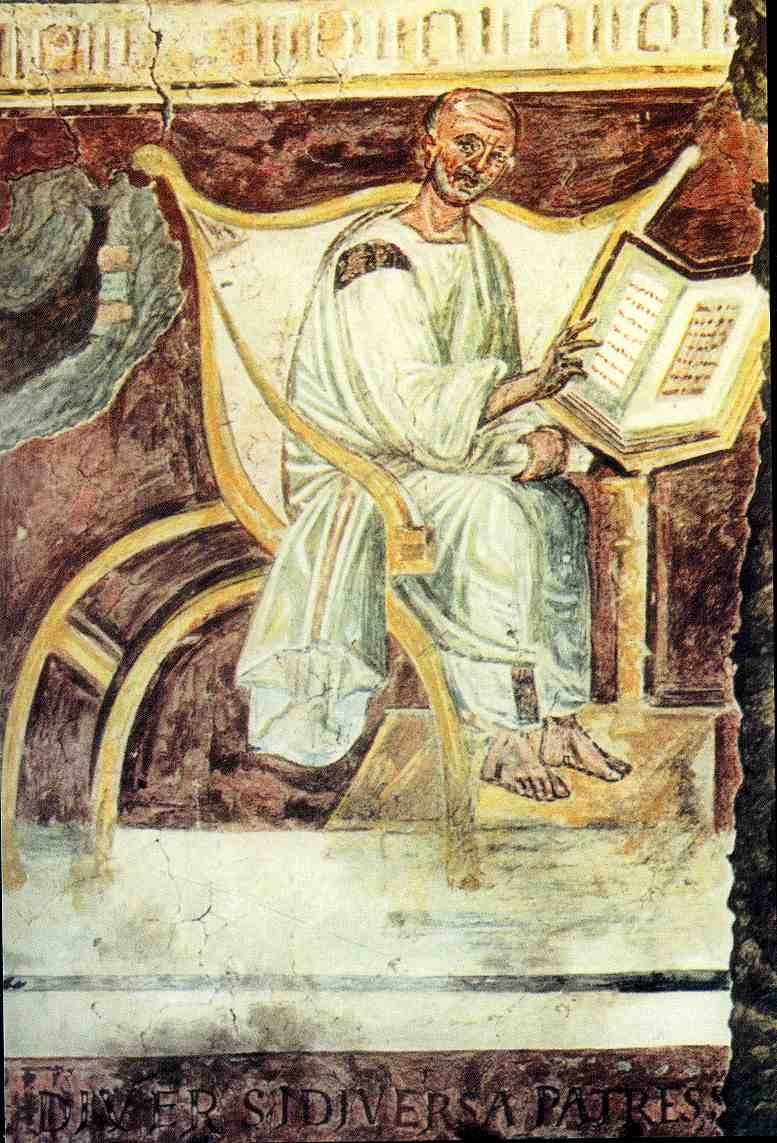
The oldest surviving portrait of Augustine of Hippo, a sixth-century fresco in the Lateran, Rome. Augustine argued that the unchanging truth the mind discovers stands above the mind and leads to God. Public domain (Wikimedia Commons), resized.

The 30-second version. Logic is real, it is necessary, and it is made of truths, which are the kind of thing minds think. A necessary thought needs a necessary thinker. Divine conceptualism says the laws of logic are God's eternal thoughts, which explains why they hold everywhere and always, why they are about things, and why minds made in God's image can know them. Every rival has to explain those same three facts without a mind behind them.
See this page's graph and discover linked topics
In full
Divine conceptualism (also theistic conceptualism or, in Greg Welty's phrase, theistic conceptual realism) is the thesis that the entities usually classed as abstract objects, especially propositions, necessary truths, the laws of logic, and (on fuller versions) properties, relations, numbers, and possible worlds, are ideas or thoughts in the divine intellect. It is a form of realism: these entities really exist, are mind-independent with respect to every created mind, and are necessary. It denies the Platonist claim that they exist on their own, independent of any mind. They depend constitutively on God, as a thought depends on its thinker.
The view therefore sits between two families of rivals:
- Platonism keeps the realism and drops the mind. Necessary abstract objects exist uncreated and independent of God.
- Nominalism, conventionalism and anti-realism keep the independence from God by denying that the objects exist at all, or by reducing them to language, convention, or useful fiction.
The view also yields an argument for God, made most explicit by James N. Anderson and Greg Welty: if the laws of logic are necessarily existing thoughts, they require a necessarily existing mind, which is a necessarily existing person.
The core claims
- The laws of logic are truths. They are true propositions, not mere sentences, behaviors or brain states.
- They are necessary. They could not have failed to be true.
- They exist. Propositions are real, and we quantify over them and refer to them when we say "that claim is true."
- They are intentional. A proposition is about something, and it presents its object in a particular way. Being about something is the mark of the mental.
- So they are thoughts. The simplest account of an intentional item is that it is mental.
- They are God's thoughts. No contingent mind could host a necessarily existing thought, so the mind that thinks them exists necessarily.
History of the view
Augustine
- On Free Choice of the Will (De Libero Arbitrio), Book II. In dialogue with Evodius, Augustine argues that there are truths, including the truths of number and of wisdom, that every reasoning mind sees in common and that do not change. Because the mind changes and these truths do not, the truth is superior to the mind and is not its product. He frames the conclusion conditionally: if there is something higher than truth, that is God, and if there is not, truth itself is God. Either way God exists. He restates the structure of the argument near the end of chapter 15.
- Eighty-Three Different Questions (De Diversis Quaestionibus 83), question 46, "On Ideas." Augustine places the ideas, which he prefers to call rationes (reasons, a rendering of the Greek logoi), in the divine intelligence. They are the stable, unformed and eternal patterns according to which changeable things are made.
- Significance: Augustine moves Plato's forms into the mind of God. This is the founding move of the divine-ideas tradition. See Augustine and Plato.
Thomas Aquinas
- Summa Theologiae I, q. 15 ("Of Ideas"). Article 1 asks whether there are ideas and answers that "it is necessary to suppose ideas in the divine mind," since the world was made according to a form in that mind. Articles 2 and 3 hold that the ideas are many, and that there are ideas of all things God knows.
- Summa Theologiae I, q. 16, a. 7 ("Whether created truth is eternal?"). Aquinas argues that the truth of statements is the truth of the intellect, so that "if no intellect were eternal, no truth would be eternal. Now because only the divine intellect is eternal, in it alone truth has eternity." He adds that this does not make anything other than God eternal.
- Significance: eternal truth is located in the divine intellect, which on Aquinas's view is identical with God himself. See Thomas Aquinas and Divine Simplicity.
Leibniz
- Monadology 43-44 (1714). God is the source of essences and possibilities as well as of existences, because the eternal truths, and the ideas on which they depend, are in God's understanding. Without God there would be nothing real in possibilities, and nothing would even be possible. If there is reality in essences or eternal truths, that reality must be grounded in something existing and actual, namely the necessary being.
- Monadology 46. Leibniz rejects the view that the eternal truths depend on God's will and are therefore arbitrary, the view he attributes to Descartes. Necessary truths depend on God's understanding, of which they are the internal object.
- Significance: this blocks the charge that conceptualism makes logic arbitrary. See Leibniz and the Contingency Argument.
Alvin Plantinga
- Does God Have a Nature? (Marquette University Press, 1980). The Aquinas Lecture for 1980. Plantinga rejects "universal possibilism," the idea that God could have made contradictions true, and works through how God relates to necessary truths and properties without making them independent of him.
- "How to Be an Anti-Realist," Proceedings and Addresses of the American Philosophical Association 56, no. 1 (1982): 47-70. Plantinga argues that truth cannot be independent of the noetic activity of persons, yet it must be independent of our noetic activity. The way to hold both is to say that truth depends on God's thinking. Anderson and Welty describe their own paper as a sustained argument for this observation of Plantinga's.
- See Alvin Plantinga.
Greg Welty
- "Theistic Conceptual Realism: The Case for Interpreting Abstract Objects as Divine Ideas" (D.Phil. thesis, University of Oxford, 2006). The fullest modern defense of the view. Welty argues that propositions, properties, relations and possible worlds are best construed as divine ideas, which keeps their realism and necessity while making them depend on God.
- "Do Divine Conceptualist Accounts Fail? A Response to Chapter 5 of God over All," Philosophia Christi 21, no. 2 (2019): 255-266. Welty's reply to William Lane Craig's critique of his thesis.
The Anderson-Welty argument
James N. Anderson and Greg Welty, "The Lord of Non-Contradiction: An Argument for God from Logic," Philosophia Christi 13, no. 2 (2011): 321-338. The paper argues for a metaphysical dependence running from God to logic: there are laws of logic because, and only because, God exists. Its sections build the case one step at a time, and the conclusion summarizes the chain.
- The laws of logic are truths. If they were not true, there would be no reason to observe them.
- They are truths about truths. The Law of Non-Contradiction is about propositions and their truth values, not about any particular subject matter.
- They are necessary truths. They could not have been untrue. There is no possible world in which they fail, since the very idea of possibility is bound up with logical consistency.
- They really exist. Truths are real (if abstract) entities. Statements such as "the Law of Non-Contradiction is true" refer to something.
- They necessarily exist. A truth that could not have failed to be true could not have failed to exist. So the laws of logic exist in every possible world.
- They are non-physical. They have no location, mass or charge, and every physical thing, including sentences on paper and patterns in brains, is contingent. Since the laws of logic exist necessarily, they cannot be physical.
- They are thoughts. Propositions are intrinsically intentional (they are about things and present them under an aspect), and the intrinsically intentional is the mental. So the laws of logic are mental in nature. The authors note that Frege called propositions Gedanken, "thoughts."
- They are divine thoughts. Human thoughts exist contingently, and thoughts belong essentially to the minds that have them. Necessarily existing thoughts therefore require a necessarily existing mind. A necessarily existing mind is the mind of a necessarily existing person, and that person must be spiritual, since no physical entity exists necessarily.
- Conclusion. If there are laws of logic, there is a necessarily existent, personal, spiritual being. The laws of logic imply the existence of God.
Two clarifications the authors make:
- The argument concerns metaphysics, what grounds logic, and leaves aside epistemology, how we come to believe in God. Every argument must use logic. The claim here is that logic itself depends on God.
- The argument shows at least one necessarily existent person. The authors note that it is compatible with the Trinity and does not by itself settle how many persons share the divine nature.
The rivals
1. Platonism
- The claim: propositions and the laws of logic are necessary abstract objects that exist on their own, outside space, time and every mind.
- Strength: it keeps realism and necessity, which most philosophers of logic want.
- Weakness for the Platonist: an abstract object that is not a mind still has to be about things and still has to present them truly. Platonism gives no account of how a non-mental object has intentional, truth-bearing content. For the theist, independent uncreated abstracta also sit badly with God as creator of all things other than himself (see Aseity).
2. Logical primitivism or brute necessity
- The claim: the laws of logic are necessary, and necessity is where explanation stops. Asking why they hold is like asking why a triangle has three sides.
- Strength: it is simple and refuses to multiply entities.
- Weakness: it answers why they must hold while leaving what they are untouched. Necessity explains why a truth could not have been false. It does not explain what kind of thing the truth is, or how it is about anything.
3. Nominalism
- The claim: there are no propositions or abstract objects, only concrete particulars, including sentences and mental tokens. Talk of "the Law of Non-Contradiction" is shorthand for facts about sentences or speakers.
- Weakness: sentences and mental tokens are contingent and local. The law held before any language existed and would hold if all speakers vanished. Anderson and Welty also argue that the nominalist charge of "reification" begs the question, since treating an abstraction as real is an error only if no abstract objects exist. See Universals.
4. Conventionalism
- The claim: logical truths are true by convention. They follow from the rules we adopt for words such as "not," "and" and "if." Rudolf Carnap's The Logical Syntax of Language (1934) treated the choice of a logical language as a matter of convention under his "principle of tolerance."
- The classic objection: W. V. O. Quine, "Truth by Convention" (1936), argued that logic cannot be generated from conventions. There are infinitely many logical truths, so the conventions would have to be stated generally, and deriving particular truths from general conventions already requires logical inference. Logic is presupposed by the very process of applying the conventions. See W.V.O. Quine and Analytic-Synthetic Distinction.
- A further problem: conventions are contingent. Had we adopted different conventions, the sentences would mean different things, and the truths they now express would remain true.
5. Anti-realism about abstract objects
- The claim: there are no abstract objects, and statements that seem to refer to them can be true without such commitment (neutralism, deflationary truth), or are useful fictions or pretense (fictionalism, figuralism, pretense theory).
- The leading Christian defender: William Lane Craig, God Over All: Divine Aseity and the Challenge of Platonism (Oxford University Press, 2016). Craig argues that uncreated abstract objects threaten divine aseity, criticizes divine conceptualism in chapter 5 (engaging Welty's thesis), and recommends that theists adopt one of several anti-realist options.
Objections and replies
Objection 1: the bootstrapping or aseity objection
- Steel-manned: if God has a nature, he has properties. If properties are God's ideas, then God's having the property of, say, being omniscient depends on his first thinking the idea of omniscience. But he could only think that idea if he were already omniscient. The explanation runs in a circle. The same worry appears from the other side: if the laws of logic are independent of God, then God's own nature and thinking depend on something outside him.
- Reply 1: the circle arises only if God's nature is constituted by his ideas. Divine conceptualism says that created things and propositions about them depend on God's ideas, while God's nature is the ground and the ideas are the content of his self-knowledge. Thomists make this explicit through Divine Simplicity: God's intellect and essence are identical, so nothing in God depends on anything prior to God.
- Reply 2: the objection, pressed against the alternative, is stronger. If logic were a set of independent abstract objects, God's own rationality would depend on something he did not make. Conceptualism removes that dependence by locating logic in God.
Objection 2: Craig's identification problem
- Steel-manned: God's thoughts may not be suited to play the roles abstract objects are supposed to play. Craig argues in God Over All that the identification of abstract objects with divine thoughts faces pressing problems, and that the theist does better to deny that abstract objects exist at all.
- Reply 1: the anti-realist must still explain the necessity and intentionality of logic. Fictionalism and pretense theories say that talk of propositions is not literally true. Yet the Law of Non-Contradiction is literally true, necessarily, and that truth is what any argument for anti-realism relies on.
- Reply 2: Welty answered Craig's chapter directly in Philosophia Christi (2019), defending the conceptualist account Craig criticized, and Craig responded in the same volume. The exchange is the place to follow the technical details.
- Note on the debate: both sides agree on the main point that matters for apologetics. Nothing exists independently of God. The disagreement is over whether to secure that by locating abstracta in God's mind or by denying them.
Objection 3: "brute necessity needs no explanation"
- Steel-manned: necessary truths are the end of the line. Demanding an explanation for them is a category mistake, since there is no possible situation in which they fail that would need ruling out.
- Reply 1: the argument asks what the laws of logic are, which is a separate question from why they could not have been otherwise. Even a brute necessary truth is a truth, and truths are about things. The question of what bears that aboutness remains.
- Reply 2: theists and atheists alike already accept that some necessary facts have explanations. Mathematicians explain why theorems hold by proving them from deeper truths, even though every theorem is necessary. Necessity does not exempt a fact from explanation.
- Reply 3: a worldview that takes logic as a free-floating brute fact has accepted an unexplained necessary entity with mind-like properties. Conceptualism offers a single necessary being who accounts for it.
Objection 4: "then my thoughts are God's thoughts"
- Steel-manned: if the Law of Non-Contradiction is a divine thought, and I think the Law of Non-Contradiction, then either I think God's numerical thought or I think something else.
- Reply: Anderson and Welty draw on the distinction between a thinker's thought and the content of that thought. Thoughts belong essentially to their thinkers, so my thinking is mine. What I grasp is the same content God thinks. A student who understands a teacher's proof has the same content in mind without having the teacher's mental act. In Christian terms, finite minds made in God's image can grasp, after him, the content God thinks.
Objection 5: "this makes logic arbitrary"
- Steel-manned: if logic depends on God, God could have willed a different logic, which makes logic arbitrary and God's commands unconstrained.
- Reply: divine conceptualism grounds logic in God's intellect and nature. Leibniz rejected the voluntarist alternative in Monadology 46, and Plantinga's Does God Have a Nature? rejects the idea that God could make contradictions true. The structure parallels the standard answer to the Euthyphro Dilemma: the standard is neither above God nor arbitrarily chosen by him, because it is grounded in who he is.
Cross-examination script: "logic simply exists"
Use when the opponent dismisses the question with "logic just exists" or "logic is just there."
- "When you say logic exists, which kind of thing do you mean?"
- (a) A necessary abstract object existing on its own.
- (b) A fact about all possible states of affairs, such as "no possible situation contains both P and not-P."
- (c) A convention about how we use words.
- If (a), abstract object:
- "Does it exist necessarily, in every possible world?" (Almost always yes.)
- "Is it about anything? The Law of Non-Contradiction is about propositions and truth, correct?"
- "What other non-mental thing do you know of that is about something? Rocks and numbers on a page are not about anything until a mind reads them. How does a non-mental object have content?"
- If (b), fact about possibilities:
- "What makes something possible or impossible in the first place? If possibilities are real enough for logic to be true of all of them, what grounds the space of possibilities?"
- "Is the fact that no possible world contains a contradiction itself a truth? Then we are back to asking what that truth is."
- If (c), convention:
- "Was the Law of Non-Contradiction false before anyone adopted the convention?"
- "If we had adopted different conventions, would contradictions have become true, or would our words just mean different things?"
- "Quine pointed out that you need logic to derive particular truths from general conventions. How do you set up conventions without already using logic?"
- On necessity:
- "You say it could not have been otherwise. Why not? Is that a fact you can explain, or a brute stop?"
- "If it is brute, you have a necessary, eternal, unchanging, everywhere-applicable truth with no explanation. Christians have a name for the necessary, eternal, unchanging source of truth."
- Close: "So we agree logic is real, necessary, universal and about things. Those are the properties of a thought held by a mind that is itself necessary and universal. That is the picture Augustine, Aquinas and Leibniz gave. Which piece of it do you reject, and what do you replace it with?"
For related moves see Laws of Logic Do Not Exist Objection Defeater and Syllogisms for Logic Itself.
Scripture connection
Divine conceptualism is a philosophical thesis, and Scripture does not state it in technical terms. Several passages fit it closely.
- John 1:1-3. The Word (Greek logos) is eternal, with God, and is God, and all things were made through him.
In the beginning was the Word, and the Word was with God, and the Word was God. The same was in the beginning with God. All things were made through him; and without him was not anything made that hath been made. (John 1:1-3, ASV)
- Colossians 1:16-17. All things were created through Christ, and in him all things hold together.
and he is before all things, and in him all things consist. (Colossians 1:17, ASV)
- Hebrews 1:3. The Son is described as "upholding all things by the word of his power" (Hebrews 1:3, ASV).
- 2 Timothy 2:13 and Titus 1:2. God "cannot deny himself" (2 Timothy 2:13, ASV) and is the God "who cannot lie" (Titus 1:2, ASV). God's faithfulness and truthfulness are fixed by his own nature, which is the scriptural shape of the claim that truth is grounded in who God is.
A caution on the Logos. The logos of John 1 is the personal, eternal Son. It carries a wide range of meaning, including word, reason and message, and an important background is the Old Testament picture of God creating by his word (Genesis 1:3, Psalm 33:6). The Logos is not simply identical to formal logic, and the passage does not teach the laws of logic as such. What it does supply is a personal, rational source of all that exists, in whom the order of creation holds together, which fits the conceptualist picture. See Logos Christology and logos.
Why it matters for apologetics
- It turns logic into evidence. The atheist who uses logic to argue against God is relying on something that, on this view, is a thought in God's mind. See Transcendental Argument for God.
- It extends to other abstracta. The same reasoning applies to mathematical truth, universals and objective truth generally. See Argument from Objective Truth, Argument from Mathematical Truth and Anyone Who Affirms Universals Must Affirm God.
- It explains knowledge. If logic is God's thought and human minds are made in his image, it is unsurprising that we can grasp necessary truths at all. See Argument from Reason and Intentionality.
Scholarship
Published academic works this page draws on, each matched to a publisher, index or library catalog record.
- James N. Anderson, Greg Welty and Evangelical Philosophical Society, "The Lord of Noncontradiction: An Argument for God from Logic," Philosophia Christi 13 (2011). doi:10.5840/pc201113229
- William Lane Craig, God Over All: Divine Aseity and the Challenge of Platonism (Oxford University Press, 2016). doi:10.1093/acprof:oso/9780198786887.001.0001
- Alvin Plantinga, Does God have a nature? (Marquette University Press, 1980). Open Library
- Alvin Plantinga, "How to be an Anti-Realist," Proceedings and Addresses of the American Philosophical Association 56 (1982). doi:10.2307/3131293
See also
- Syllogisms for Logic Itself, formal syllogisms grounding logic in God
- Transcendental Argument for God, the wider argument from the preconditions of reason
- Laws of Logic Do Not Exist Objection Defeater, the defeater against logical anti-realism
- Argument from Objective Truth, Augustine's route from unchanging truth to God
- Anyone Who Affirms Universals Must Affirm God, the parallel argument from universals
- Argument from Mathematical Truth, the parallel argument from mathematics
- Universals, the realism and nominalism debate
- Laws of Logic, the classical laws themselves
- Law of Non-Contradiction, the law the Anderson-Welty paper is named for
- Aseity, the doctrine at stake in the Platonism debate
- Divine Simplicity, the Thomist frame for God's ideas
- Euthyphro Dilemma, the parallel problem for morality
- Augustine, Thomas Aquinas, Leibniz, Alvin Plantinga, W.V.O. Quine, William Lane Craig
Common questions this page answers
Q: What is divine conceptualism?
Divine conceptualism is the view that necessary truths, propositions and the laws of logic are thoughts in the eternal mind of God. They are real and necessary because God exists necessarily and always thinks them, and they depend on God the way a thought depends on its thinker.
Q: Are the laws of logic thoughts in the mind of God?
That is the position of the divine-ideas tradition running from Augustine through Aquinas and Leibniz to Alvin Plantinga and Greg Welty. The argument is that the laws of logic are necessary truths, truths are about things, being about things is a mark of the mental, and a necessarily existing thought needs a necessarily existing mind.
Q: What is the Anderson and Welty argument for God from logic?
In "The Lord of Non-Contradiction" (Philosophia Christi, 2011), James Anderson and Greg Welty argue that the laws of logic are necessary truths about truths, that they really and necessarily exist, that they are non-physical, that as intentional propositions they are thoughts, and that necessarily existing thoughts require a necessarily existing mind and person. So if there are laws of logic, God exists.
Q: What is the difference between divine conceptualism and Platonism?
Both say abstract objects such as propositions really and necessarily exist. Platonism says they exist on their own, independent of any mind. Divine conceptualism says they exist as ideas in God's mind and depend on him.
Q: Why does William Lane Craig reject divine conceptualism?
In God Over All (2016), Craig argues that identifying abstract objects with divine thoughts faces serious problems, and he recommends that theists protect God's aseity by denying that abstract objects exist, through anti-realist views such as fictionalism or neutralism. Greg Welty replied in Philosophia Christi in 2019.
Q: Can't the laws of logic just be brute necessary facts?
A brute necessity explains why the laws could not have been false, but leaves open what they are. They are truths that are about things, and a non-mental object with content is the very thing that needs explaining. Necessary truths in mathematics also receive explanations by proof, so necessity does not exempt a fact from explanation.
Q: Does John 1:1 say that Jesus is logic?
The Greek logos in John 1:1 means word, reason or message, and refers to the eternal Son, a person. The passage presents him as the rational, personal source through whom all things were made, which fits the view that logic is grounded in God, without identifying Christ with formal logic.