Concept
Desert Fathers and Mothers
Desert Fathers, Desert Mothers, Desert Fathers and Mothers of Egypt, Abbas and Ammas, Sayings of the Desert Fathers, Apophthegmata Patrum, Apophthegmata, Egyptian desert monasticism, Scetis, Nitria, Kellia, Amma SyncleticaIntro
The Desert Fathers and Mothers were Christian men and women who, from the late 200s onward, left the towns and villages of Egypt to live in the desert as monks and nuns. Some lived completely alone, some in small groups around a wise elder, and some in large organized communities. They prayed, fasted, worked with their hands, memorized Scripture and fought what they called the battle of the thoughts.
They were mostly Egyptians, many of them ordinary farmers who spoke Coptic, and their short, sharp sayings about humility, anger, prayer and love are still read by Christians of every tradition. Christian monasticism, which later shaped Europe, Ethiopia and the Middle East, began here, in Africa.
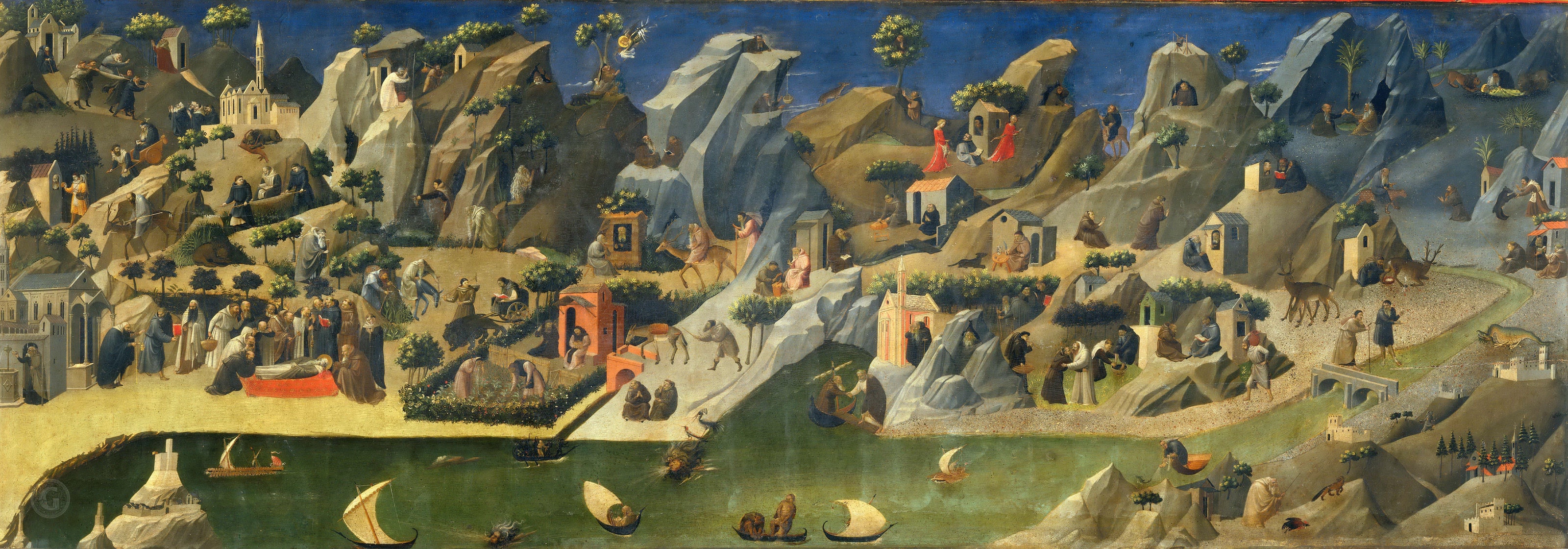 The Thebaid, scenes of the life of the desert monks, Fra Angelico (formerly attributed to Gherardo Starnina), c. 1420, Uffizi, Florence. Public domain (Wikimedia Commons), resized.

See this page's graph and discover linked topics
In full
"Desert Fathers and Mothers" is the conventional name for the ascetics of the Egyptian deserts (and, by extension, of Palestine and Syria) in the 4th and 5th centuries, whose teaching survives chiefly in the Apophthegmata Patrum ("Sayings of the Fathers"), compiled in Greek in the late 5th century in alphabetical and systematic collections and translated into Latin, Syriac, Coptic, Armenian, Ge'ez and other languages. Three forms of life coexisted: the anchoritic or eremitic life of the solitary (modeled on Antony the Great); the semi-eremitic life of the lavra or settlement, where monks lived alone in cells through the week and gathered for the Eucharist on Saturday and Sunday (Nitria, Kellia and Scetis in Lower Egypt); and the cenobitic or communal life under a rule (founded by Pachomius in Upper Egypt). The movement grew rapidly after the end of persecution in 313, attracted visitors and chroniclers (the anonymous History of the Monks in Egypt, Palladius's Lausiac History, John Cassian's Institutes and Conferences), and supplied the patterns, vocabulary and spiritual psychology of all later Christian monasticism, Eastern and Western. Its leading figures were overwhelmingly Coptic Egyptians, alongside Greeks, Palestinians, Romans and others who came to learn from them.
Where they lived
| Region | Character | Associated figures |
|---|---|---|
| The Eastern Desert near the Red Sea | Remote hermitages | Antony the Great at the Inner Mountain |
| Nitria (western edge of the Nile Delta) | Large semi-eremitic settlement with a church, bakeries and guest houses | Amoun of Nitria |
| Kellia ("the Cells") | Hundreds of scattered cells farther into the desert; excavated by archaeologists since the 1960s | Evagrius Ponticus |
| Scetis (Wadi Natrun) | The most austere settlement, with a few great elders and their disciples | Macarius the Great, Moses the Black, Arsenius, Poemen |
| The Thebaid (Upper Egypt) | Pachomian monasteries along the Nile; later the White Monastery | Pachomius, Shenoute of Atripe |
Several of the monasteries of Wadi Natrun (Saint Macarius, the Syrians, Bishoy and Paromeos) are still inhabited by Coptic monks.
Notable fathers and mothers
- Antony the Great (c. 251-356), the model hermit, whose Life by Athanasius spread the movement.
- Pachomius (c. 292-346/348), founder of communal monasticism.
- Macarius the Great (c. 300-390), a Coptic camel driver turned founder of the monastic settlement at Scetis.
- Moses the Black (c. 330-405), former slave and robber, monk and priest of Scetis, killed by raiders.
- Arsenius the Great (died c. 449), a former imperial tutor at Constantinople who became one of the strictest solitaries of Scetis.
- Poemen (died c. 450), whose sayings are the most numerous in the alphabetical collection.
- Evagrius Ponticus (345-399), a learned monk from Pontus at Kellia who systematized desert teaching on the "eight thoughts", the ancestor of the later list of seven deadly sins.
- Amma Syncletica of Alexandria (4th century), an ascetic woman whose sayings are among the deepest in the collection.
- Amma Sarah and Amma Theodora, desert mothers whose sayings are preserved alongside the fathers'.
- Shenoute of Atripe (died c. 465), abbot of the White Monastery near Sohag and the greatest writer of Coptic literature.
What they taught
- Scripture memorized and lived. Monks recited Psalms and Scripture while weaving baskets; obedience to the word was the whole point of the desert.
- The battle of the thoughts. The logismoi (tempting thoughts) of gluttony, lust, greed, sadness, anger, listlessness (acedia), vainglory and pride were analysed in detail. Evagrius gave the list its classic form; John Cassian carried it west.
- Humility and not judging. The most repeated theme of the sayings is refusal to judge others. Moses's leaking jug is the classic illustration.
- Stability. "Sit in your cell, and your cell will teach you everything", a saying attributed to Moses, captures the conviction that restlessness is the enemy of prayer.
- Love over technique. For all their fasting, the elders insisted that charity outranked asceticism: a monk should break his fast to show hospitality.
- Unceasing prayer. Short, repeated prayers through the day laid the ground for the later Eastern tradition of the Jesus Prayer.
- Spiritual direction. The relationship between elder (abba, amma) and disciple was central: "give me a word" was the standard request, and the word given was meant to be obeyed, not admired.
Why they matter for the case for African Christianity
- African origins of a world institution. The monastic life that preserved learning in medieval Europe, evangelized northern Europe through Irish and Benedictine monks, and anchored Ethiopian Christianity began among Egyptian Christians. Thomas Oden makes monasticism one of his seven ways Africa shaped the Christian mind. See How Africa Shaped the Christian Mind.
- Ordinary Africans as teachers of the world. Many of the greatest elders were unlettered Coptic peasants, and educated Greeks and Romans travelled to sit at their feet. That reverses the modern assumption about who taught whom.
- The Ethiopian link. Ethiopian monasticism traces itself to the Egyptian desert through the "Nine Saints" of the late 5th and 6th centuries and venerates the desert fathers in its own liturgy. See Ethiopian Orthodox Church.
- Continuity. Coptic desert monasteries were the backbone of Egyptian Christianity's survival under Islamic rule, in contrast to the Latin church of the Maghreb. See Decline of North African Christianity.
Tensions
- Edifying literature or history? The sayings and travel accounts were collected to teach, not to document, and many stories were shaped in transmission. Historians use them for the mentality of the movement while treating individual anecdotes cautiously. Papyri and archaeology (such as the excavations at Kellia) independently confirm the scale and organization of the settlements.
- Flight from the world? Protestant critics from the Reformation onward questioned whether withdrawal from marriage, work and society reflects the New Testament, which calls believers to holiness in ordinary callings. Defenders reply that the desert monks were few, served the poor and the church, and modeled radical devotion for others. Protestant readers today often value the sayings for their spiritual wisdom while keeping the Reformation's affirmation of ordinary vocation.
- Theological controversy. The desert was split around 400 by the Origenist controversy, in which Theophilus of Alexandria expelled monks of Nitria accused of following Origen's speculative theology. The movement was not a single school.
See also
- Antony the Great, the father of the hermits
- Pachomius, the founder of communal monasteries
- Moses the Black, the African robber who became an elder of Scetis
- Monasticism, the history of the monastic movement as a whole
- Athanasius, biographer of Antony and friend of the monks
- Coptic Orthodox Church, heir of the Egyptian desert monasteries
- How Africa Shaped the Christian Mind, monasticism as an African contribution
- Africa and Christianity, the master hub
Common questions this page answers
Q: Who were the Desert Fathers and Mothers?
Christian hermits and monks, mainly in Egypt, who from the late 3rd century withdrew into the desert to devote themselves to prayer, fasting, work and Scripture. Their teaching is preserved in the Sayings of the Desert Fathers.
Q: Were the Desert Fathers African?
Most of them were. The movement began in Egypt, and leading figures such as Antony, Pachomius, Macarius and Moses the Black were Egyptians or other Africans, though Greeks, Romans and Palestinians came to join them.
Q: What are the Sayings of the Desert Fathers?
The Apophthegmata Patrum, short stories and sayings of the desert elders gathered in Greek in the 5th century, arranged either alphabetically by elder or by theme. They focus on humility, prayer, not judging and the struggle with tempting thoughts.
Q: Were there women among the desert monks?
Yes. The desert mothers, or ammas, such as Syncletica, Sarah and Theodora, are quoted in the sayings, and Pachomius's sister Mary led a community of women. Women's monasteries were part of the movement from the start.
Q: Where did the Desert Fathers live?
In the Eastern Desert near the Red Sea, in the settlements of Nitria, Kellia and Scetis (the Wadi Natrun) west of the Nile Delta, and in the Pachomian monasteries of Upper Egypt. Several Wadi Natrun monasteries are still active today.
Q: How did the Desert Fathers influence Western Christianity?
Through Athanasius's Life of Antony, Jerome's translations, and above all John Cassian, who brought Egyptian teaching to Gaul around 415. Benedict of Nursia drew on that tradition for his Rule, which shaped medieval European monasticism.
Q: What are the eight thoughts of the Desert Fathers?
Gluttony, lust, greed, sadness, anger, listlessness (acedia), vainglory and pride, as Evagrius Ponticus organized them. Gregory the Great later reworked this list into the seven deadly sins.