Concept
Degrees of Punishment
degrees of punishment in hell, are there degrees of punishment in hell, levels of hell bible, many stripes few stripes, Luke 12:47-48 meaning, is everyone punished the same in hell, proportional judgment, more tolerable for SodomIntro
Is everyone who is lost punished the same? Jesus said no. In one of His stories, two servants both do wrong. One knew exactly what his master wanted and ignored it, and he "shall be beaten with many stripes." The other did not know, "and did things worthy of stripes," and he "shall be beaten with few stripes." Then Jesus gives the rule: "to whomsoever much is given, of him shall much be required" (Luke 12:47-48).
That is the idea of degrees of punishment. God's judgment is not one flat sentence handed to everybody. It is weighed. What a person knew, what chances they were given, what position they held and what they actually did all count. Jesus told whole towns that it would be "more tolerable" for Sodom on judgment day than for them, because they had seen His miracles and still refused Him (Matthew 11:20-24). So the Bible's picture of final judgment is not "everyone gets the worst." It is "everyone gets exactly what is just."
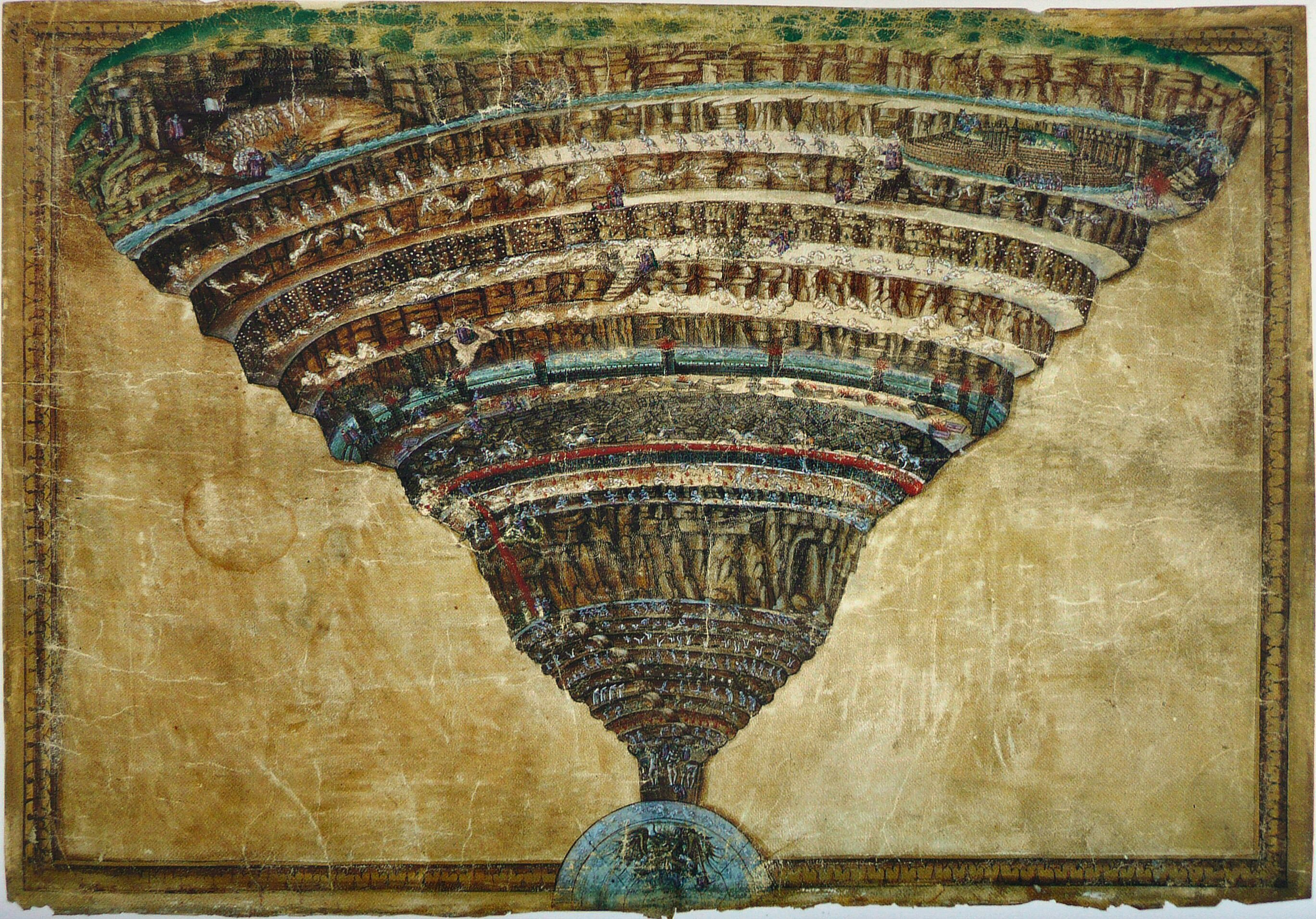
Sandro Botticelli's Map of Hell (c. 1485), drawn for Dante's Inferno. Dante's graded circles are a poet's imagination, not doctrine, but they echo the biblical teaching that judgment is proportioned. Image: public domain, via Wikimedia Commons.

See this page's graph and discover linked topics
In full
Degrees of punishment is the doctrine that the final judgment of the unrighteous is proportioned to individual culpability, so that the condemned do not all receive an identical penalty. Its primary dominical warrant is Luke 12:47-48, where two servants are both found blameworthy and receive "many" (pollas) and "few" (oligas, Strong's G3641) stripes respectively, the difference grounded in knowledge of the master's will. Jesus states the principle as a general rule in 12:48b ("to whomsoever much is given, of him shall much be required"), and applies it comparatively to cities in the "more tolerable" sayings (Matthew 10:15; 11:22-24; Luke 10:12-14). The New Testament adds further grounds of differentiation: office and teaching responsibility (James 3:1), hypocrisy under religious pretence (Mark 12:40, "greater condemnation"), complicity in Christ's betrayal (John 19:11, "greater sin"), apostasy against greater light (Hebrews 10:29, "how much sorer punishment"), and the general rule that the dead are judged "according to their works" (Revelation 20:12-13; Romans 2:6).
The doctrine is held across the major traditions. Justin Martyr wrote that each will be punished "according to the merit of his deed" (First Apology 17); Augustine held that the mildest punishment of all falls on those who added no personal sin to the original sin they inherited (Enchiridion 93); Reformed, Catholic, Orthodox, Wesleyan and Pentecostal theologies all affirm graded judgment. It is compatible with both major views of the nature of final punishment: traditionalists read the degrees as differences of severity, while advocates of Conditional Immortality read them as differences in the punishment preceding final destruction.
The key texts
- Luke 12:47-48, the two servants. Both are guilty, and the ignorant one still "did things worthy of stripes." The variable is knowledge: "knew his lord's will" against "knew not." This is the clearest statement in Scripture that knowledge raises accountability.
- Matthew 11:20-24 and Luke 10:12-14, the unrepentant cities. Chorazin, Bethsaida and Capernaum saw Jesus' mighty works. Tyre, Sidon and Sodom did not. "It shall be more tolerable for the land of Sodom in the day of judgment, than for thee." The comparison only makes sense if judgment differs in degree.
- Mark 12:40, religious predators. Those who "devour widows' houses, and for a pretence make long prayers ... shall receive greater condemnation."
- John 19:11, Pilate and the betrayer. "He that delivered me unto thee hath greater sin." Jesus grades guilt between two people involved in the same act.
- James 3:1, teachers. "We shall receive heavier judgment." Responsibility rises with the role.
- Hebrews 10:29, apostasy. "Of how much sorer punishment" for one who has "trodden under foot the Son of God."
- Revelation 20:12-13 and Romans 2:5-6, according to works. Each is judged "according to their works," a standard that is individual by definition.
The principles the texts establish
- Knowledge raises accountability. Luke 12:47-48; John 15:22 ("If I had not come and spoken unto them, they had not had sin: but now they have no excuse for their sin").
- Ignorance lowers it but does not erase it. The servant who "knew not" still did "things worthy of stripes" (Luke 12:48). Leviticus 5:17 says the same of the Israelite who breaks a command unknowingly: "though he knew it not, yet is he guilty." See Ignorance Is Innocence Objection Defeater.
- Opportunity counts. The cities that saw miracles are judged more strictly than cities that did not (Matthew 11:21-24).
- Role counts. Teachers (James 3:1) and those entrusted with "much" (Luke 12:48) answer for more.
- Each case is individual. Judgment "according to their works" (Revelation 20:13) cannot be one sentence for everyone.
Why it matters apologetically
- It answers "hell is unjust because everyone gets the same." Scripture does not teach a flat sentence. The objection attacks a view the Bible does not hold. See Hell as Eternal Torment Objection and Argument for Heaven and Hell.
- It frames the question of those who never heard. Romans 2:12 says those who "sinned without the law shall also perish without the law," judged by the light they had: creation (Romans 1:20) and conscience (Romans 2:14-16). God does not judge anyone by a standard they never had access to. See General Revelation.
- It shows God's justice is personal. A judge who weighs knowledge, intent and opportunity is more just, not less, than one who hands every offender the same sentence.
Views on what the degrees consist of
| View | Nature of final punishment | What the degrees are |
|---|---|---|
| Traditional (eternal conscious punishment) | Unending, conscious separation from God | Differences in the severity of what each person experiences |
| Conditional Immortality | Final destruction after judgment | Differences in the punishment suffered before destruction |
| Literary imagination (Dante) | Nine graded circles | A poetic picture of the principle, not a doctrinal map |
All three agree on the point the texts make: judgment is proportioned. The codex sets out the debate over the nature of punishment on Hell and Eternal Punishment and does not settle it here.
Common misunderstandings
- "Degrees of punishment means some people get off lightly." No one receives less than justice requires, and no one receives more. Proportion is the point.
- "Ignorance is a free pass." Luke 12:48 says the opposite: fewer stripes, not none.
- "Then evangelism makes people worse off." Knowledge of the gospel raises accountability, and it is also the only thing that brings reconciliation (Romans 10:14). See Ignorance Is Innocence Objection Defeater.
See also
- Hell and Eternal Punishment, the nature and duration of final punishment
- Conditional Immortality, the minority view on the nature of punishment
- Argument for Heaven and Hell, the argument that proportioned judgment fits divine justice
- Ignorance Is Innocence Objection Defeater, why not telling people the gospel does not protect them
- Hell as Eternal Torment Objection, the fairness objection to hell
- General Revelation, what everyone already knows of God
- Children in OT Theology, children and accountability
- Justin Martyr, early witness to proportioned judgment
- Augustine, the "mildest punishment" passage in the Enchiridion
Common questions this page answers
Q: Are there degrees of punishment in hell according to the Bible?
Yes. Jesus said the servant who knew his master's will and disobeyed "shall be beaten with many stripes," while the one who did not know "shall be beaten with few stripes" (Luke 12:47-48). He also said it would be "more tolerable" for Sodom on judgment day than for towns that saw His miracles and refused Him (Matthew 11:24).
Q: What does Luke 12:47-48 mean?
It teaches that God's judgment is proportioned to knowledge and responsibility. Both servants are guilty, but the one who knew more is judged more severely. Jesus sums it up: "to whomsoever much is given, of him shall much be required."
Q: Is everyone in hell punished the same?
No. Scripture says people are judged "according to their works" (Revelation 20:12-13) and names things that make judgment heavier: greater knowledge (Luke 12:47), seeing Jesus' works and rejecting Him (Matthew 11:20-24), religious hypocrisy (Mark 12:40) and being a teacher (James 3:1).
Q: Does ignorance of God make someone innocent?
No. In Luke 12:48 the servant who "knew not" still "did things worthy of stripes," and receives few stripes rather than none. Ignorance lowers accountability; it does not remove it. Leviticus 5:17 says the same: "though he knew it not, yet is he guilty."
Q: Did the early church teach degrees of punishment?
Yes. Justin Martyr wrote in the second century that each person will be punished "according to the merit of his deed" (First Apology 17), and Augustine taught that the mildest punishment of all falls on those who added no personal sin to the sin they inherited (Enchiridion 93).