Person
Darius I
Darius the Great, Darius I the Great, Darius son of Hystaspes, Darius Hystaspes, Darayavaush, Darius king of PersiaIntro
Darius I, called Darius the Great, ruled the Persian Empire from 522 to 486 BC. In the Bible he is the king under whom the Jews who had returned from Babylon finished rebuilding the Temple in Jerusalem. When local officials questioned the work, Darius had the royal archives searched, found the decree of Cyrus, and ordered the building to go ahead at government expense.
He is one of the best-documented rulers of the ancient world. He carved his own account of how he took the throne on a cliff at Behistun in western Iran, in three languages, and his name stands on palaces, tablets and monuments across the empire.
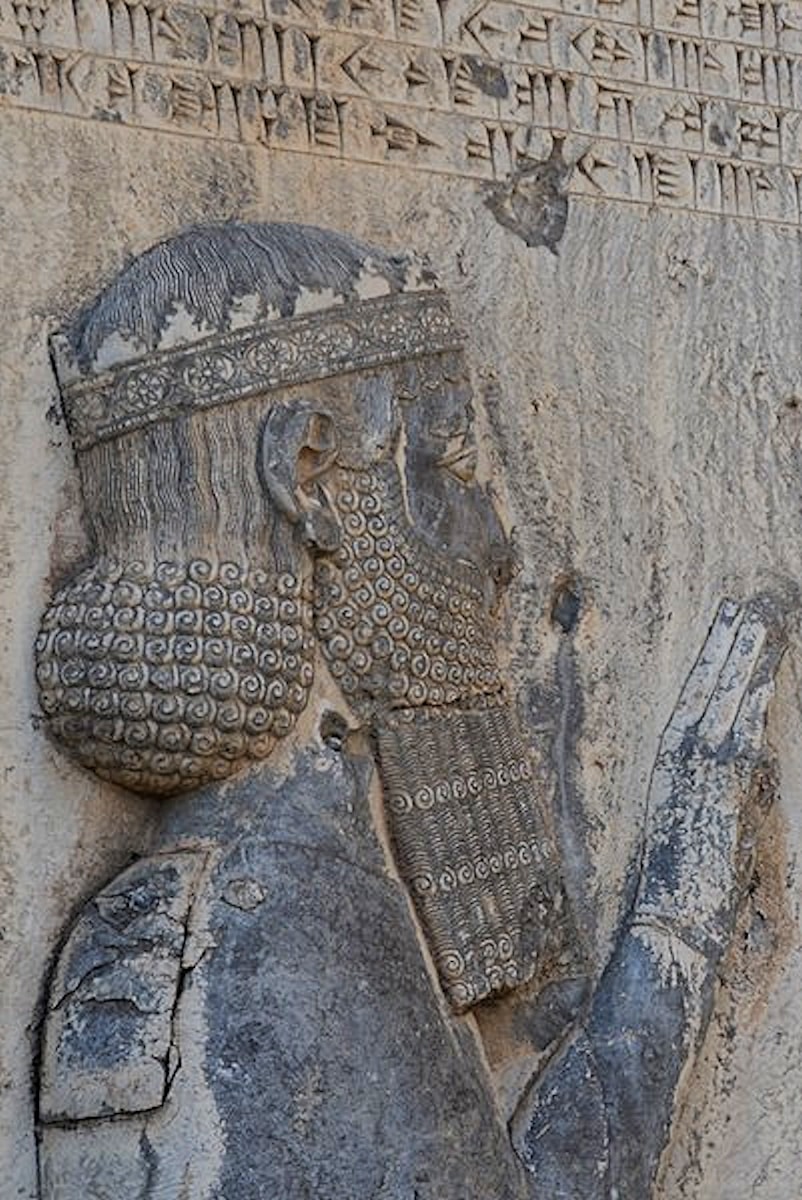
Darius I in the Behistun relief, Kermanshah province, Iran, carved about 520 BC above his trilingual inscription. Photo: Leen van Dorp / Livius.org, CC0, via Wikimedia Commons.

See this page's graph and discover linked topics
In full
Darius son of Hystaspes, of a collateral branch of the Achaemenid house, seized the throne in 522 BC after the death of Cambyses II, killing a ruler he called Gaumata, a Magian impostor posing as Cambyses' brother Bardiya. He spent his first years suppressing revolts across the empire, then reorganized it into satrapies with regular tribute, built the palaces of Persepolis and Susa, and campaigned into Europe; his army was defeated by the Athenians at Marathon in 490 BC. He died in 486 BC and was buried in a rock-cut tomb at Naqsh-e Rustam near Persepolis.
In Ezra 4-6 the work on the Temple, stalled since the reign of Cyrus, resumes "in the second year of the reign of Darius king of Persia" (Ezra 4:24), driven by the preaching of Haggai and Zechariah, whose oracles are dated by his regnal years (Haggai 1:1; Zechariah 1:1). Tattenai, governor of Beyond-the-River, writes to Darius to ask whether Cyrus really authorized the work; Darius has the archives searched, the Cyrus decree is found at Achmetha (Ecbatana), and Darius confirms it, orders costs paid from royal revenue, and threatens anyone who obstructs it (Ezra 6:1-12). The Temple is finished on 3 Adar "in the sixth year of the reign of Darius the king" (Ezra 6:15), conventionally March 515 BC.
The external evidence is extensive and in his own voice: the Behistun inscription, the foundation and building inscriptions of Persepolis and Susa, his tomb inscriptions at Naqsh-e Rustam, thousands of administrative tablets from Persepolis dated by his reign, and Babylonian contracts. Lawrence Mykytiuk lists him among the 53 Hebrew Bible persons confirmed in inscriptions.
In the Bible
- Ezra 4:5. Opponents frustrate the builders "all the days of Cyrus king of Persia, even until the reign of Darius king of Persia" (ASV).
- Ezra 4:24. The work ceases "until the second year of the reign of Darius king of Persia" (ASV).
- Ezra 5:1-17. Haggai and Zechariah prophesy; Zerubbabel and Jeshua resume building; Tattenai's letter to Darius.
- Ezra 6:1-15. Darius orders the archive search, confirms Cyrus's decree, funds the work, and the Temple is completed in his sixth year.
- Ezra 6:14. The house is finished "according to the decree of Cyrus, and Darius, and Artaxerxes king of Persia" (ASV).
- Haggai 1:1, 1:15; 2:10. Haggai's oracles dated to the second year of Darius.
- Zechariah 1:1, 1:7; 7:1. Zechariah's visions dated to the second and fourth years of Darius.
Not the same as "Darius the Mede." Daniel 5:31, 6:1-28, 9:1 and 11:1 speak of a Darius the Mede who received the kingdom when Babylon fell in 539 BC. Darius I came to the throne seventeen years later. The identity of Darius the Mede is a separate question; see Daniel Was Written in the 2nd Century Objection Defeater.
Family and lineage
- Father: Hystaspes (Old Persian Vištāspa), satrap of Parthia.
- Ancestry: Darius traces his line at Behistun through Arsames, Ariaramnes and Teispes to Achaemenes, founder of the house.
- Wives: among them Atossa, daughter of Cyrus the Great, and Artystone, another daughter of Cyrus (Herodotus 3.88).
- Son and successor: Xerxes I, son of Atossa, the Ahasuerus of Esther.
Historical and archaeological evidence
| Source | What it says | Date | Location | Grade |
|---|---|---|---|---|
| Behistun inscription and relief | Darius's own account of his ancestry, accession and victories over rebels, in Old Persian, Elamite and Babylonian | c. 520 BC | Mount Behistun, Kermanshah province, Iran (in situ, UNESCO World Heritage Site) | Direct |
| Aramaic copy of Behistun | Fragments of an Aramaic version of the same text | late 5th century BC | Elephantine, Egypt; now in Berlin | Direct |
| Persepolis and Susa building inscriptions | Darius names himself builder of the palaces (for example DPa, DSf) | c. 515-486 BC | Persepolis and Susa, Iran | Direct |
| Tomb inscriptions DNa and DNb | Royal titulary and a statement of his ethics of kingship | early 5th century BC | Naqsh-e Rustam, Iran (in situ) | Direct |
| Persepolis Fortification tablets | Thousands of Elamite administrative tablets dated by his regnal years | 509-493 BC | Excavated at Persepolis; long held at the Oriental Institute, Chicago, many returned to Iran | Direct |
| Statue of Darius from Susa | Egyptian-made statue with hieroglyphic and cuneiform inscriptions naming him | c. 500 BC | Found at Susa in 1972; National Museum of Iran, Tehran | Direct |
The Behistun inscription also unlocked cuneiform: Henry Rawlinson's copies and decipherment in the 1830s-1840s, worked out from its trilingual text, opened Akkadian to modern scholarship.
Scholarly consensus
- His existence and reign are not in question. Darius is attested in his own inscriptions and in thousands of dated documents; Mykytiuk lists him (BAR 40:2, 2014, no. 49).
- The Gaumata story. Darius's account of the false Bardiya is accepted by some historians and doubted by others, who suspect Darius killed the real Bardiya and justified himself afterward. The debate concerns Persian history, not the biblical text.
- The Ezra 5-6 documents. Many historians, including those who date the final edition of Ezra late, regard the Aramaic correspondence in Ezra 4-7 as reflecting genuine Persian chancery forms; others (for example Lester Grabbe) argue that at least parts were composed or reworked later. Kenneth Kitchen points to the archive search and royal funding of local temples as consistent with documented Persian practice, such as the Udjahorresnet inscription on Darius's restoration of the temple school at Sais in Egypt.
Theological significance
- God works through imperial administration. The Temple is finished by prophetic preaching, local perseverance, and a Persian bureaucratic search that turns up the right scroll. Ezra 6:14 joins "the commandment of the God of Israel" to the decrees of Persian kings without tension.
- The second Temple and its glory. Haggai's oracles in Darius's second year promise that "the latter glory of this house shall be greater than the former" (Haggai 2:9). Christian interpreters have long read that promise in light of the Messiah's coming to this rebuilt house.
- A pagan king blessed for helping. Darius asks the Jews to pray "for the life of the king, and of his sons" (Ezra 6:10), and the narrative records it without censure, as Jeremiah had counseled exiles to seek the welfare of the place where they lived.
Church Fathers
No patristic commentary focused on Darius I himself has been located. Early Christian chronographers used the Persian regnal years in Ezra, Haggai and Zechariah in reckoning Daniel's seventy weeks; see Artaxerxes I.
See also
- People of the Bible, every person in the codex's biblical-figures series, grouped by book of first mention
- Cyrus the Great, whose decree Darius confirmed
- Xerxes I, his son and successor
- Tattenai, the governor whose letter prompted the archive search
- Artaxerxes I and Darius II, his successors in Ezra and Nehemiah
- Cyrus Cylinder, the Persian policy toward temples and deported peoples
- Biblical Figures Confirmed by Archaeology, Mykytiuk's list
- Kenneth Kitchen, on the Persian setting of Ezra
Common questions this page answers
Q: Which Darius is in the book of Ezra?
Darius I the Great (reigned 522-486 BC). Ezra 4-6 places the resumption and completion of the Second Temple in his reign, finished in his sixth year, about 515 BC. Haggai and Zechariah date their prophecies to his second year.
Q: Is Darius I the same as Darius the Mede in Daniel?
No. Darius the Mede in Daniel receives the kingdom when Babylon falls in 539 BC. Darius I took the Persian throne in 522 BC. Who Darius the Mede was is debated separately.
Q: What is the Behistun inscription?
It is Darius I's own account of his ancestry and rise to power, carved about 520 BC on a cliff in western Iran in Old Persian, Elamite and Babylonian. It was the key to deciphering cuneiform and is the main inscription confirming him.
Q: Did Darius really pay for the Jerusalem Temple?
Ezra 6:8 says he ordered costs paid from royal revenue. That fits documented Persian practice of supporting local temples, such as Darius's restoration of the temple institution at Sais in Egypt recorded by Udjahorresnet. No Persian document mentions the Jerusalem grant itself.