Argument
Daniels Fifth Kingdom Was Never Fulfilled Objection Defeater
Daniel's Fifth Kingdom Was Never Fulfilled Objection Defeater, fifth kingdom in Daniel, Daniel 2 fifth kingdom, stone cut without hands, the fifth kingdom has no fulfillment because it was Roman, did Daniel 2 fail, Daniel four kingdoms Rome or Greece, the fourth kingdom has to be divided, Nebuchadnezzar's statue dream fulfillmentIntro
In Daniel 2, King Nebuchadnezzar dreams of a huge statue: a head of gold, chest and arms of silver, belly and thighs of bronze, legs of iron, and feet of iron mixed with clay. Then a stone, cut out "without hands," strikes the feet, the whole statue shatters, and the stone grows into a mountain that fills the earth. Daniel explains that the metals are four kingdoms in a row, and the stone is a fifth kingdom that "the God of heaven" will set up, one that "shall never be destroyed" (Daniel 2:44).
The objection says this prophecy has no fulfillment. It comes in two forms.
- The critical form. The four kingdoms were Babylon, Media, Persia and Greece. The writer lived under the Greek king Antiochus IV around 165 BC and expected God's kingdom to arrive right then. It did not. The prophecy failed.
- The skeptic or futurist form. The fourth kingdom was Rome. Jesus came during Rome, yet Rome was not crushed, and it fell centuries later to ordinary invaders. Besides, the fourth kingdom first has to be divided into the iron-and-clay feet. So the stone has not come, or the prophecy missed.
The short answer: Daniel says God would set up His kingdom "in the days of those kings," during the fourth empire, and that the stone would become a mountain, which takes time. Jesus announced that "the time is fulfilled, and the kingdom of God is at hand" (Mark 1:15) in the days of Rome. Jewish readers of the first century already took the fourth kingdom to be Rome, and so did the church fathers. Christians disagree about how much of the stone's work is still future, but no reading of the text leaves the kingdom with no fulfillment at all.
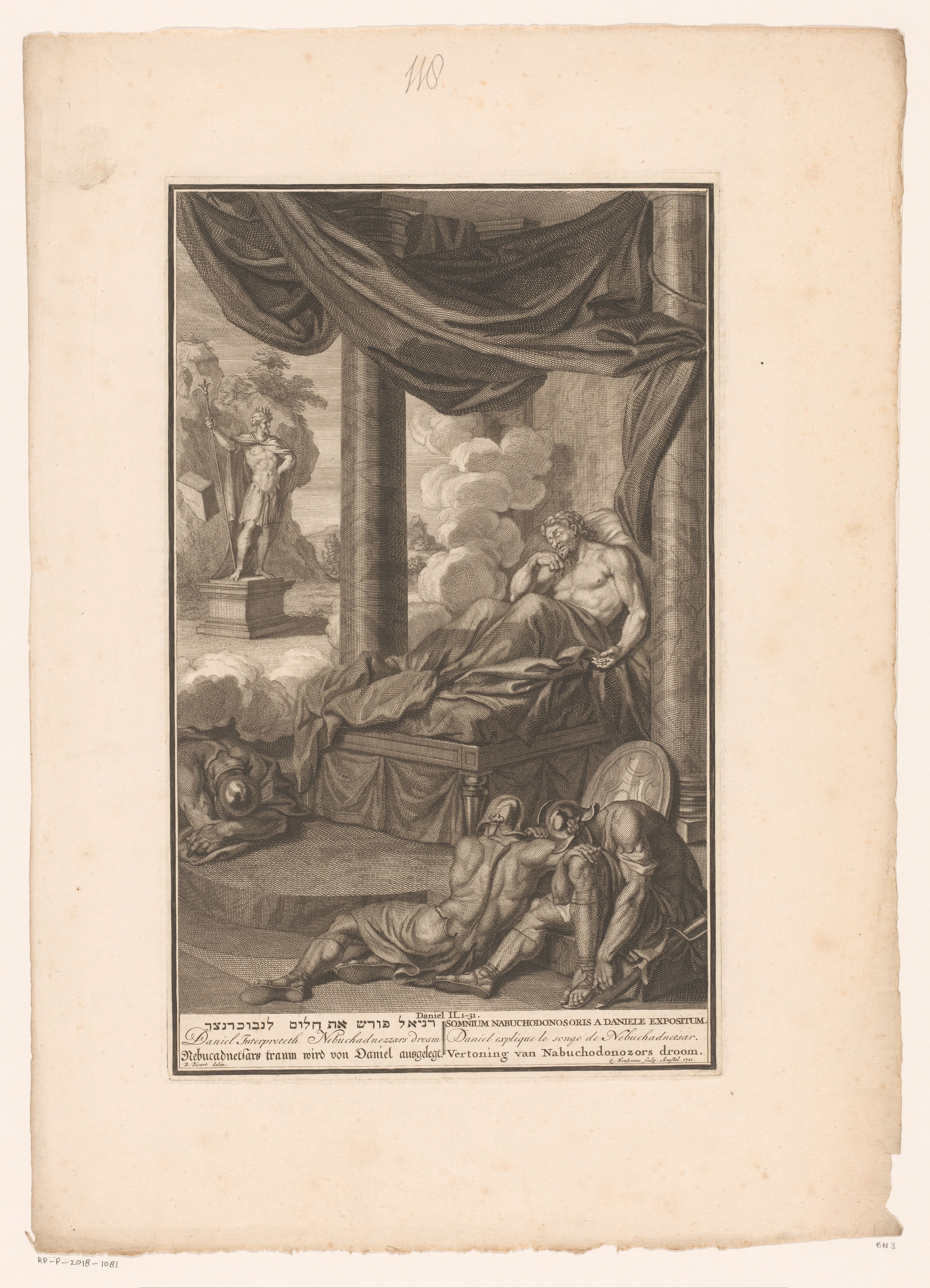
Nebuchadnezzar's dream (Daniel 2), engraving by Quiryn Fonbonne after a design by Bernard Picart, Amsterdam, 1711, Rijksmuseum. The statue stands at left as the stone breaks loose from the mountain. Image: CC0, via Wikimedia Commons.
See this page's graph and discover linked topics
In full
Defeater for the objection: "Daniel 2 predicts four world empires followed by an everlasting fifth kingdom set up by God that crushes the others. Either the fourth empire is Greece, in which case the author expected the kingdom in the 160s BC and was wrong, or the fourth empire is Rome, in which case Rome should have been destroyed by God's kingdom, yet it went on for centuries and fell to Goths and Vandals. Either way, the fifth kingdom never came."
The defeat runs on five lines. (1) The text's own timing marker: the kingdom is set up "in the days of those kings" (2:44), during the fourth empire, and the stone "became a great mountain" (2:35), a growth from small to universal, so the prophecy itself separates the setting-up from the completed filling of the earth. (2) Daniel's own map of the empires treats Media and Persia as one kingdom (the one ram with two horns, 8:20; "the Medes and Persians," 5:28) followed by Greece (8:21), which makes Rome the natural fourth; first-century Jewish readers (Josephus, 2 Esdras) and the church fathers read it that way. (3) The New Testament places the inauguration of the kingdom in Rome's days: Mark 1:15, Luke 17:20-21, Matthew 12:28, Colossians 1:13, with Matthew 11:13 and Luke 16:16 marking John the Baptist as the hinge from prophecy to proclamation. (4) The already-and-not-yet shape, stated by Paul in 1 Corinthians 15:24-28, explains why the kingdom can be present while its enemies are not yet abolished; Daniel 7 runs the same sequence, with the Son of Man receiving the kingdom (7:13-14) and the saints possessing it (7:18, 22, 27). (5) The divided feet describe the fourth kingdom's mixed character, strong and brittle at once, and the futurist reading that expects a final ten-king stage still identifies the fourth kingdom as Rome and expects the stone to finish its work at Christ's return. Every live reading has a fulfillment; only the objection's version has none. This page is structured as debate prep.
Argument structure
| # | Premise |
|---|---|
| P1 | Daniel 2 dates the setting-up of the fifth kingdom to "the days of those kings," within the fourth empire, and pictures the stone growing into a mountain over time. |
| P2 | Daniel's own symbolism makes Medo-Persia one empire and Greece the third, so the fourth is best read as Rome, the reading attested by first-century Jews and by the church fathers. |
| P3 | Jesus announced and inaugurated the kingdom of God during Roman rule, and the New Testament presents His resurrection and exaltation as the Son of Man receiving dominion. |
| P4 | Scripture distinguishes the kingdom's establishment from its consummation, so the continued existence of hostile powers does not show the kingdom has not come. |
| P5 | The iron-and-clay feet describe Rome's divided character; the futurist reading of a final divided stage still locates the stone's completed strike at Christ's return, so it too affirms fulfillment. |
| C | Therefore "the fifth kingdom has no fulfillment" does not follow on any of the readings that take the text seriously; the kingdom was set up in Rome's days and its final victory is still assured. |
Form
Defensive (a defeater), combining a textual-timing argument (what Daniel actually predicts and when), an inference to the best explanation (Rome as the fourth kingdom best fits Daniel's own map and the earliest readers), and a dilemma turned back on the objector: if the kingdom was inaugurated under Rome, the prophecy is fulfilled in its first stage; if the stone's strike is still future, the prophecy is not yet due. The objection needs a third option, a fully elapsed timeline with nothing happening, and the text does not supply one. Soundness is contemporary: the already-and-not-yet framework is the load-bearing premise, and it is widely held across Protestant, Catholic and Orthodox scholarship while traditions differ on the millennium.
The four-kingdom identification
| Statue (Daniel 2) | Beast (Daniel 7) | Traditional reading | Critical reading |
|---|---|---|---|
| Head of gold | Lion with eagle's wings | Babylon | Babylon |
| Chest and arms of silver | Bear raised on one side | Medo-Persia | Media |
| Belly and thighs of bronze | Leopard with four heads | Greece (Alexander and his successors) | Persia |
| Legs of iron, feet of iron and clay | Terrifying beast with iron teeth and ten horns | Rome | Greece (Alexander and the Seleucid and Ptolemaic successor kingdoms) |
| Stone cut without hands, becoming a mountain | One like a son of man receives an everlasting kingdom | The kingdom of God in Christ | The kingdom expected for the faithful in the Maccabean crisis |
The traditional reading is held by Josephus in substance, by Irenaeus, Hippolytus, Jerome and most Reformation and evangelical interpreters. The critical reading is defended by H. H. Rowley and John J. Collins. Augustine noted that some read the four as Assyrians, Persians, Macedonians and Romans, and referred readers to Jerome's commentary for the case (City of God 20.23).
Cheatsheet
The 30-second reply:
Read the timing line. Daniel says God sets up His kingdom "in the days of those kings," while the fourth empire still stands, and the stone starts small and becomes a mountain. Jesus walked into Roman Galilee saying "the time is fulfilled, the kingdom of God is at hand." So the kingdom was set up right on Daniel's schedule. Paul says Christ "must reign till he hath put all his enemies under his feet," which means the reign starts before the last enemy falls. A kingdom that is growing is not a kingdom that failed.
The fast facts:
- Timing. "In the days of those kings shall the God of heaven set up a kingdom" (Daniel 2:44, ASV). The setting-up happens during the fourth empire, not after it.
- Growth. The stone "became a great mountain, and filled the whole earth" (Daniel 2:35, ASV). Daniel pictures a process.
- Daniel's own map. Media and Persia are one ram with two horns (Daniel 8:20), and the goat that follows is Greece (8:21). That makes the fourth kingdom Rome.
- Jewish readers agreed. Josephus says Daniel "also wrote concerning the Roman government" (Antiquities 10.11.7), and 2 Esdras 12:11-12 identifies Rome's eagle with the kingdom of Daniel's vision.
- Jesus' announcement. "The time is fulfilled, and the kingdom of God is at hand" (Mark 1:15, ASV), spoken under Tiberius.
- Already and not yet. "For he must reign, till he hath put all his enemies under his feet" (1 Corinthians 15:25, ASV).
The 3 strongest counter-moves:
- "Show me the verse that says the kingdom starts only after Rome is gone." Daniel says the opposite: in the days of those kings.
- "Is a mustard seed a failed tree?" Jesus described the kingdom as a seed that grows into a tree (Matthew 13:31-32), the same small-to-universal pattern as the stone.
- "Which is it: Greece or Rome?" If Greece, Daniel's own ram-and-goat vision contradicts the scheme. If Rome, the kingdom was set up under Rome. The objector has to pick one, and each loses a different way.
Reciprocal concessions (grant the small point, then collect a bigger one):
- Grant: Rome was not destroyed in AD 30. Now collect: then the objector must grant that Daniel never said the kingdom's setting-up and its final victory happen on the same day, since the stone becomes a mountain. Once growth is admitted, Rome's survival in AD 30 is no evidence against the prophecy at all.
- Grant: Christians disagree about the millennium and the final stage of the fourth kingdom. Now collect: every one of those positions affirms a fulfillment, inaugurated, future, or both. The disagreement is over the calendar of fulfillment, and the objector's claim is that there is no fulfillment. Christian disagreement gives that claim no support.
- Grant: Irenaeus and Hippolytus expected a future ten-king stage. Now collect: both also identified the fourth kingdom as Rome and the stone as Christ. The fathers the objector cites for "the stone has not come yet" are the same fathers who say the stone is Christ.
The closing line:
Daniel gave you a schedule: in the days of those kings. Jesus kept it. The stone is still growing, and you are standing in the shadow of the mountain asking where the stone went.
Grammar and hermeneutics
Daniel 2:4b to 7:28 is written in Biblical Aramaic, so the objection can be tested on the Aramaic before any theology is brought in.
- "Set up" is causative, and God is the subject. In 2:44 the verb is yəqîm, the causative (haphel) imperfect of qûm, "cause to stand, set up," with "the God of heaven" (ʾĕlāh šəmayyāʾ) as subject. In 2:39 the human kingdoms simply "arise," təqûm, the plain (qal) form of the same root. The same verb in two stems marks the difference Daniel cares about: the four kingdoms rise; the fifth is raised by God. The end of 2:44 returns to the plain stem, təqûm, for the kingdom itself: "it shall stand for ever."
- The time phrase is plural and within the empires. "In the days of those kings" is ûḇəyômêhôn dî malkayyāʾ ʾinnûn, literally "and in their days, of those kings." Interpreters debate whether "those kings" means the kings of all four empires or the kings of the final iron-and-clay stage, but on either reading the setting-up falls inside the era of the statue, while it still stands.
- Same noun for all five. Each empire, and God's, is a malkû, "kingdom, kingship, dominion." Daniel treats the fifth as a real kingdom in the same category as the other four, with a king, a people and a dominion. An inward mood or a later idea would not fit that noun.
- "Became" is a change of state. In 2:35 the stone "became a great mountain" (hăwāṯ ləṭûr raḇ) and "filled the whole earth" (ûməlāṯ kāl-ʾarʿāʾ). The stone is first a stone, then a mountain. The dream itself builds in development between the strike and the filling.
- "Without hands" names the agent. The stone is cut out lāʾ bîḏayin, "not by hands" (2:34; 2:45), with "hands" in the dual. The phrase excludes human manufacture. Augustine and Jerome both read it of Christ's birth from a virgin; at minimum the grammar says the fifth kingdom's origin is divine, which is why its timetable does not follow the pattern of human conquest.
- "Divided" describes a condition. In 2:41 the kingdom "shall be a divided kingdom" (malkû pəlîḡāh, a passive participle), "but there shall be in it of the strength of the iron" (niṣbəṯāʾ dî parzəlāʾ). Division and iron strength are present together in the same kingdom. Read on its own grammar, the verse describes a kingdom that is mixed, strong and brittle at once. It sets no stage of falling apart into ten pieces that must be finished before anything else can happen. The number ten does not appear in Daniel 2; it comes from the ten horns of Daniel 7:7 and 7:24, and connecting the two is an interpretive step, legitimate but not stated.
- Genre: symbolic dream-vision. A statue made of four metals is symbolic. Symbolic prophecy compresses time and sequence. Pressing the stone's strike into a single instant, and then calling the prophecy failed because no single instant fits, imposes a literalism on the genre that the dream itself resists when it shows the stone growing.
P1, The text dates the setting-up within the fourth empire
Affirmative case (second-order arguments)
- The timing clause. Daniel 2:44 locates the kingdom's establishment "in the days of those kings." The prophecy does not wait for the statue to be gone; the stone strikes the statue while it stands.
- The growth clause. Daniel 2:35 says the stone "became a great mountain, and filled the whole earth." A stone that becomes a mountain has a beginning and an expansion. The objection reads the strike and the filling as one moment; the text separates them.
- The Gospels' growth parables. Jesus' mustard seed and leaven (Matthew 13:31-33) picture the kingdom starting small and filling everything, the same shape as Daniel's stone.
Anticipated objections
- "The stone smites the statue and the metals are blown away like chaff. That is sudden destruction, not slow growth." The strongest form of the futurist point.
- "'In the days of those kings' can mean the very last of those kings, at the end of the age."
Rebuttals
- Grant the suddenness of the strike and keep reading. Daniel pictures both a decisive blow and a growth. The Christian reading keeps both: the decisive victory is won at the cross and resurrection and is made visible at Christ's return, while the mountain fills the earth in between. Futurist and inaugurated readers divide the two moments differently, and both readings give the prophecy a fulfillment.
- Even "the last of those kings" is still within the empires. On that reading the objection loses anyway, because the fulfillment is then not overdue. The objection needs the timeline to have fully run out with nothing happening, and neither reading of the phrase gives it that.
P2, Daniel's own map makes the fourth kingdom Rome
Affirmative case (second-order arguments)
- Daniel joins Media and Persia. The writing on the wall announces Babylon's kingdom "given to the Medes and Persians" (Daniel 5:28). The law of "the Medes and Persians" is one law (6:8). In Daniel 8 a single ram with two horns is "the kings of Media and Persia" (8:20), and the goat that defeats it is "the king of Greece" (8:21). By Daniel's own symbolism, the second kingdom is Medo-Persia and the third is Greece, which leaves the fourth to Rome.
- First-century Jewish readers read Rome. Josephus retells the dream and pointedly declines to explain the stone, since he writes only of things past and present (Antiquities 10.10.4), and elsewhere says that "Daniel also wrote concerning the Roman government, and that our country should be made desolate by them" (Antiquities 10.11.7). 2 Esdras 12:11-12 identifies the eagle, a symbol of Rome, as "the kingdom which was seen in the vision of thy brother Daniel."
- The church fathers read Rome. Hippolytus: the legs of iron and the fourth beast "expressed the Romans, who hold the sovereignty at present" (On Christ and Antichrist 28). Jerome: "the fourth empire, which clearly refers to the Romans, is the iron empire which breaks in pieces and overcomes all others" (Commentary on Daniel 2:40, Archer translation).
Anticipated objections
- "There was a separate Median kingdom before Persia; Daniel's 'Darius the Mede' shows the author thought Media ruled Babylon on its own." The Rowley and Collins argument.
- "The iron-and-clay mixture 'with the seed of men' (2:43) fits the Ptolemy-Seleucid marriage alliances of Daniel 11:6 and 11:17 exactly."
- "Rome is read into Daniel by later readers who lived under Rome."
Rebuttals
- Daniel's text binds Media to Persia. Whatever one concludes about Darius the Mede (see Daniel Was Written in the 2nd Century Objection Defeater for the candidates), the book never pictures a separate Median world empire: it gives one ram with two horns, one law of the Medes and Persians, and Babylon handed over to both together. The critical scheme has to read against Daniel 8 to get four kingdoms ending in Greece.
- Dynastic intermarriage is not unique to the Hellenistic kingdoms. Roman power was also bound together by marriage alliances and by ruling a mixture of peoples it could not fuse, which is how Jerome read the clay. And even granting the critical reading of 2:43, the critical case then rests the whole failure charge on the premise that the author meant the 160s BC, a premise that depends on the late date, which is itself contested.
- The Rome reading is the earliest attested reading. Josephus and 2 Esdras were not Christians and had no Christian motive. They read Rome because the text points past Greece.
P3, The kingdom was announced and inaugurated during Rome
Affirmative case (second-order arguments)
- Jesus' own announcement. "The time is fulfilled, and the kingdom of God is at hand" (Mark 1:15, ASV). "If I by the finger of God cast out demons, then is the kingdom of God come upon you" (Luke 11:20, ASV; compare Matthew 12:28). "The kingdom of God cometh not with observation ... for lo, the kingdom of God is within you" (Luke 17:20-21, ASV), where "within you" is often rendered "in your midst."
- The hinge at John. "For all the prophets and the law prophesied until John" (Matthew 11:13, ASV). Luke's parallel adds: "from that time the gospel of the kingdom of God is preached" (Luke 16:16, ASV). The age of prophetic anticipation, Daniel included, runs up to John; the age of kingdom proclamation follows, in Roman Judea.
- Transfer into the kingdom is already happening. The Father "delivered us out of the power of darkness, and translated us into the kingdom of the Son of his love" (Colossians 1:13, ASV).
- Daniel 7 tells the same story with a person. One "like unto a son of man" comes to the Ancient of Days and is given "dominion, and glory, and a kingdom ... which shall not be destroyed" (Daniel 7:14, ASV), echoing the "never be destroyed" of 2:44. Jesus claims that imagery before the high priest (Mark 14:62), and Peter announces that God has made Him "both Lord and Christ" (Acts 2:36).
- The stone motif in Jesus' teaching. After citing the rejected stone of Psalm 118 (Matthew 21:42), Jesus adds that "on whomsoever it shall fall, it will scatter him as dust" (Matthew 21:44, ASV; Luke 20:18), widely read as an echo of Daniel's crushing stone. Matthew 21:44 is missing from a few early witnesses, Codex Bezae among them, but the Lukan parallel is secure.
- The fathers placed the stone's coming at the incarnation. Irenaeus: "Daniel, foreseeing His advent, said that a stone, cut out without hands, came into this world" (Against Heresies 3.21.7). Augustine reads the mountain filling the whole face of the earth as Christ's kingdom spreading through the world in his own day (Tractates on John 9.15). Jerome: the rock, "the Lord and Savior," was cut off without hands "by birth from a virgin's womb" and "became a great mountain and filled the whole earth" (Commentary on Daniel 2:45).
Anticipated objections
- "Jesus lived under Rome, so what? Lots of people did. That does not make Him the stone."
- "'The kingdom is within you' spiritualizes a political prophecy."
- "Matthew 11:13 says the prophets prophesied until John. So Daniel's prophecy should have been finished by then, and it was not."
Rebuttals
- The timing is one strand among several. The argument does not rest on Jesus being alive under Rome. It rests on Him announcing the very kingdom Daniel names, claiming Daniel's Son of Man imagery, and being proclaimed as enthroned, all during the fourth empire. That is a cumulative identification.
- Daniel's kingdom is not of human manufacture. "Cut out without hands" already excludes an ordinary political revolution. A kingdom that begins in a people "translated" into it and grows until it fills the earth fits Daniel's own description better than a coup would.
- Matthew 11:13 marks the close of an era. The verb "prophesied" (eprophēteusan) is a summary aorist describing the prophets' activity as a completed era leading up to John. It says the time of announcing is over and the time of arrival has begun. Luke 16:16 makes that explicit. It does not say every consequence of every prophecy was finished in John's lifetime, and Jesus Himself goes on to speak of a future day of judgment in the same chapter (Matthew 11:22-24).
P4, Establishment and consummation are distinct
Affirmative case (second-order arguments)
- Paul's sequence. "Then cometh the end, when he shall deliver up the kingdom to God, even the Father; when he shall have abolished all rule and all authority and power. For he must reign, till he hath put all his enemies under his feet. The last enemy that shall be abolished is death" (1 Corinthians 15:24-26, ASV). Christ reigns while enemies remain; their abolition completes the reign.
- Daniel 7's sequence. The saints "shall receive the kingdom" (7:18), the beast makes war on them for a time, and then "the time came that the saints possessed the kingdom" (7:22). Daniel himself includes a period in which the kingdom is given and yet opposed.
- The New Testament's final scene. "The kingdom of the world is become the kingdom of our Lord, and of his Christ: and he shall reign for ever and ever" (Revelation 11:15, ASV). The consummation is announced as a future event for a kingdom that already exists.
- A widely held framework. Reading the kingdom as already inaugurated and not yet consummated is broadly shared in modern scholarship across traditions, from Oscar Cullmann to George Eldon Ladd. See Kingdom of God and Eschatology.
Anticipated objections
- "Already-not-yet is an unfalsifiable rescue device."
- "If the kingdom is here, why do wicked governments still exist?"
Rebuttals
- It is falsifiable, and it is older than the problem. The framework predicts a kingdom proclaimed in the fourth empire, spreading across the nations, and awaiting a final judgment. A kingdom that never spread beyond a Judean sect, or that vanished, would falsify it. And the framework is in the texts themselves (Daniel 2:35; Daniel 7:18-22; 1 Corinthians 15:25), written long before anyone needed to explain a delay. See Failed Second Coming Prophecy Objection Defeater.
- A reign that has begun is still a reign while enemies remain. Paul's "he must reign, till" assumes enemies during the reign. The objection assumes a kingdom cannot be established until all opposition is gone, and Daniel nowhere states that requirement.
P5, The divided feet and the futurist reading
Affirmative case (second-order arguments)
- Mixed character fits Rome. Rome crushed everything before it like iron (Daniel 2:40) and yet ruled a mixture of peoples, provinces and client kings it never fused, with recurring civil wars and later formal divisions of rule. Jerome saw the brittleness in his own day: nothing was stronger than the Roman Empire at its beginning, he wrote, and "there is nothing more feeble, since we require the assistance of barbarian tribes both in our civil wars and against foreign nations" (Commentary on Daniel 2:40).
- The futurist reading still affirms fulfillment. Irenaeus took the ten toes as ten kings among whom the kingdom will be partitioned, and the stone as Christ, "who shall destroy temporal kingdoms" (Against Heresies 5.26.1-2). Hippolytus said the toes signify kings who are to arise (On Christ and Antichrist 25, 28). Dispensational and many historic premillennial interpreters today read Daniel 2's final strike as Christ's return. On that reading the strike is not overdue; it is ahead.
- The fathers held both sides at once. Irenaeus placed the stone's coming at the incarnation (3.21.7) and its destruction of the kingdoms at the end (5.26). Augustine saw the mountain already filling the earth, yet in City of God 20.23 he treats Daniel 7's final persecution and the kingdom of the saints as still future, and is openly cautious about the ten kings, admitting he fears "we may be deceived in this." The fathers' testimony is that the stone came in Christ and that its work is not yet finished.
Anticipated objections
- "The fourth kingdom has to be divided first. Rome's formal division into East and West came in AD 395, long after Jesus. So the stone could not have come in the first century."
- "The church fathers conceded that the stone has not struck yet. So even they admit the prophecy has not been fulfilled."
Rebuttals
- This is the strongest form of the objection, and it does not reach its conclusion. Grant that the divided condition must be accounted for. Daniel 2:41 describes a kingdom that is divided and has iron strength at the same time, a condition of the fourth kingdom, and the text does not set the division as a later chronological phase that must be completed before the stone moves. Rome was divided in that sense long before AD 395: civil war between rival rulers in the first century BC, provinces of different peoples, client kingdoms, the year of four emperors in AD 69. If instead one reads the toes as a final ten-king stage still future, then the stone's final strike is future too, and the prophecy is pending. In neither case is it failed.
- The fathers conceded the opposite of what the objection needs. They agree the fourth kingdom is Rome and the stone is Christ. Where some of them placed the final strike in the future, they expected a fulfillment still to come. The fathers conceded that Daniel's kingdom was set up under Rome, as Irenaeus 3.21.7, Augustine and Jerome show, and some of them added that its final victory is future. Neither concession supports "never fulfilled."
Master objections to the defeater
MO1: "You have made the prophecy unfalsifiable. If the kingdom came, it is fulfilled; if it did not, it is 'not yet.'"
- The prophecy made checkable commitments: a sequence of empires ending in one strong, crushing, mixed fourth kingdom; a divine kingdom set up during it; that kingdom never passing to another people; and a growth until it fills the earth. A kingdom proclaimed in Roman Judea that is now confessed among the nations of every continent is the kind of outcome the prophecy described. Had the movement died with its founder, or been absorbed into another people's empire, the prophecy would have failed on its own terms.
MO2: "The critical scholarly consensus says the book is from the 160s and its kingdom never came. Why should anyone trust a minority reading?"
- The critical reading depends on the late date, and the late date depends largely on the premise that predictive prophecy does not occur (see Daniel Was Written in the 2nd Century Objection Defeater). Even granting a late date, the earliest Jewish readers outside the church, Josephus and 2 Esdras, read the fourth kingdom as Rome, which shows the text was heard as reaching past Greece.
MO3: "Rome fell to barbarians, not to a stone from heaven. History shows ordinary causes."
- Daniel says the God of heaven "removeth kings, and setteth up kings" (2:21, ASV) through ordinary history as well as extraordinary acts. The stone's effect in the prophecy is that the empires pass and are scattered "like the chaff," while the kingdom of God remains. Rome passed. The church that Rome persecuted outlived it, and the kingdom it proclaims was not "left to another people."
Tactical opening / closing
Opening:
Before we argue about Rome, read the timing line out loud: "in the days of those kings." When does Daniel say God sets up His kingdom? During the empires, or after they are gone?
Closing:
You said the stone never came because Rome survived. Daniel said the stone would become a mountain. Rome is gone. The kingdom Jesus announced in Rome's backyard is in every nation Rome ever ruled, and in a great many it never heard of. The mountain is still growing.
Live-cite kit
- Scripture: Daniel 2:44 (timing and permanence); Daniel 2:34-35 (stone without hands becomes a mountain); Daniel 8:20 and 8:21 (Medo-Persia one ram, Greece the goat); Daniel 7:13-14, 7:18, 7:22 (Son of Man and the saints receive the kingdom); Mark 1:15; Luke 17:20-21; Matthew 11:13 with Luke 16:16; Colossians 1:13; 1 Corinthians 15:24-28; Mark 14:62; Acts 2:32-36
- Ancient Jewish readers: Josephus, Antiquities 10.10.4 (declines to explain the stone) and 10.11.7 ("Daniel also wrote concerning the Roman government"); 2 Esdras 12:11-12 (Rome's eagle is the kingdom of Daniel's vision)
- Church fathers: Irenaeus, Against Heresies 3.21.7 and 5.26.1-2; Hippolytus, On Christ and Antichrist 28; Jerome, Commentary on Daniel 2:40 and 2:45; Augustine, Tractates on John 9.15 and City of God 20.23
- Scholarly (the critical case, stated fairly): H. H. Rowley, Darius the Mede and the Four World Empires in the Book of Daniel (1935); John J. Collins, Daniel (Hermeneia, 1993)
- Scholarly (the inaugurated kingdom): George Eldon Ladd, The Presence of the Future (1974); Oscar Cullmann, Christ and Time (1946)
- Aphorism: "A stone that becomes a mountain is not late. It is growing."
- Aphorism: "Daniel gave a schedule: in the days of those kings. Jesus kept it."
Connection to Scripture
- Daniel 2:31-35 and 2:40-44, the dream and its interpretation.
- Daniel 7:9-14, the parallel vision of the four beasts and the Son of Man.
- Mark 1:14-15, the kingdom announced as at hand.
- 1 Corinthians 15:24-28, the reign that continues until every enemy is subdued.
- Revelation 20 to 22, the final defeat of evil and the new creation.
Scholarship
Published academic works this page draws on, each matched to a publisher, index or library catalog record.
- George Eldon Ladd, The presence of the future (1974). Open Library
- Harold Henry Rowley, Darius the Mede and the four world empires in the book of Daniel (1935). Open Library
See also
- Daniel 2 and 7 Prophecy Argument, the positive case that the four-kingdom sequence came true, even on a 2nd-century date.
- Kingdom of God, the already-and-not-yet kingdom the stone represents.
- Daniel Was Written in the 2nd Century Objection Defeater, the dating question the critical form depends on.
- Failed Second Coming Prophecy Objection Defeater, the companion defeater on "soon" and the delay of the return.
- Failed Messianic Prophecy Objection Defeater, the wider charge that messianic prophecy failed.
- Biblical Prophecy, the positive case and method.
- Eschatology, the traditions on the millennium and the final state.
- Son of Man Title, Daniel 7's figure claimed by Jesus.
- Irenaeus of Lyons, Jerome and Augustine, the fathers cited above.
Common questions this page answers
Q: What is the fifth kingdom in Daniel 2?
It is the kingdom the God of heaven sets up, pictured as a stone cut out without hands that shatters the statue of four empires and grows into a mountain filling the earth (Daniel 2:44). Christians identify it with the kingdom of God announced and inaugurated by Jesus Christ, which will never be destroyed or handed to another people.
Q: Did Daniel's fifth kingdom prophecy fail because Rome was not destroyed?
No. Daniel says the kingdom is set up "in the days of those kings," while the fourth empire still stands, and the stone becomes a mountain over time. Jesus announced the kingdom during Roman rule, and Paul says Christ reigns until all enemies are put under His feet (1 Corinthians 15:25). Rome's survival in the first century fits the prophecy's own timing.
Q: Are Daniel's four kingdoms Babylon, Persia, Greece and Rome, or Babylon, Media, Persia and Greece?
The traditional reading is Babylon, Medo-Persia, Greece and Rome; many critical scholars read Babylon, Media, Persia and Greece. Daniel's own symbolism favors the first, since Daniel 8:20-21 pictures Media and Persia as one ram followed by Greece, and first-century Jewish readers such as Josephus already read the fourth kingdom as Rome.
Q: Doesn't the fourth kingdom have to be divided into ten before the stone strikes?
Daniel 2:41 calls the fourth kingdom divided while it still has the strength of iron, describing a mixed, strong-and-brittle kingdom; Daniel 2 never mentions the number ten, which comes from the ten horns of Daniel 7. Futurist interpreters who expect a final ten-king stage place the stone's final strike at Christ's return, so on their reading the prophecy is pending, not failed.
Q: Did the church fathers say the stone in Daniel 2 is Christ?
Yes. Irenaeus wrote that Daniel, foreseeing Christ's advent, said a stone cut out without hands came into this world (Against Heresies 3.21.7). Hippolytus and Jerome identified the iron kingdom as Rome and the stone as Christ, and Augustine read the mountain filling the earth as Christ's kingdom spreading through the world. Some fathers also expected the stone's final destruction of earthly kingdoms to come at the end.
Q: Is the kingdom of God already here or still coming?
Both, in the reading widely held across Christian traditions. Jesus said the kingdom was at hand and had come upon His hearers, while Paul describes Christ's reign continuing until the last enemy, death, is abolished. Premillennial, amillennial and postmillennial Christians differ over the shape of that final stage, but all affirm the kingdom's present reality and future completion.