Argument
Daniel 2 and 7 Prophecy Argument
Daniel 2 and 7 prophecy, Daniel's four kingdoms prophecy, four kingdoms of Daniel fulfilled, Daniel four empires argument, Nebuchadnezzar's statue and Daniel's beasts, Babylon Medo-Persia Greece Rome prophecy, Daniel predicted Rome, Daniel predicted Alexander the Great, Daniel 7 Son of Man kingdomIntro
The book of Daniel contains two visions of world history that run side by side. In Daniel 2, King Nebuchadnezzar dreams of a great statue with a head of gold, chest of silver, belly of bronze, legs of iron, and feet of iron mixed with clay, until a stone "cut out without hands" smashes it and grows into a mountain that fills the earth. In Daniel 7, Daniel sees four beasts rise from the sea, a lion, a bear, a leopard and a terrifying iron-toothed beast, and then "one like unto a son of man" comes with the clouds to God and receives a kingdom that will never be destroyed.
Both visions say the same thing: four empires in a row, then a kingdom from God that outlasts them all.
This page makes the positive case that history followed that outline. Babylon fell to the Medes and Persians. Persia fell to Alexander the Great's Greeks. Alexander's empire broke apart at its height into four parts. Rome rose to crush and rule the whole Mediterranean world. During Rome's rule, Jesus announced that the kingdom of God had come, called Himself the Son of Man from Daniel 7, and founded a kingdom that outlived Rome.
There is a strong objection: many scholars think Daniel was written around 165 BC, after much of this history had already happened. The argument below takes that seriously. Its key point is that even on the latest date anyone proposes, Rome had not yet become the iron empire that devours the whole earth, and the kingdom of the Son of Man was still two centuries away.
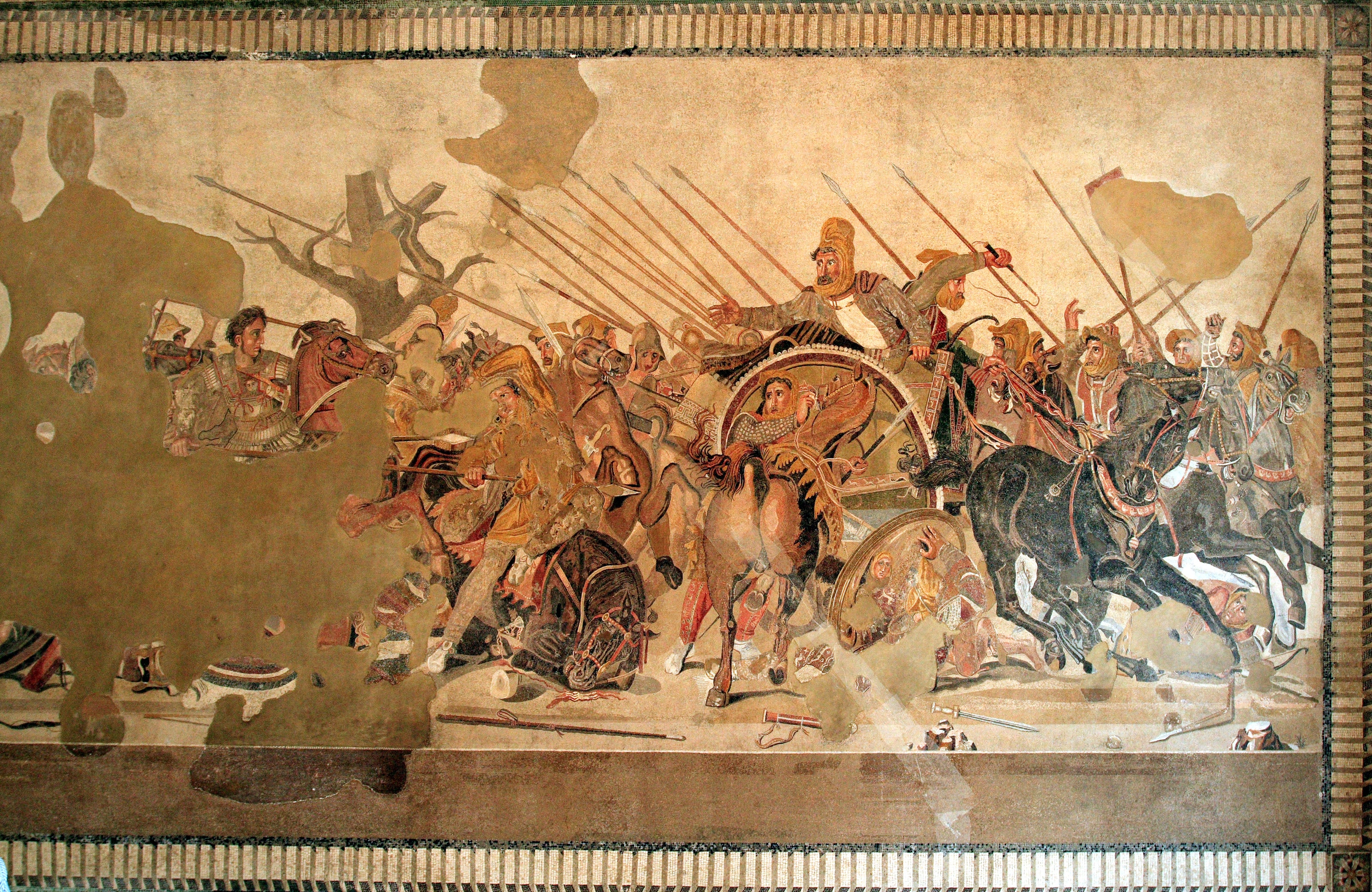
The Alexander Mosaic from the House of the Faun, Pompeii (c. 100 BC), Naples National Archaeological Museum, showing Alexander the Great routing Darius III, the "rough he-goat... the king of Greece" breaking the ram of Media and Persia (Daniel 8:5-7, 21). Photo by Magrippa, CC BY-SA 3.0, via Wikimedia Commons, resized.

See this page's graph and discover linked topics
In full
The argument is an abductive case from fulfilled sequence prophecy. Daniel 2:31-45 and 7:1-27 present a four-kingdom sequence followed by an everlasting kingdom; Daniel 8:20-21 names the second and third kingdoms (the ram is "the kings of Media and Persia"; the goat is "the king of Greece"); Daniel 8:8, 8:22 and 11:3-4 predict that the first Greek king's dominion will be broken at its height and divided toward the four winds, "but not to his posterity." On the traditional identification (Babylon, Medo-Persia, Greece, Rome), the sequence matches the history of 605 BC to the first century AD, and the everlasting kingdom is given, in the days of the fourth empire, to the Son of Man (7:13-14) and to "the saints of the Most High" (7:18, 22, 27), whom the New Testament identifies with Jesus and His people.
The argument is built to survive the critical date. It concedes, for the sake of argument, that a Maccabean author (c. 167-164 BC) could have written the Persian and Greek material after the events, and rests its predictive weight on two claims no 2nd-century date can absorb: (1) the fourth kingdom, "diverse from all the kingdoms," that "shall devour the whole earth" (7:23), fits Rome, whose conquest of the Hellenistic east (Macedonia 168 BC, Seleucid Syria 64 BC, Jerusalem 63 BC, Ptolemaic Egypt 30 BC) lay in the future in 165 BC; and (2) the everlasting kingdom was announced and inaugurated by a man who claimed Daniel's Son of Man title, during Rome's rule, two centuries after the latest proposed date of writing. The rival scheme (Babylon, Media, Persia, Greece) is presented fairly: it is held by H. H. Rowley and John J. Collins, and in an early-date form by Robert J. M. Gurney. Soundness is contested because the identification of the fourth kingdom is disputed. The question of whether the kingdom has been fulfilled is answered at Daniels Fifth Kingdom Was Never Fulfilled Objection Defeater, and the dating question at Daniel Was Written in the 2nd Century Objection Defeater; this page builds the positive case and links to both rather than repeating them. This page is structured as debate prep.
Argument structure
| # | Premise |
|---|---|
| P1 | Daniel 2 and 7 predict a sequence of four world kingdoms followed by an everlasting kingdom from God, given to "one like unto a son of man" and to the saints. |
| P2 | Daniel itself identifies the first three: Babylon (2:38), Media and Persia as one kingdom (5:28; 8:20), and Greece (8:21), whose first king's empire would be broken at its height and divided four ways, not to his posterity (8:8, 22; 11:3-4). History followed that sequence. |
| P3 | The fourth kingdom, iron-strong, crushing, diverse from all, devouring the whole earth, is best identified with Rome; on any proposed date of writing, including c. 165 BC, Rome's conquest of the eastern Mediterranean was still future. |
| P4 | In the days of the fourth kingdom, Jesus announced the kingdom of God, claimed Daniel's Son of Man title, and founded a kingdom that spread through the Roman world and outlasted Rome. |
| P5 | The best explanation of a sequence that is accurate beyond the latest proposed date of writing is genuine predictive revelation. |
| C | Therefore Daniel 2 and 7 count as fulfilled predictive prophecy, and as evidence for the God who, in Daniel's words, "removeth kings, and setteth up kings" (2:21, ASV). |
Form
Abductive (inference to the best explanation), with an a fortiori structure built in. If Daniel was written in the 6th century, as the book presents itself, then P2 through P4 are all predictive and the case is very strong. If Daniel was written c. 165 BC, P2 can be set aside as possibly written after the events, and the case still stands on P3 and P4. The argument therefore does not require the dating debate to be won, only the identification of the fourth kingdom. That identification is the contested premise, and the opponent's best move is to deny it.
The two visions side by side
| Daniel 2: the statue | Daniel 7: the beasts | Daniel 8 and 11 | Traditional reading | History |
|---|---|---|---|---|
| Head of gold (2:32, 37-38) | Lion with eagle's wings (7:4) | Babylon | Neo-Babylonian empire, dominant from 605 BC; Nebuchadnezzar is told "thou art the head of gold" (2:38) | |
| Chest and arms of silver (2:32, 39) | Bear raised up on one side, three ribs in its mouth (7:5) | Ram with two horns, the higher coming up last (8:3-4, 20) | Medo-Persia | Babylon falls to Cyrus in October 539 BC; Persia, the later and greater partner, dominates Media |
| Belly and thighs of bronze (2:32, 39) | Leopard with four wings and four heads (7:6) | Goat from the west that "touched not the ground," with a great horn that is broken and replaced by four (8:5-8, 21-22); a mighty king whose kingdom is divided "toward the four winds of heaven, but not to his posterity" (11:3-4) | Greece | Alexander crosses into Asia in 334 BC and defeats Persia at Gaugamela in 331 BC; dies at Babylon in 323 BC aged 32; his sons Alexander IV and Heracles are killed by about 309 BC; after Ipsus (301 BC) four main kingdoms emerge under Cassander, Lysimachus, Seleucus and Ptolemy |
| Legs of iron, feet of iron and clay (2:33, 40-43) | Terrifying beast with iron teeth and ten horns, "diverse from all the beasts" (7:7, 23) | Rome | Rome defeats the Seleucids at Magnesia (190 BC), ends the Macedonian kingdom at Pydna (168 BC), annexes Syria (64 BC), takes Jerusalem (63 BC) and Egypt (30 BC) | |
| Stone cut out without hands, becomes a mountain (2:34-35, 44-45) | One like a son of man receives an everlasting kingdom; the saints possess it (7:13-14, 18, 22, 27) | The kingdom of God in Christ | Jesus announces the kingdom under Tiberius (Mark 1:15) and claims the Son of Man title before the Sanhedrin (Mark 14:62) |
The rival critical table reads the second kingdom as Media, the third as Persia and the fourth as Greece, with the iron-and-clay feet as the divided Ptolemaic and Seleucid kingdoms. See the table at Daniels Fifth Kingdom Was Never Fulfilled Objection Defeater.
Cheatsheet
The 30-second version:
Daniel gives you four empires and then God's kingdom. He names the second and third himself: Media-Persia, then Greece. Greece's first king is broken at his height and his empire splits four ways, not to his own family. That is Alexander. The fourth is iron, crushes everything, and devours the whole earth. Even if you date Daniel to 165 BC, Rome had not yet swallowed Syria, Judea or Egypt. And in Rome's days a man walks into Galilee saying the kingdom of God has come and calls Himself Daniel's Son of Man. The latest date anyone gives Daniel is still too early to explain that.
Fast facts:
- Daniel names names. "The ram... they are the kings of Media and Persia. And the rough he-goat is the king of Greece" (Daniel 8:20-21, ASV).
- Alexander in one verse. "His kingdom shall be broken, and shall be divided toward the four winds of heaven, but not to his posterity" (Daniel 11:4, ASV).
- Rome's timeline. Pydna 168 BC; Syria annexed 64 BC; Jerusalem taken by Pompey 63 BC; Egypt annexed 30 BC. All later than the latest proposed date for Daniel.
- Non-Christian Jews read Rome. Josephus (Antiquities 10.11.7), 2 Esdras 12:11-12, and the Babylonian Talmud (Avodah Zarah 2b, on Daniel 7:23) identify the fourth kingdom with Rome.
- The Son of Man claim. "Ye shall see the Son of man sitting at the right hand of Power, and coming with the clouds of heaven" (Mark 14:62, ASV), and the council condemned Him for blasphemy (14:64).
Counter-moves:
- "Which kingdom crushed and ruled the Hellenistic kingdoms?" The fourth kingdom has to be stronger than the third and swallow it. Rome did that to Greece; Greece did not do it to itself.
- "Give me the date of writing, and I will give you the date Rome took Jerusalem." On every proposed date, the conquest comes later.
- "Which Jewish reader before the church read the fourth kingdom as Greece?" Josephus and 2 Esdras both read Rome.
Reciprocal concessions:
- Grant: a Maccabean author could have known the history of Alexander and the Ptolemies and Seleucids. Collect: then the objector must explain why the fourth kingdom, on the reading attested by the earliest Jewish interpreters, is the one empire whose eastern conquests that author could not yet have seen.
- Grant: Rome was a rising power by 168 BC, when the Roman envoy Popillius Laenas turned Antiochus IV back from Egypt (the "ships of Kittim" of Daniel 11:30 on many readings). Collect: a rising power in 168 is very different from the iron empire that has "devoured the whole earth"; and the critical reading itself denies that the author meant Rome, so the objector cannot both credit the author with foreseeing Rome and deny that he wrote about it.
Closing line:
Four kingdoms and a fifth. Daniel named the second and third, history named the fourth, and Jesus of Nazareth claimed the fifth. Pick any date you like for the book; the kingdom of the Son of Man still came after it.
Grammar and hermeneutics
- Daniel names the kingdoms in plain prose. The interpretation of the ram and goat is not symbolic: "the kings of Media (Māday) and Persia (Pāras)" and "the king of Greece (Yāwān)" (8:20-21). Any reading of the four kingdoms has to fit the book's own explicit identifications.
- One ram, two horns. Media and Persia are one animal in Daniel 8 and one law in 6:8, 12, 15 ("the law of the Medes and Persians"), and Babylon is given "to the Medes and Persians" together (5:28). The critical scheme needs a separate Median world kingdom between Babylon and Persia; the book's own language binds the two together.
- Parallel visions interpret each other. Daniel 2 and 7 share structure (four, then an everlasting kingdom) and wording: the kingdom that "shall never be destroyed" (2:44) and the Son of Man's kingdom "which shall not be destroyed" (7:14). Reading them together is the book's own method, since Daniel 7 is placed as a reprise of Daniel 2 within the Aramaic section (2:4b-7:28).
- "One like a son of man." The Aramaic kəbar ʾĕnāš is a simile: a figure with a human likeness, set against the four beasts. That contrast is the point of the vision: bestial empires give way to a human-faced kingdom from God. On the title and its claim to deity, see Son of Man Title.
- Genre. Daniel 2 and 7 are symbolic dream-visions, so the details (metals, horns, ribs) are not to be pressed one by one. The argument rests on the sequence and the explicit identifications, not on any single symbol.
P1, Daniel predicts four kingdoms and then an everlasting kingdom
Affirmative case (second-order arguments)
- The statue. "Thou art the head of gold. And after thee shall arise another kingdom inferior to thee; and another third kingdom of brass, which shall bear rule over all the earth. And the fourth kingdom shall be strong as iron" (Daniel 2:38-40, ASV). Then: "in the days of those kings shall the God of heaven set up a kingdom which shall never be destroyed" (2:44).
- The beasts. "These great beasts, which are four, are four kings, that shall arise out of the earth. But the saints of the Most High shall receive the kingdom, and possess the kingdom for ever" (7:17-18, ASV).
- The figure who receives the kingdom. "There came with the clouds of heaven one like unto a son of man, and he came even to the ancient of days... And there was given him dominion, and glory, and a kingdom, that all the peoples, nations, and languages should serve him" (7:13-14, ASV).
Anticipated objections
- "Four-empire schemes were a common ancient pattern, so Daniel's four is a literary convention."
- "The visions are vague enough to fit many sequences."
Rebuttals
- Convention does not explain content. Four-kingdom schemes do appear in Greek and Roman historical writing. Daniel's sequence, though, comes with explicit names (8:20-21), a specific fate for the third kingdom (11:3-4), and a fourth kingdom of a distinct character. Using a familiar frame does not make the particular predictions inside it vague.
- The sequence is fixed at both ends. The first kingdom is Babylon (2:38) and the second and third are named (8:20-21). That leaves very little room: the fourth must be the empire that followed Greece and was stronger than it.
P2, The first three kingdoms are named and the history matches
Affirmative case (second-order arguments)
- Babylon to Medo-Persia. "PERES; thy kingdom is divided, and given to the Medes and Persians" (5:28, ASV). Babylon fell to Cyrus in 539 BC; see Cyrus the Great and Cyrus Cylinder.
- The ram's higher horn. The ram's two horns are unequal and "the higher came up last" (8:3), matching Persia's rise over Media under Cyrus.
- The goat's speed and the broken horn. The goat crosses "the face of the whole earth, and touched not the ground" (8:5), breaks the ram's two horns (8:7), and "when he was strong, the great horn was broken; and instead of it there came up four notable horns toward the four winds of heaven" (8:8, ASV). Alexander conquered Persia within about a decade and died at 32, at the height of his power.
- "Not to his posterity." Alexander's kingdom would be "divided toward the four winds of heaven, but not to his posterity, nor according to his dominion wherewith he ruled" (11:4, ASV). His son Alexander IV and his other son Heracles were both killed by about 309 BC, and the empire went to his generals, from whom four main kingdoms emerged after the battle of Ipsus in 301 BC.
Anticipated objections
- "All of this could have been written after the fact by a 2nd-century author."
- "The four successor kingdoms were really more than four, and they shifted constantly."
Rebuttals
- Granted for the sake of argument. On the critical date, P2 carries no predictive weight, and the argument does not lean on it. On the book's own date it is remarkable, and the case for that date is made at Daniel Was Written in the 2nd Century Objection Defeater. Either way, the argument proceeds to P3 and P4, which no proposed date reaches.
- Four is the settled outcome. The partition was messy for two decades, and the four-way division after Ipsus did not last unchanged. Daniel's point is the breaking of one great dominion into lesser kingdoms "not with his power" (8:22), and the four horns name its main lasting shape.
P3, The fourth kingdom is Rome, and Rome's conquest of the east was future on every date
Affirmative case (second-order arguments)
- The fourth kingdom swallows the third. The iron kingdom "breaketh in pieces and subdueth all things" (2:40) and "shall devour the whole earth, and shall tread it down, and break it in pieces" (7:23). The empire that followed Greece and crushed the Hellenistic kingdoms was Rome.
- The Roman timetable. Rome defeated Antiochus III at Magnesia (190 BC) and ended the Macedonian monarchy at Pydna (168 BC). It destroyed Corinth in 146 BC, annexed Seleucid Syria in 64 BC, took Jerusalem under Pompey in 63 BC, and annexed Ptolemaic Egypt in 30 BC. In 165 BC, the latest date commonly proposed for Daniel, the Seleucid and Ptolemaic kingdoms still stood, and Judea had never been under Roman rule.
- The earliest Jewish readers read Rome. Josephus writes that Daniel "also wrote concerning the Roman government" (Antiquities 10.11.7). 2 Esdras 12:11-12 identifies the Roman eagle with the kingdom of Daniel's vision. The Babylonian Talmud reads the fourth beast of Daniel 7:23 as Rome (Avodah Zarah 2b). None of these readers had a Christian reason to read Rome.
- The church fathers and later interpreters read Rome. Hippolytus (On Christ and Antichrist 28) and Jerome (Commentary on Daniel 2:40) identify the iron kingdom as Rome, as do C. F. Keil and E. J. Young among modern conservative commentators.
- The argument from the latest date. Conservative defenders of the Roman identification press this point: if the fourth kingdom is Rome, then even a Maccabean author was writing predictive prophecy, because the iron empire that devoured the whole earth did not yet exist in his day. The critic who wants Daniel to contain no prediction must therefore deny the Roman identification, and the Roman identification is the one attested by the earliest readers.
Anticipated objections
- "Daniel's fourth kingdom is Greece. The author treated Media as a separate kingdom, as the figure of 'Darius the Mede' shows, so the four are Babylon, Media, Persia and Greece, ending with Antiochus IV." The Rowley and Collins case, and the strongest objection.
- "The little horn of Daniel 7:8 grows from the fourth beast, and the little horn of Daniel 8:9 grows from the Greek goat and is clearly Antiochus IV. So the fourth beast is Greece."
- "By 168 BC a Jewish author could see Rome coming."
- "Some conservatives also read the fourth kingdom as Greece." Robert J. M. Gurney, writing in Themelios, holds an early date and the Babylon-Media-Persia-Greece scheme, and reads the stone as Christ's first coming after Greece fell.
Rebuttals
- The book binds Media to Persia. Daniel never pictures a separate Median world empire: one ram with two horns (8:20), one law of the Medes and Persians, and Babylon given to both together (5:28). The critical scheme has to read Daniel 2 and 7 against Daniel 8.
- Two little horns, two contexts. The horn of Daniel 7 rises among ten horns on the fourth beast and is followed directly by the final judgment and the everlasting kingdom; the horn of Daniel 8 rises from one of the four horns of the Greek goat. Many interpreters, from Jerome onward, read the Antiochus horn of Daniel 8 as a type or foreshadowing of the final opponent of Daniel 7, and the similarity does not require the two beasts to be the same kingdom. This is the critical scheme's best textual argument, and it should be engaged directly rather than dismissed.
- Seeing a power is different from foreseeing its empire. Roman intervention was visible by 168 BC, but nothing in 165 BC showed that Rome would absorb Syria, Judea and Egypt and rule them for centuries. And the critical scheme does not claim the author predicted Rome; on its reading he wrote of Greece. The objection can have Rome foreseen, or Rome absent, but not both.
- The Gurney reading still yields fulfilled prophecy. On an early date, the fall of Babylon, Persia and Alexander's Greece is predictive, and the stone strikes in the time of Christ. The argument as stated favors the Roman identification, but even the alternative conservative reading supports the conclusion that Daniel predicted the sequence.
P4, In the days of the fourth kingdom, the Son of Man received the kingdom
Affirmative case (second-order arguments)
- The announcement under Rome. "The time is fulfilled, and the kingdom of God is at hand" (Mark 1:15, ASV), spoken in Roman-ruled Galilee in the reign of Tiberius (Luke 3:1).
- The claim to be Daniel's figure. At His trial Jesus combined Daniel 7:13 with Psalm 110:1: "ye shall see the Son of man sitting at the right hand of Power, and coming with the clouds of heaven" (Mark 14:62, ASV). The council heard it as blasphemy (14:64), which shows they understood the claim to share God's throne. See Son of Man Title.
- The kingdom given to the saints. Daniel 7 gives the kingdom both to the Son of Man and to "the people of the saints of the Most High" (7:27). The New Testament presents the risen Jesus as given "all authority" (Matthew 28:18) and His people as "translated into the kingdom" (Colossians 1:13).
- The kingdom outlasted the empire. A movement founded under Rome, persecuted by Rome, spread through the Roman world and outlived the western empire. Daniel's stone becomes a mountain; see Daniels Fifth Kingdom Was Never Fulfilled Objection Defeater and Kingdom of God for the already-and-not-yet shape of that fulfillment.
Anticipated objections
- "Christians read Jesus into Daniel after the fact."
- "Daniel's kingdom is political and final. Rome was not destroyed by the church."
Rebuttals
- The claim was made by Jesus Himself, at a cost. The Son of Man title appears almost only on Jesus' own lips, and the Sanhedrin condemned Him for using it in a Daniel 7 sense. The connection was made in His lifetime, not by later readers.
- This is the subject of the companion defeater. Daniel sets up the kingdom "in the days of those kings" and pictures a stone that grows into a mountain. The question of its final victory is treated at Daniels Fifth Kingdom Was Never Fulfilled Objection Defeater and Failed Second Coming Prophecy Objection Defeater.
P5, The best explanation is genuine prediction
Affirmative case (second-order arguments)
- The fit exceeds the latest date. The Roman conquest of the east and the kingdom announced by the Son of Man both fall after every proposed date of writing.
- The alternatives fail differently. Lucky guess: the prediction specifies an iron empire after Greece that would devour the whole earth, followed by an everlasting kingdom of a human-like figure from God, which is too specific for chance. Post-event writing: no proposed date is late enough, given the Qumran copies of Daniel (see Dead Sea Scrolls). Reading-in: the Roman identification is pre-Christian and Jewish, and the Son of Man claim is Jesus' own.
- It coheres with the wider prophetic record. See Biblical Prophecy and Argument from Prophecy Fulfillment.
Anticipated objections
- "Any explanation is better than a supernatural one."
Rebuttals
- That is the premise in dispute. Ruling out prediction in advance decides the question before the evidence is read. The argument asks only that prediction be allowed as a live option and then compared with the alternatives on the evidence.
Master objections to the argument as a whole
- "The whole thing depends on a disputed identification." Yes, and the argument says so (soundness: contested). It offers the identification attested by the earliest Jewish readers and fixed by Daniel's own naming of the second and third kingdoms, and shows that the opponent's only escape is the Media-separate scheme, which reads against Daniel 8.
- "Prophecy that needs interpretation is not evidence." Every historical source needs interpretation. Here, the key identifications are made by the text itself (2:38; 8:20-21), and the rest follows from the order of events.
Tactical opening / closing
Opening line:
Let's agree on the date first. Give me the latest date you think Daniel was written. Now tell me who took Jerusalem in 63 BC.
Closing landing strip:
This argument does not need you to believe Daniel was written in Babylon. It only needs you to read the four kingdoms the way Josephus did. Do that, and on your own date the book is still describing an empire it had not seen and a kingdom that came two hundred years later.
Live-cite kit
- Scripture: Daniel 2:38-45 (statue and stone); Daniel 7:13-14, 18, 22-23, 27 (Son of Man, the saints, the fourth kingdom); Daniel 8:5-8, 20-22 (ram and goat named); Daniel 11:3-4 (Alexander's kingdom divided, not to his posterity); Mark 1:15; Mark 14:62-64
- Ancient Jewish readers: Josephus, Antiquities 10.10.4 and 10.11.7; 2 Esdras 12:11-12; Babylonian Talmud, Avodah Zarah 2b
- Church fathers: Hippolytus, On Christ and Antichrist 28; Jerome, Commentary on Daniel 2:40
- Scholarly (traditional): C. F. Keil, Commentary on Daniel; E. J. Young, The Prophecy of Daniel (1949)
- Scholarly (rival schemes): H. H. Rowley, Darius the Mede and the Four World Empires in the Book of Daniel (1935); John J. Collins, Daniel (Hermeneia, 1993); Robert J. M. Gurney, "The Four Kingdoms of Daniel 2 and 7," Themelios
- Aphorism: "Give me your latest date for Daniel. Rome took Jerusalem after it."
Connection to Scripture
- Daniel 2:31-45, the statue and the stone.
- Daniel 7:1-27, the four beasts and the Son of Man.
- Daniel 8:1-27, the ram and the goat, interpreted by name.
- Daniel 11:2-4, the Persian kings and Alexander's divided kingdom.
- Mark 1:14-15 and Mark 14:61-64, the kingdom announced and the Son of Man claimed.
Scholarship
Published academic works this page draws on, each matched to a publisher, index or library catalog record.
- Harold Henry Rowley, Darius the Mede and the four world empires in the book of Daniel (1935). Open Library
- Edward J. Young, The prophecy of Daniel (1949). Open Library
See also
- Daniels Fifth Kingdom Was Never Fulfilled Objection Defeater, the defeater for the charge that the stone kingdom never came.
- Daniel Was Written in the 2nd Century Objection Defeater, the dating question.
- Daniel 9 Seventy Weeks Objection Defeater, Daniel's other great time prophecy.
- Jeremiah's Seventy Years, the prophecy Daniel was reading when he prayed in Daniel 9.
- Olivet Discourse and AD 70, where Jesus takes up Daniel's Son of Man and abomination of desolation.
- Son of Man Title, the title Jesus took from Daniel 7.
- Kingdom of God, the kingdom of the stone.
- Biblical Prophecy, the catalog, including the entries on Daniel's kingdoms.
- Argument from Prophecy Fulfillment, the wider prophetic argument.
- Nebuchadnezzar, the king who dreamed the statue.
- Cyrus the Great, the conqueror of Babylon.
- Arguments, master index.
Common questions this page answers
Q: What are the four kingdoms in Daniel 2 and Daniel 7?
The traditional reading identifies them as Babylon, Medo-Persia, Greece and Rome, followed by the everlasting kingdom of God. Daniel names the first three himself: Nebuchadnezzar is the head of gold (2:38), and the ram and goat of Daniel 8 are "the kings of Media and Persia" and "the king of Greece" (8:20-21). Many critical scholars instead read Babylon, Media, Persia and Greece.
Q: Did Daniel predict Alexander the Great?
Daniel 8 describes a goat from the west that crosses the earth without touching the ground, shatters the ram of Media and Persia, and whose great horn is broken at its height and replaced by four, and Daniel 11:3-4 says a mighty king's kingdom will be divided toward the four winds, "not to his posterity." Alexander conquered Persia, died at 32, and his empire passed to his generals rather than his sons. Whether this counts as prediction depends on when Daniel was written.
Q: Is Daniel's prophecy of Rome still predictive if Daniel was written in 165 BC?
Yes, if the fourth kingdom is Rome. In 165 BC Rome had not yet annexed Seleucid Syria (64 BC), taken Jerusalem (63 BC) or annexed Egypt (30 BC), so the iron empire that "shall devour the whole earth" (Daniel 7:23) did not yet exist. That is why the critical reading identifies the fourth kingdom as Greece instead.
Q: Who is the "son of man" in Daniel 7?
He is a figure "like unto a son of man" who comes with the clouds of heaven to the Ancient of Days and receives an everlasting kingdom that all peoples serve (Daniel 7:13-14). Jesus applied this passage to Himself before the Sanhedrin (Mark 14:62), and the council condemned Him for blasphemy. Some interpreters read the figure collectively of "the saints of the Most High" (7:18, 27), and the two readings are often combined.
Q: Did Jews before Christianity identify Daniel's fourth kingdom as Rome?
Josephus, writing in the first century, said that Daniel "also wrote concerning the Roman government" (Antiquities 10.11.7), and 2 Esdras 12:11-12 identifies Rome's eagle with the kingdom of Daniel's vision. The Babylonian Talmud also reads Daniel 7:23 of Rome (Avodah Zarah 2b). None of these sources were Christian.