Concept
Cosmology and Physics
Cosmology and Physics Hub, Physics and Christianity, Cosmology and Christianity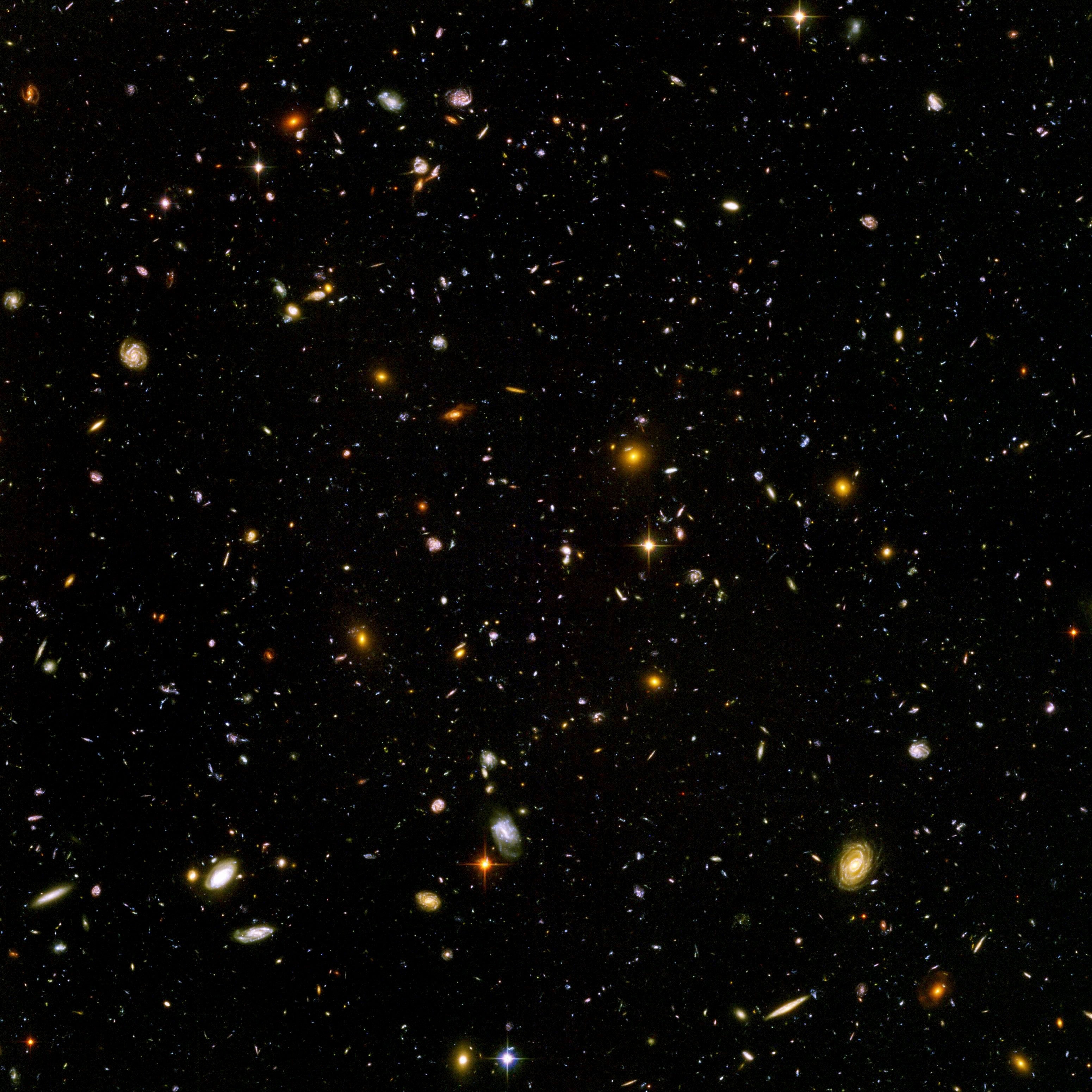
The Hubble Ultra Deep Field (2004). Almost every point of light here is a galaxy, about 10,000 of them in a patch of sky smaller than a tenth of the full Moon's width. Image: NASA, ESA, S. Beckwith (STScI) and the HUDF Team, public domain, via Wikimedia Commons.
Intro
Cosmology asks where the universe came from and how it is put together. Physics asks what rules it runs on. For most of history, many thinkers assumed the universe had simply always been here. Twentieth-century science overturned that picture. The universe is expanding, it is cooling, and the evidence points back to a real beginning.
That discovery matters for Christians. The Bible opens with "In the beginning God created the heavens and the earth" (Genesis 1:1). A universe with a beginning needs a cause outside itself. And the more physicists learn about the laws and numbers of nature, the more finely balanced they turn out to be for life.
This page is the codex's home for cosmology and physics. It gathers the evidence for a cosmic beginning, the fine-tuning of the universe for life, the strange fact that nature obeys mathematics, and the arguments and defeaters built on all of it. Start with the learning path, or jump to the section you need.
The 30-second version:
The universe had a beginning. Expansion, the cosmic microwave background and the Borde-Guth-Vilenkin theorem all point to a finite past, and whatever begins needs a cause. The laws and constants of physics are balanced so finely that small changes would rule out stars, chemistry and life. And nature runs on mathematics a mind can read. A Creator who is rational, powerful and purposeful explains all three better than chance or brute fact.
See this page's graph and discover linked topics
In full
Folder hub for the cosmology and physics sub-area of Origins and Science. It covers three families of evidence that the codex uses in natural theology: the finite past (Big Bang cosmology, the cosmic microwave background, the thermodynamic arrow, the Borde-Guth-Vilenkin theorem), fine-tuning (the constants and initial conditions that permit stars, carbon, water and observers, together with the multiverse reply), and intelligibility (the mathematical form of physical law, conservation principles grounded in symmetry, and the informational reading of physics).
Each family feeds a structured argument held elsewhere in the codex: the finite past feeds the Kalam Cosmological Argument and the Argument from Thermodynamics; fine-tuning feeds the Fine-Tuning Argument; intelligibility feeds the Argument from Discoverability and Laws of the Universe as Witness to Design. The concept pages here state the science and its strongest naturalist readings; the argument pages set out the premises for debate.
The age of the universe is measured within the standard cosmological model at about 13.8 billion years. Christians read that figure in more than one way. Old-earth creationists and theistic evolutionists accept it; young-earth creationists hold that the creation week was recent and offer alternative models for distant starlight and cosmic history. Both readings are treated as live on Young Earth Creationism, Old Earth Creationism and Genesis Interpretation Spread. The arguments for a beginning do not depend on settling that question, because every view agrees that the universe is not eternal.
Learning path
- The beginning. Big Bang, then Expansion of the Universe and Cosmic Microwave Background.
- Why the past is finite. Borde-Guth-Vilenkin Theorem and Second Law of Thermodynamics.
- The proposals that avoid a beginning. Hartle-Hawking No-Boundary Proposal and Multiverse.
- Fine-tuning. Stellar Nucleosynthesis, Triple-Alpha Process and Carbon, then the Fine-Tuning Argument.
- A universe a mind can read. Mathematical Intelligibility of Nature and Conservation Laws.
- The arguments. Kalam Cosmological Argument, Argument from Thermodynamics, Laws of the Universe as Witness to Design.
The beginning of the universe
- Big Bang: the standard model of a universe that expanded from a hot, dense state, and why it implies a beginning.
- Expansion of the Universe: Hubble's 1929 discovery that space itself is stretching, and what it is "expanding into."
- Cosmic Microwave Background: the faint afterglow of the early universe, found in every direction of the sky.
- Baryon Acoustic Oscillations: the frozen sound waves of the early universe, used as a cosmic measuring rod.
- Age of the Universe: how the 13.8-billion-year figure is measured, the Hubble tension, and how Christians read it.
- Borde-Guth-Vilenkin Theorem: why a universe that has been expanding on average cannot be infinitely old.
- Second Law of Thermodynamics: entropy, the arrow of time, and why an eternal universe would already have run down.
- Dark Energy: the unexpected acceleration of cosmic expansion and the fine-tuning of the cosmological constant.
- Hartle-Hawking No-Boundary Proposal: the 1983 attempt to round off the beginning, and what it leaves unexplained.
Fine-tuning and the conditions for life
- Stellar Nucleosynthesis: how stars forge almost every element in your body heavier than hydrogen and helium.
- Triple-Alpha Process and Carbon: the narrow nuclear resonance that lets stars make carbon, and Hoyle's prediction of it.
- Faint Young Sun Paradox: how early Earth stayed warm under a dimmer Sun, and what the competing answers imply.
- Water Older Than the Sun: evidence that much of Earth's water predates the Sun, set beside the primordial waters of Genesis 1.
- Water and Life: the anomalous properties of water that life depends on.
- Multiverse: the leading naturalistic answer to fine-tuning, and the problems it carries.
- Boltzmann Brain: why the multiverse rescue predicts lone fluctuating observers rather than an ordered cosmos like ours.
- Anthropic Principle: the weak and strong versions, and why "we would not be here otherwise" does not explain the tuning.
Laws, mathematics and information
- Mathematical Intelligibility of Nature: why the universe obeys equations, and the "unreasonable effectiveness" of mathematics.
- Conservation Laws: energy, momentum and charge, and Noether's link between conservation and symmetry.
- It from Bit: John Wheeler's thesis that physical reality rests on information.
- Quantum Entanglement and God: what entanglement does and does not show about God.
- Newtonian Absolute Space: Newton's view of space and time as real, absolute realities, and its theological setting.
- Laws of the Universe as Witness to Design: the master synthesis of lawfulness as evidence for a lawgiver.
Arguments built on cosmology and physics
- Kalam Cosmological Argument: whatever begins to exist has a cause; the universe began to exist; so it has a cause.
- Argument from the Impossibility of an Actual Infinite Past: the philosophical case that the past cannot be infinite.
- Argument from Thermodynamics: the universe is running down, so it cannot have been running forever.
- Argument from the Creation of Time: if time began with the universe, its cause is timeless.
- Argument from Cosmology (Guillen): Michael Guillen's case from the Big Bang and the fine-tuned initial conditions of the universe.
- Argument from Physics (Guillen): Guillen's case from the structure of quantum mechanics and the fine-tuning of physical constants.
- Fine-Tuning Argument: the constants of physics are best explained by design.
- Argument from Discoverability: the universe is tuned for life and also for being figured out.
- Causal Adequacy Argument for a Mind Behind the Universe: an effect needs a cause able to produce it.
- Argument from the Suns Origin: a contested design inference from the Sun's formation and properties.
- Stellar Formation Refutation: weighing the young-earth claim that stars cannot form naturally, move by move.
Defeaters on cosmology and physics
- Spacetime Means the Universe Is Eternal Objection Defeater: why "time is part of the universe" does not make the universe eternal.
- Quantum Physics Reverses Entropy Objection Defeater: why local quantum effects do not rescue an eternal universe.
- Nothing Is Fixed Only Metastable Objection Defeater: answering the claim that because everything is a changing process, there is no unchanging foundation and no need for an unchanging God.
- Cosmic Insignificance Objection Defeater: why the size of the universe does not make human beings unimportant.
- Imperfect Universe Objection Defeater: answering "a perfect God would have made a perfect universe."
- Science and Religion Are at War Objection Defeater: where the conflict story came from and why historians reject it.
Apologetic deployment
Lead with the beginning. The Big Bang, the cosmic microwave background and the Borde-Guth-Vilenkin theorem are mainstream science, so the opponent cannot wave them away as religious. The open question is what caused the beginning.
Use fine-tuning second. Once the universe is shown to have a cause, the fine-tuning evidence speaks to what kind of cause it is: one that chose these values out of a vast range of alternatives.
Keep the age question in its place. A skeptic may try to turn the conversation into a dispute over young earth and old earth. Every Christian view agrees the universe began, so the arguments on this page work for all of them.
See also
- Origins and Science, the parent hub
- Origin of Life and Biology, the sister hub for life, the cell and biological design
- Origins and Cosmology, the cross-domain hub for the doctrine of creation
- Cosmological Arguments, the argument category for a first cause
- Teleological Arguments, the argument category for design
- Creatio ex Nihilo, the doctrine of creation out of nothing
- Young Earth Creationism, the age question from the young-earth side
- Old Earth Creationism, the age question from the old-earth side
Common questions this page answers
Q: Does the Big Bang prove God exists?
The Big Bang does not name God, and it does provide strong evidence that the universe had a beginning. Whatever begins to exist needs a cause, and a cause of all space, time and matter has to be beyond space, time and matter. That is the reasoning of the Kalam Cosmological Argument, and the Big Bang page sets out the evidence behind its key premise.
Q: Is there scientific evidence that the universe had a beginning?
Yes. The Expansion of the Universe, the Cosmic Microwave Background and the Second Law of Thermodynamics all point to a finite past, and the Borde-Guth-Vilenkin Theorem shows that a universe which has on average been expanding cannot extend infinitely into the past.
Q: What is cosmic fine-tuning?
Fine-tuning is the observation that the constants and starting conditions of physics fall within narrow ranges that permit stars, chemistry and life. Carbon production in stars (Triple-Alpha Process and Carbon) and the value of Dark Energy are two well-known cases. The Fine-Tuning Argument holds that design explains this better than chance or necessity.
Q: Doesn't the multiverse explain fine-tuning?
The Multiverse is the main naturalistic reply, and it carries real costs. There is no direct observational evidence for other universes, any mechanism that generates them would itself need fine-tuning, and the Boltzmann Brain problem suggests a random multiverse predicts lone fluctuating observers rather than an ordered cosmos like ours.
Q: Why does the universe obey mathematics?
Physicists have long wondered at it. Eugene Wigner called it the "unreasonable effectiveness of mathematics." On theism the fit is expected: a rational God made a world that rational minds made in his image can understand. Mathematical Intelligibility of Nature and Laws of the Universe as Witness to Design develop the point.
Q: How old is the universe, and does the answer matter for Christianity?
The standard cosmological measurement is about 13.8 billion years (Age of the Universe). Old-earth Christians accept that figure and young-earth Christians read the evidence within a recent creation; both positions are defended in the codex. The arguments for a Creator from the beginning, fine-tuning and intelligibility hold on either reading.