Argument
Concepts Do Not Exist Objection Defeater
concepts do not exist, concepts don't exist, ideas don't exist, abstract things don't exist, only physical things exist, concepts are not real, abstractions do not exist, is a statement a concept, are concepts ideas or abstractions, do concepts have ontology, Aquinas says we need matter before we know ourselvesIntro
Some people argue that concepts do not exist. Only physical things are real: trees, brains, electrons. Justice, truth, triangularity and the like are "just words."
The first thing to do is ask what they mean, because the sentence can mean three very different things:
- Concepts are not physical objects. True. You can't weigh justice or put the idea of a triangle in a jar. Christians agree.
- Concepts do not exist apart from minds. A serious position. Many philosophers, including many Christians, hold that concepts live in minds and do not float around on their own.
- Concepts do not exist in any way at all, not even as thoughts. This one defeats itself. The sentence "concepts do not exist" is built out of concepts: concept, existence, not. If there were no concepts at all, the sentence would mean nothing, and there would be nothing to agree or disagree with.
So the debate usually comes down to this: something does not have to be physical to be real. Thoughts, rules and meanings are real in their own way. The open question is what ultimately grounds them, and Christianity has an answer: the mind of God.
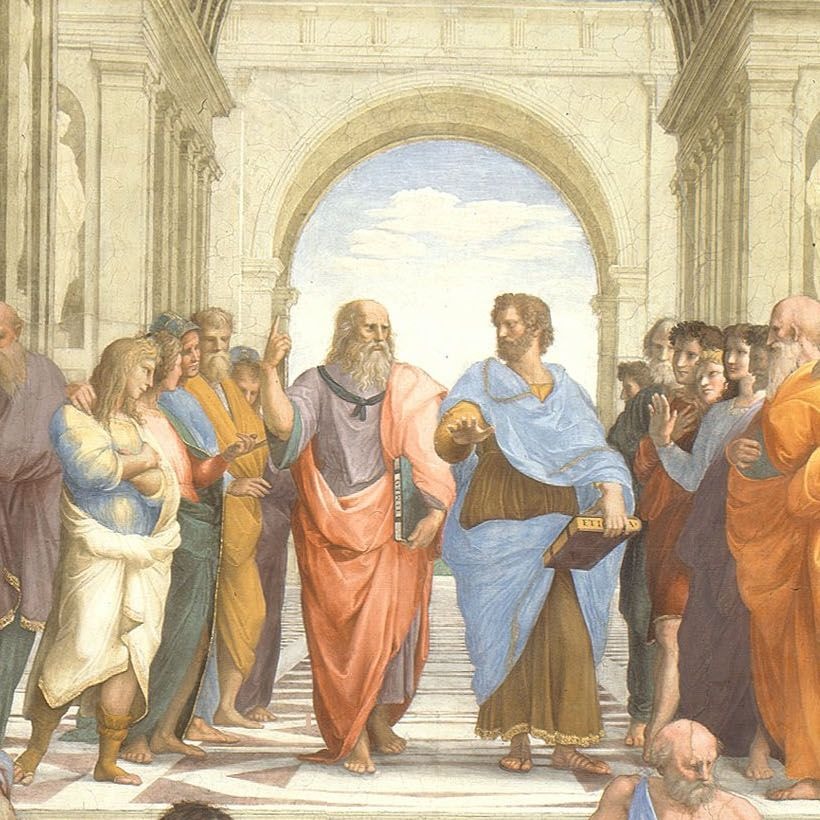 Plato, pointing up, and Aristotle, holding his hand level over the earth, in Raphael's School of Athens (1509-1511). Their gestures are often read as the two great answers to where ideas live: in a world above, or in the things around us. Public domain.
See this page's graph and discover linked topics
In full
"Concepts do not exist" equivocates between three theses:
- Anti-physicality: concepts are not material objects. True and harmless.
- Anti-realism about abstracta: concepts and universals have no existence independent of minds (conceptualism, nominalism). A live option, held by Christians and non-Christians alike.
- Eliminativism: there is no conceptual content at all, even in thought. Performatively self-refuting, since asserting it requires contentful thought.
The defeater disambiguates, grants the first, engages the second, and shows the third cannot be coherently asserted. It then asks the objector for his criterion of existence, since any criterion strict enough to exclude concepts ("only what has mass and location exists") is itself a concept with no mass and no location. Finally it offers the classical Christian account: concepts exist in finite minds, are formed by abstraction from real things (Aquinas), and the intelligibility they track is grounded in the eternal mind of God (Augustine).
Cheatsheet
30-second reply: "Which do you mean? That concepts aren't physical? I agree. That they don't exist outside minds? Let's talk, plenty of Christians agree. Or that they don't exist at all? Then your sentence is made of things that don't exist, and you've told me nothing."
Fast facts:
- A statement is a sentence. A proposition is what the sentence means, the thing that is true or false. A concept is a unit of understanding the proposition is built from. "Concepts do not exist" is a statement expressing a proposition built from the concepts concept, existence and not.
- An idea is any mental content (an image, a memory, a concept). A concept is the kind of idea used to classify and reason. Abstraction is the mental act that forms a concept by noticing what many things share. An abstract object is a supposed mind-independent entity, such as a number.
- Aristotle: being is "said in many ways" (Metaphysics IV.2). Not-physical does not mean not-real.
Counter-moves:
- "Concepts are just brain states." Then they exist, as brain states. The claim was that they don't exist.
- "They're just words." A word is a sound or a mark. What makes two different words in two languages mean the same thing? That shared meaning is the concept.
- "Only what science measures exists." That sentence is not something science measures.
Concessions (with their reciprocals):
- Grant: concepts need not be mind-independent objects. Collect: then they exist as contents of minds, and the objection has changed into a different claim.
- Grant: a self-refutation charge does not refute nominalism. Collect: it does refute eliminativism, which is what "concepts do not exist" literally says.
Closing line: "The question was never whether concepts are physical. It's what kind of reality they have, and what grounds it."
Argument structure
| Premise | Notes | |
|---|---|---|
| P1 | "Concepts do not exist" can mean anti-physicality, anti-realism, or eliminativism | Disambiguate before answering |
| P2 | Anti-physicality is true and does not entail non-existence | Aristotle, Metaphysics IV.2 |
| P3 | Eliminativism cannot be asserted without contentful thought, so it is performatively self-refuting | Performative Self-Refutation of Atheist Denial |
| P4 | Any criterion of existence strict enough to exclude concepts excludes itself, along with logic and mathematics | Quine on ontological commitment |
| P5 | Concepts share the marks of real things: identity, determinate content, relations, persistence, and a role in reasoning | Ontic features (below) |
| C | Concepts are real at least as contents of minds; whether their intelligibility needs a deeper ground is the live question, and theism answers it | Universals, Anyone Who Affirms Universals Must Affirm God |
Form
Defensive, with a performative self-refutation against the strong reading and a burden-shift against the criterion of existence.
Premise 1, Three claims in one sentence
Affirmative case
- The same words cover a truism, a respectable philosophical thesis, and a self-defeating one. Answering the wrong one wastes the debate.
- The question to ask: "Are you saying concepts are merely mental, or that they have no existence whatsoever, even in the mind?"
Anticipated objections
- "You're just playing word games."
Rebuttals
- Distinguishing meanings is how arguments stay honest. If the objector means only the first or second claim, he should say so and the debate changes.
Premise 2, Not physical is not the same as not real
Affirmative case
- Chess rules. You can touch a bishop but not the rule that it moves diagonally. Yet the rule decides which moves are legal.
- Software. You cannot hold an app the way you hold a phone, yet it runs and produces results.
- Blueprints and fiction. A blueprint represents a house that may not exist yet; a thought about Sherlock Holmes is real though Holmes is not. The representation is real even when its object is not.
Anticipated objections
- "The rule and the software are just physical patterns."
Rebuttals
- Then they exist, as patterns, and the objector has moved from claim 3 to a theory of what concepts are. That is a different debate, about Materialism and Intentionality.
Premise 3, The strong claim refutes itself
Affirmative case
- If the proposition "concepts do not exist" is meaningful, it has conceptual content.
- The objector presents it as meaningful.
- So it has conceptual content, and at least some concepts exist.
This is a performative self-refutation of the strong claim: the act of asserting it supplies a counterexample. It is not a formal contradiction against the weaker claims, because someone can accept conceptual thought while denying that concepts are independent entities.
Anticipated objections
- "Eliminative materialists (Paul Churchland) say folk-psychological categories like 'belief' and 'concept' will be replaced by neuroscience."
Rebuttals
- Churchland's program predicts that talk of concepts will be replaced by better categories; it does not say there is no content in thought at all. And the prediction is itself offered as something believed for reasons, which is the very thing it says will be eliminated. See Self-refutation.
Premise 4, What is your criterion of existence?
Affirmative case
- Ask: "What test are you using to decide that something exists, and why does it exclude concepts while admitting other things?"
- "Has mass and location" excludes numbers, the laws of logic, the past, and the test itself.
- "Is causally active" is disputed for concepts but plausible: deliberating over a concept like fairness changes what people do.
- Quine's rule was that we are committed to whatever our best theories quantify over. Our best theories quantify over numbers, sets and functions. That is why nominalists such as Hartry Field had to work hard to rewrite physics without them.
Anticipated objections
- "My criterion is empirical: what we can observe."
Rebuttals
- "Only the observable exists" is not observable. It is a philosophical rule, which is a concept, and so the criterion presupposes what it denies.
Premise 5, The marks of the real
Affirmative case
| Mark | In concepts | In uncontroversially real things |
|---|---|---|
| Identity | Justice is not beauty | A tree is not a rock |
| Determinate content | Each concept has conditions of correct use | Objects have definite properties |
| Relations | Concepts stand in logical relations (entailment, contrast) | Objects stand in spatial and causal relations |
| Persistence | A concept can be kept and recalled over years | Objects persist through change |
| Normativity | Calling a square a circle is a mistake | (Physical things are not right or wrong) |
| Instantiation | Triangularity applies to many triangles | Many triangles exist |
These marks support the reality of conceptual activity and content. They do not, by themselves, prove that concepts exist apart from minds. The last row is telling: concepts carry a standard of correctness that physical objects do not, which is part of why meaning is hard to reduce to matter.
Anticipated objections
- "Having properties isn't sufficient for existence; Sherlock Holmes 'has' properties."
Rebuttals
- Agreed, which is why the claim is modest: concepts exist at least as contents of real minds. Holmes does not exist; your thought about Holmes does.
The Christian account
- Concepts in finite minds. Aquinas held that the human intellect forms concepts by abstracting the natures of material things from sense experience (ST I q.85 a.1). Concepts exist in the intellect, but they are not invented; they track real features of things. This is moderate realism.
- Intelligibility in God's mind. Augustine argued that the patterns by which things are made are stable ideas in the divine intelligence (Eighty-Three Different Questions q.46). This is often called divine conceptualism: necessary truths and kinds are grounded in God's eternal thought, not in a separate Platonic realm. "In the beginning was the Word" (John 1:1, ASV), and "All things were made through him" (John 1:3, ASV).
- Why it matters. If the world is made through the Word, it is no surprise that finite minds can form concepts that fit it. On naturalism, the fit between our concepts and reality needs its own explanation. See Universals and Anyone Who Affirms Universals Must Affirm God.
This is a metaphysical explanation, not a laboratory proof. Its strength is that it explains why concepts are real, why they are not physical, and why they fit the world.
"Aquinas says we need matter before we can know ourselves"
Objectors sometimes cite Aquinas to argue that the mind is just matter. Here is what he said and what he did not say:
- What he said. In this life the proper object of the human intellect is the nature of material things, known through the senses (ST I q.84 a.7). The intellect does not know itself directly by its essence but through its own acts of understanding, which first come from knowing material things (ST I q.87 a.1).
- What he did not say. That the intellect is matter. In the same work he argues that understanding is not the act of a bodily organ, because the intellect can know the natures of all bodies (ST I q.75 a.2).
- The point. Depending on the senses for a starting point is not the same as being identical to the senses. A pilot depends on instruments to fly at night; the pilot is not the instruments.
Master objections
- "This is a God-of-the-gaps move." The argument starts from the reality of thought, which the objector himself uses, not from a gap in science. See God of the Gaps.
- "Christians disagree about universals, so you have no position." Christians agree that concepts are real and that God grounds intelligibility; they disagree about the details (Platonist, Thomist, conceptualist). The objector's own camp is equally divided.
- "Even if concepts exist, that doesn't prove God." Correct, on its own. It removes a physicalist objection and opens the question of grounding, which Anyone Who Affirms Universals Must Affirm God presses further.
Tactical opening and closing
Opening: "When you say concepts don't exist, do you mean they aren't physical, or that they're not real at all?"
Closing: "You used three concepts to tell me concepts don't exist. I'd rather ask what grounds them. My answer is the eternal mind of God. What's yours?"
Live-cite kit
Scripture:
- "In the beginning was the Word, and the Word was with God, and the Word was God" (John 1:1, ASV).
- "By faith we understand that the worlds have been framed by the word of God, so that what is seen hath not been made out of things which appear" (Hebrews 11:3, ASV).
- "For the invisible things of him since the creation of the world are clearly seen, being perceived through the things that are made" (Romans 1:20, ASV).
Scholarly:
- Aristotle, Metaphysics IV.2: being is said in many ways.
- Augustine, Eighty-Three Different Questions q.46: the ideas in the divine mind.
- Aquinas, ST I q.85 a.1 (abstraction) and I q.75 a.2 (understanding is not a bodily act).
- Quine, "On What There Is" (1948): what a theory says exists.
Aphorism: "Not physical is not the same as not real."
Connection to Scripture
John's prologue grounds creation in the Word (Logos), a term that in Greek carries reason and meaning as well as speech (Logos Christology). Hebrews says the visible world was framed by God's word and not made out of visible things. Both texts place meaning before matter, which is the order the objection reverses.
Patristic and scholarly note
The medieval problem of universals turned on this question. Anselm, Abelard and Aquinas all treated concepts as real in some sense while disagreeing about whether what they express exists outside the mind. Aquinas's moderate realism (natures exist in things, and the intellect grasps them universally) and Augustine's divine ideas are the two classical Christian resources. In recent philosophy Greg Welty has defended theistic conceptual realism, the view that abstract objects are God's thoughts, as an alternative to both Platonism and nominalism.
Scholarship
Published academic works this page draws on, each matched to a publisher, index or library catalog record.
- Hartry H. Field, Science without numbers (1980). Open Library
See also
- Universals, the realism, conceptualism and nominalism debate in full
- Anyone Who Affirms Universals Must Affirm God, the argument from universals to God
- Intentionality, how thoughts are about things
- Performative Self-Refutation of Atheist Denial and Self-refutation, the logic of self-defeating claims
- Materialism, the view behind "only physical things exist"
- God Is Metaphysically Absurd Objection Defeater, the related charge against God's existence
- Logos Christology, the Word through whom all things were made
Common questions this page answers
Q: Do concepts exist?
Yes, at least as contents of minds. Concepts are not physical objects, but not being physical is not the same as not being real. Whether concepts also exist independently of minds is debated, and Christian philosophers hold several views on it.
Q: Is a statement a concept?
No. A statement is a sentence, the proposition is what the sentence means, and concepts are the units of understanding the proposition is built from. "Concepts do not exist" is a statement expressing a proposition built from the concepts concept, existence and negation.
Q: Are concepts ideas or abstractions?
A concept is a kind of idea, specifically one used to classify and reason. Abstraction is the mental process that forms many concepts, by noticing what different things have in common. An abstract object is something else again: a supposed entity, like a number, that exists apart from minds.
Q: Isn't saying "concepts do not exist" self-refuting?
It is if it means that concepts have no reality at all, because the sentence uses concepts to say it. It is not self-refuting if it means only that concepts do not exist apart from minds, which is a respectable philosophical position.
Q: Did Aquinas say we need matter before we can know ourselves?
He said the human intellect first knows the natures of material things through the senses, and knows itself through its own acts of understanding. He also argued that understanding is not the act of a bodily organ. Needing the senses as a starting point is not the same as the mind being matter.
Q: How does Christianity explain concepts?
Classical Christian thought holds that concepts exist in finite minds, formed by abstracting real features of things, and that the intelligible order they grasp is grounded in God's eternal mind. Augustine located the patterns of all created things in the divine intelligence.