Concept
Clownfish and Sea Anemone
clownfish, anemonefish, clownfish and sea anemone, clownfish symbiosis, clownfish anemone mutualism, AmphiprionIntro
A sea anemone is a wall of stinging tentacles that paralyzes and eats almost any small fish that touches it. The clownfish is the exception: it lives inside those tentacles, sheltered by the very stings that kill everything else, and in return it cleans, feeds, and defends its host. The two are bound together so tightly that wild clownfish do not thrive without an anemone home. The hard part for a step-by-step story is the entry cost. A fish that swims into a lethal anemone before it has the protective coat that lets it live there is simply stung and eaten. The fish needs the chemistry to survive the host, and the chemistry is pointless without the host. A fitted, two-sided arrangement like this, where each side is set up in advance for the other, is what design looks like.
See this page's graph and discover linked topics
In full
Anemonefish (about thirty species in Amphiprion and Premnas) live among the tentacles of host sea anemones whose nematocysts (stinging cells) are deadly to most fish. The clownfish is protected by a specialized mucus coat, several times thicker than ordinary fish slime, that appears to lack the chemical triggers that fire nematocysts and to mimic the anemone's own surface chemistry, so the host does not treat the fish as prey or as foreign. New fish acclimate by touching the tentacles in stages. The relationship runs both ways: the clownfish gains shelter and a guarded nest site, while the anemone gains cleaning, water circulation from fin movement, nutrients from waste and dropped food, and defense from anemone-eating fish. The arrangement carries a lethal entry cost that resists gradual assembly, the protective chemistry, the acclimation behavior, and a host that tolerates the fish must all be in place for the partnership to begin, and a fish lacking the coat dies on contact rather than gaining a foothold.
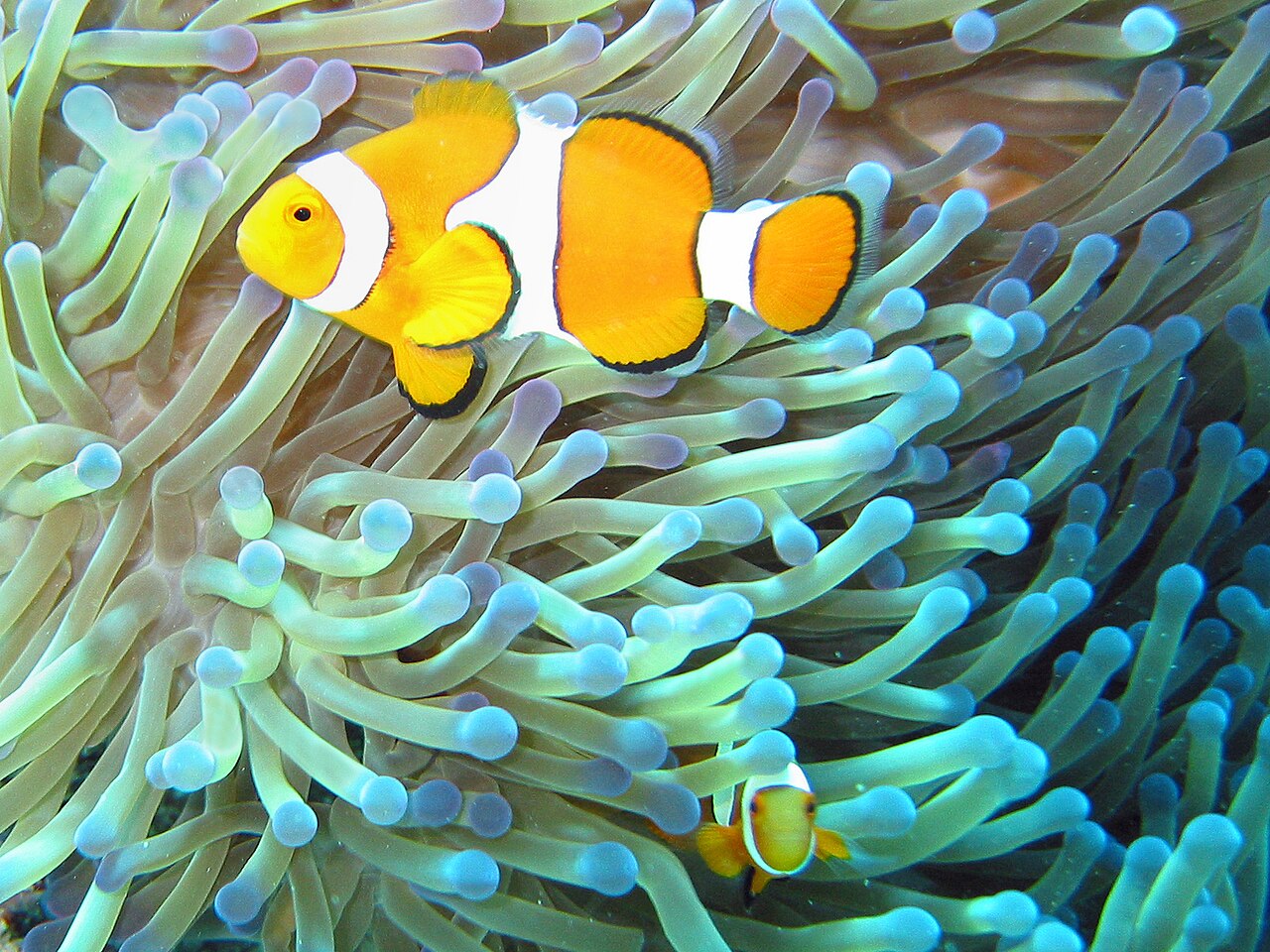
A clownfish sheltering in a host sea anemone. Image: public domain, via Wikimedia Commons.
The mechanism
- A lethal host. The anemone's tentacles bristle with nematocysts that inject venom on contact, killing and digesting small fish.
- The protective coat. The clownfish carries an unusually thick mucus layer that appears to lack the cues that discharge nematocysts and to mimic the anemone's surface chemistry, so the host reads the fish as part of itself.
- Acclimation. A clownfish entering a new anemone touches the tentacles in a careful sequence, apparently tuning its mucus before committing to full contact.
- What the fish gives. It drives off anemone-eating fish, picks away parasites and debris, fans water through the tentacles to improve oxygen and circulation, and fertilizes the host with waste and scraps.
- What the fish gets. A predator-proof home, a guarded nest for its eggs, and a feeding base.
Why this points to design
The whole way of life depends on safely inhabiting tentacles that are fatal to every other fish, which requires the matched mucus chemistry and the acclimation behavior to be present together in a host that would otherwise kill the fish. A fish without the coat dies; a coat with no fish to carry it does nothing; a host that did not tolerate the fish ends the story before it starts. The benefit appears only when all three are aligned, which is not how a slow series of separately advantageous steps proceeds. Two organisms fitted to each other in advance, one carrying exactly the chemistry needed to survive the other's defenses, is the kind of prearranged match that points to a designer. See Intelligent Design and the symbiosis discussion in Animals That Defy Evolution.
The evolutionary account, and why it falls short
The standard reply is that the partnership began loose and optional and tightened over time: a fish that tolerated stings even partially gained some shelter near the anemone, and selection improved the mucus and the behavior step by step until the bond became close.
The reply glides past the entry problem it needs to solve. Getting a fish to gain repeated, survivable contact with a host that is built to kill fish requires the mucus chemistry, the acclimation behavior, and the host's tolerance to move in step from the very first useful stage, and a fish with the wrong surface chemistry does not get a partial reward, it gets stung. Naming a path from "facultative" to "obligate" is not the same as exhibiting the intermediate fish that could survive the host with a half-formed coat, or the genetic changes that built host-specific chemical cloaking. The prearranged fit between a specific fish and a specific lethal host is precisely what the gradual story cannot deliver and what design accounts for directly.
See also
- Animals That Defy Evolution, the hub this spoke belongs to
- The yucca moth and its yucca plant, another obligate partnership in this hub where both species depend on each other to reproduce
- Intelligent Design, the positive design program
- Edge of Evolution, the empirical reach of random mutation
Common questions this page answers
Q: How is the clownfish and sea anemone evidence for design?
The clownfish lives inside stinging tentacles that kill other fish, protected by a special mucus coat, and in return it cleans, feeds, and defends the anemone. The partnership has a lethal entry cost: a fish without the protective chemistry dies in the host, and the chemistry is useless without the host. Because the fish, its protective coat, and the host's tolerance only pay off when aligned together, the fitted, two-sided match looks engineered rather than gradually negotiated.
Q: Why doesn't the clownfish get stung by the anemone?
It carries an unusually thick mucus coat that appears to lack the chemical triggers that fire the anemone's stinging cells and to mimic the anemone's own surface chemistry, so the host does not treat the fish as prey or as foreign. New clownfish also acclimate by touching the tentacles in careful stages, apparently tuning their mucus before settling in.
Q: Couldn't the clownfish-anemone relationship have evolved gradually?
The usual story says it began as a loose association and tightened over time, but that skips the entry problem: a fish must gain repeated, survivable contact with a host built to kill fish, and a fish with the wrong surface chemistry is stung rather than partly rewarded. The protective coat, the acclimation behavior, and the host's tolerance have to align from the first useful stage, and the intermediate fish and the genetic changes for host-specific cloaking have never been demonstrated. That prearranged fit is what points to design.
Q: What does each partner get from the relationship?
The clownfish gets a predator-proof home and a guarded nest among tentacles that repel its enemies. The anemone gets cleaning, better water circulation from the fish's fin movement, nutrients from its waste and dropped food, and defense against fish that would eat the anemone. Each is equipped to benefit the other, which is the heart of the design inference here.