Person
Claudius
Emperor Claudius, Tiberius Claudius Caesar Augustus Germanicus, Claudius Caesar, Tiberius Claudius Nero GermanicusIntro
Claudius was the fourth Roman emperor, ruling from AD 41 to 54, between Caligula and Nero. Acts names him twice. A Christian prophet named Agabus foretold "a great famine over all the world: which came to pass in the days of Claudius" (Acts 11:28, ASV). And when Paul reached Corinth he met Aquila and Priscilla, "lately come from Italy... because Claudius had commanded all the Jews to depart from Rome" (Acts 18:2, ASV).
Both events are mentioned by Roman writers. The historian Suetonius says Claudius expelled the Jews from Rome because they were constantly rioting "at the instigation of Chrestus," a phrase many historians read as a garbled reference to Christ.
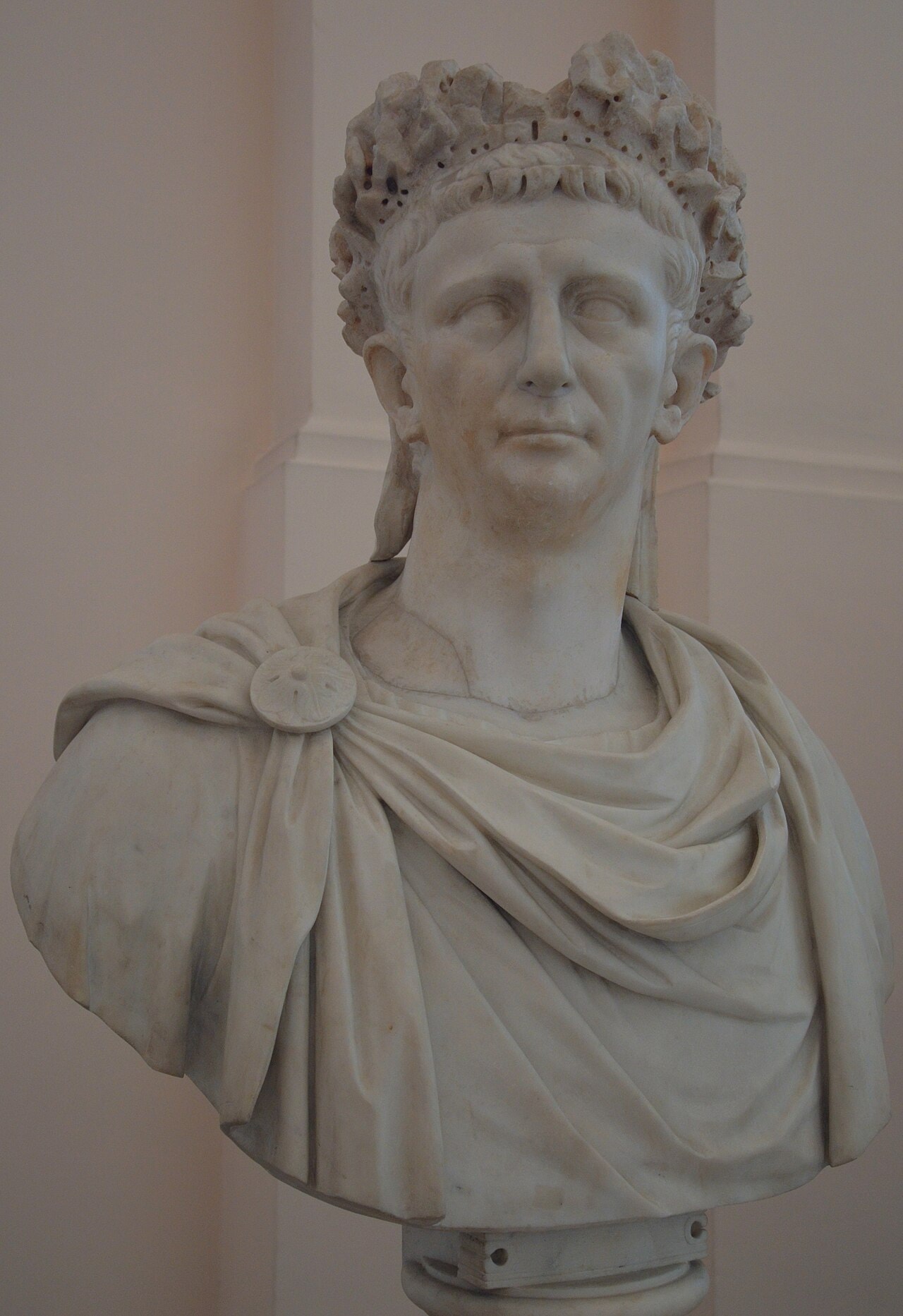
Marble bust of Claudius wearing the civic crown, Naples National Archaeological Museum. Photo: Carole Raddato, CC BY-SA 2.0, via Wikimedia Commons, resized.

The 30-second version:
Claudius ruled Rome from AD 41 to 54. Acts mentions a famine in his reign and his order expelling Jews from Rome, which brought Aquila and Priscilla to Corinth. Roman historians record repeated food shortages under Claudius, and Suetonius says he expelled the Jews for rioting over "Chrestus," probably the name of Christ. His letter naming Gallio as proconsul, found at Delphi, fixes the date of Paul's stay in Corinth. He is attested by thousands of coins, inscriptions and ancient histories.
See this page's graph and discover linked topics
In full
Tiberius Claudius Nero Germanicus was born at Lugdunum (Lyon) on 1 August 10 BC, the son of Drusus the Elder and Antonia, nephew of the emperor Tiberius and uncle of Caligula. Long kept out of public life because of a limp and a stammer, he was proclaimed emperor by the Praetorian Guard after Caligula's murder in January AD 41, with the help, Josephus says, of his friend Herod Agrippa I. His reign saw the invasion of Britain (AD 43), the growth of the imperial bureaucracy, and the return of Judea to procurators after Agrippa's death in AD 44. He died on 13 October 54, by ancient report poisoned by his wife Agrippina so that her son Nero would succeed. In the New Testament he is the emperor of the famine (Acts 11:28) and of the expulsion of Jews from Rome (Acts 18:2), usually dated AD 49. His reign also supplies one of the fixed points of New Testament chronology: his letter to Delphi naming Gallio as proconsul of Achaia (see Gallio Inscription).
In the Bible
- Acts 11:27-30, the famine. Agabus "signified by the Spirit that there should be a great famine over all the world: which came to pass in the days of Claudius" (Acts 11:28, ASV). The disciples at Antioch sent relief to Judea by Barnabas and Saul.
- Acts 18:1-3, the expulsion. At Corinth Paul "found a certain Jew named Aquila, a man of Pontus by race, lately come from Italy, with his wife Priscilla, because Claudius had commanded all the Jews to depart from Rome" (Acts 18:2, ASV). Paul worked with them as a tentmaker. By the time Paul wrote Romans, after Claudius' death, they were back in Rome (Romans 16:3).
- "Cæsar" in Acts. Other references to Caesar in Acts 17:7 ("the decrees of Cæsar") fall in Claudius' reign, but do not name him.
Family and lineage
- Parents. Drusus the Elder (Nero Claudius Drusus), brother of Tiberius, and Antonia Minor, daughter of Mark Antony and Octavia.
- Grandmother. Livia, wife of Augustus.
- Relations. Nephew of Tiberius; brother of Germanicus; uncle of Caligula.
- Wives. Four, including Valeria Messalina (executed AD 48) and his niece Agrippina the Younger, whom he married in AD 49.
- Children. Britannicus and Octavia by Messalina; he adopted Agrippina's son Nero, who married Octavia and succeeded him.
- A Herodian friend. He grew up at court with Herod Agrippa I, to whom he gave Judea and Samaria in AD 41. See Herod Agrippa I.
Historical and archaeological evidence
The expulsion of the Jews
- Suetonius (c. AD 121): Iudaeos impulsore Chresto assidue tumultuantis Roma expulit, "Since the Jews constantly made disturbances at the instigation of Chrestus, he expelled them from Rome" (Life of Claudius 25.4).
- Orosius, a Christian historian writing in AD 417, dates the expulsion to "the ninth year" of Claudius, AD 49, citing Josephus, though no surviving text of Josephus mentions it (Histories Against the Pagans 7.6.15).
- Cassius Dio (early 3rd century) says that in AD 41 Claudius, finding the Jews too numerous to expel without disorder, did not drive them out but forbade them to hold meetings (Roman History 60.6.6).
Many historians, Peter Lampe and Rainer Riesner among them, take Suetonius' "Chrestus" as a misunderstanding of Christus, a common confusion since Chrestus was a familiar slave name pronounced almost the same; the "disturbances" would then be conflicts in Roman synagogues over Jesus as Messiah. Others, notably H. Dixon Slingerland, argue that Chrestus was an otherwise unknown Jewish agitator. Scholars also debate whether Dio's AD 41 measure and Suetonius' expulsion are one event or two; most favor two, with the expulsion in AD 49, which fits Paul's arrival in Corinth around AD 50 and the Gallio date.
The famine
- Suetonius speaks of a scarcity of grain at Rome caused by repeated droughts under Claudius (Life of Claudius 18.2).
- Tacitus records a famine at Rome in AD 51 (Annals 12.43).
- Josephus describes "a great famine" in Judea around AD 45-48, when Queen Helena of Adiabene bought grain from Egypt and figs from Cyprus for Jerusalem (Antiquities 20.51-53, 101).
- Egyptian papyri record unusually high grain prices in AD 45-46, as Kenneth Gapp showed in "The Universal Famine under Claudius" (Harvard Theological Review 28, 1935).
No single empire-wide famine is recorded. Acts' "over all the world" (oikoumenē) is best read as widespread shortages across the empire during the reign rather than one simultaneous famine; Luke's own wording, "in the days of Claudius," covers the whole period.
Inscriptions, papyri and coins
- The Delphi letter naming Gallio as proconsul, dated by Claudius' 26th imperial acclamation to AD 52 (see Gallio Inscription).
- The Letter of Claudius to the Alexandrians (AD 41; London Papyrus 1912, British Library), in which he orders the Greeks and Jews of Alexandria to keep the peace and warns the Jews not to bring in co-religionists from Syria or Egypt.
- The Nazareth Inscription, a marble edict of "Caesar" against tomb violation, which some scholars attribute to Claudius. The attribution is debated. See Nazareth Inscription.
- Coins in great numbers across the empire, including issues of Herod Agrippa I and the procurators of Judea that name him.
Grade. Direct. He is attested by ancient histories, inscriptions, papyri and coins. Mykytiuk counts him among the 30 confirmed New Testament persons.
Scholarly consensus
- Historicity and dates. Beyond dispute.
- Acts 18:2. Most historians accept that Acts correctly connects Aquila and Priscilla's move with a Claudian expulsion, and many date it to AD 49 with Orosius. The expulsion probably affected the leaders of the disturbances or the community's assemblies rather than every Jew in Rome; Luke's "all the Jews" reflects the decree's wording or its reputation.
- Chrestus. The majority view is that Suetonius refers, at least indirectly, to Christ, which would make this one of the earliest pagan references to the Christian movement. The minority view of an unknown agitator named Chrestus is a serious position. Either way, the passage confirms Acts' expulsion.
- The famine. Accepted as real; the debate concerns its extent and dating within the reign.
Theological significance
- Prophecy fulfilled in history. Luke reports Agabus' prediction and its fulfillment in a datable reign, inviting readers to check it. Acts' habit of tying events to named rulers is part of its claim to be history.
- Providence in an expulsion. An imperial order that uprooted Aquila and Priscilla placed them in Corinth just as Paul arrived, and made them two of his closest co-workers (Romans 16:3-4).
- The gospel in Rome before Paul. If Suetonius' "Chrestus" means Christ, the faith had reached Rome's synagogues by the 40s, years before Paul's letter to the Romans, which addresses an established church.
- Generosity in famine. The church at Antioch responded to the prophecy with relief "every man according to his ability" (Acts 11:29, ASV), an early model of Christian care across ethnic lines.
Church Fathers
- Eusebius: "Under him the world was visited with a famine, which writers that are entire strangers to our religion have recorded in their histories. And thus the prediction of Agabus recorded in the Acts of the Apostles, according to which the whole world was to be visited by a famine, received its fulfillment" (Church History 2.8.1, NPNF translation).
- Orosius (AD 417), cited above, dates the expulsion of Acts 18:2 to Claudius' ninth year and quotes Suetonius' "Chrestus" sentence, which he applies to Christ (Histories Against the Pagans 7.6.15).
Scholarship
Published academic works this page draws on, each matched to a publisher, index or library catalog record.
- Kenneth Sperber Gapp, "The Universal Famine under Claudius," Harvard Theological Review 28 (1935). doi:10.1017/s0017816000023038
See also
- Herod Agrippa I, the Jewish king he raised to rule Judea
- Gallio Inscription, his letter to Delphi that dates Paul in Corinth
- Gallio, the proconsul named in that letter
- Nazareth Inscription, an imperial edict sometimes attributed to him
- Tiberius, his uncle and predecessor but one
- Paul the Apostle, whose ministry falls within his reign
- Church at Corinth, founded when Aquila and Priscilla arrived from Rome
- Dating of Paul's Letters, the chronology his reign helps fix
- Biblical Figures Confirmed by Archaeology, where Claudius stands on Mykytiuk's list
- People of the Bible, every person on the list, by book of first mention
Common questions this page answers
Q: Which Roman emperor expelled the Jews from Rome in Acts 18:2?
Claudius, who ruled AD 41-54. Suetonius says he expelled them because they kept rioting "at the instigation of Chrestus" (Life of Claudius 25.4), and the Christian historian Orosius dates the expulsion to AD 49.
Q: Who was Chrestus in Suetonius?
Most historians think "Chrestus" is a misspelling or misunderstanding of Christus, Christ, and that the riots were disputes in Rome's synagogues over Jesus. A minority think he was an unknown Jewish agitator of that name.
Q: Was there a famine in the days of Claudius?
Yes. Suetonius and Tacitus record grain shortages at Rome, Josephus describes a great famine in Judea around AD 45-48, and Egyptian papyri show very high grain prices in AD 45-46. Acts 11:28 says Agabus predicted it.
Q: How does Claudius help date Paul's ministry?
His letter to Delphi names Gallio as proconsul of Achaia and dates to AD 52. Since Paul stood before Gallio in Corinth (Acts 18:12), Paul's stay there falls around AD 50-52, which also fits an expulsion of Jews from Rome in AD 49.