Concept
Christianity in Africa Today
How Many Christians Are in Africa, African Christianity Statistics, Christian Population of Africa, Growth of Christianity in Africa, Center of Gravity of Christianity, Christianity's Center of Gravity, Southward Shift of ChristianityIntro
In 1900 there were fewer than ten million Christians in all of Africa. Today there are around 700 million or more, depending on who is counting, and Africa has more Christians than any other continent. That is one of the largest religious changes in human history, and most of it happened in the lifetime of people still alive.
This page gives the numbers carefully, with their sources and years, because different researchers count differently. It shows how Christians are spread across Africa's regions, how they divide among Catholic, Protestant, Orthodox, independent and Pentecostal churches, which countries have the most Christians, and how Africa's growth has moved the center of world Christianity south.
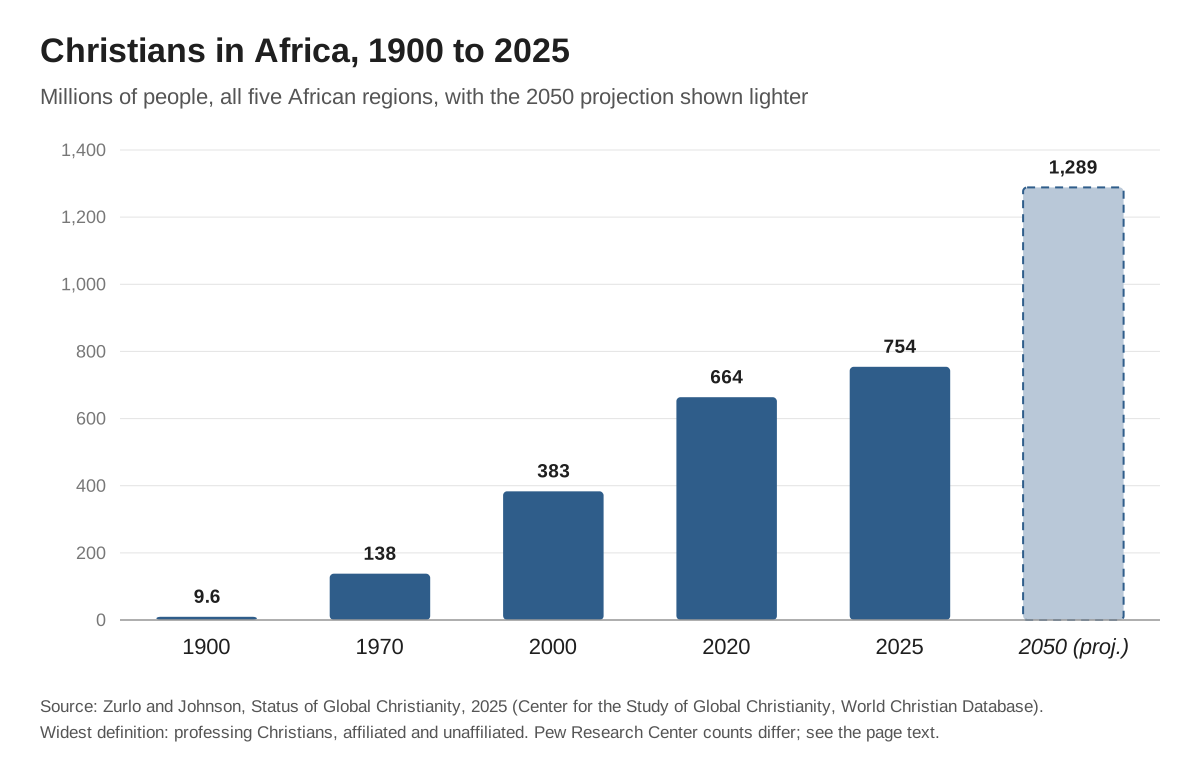 Christians in Africa, 1900 to 2025, with the 2050 projection. Chart drawn for the codex from the Center for the Study of Global Christianity's Status of Global Christianity, 2025.
See this page's graph and discover linked topics
In full
Two research programs supply nearly all serious estimates of Christianity in Africa:
- The Center for the Study of Global Christianity (CSGC) at Gordon-Conwell Theological Seminary, which publishes the World Christian Database (Gina A. Zurlo and Todd M. Johnson, eds., Brill) and an annual Status of Global Christianity table. It uses the widest definition of Christian (professing Christians, whether or not affiliated to a church) and counts by continent and UN region, with history back to 1900 and projections to 2050.
- The Pew Research Center, whose 2025 report How the Global Religious Landscape Changed From 2010 to 2020 estimates the religious composition of 201 countries and territories from more than 2,700 censuses and surveys. It counts by self-identification and groups Africa into "sub-Saharan Africa" and "Middle East-North Africa."
Both agree on the main facts:
- Christianity in Africa grew from a small minority in 1900 to roughly half the continent's people.
- Africa now holds more Christians than any other continent or region.
- The growth is concentrated south of the Sahara; North Africa remains overwhelmingly Muslim.
- The center of gravity of world Christianity has moved from Europe toward Africa.
They differ on exact totals and on how to classify churches, and those differences are shown below rather than smoothed over.
Growth since 1900
CSGC figures (Status of Global Christianity, 2025, from the World Christian Database, accessed January 2025):
| Year | Christians in Africa | Christians worldwide | Africa's share of world Christians |
|---|---|---|---|
| 1900 | 9,640,000 | 558,346,000 | 1.7% |
| 1970 | 137,866,000 | 1,216,131,000 | 11.3% |
| 2000 | 383,463,000 | 1,987,905,000 | 19.3% |
| 2020 | 663,664,000 | 2,519,505,000 | 26.3% |
| 2025 | 754,229,000 | 2,645,317,000 | 28.5% |
| 2050 (projection) | 1,288,574,000 | 3,312,204,000 | 38.9% |
The share column is simple division on the CSGC table. The same table gives an average growth rate for African Christianity of 2.59% a year from 2020 to 2025, the fastest of any continent.
As a share of Africans. Zurlo summarized the twentieth-century change in 2020: Christianity in Africa grew "from 9% Christian in 1900 to nearly 50% Christian in 2020" (CSGC, 18 March 2020). Roughly four-fifths of the growth in numbers between 1900 and 2020 came after 1970, after most African states had become independent, a point developed at Christianity Spread Only by the Sword Objection Defeater.
Pew figures (2025 report, data for 2010 and 2020):
| Region | Christians, 2010 | Christians, 2020 | Christian share of population, 2020 | Share of world Christians, 2020 |
|---|---|---|---|---|
| Sub-Saharan Africa | 531,650,000 | 697,420,000 | 62.0% | 30.7% |
| Middle East-North Africa (includes non-African countries) | 11,800,000 | 12,920,000 | 2.9% | under 1% |
Pew reports that sub-Saharan Africa's Christian population grew 31% in that decade, and that by 2020 the region held the largest share of the world's Christians, 30.7%, ahead of Europe at 22.3%. Pew attributes the shift both to Africa's higher fertility and to widespread disaffiliation from Christianity in Western Europe.
Why the two counts differ
Summing Pew's country estimates for every African country and territory in its dataset gives about 703 million Christians in 2020, roughly 51% of the continent. CSGC's 2020 figure for Africa is about 664 million. Yet CSGC counts more Christians worldwide (2.52 billion in 2020) than Pew (2.27 billion). The reasons:
- Different definitions. CSGC counts "professing Christians," including those it judges to be secret or unaffiliated believers; Pew counts self-identification.
- Different sources and adjustments. Censuses in several African countries do not ask about religion, so both programs rely on surveys and modeling, and they weight sources differently.
- Different world totals. Because CSGC finds more Christians in Asia, Latin America and Europe, Africa's share of the world total is lower in CSGC's figures (26.3% in 2020) than in Pew's (30.7%), even though Pew's African total is higher.
The responsible summary is a range: roughly 660 to 700 million Christians in Africa around 2020, and about 750 million by 2025 on CSGC's estimate.
Distribution by region
The table below sums Pew's 2020 country estimates using the United Nations' five African subregions (the grouping CSGC also uses). Under that scheme Northern Africa includes Sudan; Middle Africa includes Angola, Cameroon, Chad and both Congos; Eastern Africa runs from Eritrea south to Zambia, Zimbabwe, Mozambique and Madagascar; Southern Africa is South Africa, Namibia, Botswana, Lesotho and Eswatini.
| UN subregion | Christians, 2010 | Christians, 2020 | Christian share of population, 2020 | CSGC average growth, 2020 to 2025 |
|---|---|---|---|---|
| Eastern Africa | about 241 million | about 320 million | about 71% | not given |
| Middle (Central) Africa | about 117 million | about 162 million | about 86% | 3.16% a year (fastest) |
| Western Africa | about 123 million | about 156 million | about 38% | not given |
| Southern Africa | about 51 million | about 59 million | about 86% | 0.96% a year (slowest) |
| Northern Africa | about 5 million | about 6 million | about 2% | 1.23% a year |
| Africa | about 537 million | about 703 million | about 51% | 2.59% a year |
Counts and shares: computed for the codex from the Pew Research Center's Religious Composition 2010-2020 dataset (2025). Growth rates: Gina A. Zurlo, CSGC, reporting the World Christianity 2025 figures.
What the regions show:
- Eastern Africa has the largest number of Christians: Ethiopia, Kenya, Tanzania, Uganda, Madagascar, Malawi, Zambia, Mozambique and Zimbabwe all have large Christian majorities or pluralities.
- Middle Africa is the most Christian region by share and is growing fastest, driven by the Democratic Republic of the Congo and Angola.
- Western Africa is religiously divided. Nigeria, Ghana and Côte d'Ivoire have large Christian populations, while the Sahel states (Mali, Niger, Senegal, Mauritania) are overwhelmingly Muslim. Nigeria is roughly split between a Muslim north and a Christian south.
- Southern Africa is heavily Christian and growing slowly, with the oldest Protestant and independent church traditions on the continent.
- Northern Africa is overwhelmingly Muslim. Egypt's Coptic Orthodox Church is by far the largest Christian body; Pew estimates Egypt's Christians at about 5.3 million (4.8%) in 2020, while Coptic Church sources commonly give much higher figures, a long-running dispute. See Coptic Orthodox Church and Decline of North African Christianity.
Distribution by tradition
Researchers divide African Christians differently, so the figures below come from three sources with their own categories.
Pew Research Center, Global Christianity (2011), sub-Saharan Africa, 2010:
| Tradition | Share of the region's Christians |
|---|---|
| Protestant (Pew includes African independent churches and Anglicans here) | 57% |
| Catholic | 34% |
| Orthodox | 8% |
| Other Christian | 1% |
CSGC figures for all of Africa, 2010 estimates and 2025 projections (as tabulated from CSGC data by J. Kwabena Asamoah-Gyadu, "Growth and Trends in African Christianity in the 21st Century," Regnum Books International). The rows overlap: Pentecostals and Charismatics are counted across all traditions, and Evangelicals across several.
| Category | 2010 | Share of Africa's population | 2025 (projected) | Share |
|---|---|---|---|---|
| All Christians | 502,673,000 | 48.1% | 751,547,000 | 50.0% |
| Roman Catholics | 178,266,000 | 17.1% | 274,772,000 | 18.3% |
| Protestants | 192,187,000 | 18.4% | 270,367,000 | 18.0% |
| Independents (including African initiated churches) | 109,828,000 | 10.5% | 155,266,000 | 10.3% |
| Orthodox | 45,175,000 | 4.3% | 63,246,000 | 4.2% |
| Pentecostals and Charismatics (cross-cutting) | 179,046,000 | 17.1% | 257,931,000 | 17.1% |
| Evangelicals (cross-cutting) | 115,201,000 | 11.0% | 168,819,000 | 11.2% |
The projected 2025 total in that table (751.5 million) is very close to CSGC's later published 2025 estimate (754.2 million).
The Catholic Church's own count. The Vatican's Annuarium Statisticum Ecclesiae 2023 (published 2025) reported about 281 million baptized Catholics in Africa at the end of 2023, up 3.3% in a year, the fastest growth of any continent, and about 20% of the world's Catholics. The Democratic Republic of the Congo had the most Catholics of any African country, followed by Nigeria.
What the tradition figures show:
- Catholics and Protestants are roughly equal in CSGC's accounting; Pew, which folds independents into Protestantism, makes Protestants the clear majority south of the Sahara.
- Orthodoxy is concentrated in Ethiopia, Eritrea and Egypt, the ancient Oriental Orthodox churches, which are among the oldest continuous Christian communities in the world. See Ethiopian Orthodox Church.
- Independents include the African initiated churches founded by African prophets and leaders from the early twentieth century. See African Initiated Churches.
- Pentecostals and Charismatics, about a sixth of all Africans on CSGC's figures, run through every tradition. See African Pentecostal and Charismatic Christianity.
The largest national Christian populations
Pew Research Center estimates for 2020, from the dataset released with its 2025 report. The world rank is among all countries.
| Rank in Africa | Country | Christians, 2020 | Christian share, 2020 | Christians, 2010 | World rank |
|---|---|---|---|---|---|
| 1 | Nigeria | 92,770,000 | 43.4% | 73,980,000 | 6 |
| 2 | Democratic Republic of the Congo | 92,400,000 | 96.3% | 66,160,000 | 7 |
| 3 | Ethiopia | 73,230,000 | 61.6% | 56,640,000 | 8 |
| 4 | South Africa | 51,630,000 | 85.3% | 44,140,000 | 9 |
| 5 | Kenya | 44,730,000 | 85.7% | 34,580,000 | 12 |
| 6 | Tanzania | 39,440,000 | 64.7% | 27,610,000 | |
| 7 | Uganda | 39,010,000 | 87.7% | 28,380,000 | |
| 8 | Angola | 31,120,000 | 93.0% | 21,330,000 | |
| 9 | Ghana | 22,730,000 | 71.3% | 18,110,000 | |
| 10 | Madagascar | 21,490,000 | 74.2% | 15,520,000 | |
| 11 | Mozambique | 18,880,000 | 61.3% | 12,960,000 | |
| 12 | Zambia | 18,730,000 | 98.3% | 13,640,000 | |
| 13 | Cameroon | 18,300,000 | 69.8% | 14,100,000 | |
| 14 | Malawi | 17,070,000 | 87.4% | 12,890,000 | |
| 15 | Zimbabwe | 13,540,000 | 87.2% | 11,280,000 |
Notes on the table:
- Nigeria and the Congo are effectively tied. The two estimates differ by less than half a percent, well within the uncertainty of the data. Nigeria has no recent census figures on religion, and its Christian share is debated; Pew puts it at 43.4% with Muslims at 56.1%.
- Four African countries are in the world's top ten by number of Christians in Pew's 2020 data (Nigeria, the Congo, Ethiopia and South Africa), alongside the United States, Brazil, Mexico, the Philippines, Russia and Italy.
- Every country on the list grew between 2010 and 2020. Mozambique was the only country in the world where Pew found the Christian share rising substantially in the decade (by 5 points).
The southward shift of world Christianity
The center of gravity
The Atlas of Global Christianity (Todd M. Johnson and Kenneth R. Ross, eds., Edinburgh University Press, 2009) plotted the "statistical center of gravity" of world Christianity, the point on the globe that balances where all Christians live:
- In 1910 it lay near Madrid, Spain, when, in the words of CSGC researcher Peter Crossing, over 80 percent of all Christians were European.
- By 2010 it had moved to West Africa, in the neighborhood of Timbuktu, Mali; Peter Crossing of the CSGC described it as lying well south of Timbuktu.
- An earlier study by Johnson and Sun Young Chung (2004) projected that by 2100 it would lie in northern Nigeria.
The Global South majority
| Year | Share of the world's Christians living in the Global South (CSGC) |
|---|---|
| 1900 | 17.6% |
| 1970 | 43.0% |
| 2000 | 58.9% |
| 2020 | 66.6% |
| 2025 | 68.9% |
| 2050 (projection) | 78.0% |
In CSGC's 2025 table, Africa (754 million) leads Latin America (620 million), Europe including Russia (552 million), Asia (417 million) and Northern America (272 million). Pew's 2015 projections expected sub-Saharan Africa to hold nearly four in ten of the world's Christians (38%) by 2050, up from 24% in 2010.
Philip Jenkins brought this shift to a wide audience in The Next Christendom (2002), arguing that the typical Christian of the twenty-first century would be found in Africa, Latin America or Asia rather than in Europe; see Pentecostalization of Global Christianity.
What drives the growth
- Conversion, mostly in the twentieth century. The rise from about 9% to about half of Africans could not come from births alone; it required large numbers of people, mostly from traditional religions, to become Christians. Most of that happened after 1970.
- Population growth, today. Pew attributes most current growth to Africa's high fertility and young population. Its 2015 projections expected sub-Saharan Christians to grow from 517 million (2010) to more than 1.1 billion (2050), while the Muslim share of the region rises somewhat faster.
- African agency. Catechists, evangelists, prophets and independent churches did most of the evangelizing. See African Initiated Churches, William Wade Harris and Simon Kimbangu.
- Bible translation into African languages, which made the faith native. See Missionary Translation and African Languages.
- Pentecostal and charismatic renewal, with its emphasis on prayer, healing and deliverance, especially since the 1970s.
- Low disaffiliation. Unlike Western Europe and North America, sub-Saharan Africa has seen little movement out of Christianity.
Challenges alongside growth
- Persecution and violence in Nigeria, the Sahel, Sudan, Somalia, Eritrea and elsewhere. See Persecution of Christians in Africa.
- Prosperity teaching and abusive leadership in parts of the church. See Prosperity Gospel in Africa.
- Depth of discipleship, including the persistence of traditional practices among Christians. See African Traditional Religion and Christianity.
- Theological education that has not kept pace with numerical growth, a concern raised repeatedly by African church leaders.
Apologetic relevance
- "Christianity is the white man's religion." The typical Christian today is more likely to be African than European. The largest Christian populations in Africa are led entirely by Africans, and the fastest growth came after the colonizers left. See Christianity Is the White Mans Religion Objection Defeater and Christianity Spread Only by the Sword Objection Defeater.
- The secularization forecast. The confident twentieth-century prediction that modernization would erase religion has failed across most of the world, and Africa is the clearest case. See Pentecostalization of Global Christianity.
- The universality of the gospel. A faith born in Judea, planted in Africa in the first centuries, and now growing fastest in Africa is not the possession of any one civilization. The vision of "a great multitude, which no man could number, of all nations, and kindreds, and people, and tongues" (Revelation 7:9, KJV) fits the shape of the church better now than at any point in history.
- Numbers do not prove truth. Growth shows where the faith is alive; it is not itself evidence that the faith is true. The apologetic use is defensive: it answers the claims that Christianity is Western, colonial or dying.
Tensions
- CSGC and Pew disagree on totals and shares. CSGC gives about 664 million African Christians in 2020 and Africa 26.3% of world Christians; Pew's country data sum to about 703 million and give sub-Saharan Africa alone 30.7%. Both are cited above with their definitions. Neither should be quoted without its source and year.
- Classification of independents. CSGC counts African initiated churches as "Independents," a separate megabloc; Pew counts them as Protestants. The existing Pentecostalization of Global Christianity page groups African independent and initiated churches among "neo-charismatic" churches, a third classification. All three are in use in the literature, and the tradition shares above depend on which is adopted.
- Egypt's Christian population. Pew's estimate (about 5% of Egyptians in 2020) is much lower than figures commonly given by the Coptic Church. The codex reports Pew's figure with this caveat.
Scholarship
Published academic works this page draws on, each matched to a publisher, index or library catalog record.
- Philip Jenkins, The Next Christendom: The Coming of Global Christianity (Oxford University Press, 2002). doi:10.1093/0195146166.001.0001
See also
- Africa and Christianity, the master hub
- Christianity in Africa, ris3n's paper on African Christianity before and after colonialism
- African Christianity Pre-Colonial, the ancient churches behind today's numbers
- Pentecostalization of Global Christianity, the global movement and the southward shift
- African Pentecostal and Charismatic Christianity, the fastest-growing stream in Africa
- African Initiated Churches, the independent churches founded by Africans
- Christianity Spread Only by the Sword Objection Defeater, why the growth timing matters
- Christianity Is the White Mans Religion Objection Defeater, the demographic answer
- Persecution of Christians in Africa, the cost of faith in parts of the continent
- Prosperity Gospel in Africa, a challenge within the growth
- Ethiopian Orthodox Church, the largest Orthodox church in Africa
- Coptic Orthodox Church, the church of Egypt
Common questions this page answers
Q: How many Christians are there in Africa?
About 754 million in 2025, according to the Center for the Study of Global Christianity's Status of Global Christianity, 2025. The Pew Research Center's country estimates sum to about 703 million in 2020, including 697 million in sub-Saharan Africa. Estimates differ because the two programs define and count Christians differently.
Q: How many Christians were in Africa in 1900?
About 9.6 million, according to the Center for the Study of Global Christianity, roughly 9% of Africans. By 2020 the number had grown to about 664 million on the same source, nearly half of all Africans.
Q: Does Africa have more Christians than any other continent?
Yes. Pew found that in 2020 sub-Saharan Africa held 30.7% of the world's Christians, more than Europe (22.3%) or Latin America. The Center for the Study of Global Christianity's 2025 figures give Africa 754 million Christians, ahead of Latin America (620 million) and Europe (552 million).
Q: Which African country has the most Christians?
Nigeria and the Democratic Republic of the Congo are effectively tied, each with about 92 million Christians in Pew's 2020 estimates (92.8 million and 92.4 million). Ethiopia (73 million) and South Africa (52 million) follow. The Congo is about 96% Christian; Nigeria is roughly 43% Christian and 56% Muslim.
Q: What is the largest Christian denomination in Africa?
The Catholic Church is the largest single church, with about 281 million baptized members at the end of 2023 according to Vatican statistics. Protestants taken together are as numerous or more, depending on whether independent churches are counted with them, and Pentecostal and charismatic believers run across all traditions.
Q: Where is the center of gravity of world Christianity?
According to the Atlas of Global Christianity (2009), the statistical center of world Christianity moved from near Madrid in 1910 to the neighborhood of Timbuktu, Mali, by 2010, and is projected to reach northern Nigeria by 2100.
Q: Why is Christianity growing so fast in Africa?
In the twentieth century the main driver was conversion, mostly from traditional religions and mostly after independence. Today high birth rates and a young population drive most growth, along with evangelism, Bible translation into African languages, Pentecostal renewal and very low rates of people leaving the faith.
Q: What percentage of Africa is Christian?
Roughly half. Pew's 2020 country data sum to about 51% for the whole continent, with 62% in sub-Saharan Africa and under 3% in North Africa. CSGC projected 50% for 2025.