Concept
Cecilia Flores (Oscar Romero 2015)
Cecilia Flores, Cecilia Maribel Flores, Cecilia Flores de Rivas, Oscar Romero miracle, Romero canonization miracle, Saint Oscar Romero miracleIntro
In 2015 a Salvadoran mother named Cecilia Maribel Flores was expecting her third child. The pregnancy was already high-risk, and doctors delivered the baby by emergency caesarean section. Afterward she developed HELLP syndrome, a dangerous complication of pregnancy that destroys red blood cells, damages the liver and drops the platelets the blood needs to clot. Her liver and kidneys were failing, she was bleeding internally, and she slipped into a coma.
A doctor told her husband, Alejandro Rivas, that she was likely to die and that if he believed in God he should pray. He went home and opened a Bible that had belonged to his late grandmother. Inside was a prayer card of Archbishop Oscar Romero of San Salvador, whom his grandmother had loved. He knelt and asked for Romero's prayers for his wife. She began to improve that same night, woke from the coma, and made a full recovery.
The family kept it private at first, then told their pastor. The Archdiocese of San Salvador sent the case to Rome in 2017, the Vatican's medical board found no scientific explanation, and Pope Francis approved the healing as a miracle in March 2018. It is the miracle by which Oscar Romero was declared a saint on 14 October 2018. The case is filed in the documented tier because it passed the formal Vatican process.
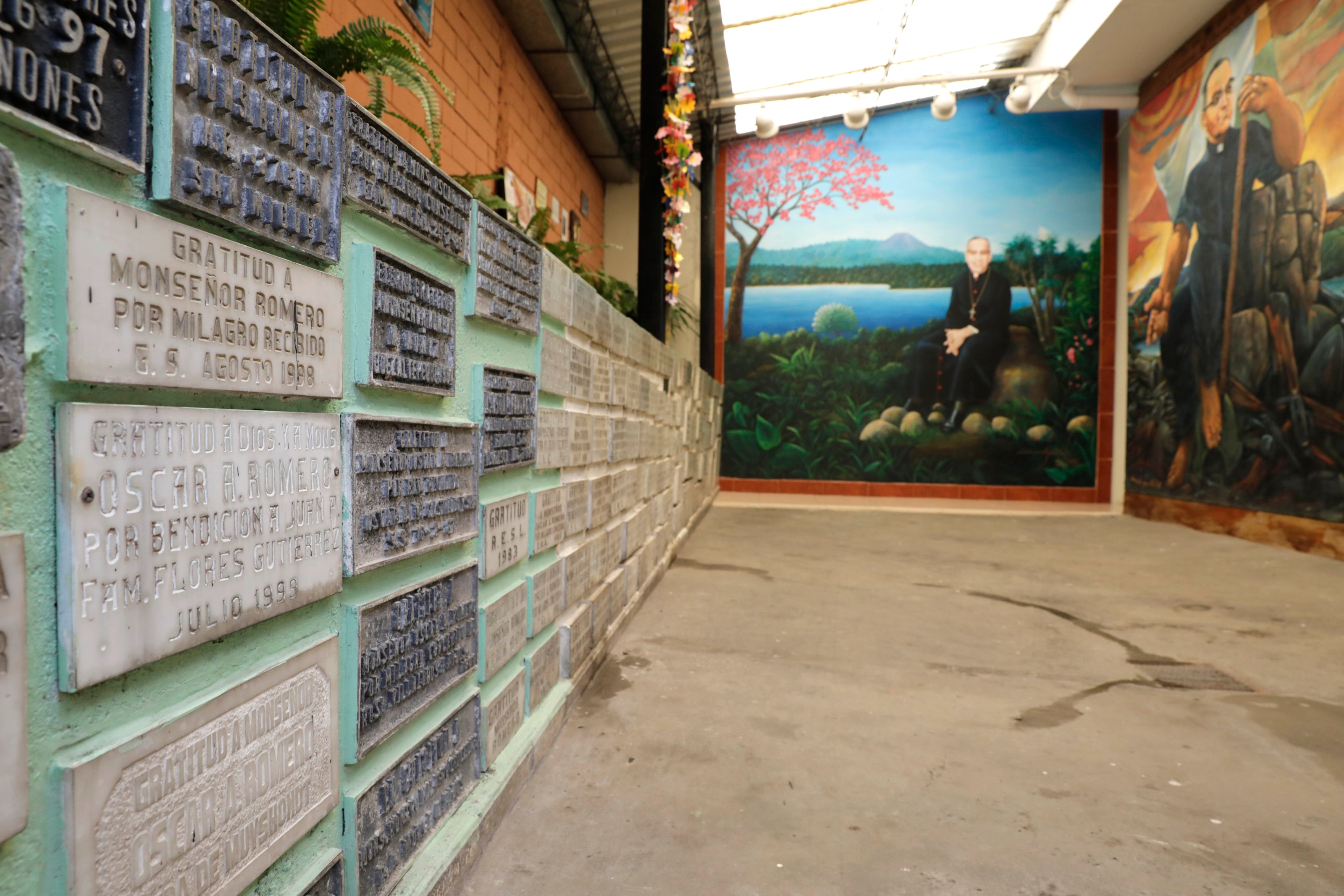
Thanksgiving plaques to Oscar Romero "por milagro recibido" (for a miracle received), photographed in San Salvador on 12 October 2018, two days before his canonization. Photo: Presidency of El Salvador, CC0, via Wikimedia Commons.
The 30-second version:
Cecilia Flores, a Salvadoran mother, developed HELLP syndrome after an emergency caesarean in 2015, with liver and kidney damage, internal bleeding and coma. Her doctor told her husband she would probably die. He prayed for Oscar Romero's intercession using a card found in his grandmother's Bible, she improved from that night, and she recovered fully. The Vatican's medical board found the recovery inexplicable in October 2017, and Pope Francis approved it as the miracle for Romero's canonization on 6 March 2018.
See this page's graph and discover linked topics
In full
Oscar Arnulfo Romero (1917 to 1980), Archbishop of San Salvador from 1977, was shot dead on 24 March 1980 while celebrating Mass in the chapel of the Divina Providencia hospital, the day after a homily in which he urged soldiers to stop the repression of the civilian population. He was beatified in San Salvador on 23 May 2015 as a martyr, a step that requires no miracle. Canonization does, and the Cecilia Flores case supplied it.
The Archdiocese of San Salvador forwarded the case to the Congregation for the Causes of Saints on 1 March 2017. According to the Salvadoran daily El Mundo, which reported the timeline when the case was made public, the Congregation's medical commission approved it on 26 October 2017, the council of theologians on 14 December 2017, and the cardinals and bishops on 6 February 2018. On 6 March 2018 Pope Francis authorized the Congregation to promulgate the decree on "the miracle, attributed to the intercession of Blessed Oscar Arnolfo Romero Galdámez, archbishop of San Salvador," and the Holy See Press Office published it on 7 March. Romero was canonized in St. Peter's Square on 14 October 2018, alongside Pope Paul VI.
Summary
Cecilia Maribel Flores, a married mother from El Salvador, was treated through the Salvadoran Social Security Institute for a third pregnancy already classed high-risk because of preeclampsia. In the late summer of 2015 she underwent an emergency caesarean section and was diagnosed with HELLP syndrome, with liver and kidney damage, internal hemorrhaging and coma. Doctors told her husband, Alejandro Rivas, that she was likely to die. He prayed for the intercession of Blessed Oscar Romero, she began to improve the same night, and she woke and recovered fully; America (March 2018) gives 10 September 2015 as the day she woke. The case was investigated by the Archdiocese of San Salvador and the Congregation for the Causes of Saints, and Pope Francis approved it as a miracle on 6 March 2018. It opened the way for Romero's canonization on 14 October 2018.
The event
- A high-risk pregnancy. Cecilia Flores was carrying her third child. The pregnancy had already been classified as high-risk because of preeclampsia (El Mundo, El Salvador).
- Emergency delivery and collapse. The baby was delivered by emergency caesarean section. She then developed HELLP syndrome, which the America report of March 2018 spells out as hemolysis, elevated liver enzymes and low platelet count. A doctor told her husband that her liver and a kidney were damaged; the Associated Press reported internal hemorrhaging and kidneys near failure, and that she was not expected to survive.
- The coma. She lapsed into a coma. El Mundo reports that doctors induced it to stabilize her lungs and kidneys.
- The doctor's words. As her husband recounted them to the AP: "If you believe in God or if you believe in anything, ask Him for your wife to be saved with a miracle."
- The prayer. Alejandro Rivas had resisted his late grandmother's devotion to Romero. He went home, opened the Bible she had given him, found a card bearing Romero's image, knelt, and prayed for Romero's intercession.
- The turn. According to the AP, her improvement began around 2:00 to 2:30 a.m., the hour at which he had prayed, and a nurse gave him the news. "It left me frozen. I didn't understand what was going on," he said.
- Recovery. She came out of the coma and made a full recovery. America's March 2018 report dates her waking to 10 September 2015.
- Recognition. The couple at first kept the healing private, then told their pastor, who gathered documentation. The Archdiocese of San Salvador sent the case to Rome on 1 March 2017, and the formal process ran from the medical commission (26 October 2017) to the papal decree (6 March 2018). Monsignor Rafael Urrutia of the archdiocese presented the case to the press, and the Salvadoran daily El Diario de Hoy published the account on 8 March 2018.
Witnesses + documentation
- Cecilia Maribel Flores, the healed woman, who has spoken publicly, including at the hospital chapel where Romero was killed, in October 2018.
- Alejandro Rivas, her husband, who prayed and who gave the account of the doctor's warning and the timing of the turn.
- The treating physicians and nursing staff of the Salvadoran Social Security Institute, whose records went to the Vatican; they are not named in published reports.
- The Archdiocese of San Salvador, which assembled the case, and Monsignor Rafael Urrutia, who presented it publicly.
- The Congregation for the Causes of Saints, whose medical commission, theologians and cardinals each approved the case.
- The Holy See Press Office, whose bulletin of 7 March 2018 records the decree.
Verification
What was checked:
- The official recognition. The Holy See Press Office bulletin of 7 March 2018 records that in an audience of 6 March 2018 Pope Francis authorized the decree on the miracle attributed to Blessed Oscar Romero.
- The stages of review. The dates of submission (1 March 2017), medical approval (26 October 2017), theological approval (14 December 2017) and cardinals' approval (6 February 2018) are reported by El Mundo of San Salvador.
- The diagnosis. HELLP syndrome after an emergency caesarean is reported consistently by America, the Associated Press, El Mundo and Avvenire.
- The outcome. Romero was canonized on 14 October 2018, and Cecilia Flores travelled to Rome for the ceremony.
Naturalistic explanations considered:
- Recovery under treatment. HELLP syndrome is treated by delivering the baby and by intensive supportive care, and many women recover. She was in intensive care, and some reports say she received dialysis. The case therefore rests on the severity of her condition, the doctors' expectation of death, the timing of the turn, and the completeness of recovery, all of which the medical commission weighed before calling it inexplicable.
- Coincidence. The improvement began the night of the prayer. Coincidence cannot be excluded in a single case; the case is offered as one strand in a cumulative argument.
Caveats and remaining uncertainties:
- The medical file is not public. No treating physician is named, and the Medical Council's report has not been published.
- Reports differ on details. America's March 2018 report places the start of the crisis in August 2015, and the Associated Press places the surgery in September 2015. Her reported age in 2018 varies between 35 and 36. Reports name her as Cecilia Flores, Maribel Flores and Cecilia Flores de Rivas.
- The account comes mainly through Catholic and Salvadoran sources, though the decree and canonization were reported internationally by the Associated Press and ANSA.
- No skeptical analysis was found. A search turned up no published critique of this case.
Apologetic value
- A doctor's verdict and a dated turn. The physician's warning that she would likely die, the prayer that night and improvement from the same hours give the case a clear before and after.
- Professional review. The finding came from a medical commission reviewing hospital records, followed by two further levels of review.
- A husband's prayer. The scene fits the promise that "the prayer of faith shall save him that is sick" (James 5:15, ASV). The healing is God's; the recognition attributes it to Romero's intercession, which Protestant readers will read differently.
- Honest limits. HELLP syndrome can resolve with treatment, and the records are not public. Deploy it as one strand in a cumulative case. See Argument from Miracles.
- How to deploy it. Lead with the doctor's expectation of death, concede that intensive treatment was under way, and press the timing and completeness of the recovery.
See also
- Miracles, master hub
- _schema, the vetting standard this entry follows
- Candela Giarda (John Paul I 2011), another Latin American recovery from a near-death intensive-care picture approved after formal review
- Valeria Valverde (Carlo Acutis 2022), another recent canonization miracle
- Monica Besra (Mother Teresa 1998), another case in which a twentieth-century figure's cause rested on one healing
- Argument from Miracles, the argument this case supports
- David Hume, whose standard for credible miracle testimony this case presses on
- Naturalism, the worldview such cases press against
Common questions this page answers
Q: What was the miracle for Oscar Romero's canonization?
It was the healing of Cecilia Maribel Flores, a Salvadoran mother who developed HELLP syndrome after an emergency caesarean in 2015 and fell into a coma with liver and kidney damage. Her husband prayed for Romero's intercession, she improved that night, and she recovered fully. Pope Francis approved the miracle on 6 March 2018.
Q: Who is Cecilia Flores?
She is the Salvadoran woman whose 2015 recovery from HELLP syndrome and coma was recognized as the miracle for the canonization of Saint Oscar Romero. Her husband is Alejandro Rivas, and she attended the canonization in Rome in October 2018.
Q: When was Oscar Romero made a saint?
Pope Francis canonized Oscar Romero in St. Peter's Square on 14 October 2018, together with Pope Paul VI. Romero had been beatified as a martyr in San Salvador on 23 May 2015.
Q: Did doctors confirm the Romero miracle?
The medical commission of the Vatican's Congregation for the Causes of Saints reviewed the case and approved it on 26 October 2017, finding no scientific explanation for the recovery. The hospital records are not public, and no treating physician is named in published reports.
Q: What is HELLP syndrome?
HELLP syndrome is a severe complication of pregnancy, usually linked to preeclampsia, named for hemolysis (destruction of red blood cells), elevated liver enzymes and a low platelet count. It can cause liver and kidney failure and bleeding, and it is life-threatening for the mother.