Concept
Categorical Propositions and the Square of Opposition
Square of Opposition, Traditional Square of Opposition, Categorical Propositions, AEIO Propositions, A E I O, Contradictories and Contraries, Existential Import, Modern Square of Opposition, Boolean Square of Opposition, Subalternation, SubcontrariesIntro
A lot of arguments are about groups. All Christians, no scientists, some religions, some miracle claims. A sentence that says how one group relates to another is called a categorical proposition, and there are only four basic kinds.
- A: All S are P. All dogs are mammals.
- E: No S are P. No dogs are reptiles.
- I: Some S are P. Some dogs are brown.
- O: Some S are not P. Some dogs are not brown.
The letters come from the Latin words AffIrmo (I affirm) and nEgO (I deny). A and I say yes. E and O say no.
These four sentences stand in fixed relationships to each other. Aristotle worked them out, and later teachers drew them as a square. The square tells you, at a glance, which claims can both be true, which can both be false, and which cancel each other out.
Why this matters in a debate:
- One example can sink an "all" claim. If someone says all religions teach the same thing, a single clear case where two religions disagree refutes it.
- "Some" does not prove "all." Some Christians being hypocrites does not show all Christians are hypocrites.
- "Either all or none" is usually a trap. Either every religion is true or every religion is false leaves out the obvious third option: some are true and some are false.
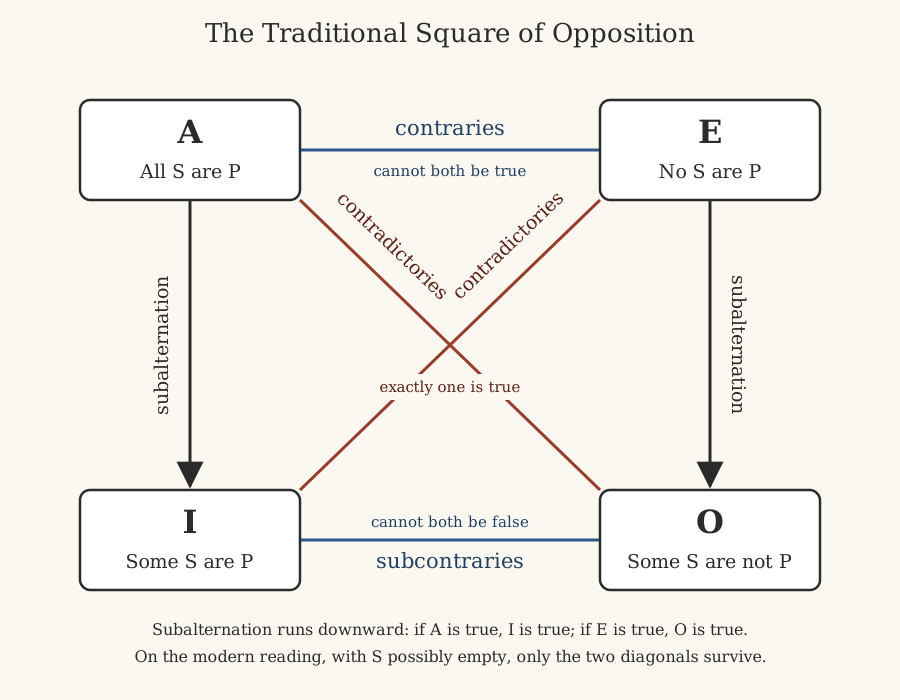
The traditional square of opposition. The diagonals join statements that cannot both be true and cannot both be false. Diagram drawn for the codex.
The 30-second version. Every claim about groups comes in one of four shapes: all, none, some are, some are not. "All" and "some are not" contradict each other, so exactly one is true. "None" and "some are" contradict each other the same way. That is why one counterexample refutes a universal claim, why "some" never proves "all," and why "either all or none" is usually a false choice.
See this page's graph and discover linked topics
In full
A categorical proposition relates two classes, a subject term (S) and a predicate term (P), by affirming or denying that the subject class is wholly or partly included in the predicate class. Traditional logic recognizes four standard forms, distinguished by quality (affirmative or negative) and quantity (universal or particular).
| Form | Standard wording | Quality | Quantity | Predicate-logic rendering |
|---|---|---|---|---|
| A | All S are P | affirmative | universal | ∀x(Sx → Px) |
| E | No S are P | negative | universal | ∀x(Sx → ¬Px) |
| I | Some S are P | affirmative | particular | ∃x(Sx ∧ Px) |
| O | Some S are not P | negative | particular | ∃x(Sx ∧ ¬Px) |
Read the symbols this way: ∀x is "for every x," ∃x is "there is at least one x," → is "if... then," ∧ is "and," and ¬ is "not." So the A form says for every x, if x is an S then x is a P, and the O form says there is at least one x that is an S and is not a P.
The square of opposition arranges the four forms so that each edge and diagonal names a logical relation. The doctrine begins in Aristotle's De Interpretatione 6-7, which states that A and O are contradictories, E and I are contradictories, and A and E are contraries (17b17-26 in the standard Bekker numbering, as cited by the Stanford Encyclopedia entry). The remaining relations were drawn out by later logicians, and the square as a diagram became standard in medieval logic teaching.
The four relations
1. Contradictories (A and O, E and I)
- Rule: exactly one is true and the other false. They cannot both be true, and they cannot both be false.
- All Christians are hypocrites (A) versus Some Christians are not hypocrites (O).
- No one has ever risen from the dead (E) versus Someone has risen from the dead (I).
- Why it matters: to refute a universal, you only need its contradictory. You never have to prove the opposite universal.
2. Contraries (A and E)
- Rule (traditional reading): they cannot both be true, but they can both be false.
- All religions are true (A) versus No religions are true (E). Both are false if some religions are true and others are not.
- Why it matters: an opponent who offers you only the two contraries has handed you a False Dilemma. The live option is in the middle.
3. Subcontraries (I and O)
- Rule (traditional reading): they cannot both be false, but they can both be true.
- Some miracle claims are fraudulent (I) and Some miracle claims are not fraudulent (O). Both can be true at once.
- Why it matters: granting the I form costs you nothing about the O form. Conceding that some claims are false is fully compatible with holding that others are true.
4. Subalternation (A to I, E to O)
- Rule (traditional reading): truth flows down, falsity flows up.
- If A is true, I is true. If E is true, O is true.
- If I is false, A is false. If O is false, E is false.
- Nothing follows in the other direction. A true I does not give you a true A. A false A does not give you a false I.
- Why it matters: this is the formal reason "some" never proves "all." Moving from I to A is the logical shape of a hasty generalization.
Summary table
| Pair | Relation | Both true? | Both false? |
|---|---|---|---|
| A and O | contradictories | no | no |
| E and I | contradictories | no | no |
| A and E | contraries | no | yes |
| I and O | subcontraries | yes | no |
| A to I, E to O | subalternation | truth passes down | falsity passes up |
The existential-import problem
The traditional square quietly assumes that the subject class has members. Modern logic does not make that assumption, and the difference changes the square.
- The modern (Boolean) reading. On the predicate-logic renderings above, the universals A and E carry no existential import.
∀x(Sx → Px)is true when there are no S at all, because the conditional is then never false. The particulars I and O do carry import, because∃xasserts that at least one S exists. - What breaks. Suppose S is an empty class, such as unicorns.
- A (All unicorns are white) and E (No unicorns are white) are both true, so they are no longer contraries.
- I (Some unicorns are white) and O (Some unicorns are not white) are both false, so they are no longer subcontraries.
- A is true while I is false, so subalternation fails.
- What survives. Only the two diagonals. A and O remain contradictories, and E and I remain contradictories, whether or not anything falls under S.
- The textbook treatment. Copi's Introduction to Logic calls this the Boolean interpretation and names the error of inferring a particular from a universal without an existence premise the existential fallacy. Hurley's A Concise Introduction to Logic sets the same contrast as the Aristotelian standpoint (subject assumed to exist, full square valid) versus the Boolean standpoint (no such assumption, only contradictories valid).
- A historical wrinkle. Terence Parsons and Graziana Ciola, in the Stanford Encyclopedia entry "The Traditional Square of Opposition," point out that Aristotle worded the O form as Not every S is P. On their reading, the traditional view gives affirmatives existential import and negatives none, so the O form is true when S is empty, and the full square stays coherent even with empty terms. They also report that by the end of the fourteenth century there was a common understanding among logicians that negative propositions lack existential import.
The practical upshot. When everyone in the conversation agrees the subject class has members (Christians, religions, historians, miracle reports), the full traditional square applies. When the existence of the subject is the very thing in dispute (gods, souls, the multiverse, other worlds), lean only on the contradictories, which hold under either reading.
Apologetic use: getting the quantifier right
Most bad inferences about groups are quantifier errors. Name the form, and the error usually names itself.
1. "Some" does not yield "all"
- The move: "Some Christians are hypocrites" (I), therefore "Christianity produces hypocrites" or "Christians are hypocrites," spoken as if it meant all of them (A).
- The diagnosis: I does not entail A. Subalternation runs only downward.
- The reply: "Agreed, some are. Some members of every group are. Your conclusion needs all, and you have shown some."
- Related: the same shape shows up when properties of some members are pinned on the whole group. See Composition and Division.
2. One counterexample refutes a universal
- The move: a sweeping A or E claim.
- All religions are basically the same (A).
- No one can know that God exists (E).
- Every argument for God has been refuted (A).
- The diagnosis: to defeat an A, establish its O. To defeat an E, establish its I.
- The reply:
- All religions are the same. Christianity teaches that Jesus died by crucifixion and rose again (1 Corinthians 15:3-4). The Quran states that he was not crucified (Quran 4:157). At least one pair of religions does not teach the same thing, so the A is false.
- No one can know God exists. The claim is itself a piece of claimed knowledge about every possible knower, which is a heavy burden to carry. One well-grounded case of knowledge falsifies it. See Self-refutation and Burden of Proof.
- Tactical line: "You made an all claim. I only need one some not."
3. Denying an "all" gives you "not all," and nothing stronger
- The move: "It is false that all miracle reports are reliable" (denying A), therefore "No miracle reports are reliable" (E).
- The diagnosis: the contradictory of A is O, Some miracle reports are not reliable. That is compatible with others being reliable. Jumping from not-A to E treats contraries as if they were contradictories.
4. "Some are" does not strictly mean "some are not"
- In ordinary speech, "some Christians are kind" hints that not all are. That hint is a conversational implication, which logic does not guarantee. I and O can both be true, and I can be true while O is false.
- Use it both ways. Do not let an opponent turn your concession "some X are Y" into an admission that "some X are not Y." And do not claim more than the I form for yourself.
5. Contradictories versus contraries in "either-or" claims
- A genuine disjunction: Either God exists or God does not exist. This pairs a claim with its contradictory, so exactly one is true. The Law of Non-Contradiction rules out both, and the law of excluded middle rules out neither. This is no False Dilemma.
- A false dilemma built on contraries: Either every religion is true or every religion is false. A and E can both be false. The middle option, that some religious claims are true and others false, is exactly the Christian position on exclusive truth.
- A quick test: ask whether the two options could both be false. If yes, they are contraries and a third option exists. If no, they are contradictories and the disjunction stands.
6. Unquantified claims: ask "all or some?"
- Slogans hide their quantifier. "Religion causes violence." "Scientists reject God." "Christians are anti-science."
- The question: "Do you mean all, or some?"
- If all, one counterexample refutes it.
- If some, the claim is true of nearly every large group and proves nothing about the truth of the belief.
How this connects to the rest of logic
- Categorical propositions are the building blocks of the classical syllogism, the core of Deductive Reasoning for two thousand years.
- Their predicate-logic renderings are what modern rules such as Modus Ponens operate on once the quantifiers are removed by instantiation.
- The contradictory relation is the Law of Non-Contradiction applied to quantified claims, which is why it is the one relation every reading of the square keeps. See also Laws of Logic.
- A Reductio ad Absurdum against a universal often works by deriving its contradictory particular from the opponent's own commitments.
See also
- Logic, the parent hub for the codex's logic pages
- Deductive Reasoning, where categorical propositions combine into syllogisms
- Aristotle, who first stated the core relations in De Interpretatione
- False Dilemma, the fallacy of offering two contraries as if they were the only options
- Composition and Division, a cousin error about parts and wholes
- Law of Non-Contradiction, the principle behind the contradictory relation
- Laws of Logic, the classical laws the square presupposes
- Modus Ponens, the basic rule of inference
- Reductio ad Absurdum, the method that often refutes universals
- Self-refutation, for universal claims that undercut themselves
- Debate Logic Toolkit, quick-reference tools for live exchanges
Common questions this page answers
Q: What are the four types of categorical propositions?
They are A (All S are P), E (No S are P), I (Some S are P) and O (Some S are not P). A and E are universal, I and O are particular. A and I are affirmative, E and O are negative.
Q: What is the square of opposition in logic?
It is a diagram that places the four categorical forms at the corners of a square to show how they relate. The diagonals are contradictories (exactly one true), the top edge joins contraries (cannot both be true), the bottom edge joins subcontraries (cannot both be false), and the sides show subalternation (truth passes from the universal down to the particular).
Q: What is the difference between contradictory and contrary statements?
Contradictory statements cannot both be true and cannot both be false, so exactly one of them is true. Contrary statements cannot both be true, but they can both be false. "All religions are true" and "No religions are true" are contraries, since both are false if some are true and some are not.
Q: How many counterexamples does it take to refute a universal claim?
One. A universal affirmative (All S are P) is refuted by its contradictory, Some S are not P, which needs only a single clear case. A universal negative (No S are P) is refuted by Some S are P, which also needs only one case.
Q: What is existential import and why does it matter for the square of opposition?
A statement has existential import if it asserts that its subject class has members. On the modern Boolean reading, "All S are P" does not assert that any S exist, while "Some S are P" does. If S is empty, contrariety, subcontrariety and subalternation all fail, and only the two contradictory pairs survive. Copi and Hurley both teach this as the modern square.
Q: Is "either God exists or God does not exist" a false dilemma?
No. The two options are contradictories, so exactly one of them must be true. A false dilemma offers two options that could both be false, such as "either every religion is true or every religion is false."
Q: Does "some Christians are hypocrites" prove that Christianity is false?
No. It is an I-form claim, and I does not entail the universal A-form "all Christians are hypocrites." Even if it did, the behavior of believers is a separate question from whether the beliefs are true.