Concept
Catastrophic Plate Tectonics
CPT, Runaway Subduction, Runaway Subduction Model, Catastrophic Plate Tectonics Model, Flood Plate Tectonics, Post-Flood UpliftIntro
Catastrophic plate tectonics, or CPT, is the leading young-earth model for how the Earth's surface was reshaped during Noah's Flood. It accepts that the continents and ocean floors sit on moving plates, as all geologists do. Its claim is about speed: the plates moved very fast for about one year, during the Flood, and have crept along slowly ever since.
On this model, old ocean floor broke loose along the edges of the pre-Flood continents and sank into the mantle. Hot rock rose to take its place and formed new, raised ocean floor, which pushed the sea up over the land. When the new floor cooled, the ocean basins sank and the water drained off the continents. Mountains such as the Himalayas were pushed up as the plates collided and settled, which is how flood geologists explain sea fossils near mountain summits.
CPT is the main answer to the hardest question flood geology faces: how mountains could rise so far, so quickly, after the Flood. It is also the part of the young-earth case that critics, including some Christian geologists, press hardest.
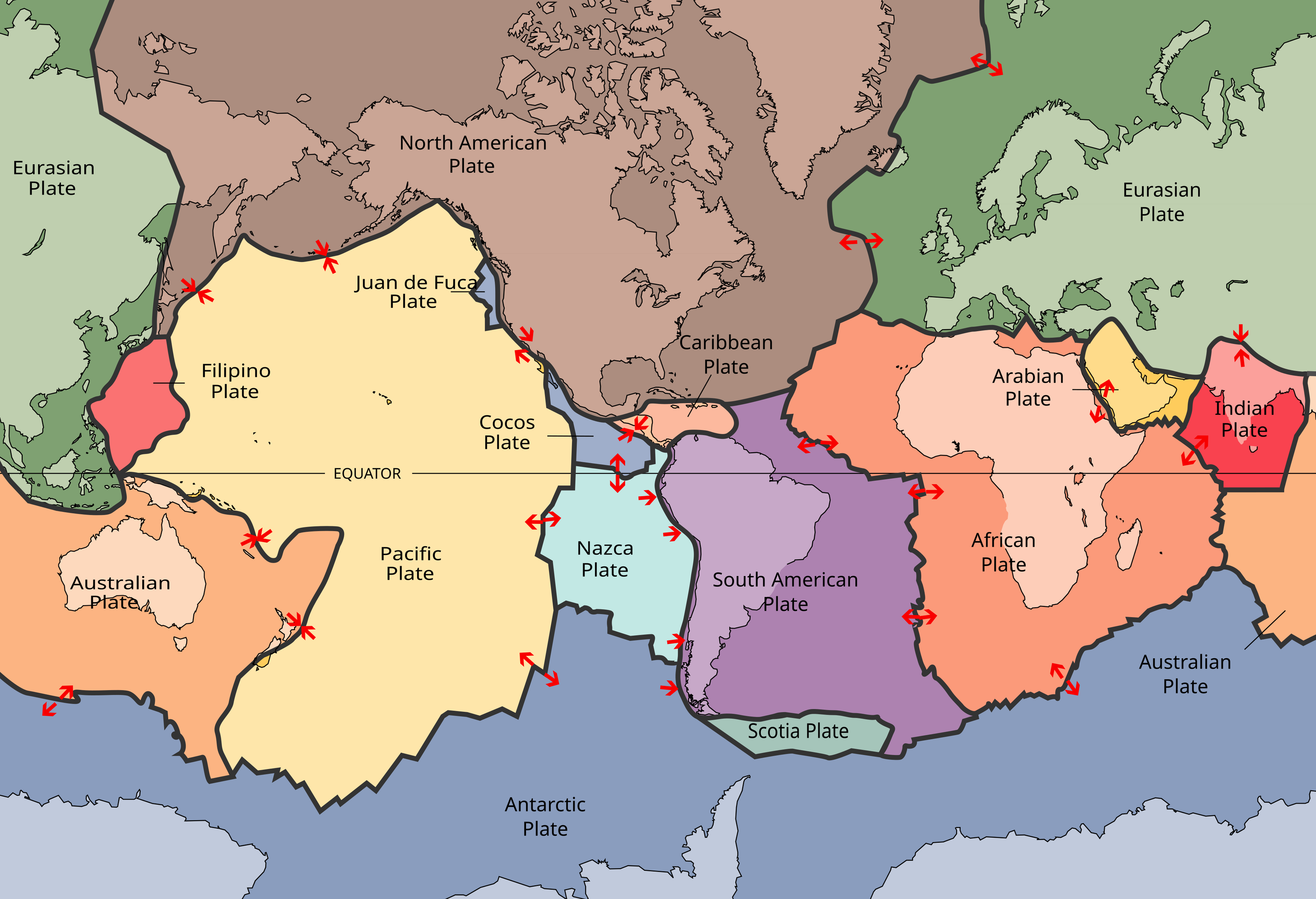 The Earth's principal tectonic plates. Mainstream geology and catastrophic plate tectonics map the same plates and boundaries; they disagree about how fast the plates once moved. Map by the U.S. Geological Survey, public domain (Wikimedia Commons).

See this page's graph and discover linked topics
In full
Catastrophic plate tectonics was set out as a whole-Earth Flood model by Steven Austin, John Baumgardner, Russell Humphreys, Andrew Snelling, Larry Vardiman and Kurt Wise, "Catastrophic Plate Tectonics: A Global Flood Model of Earth History," Proceedings of the Third International Conference on Creationism (Pittsburgh, 1994), pp. 609-621. Its physics rests on the three-dimensional mantle-convection modeling of John Baumgardner, a geophysicist who developed the TERRA mantle-convection code at Los Alamos National Laboratory, a code also used in mainstream research.
The core mechanism is runaway subduction. Cold ocean lithosphere is denser than the warmer mantle beneath it, so it tends to sink. In ordinary conditions the mantle is stiff enough that it sinks a few centimeters a year. Baumgardner's models propose that silicate rock weakens sharply when it is stressed and heated, so that a sinking slab softens the mantle around it, which lets it sink faster, which softens the mantle further. The authors describe the result as "meters-per-second mantle convection" for a short episode, after which the process runs down as the old ocean floor is used up.
The model ties a chain of Flood-year events to that one mechanism:
- Breakup. Ocean slabs break loose along the pre-Flood continental margins and plunge into the mantle.
- Rifting and new sea floor. Along spreading ridges, hot mantle wells up and forms new ocean floor. Flood geologists connect this with "the fountains of the great deep" being "broken up" (Genesis 7:11).
- Continents flooded. New ocean floor is hot and buoyant, so it stands higher than old floor. Sea level rises, and the ocean spills across the continents, laying down sediment.
- Magnetic reversals. The 1994 paper proposes that cold slabs reaching the core disturbed it enough to produce rapid reversals of the Earth's magnetic field, which would be recorded in the new ocean floor as it formed.
- Basins sink, waters drain. As the new ocean floor cools it grows denser and sinks, deepening the basins that hold today's oceans, and the water runs off the land.
- Collision and uplift. Continents driven together late in the Flood and in the years after it pile up mountain belts. A long period of settling follows, with earthquakes, volcanism and rapid sedimentation in continental basins.
- A warm ocean and an ice age. The heat left in the oceans drives heavy evaporation and snowfall, which young-earth writers connect with a single post-Flood ice age.
The model is a minority view in geology; no mainstream geological society accepts it. Inside young-earth creationism it is the most widely adopted Flood model, though it has a rival in Walt Brown's hydroplate theory, and the two cannot both be right.
Why it matters to the Flood case
The Marine Fossils on Mountains Argument and the wider Global Flood Evidence case need mountains to rise after the sea creatures in their rocks were buried. Mainstream geology spreads that uplift over tens of millions of years. A young-earth reading has a few thousand years at most, and most of the work has to happen in and soon after the Flood. CPT is the proposal that supplies a mechanism. If it holds, the uplift problem is answered; if it fails, flood geology needs another mechanism for the same job. The Marine Fossils on Mountains Argument states plainly that this is the weakest link in the case, and this page sets out both sides of it.
Scripture is read as consistent with fast uplift. Psalm 104:6-9 pictures the waters standing above the mountains and then fleeing at God's rebuke; the ASV and WEB render verse 8 with the land as subject:
(The mountains rose, the valleys sank down) Unto the place which thou hadst founded for them. (Psalm 104:8, ASV)
The KJV and YLT make the waters the subject instead, and many readers place verses 6-9 at creation's third day rather than the Flood, so the verse fits CPT without proving it. The passage page sets out the readings.
The case its proponents make
- The plates are real, and so is the motion. CPT keeps all the evidence that plate tectonics happened: matching coastlines, the spreading ridges, the subduction zones, the age pattern of the sea floor. It disputes only the rate. A young-earth geologist can therefore use the standard map of the plates without reserve.
- The physics is modeled, not hand-waved. Runaway subduction comes out of numerical modeling by a geophysicist whose code is used in mainstream mantle research. Its proponents say the weakening of hot, stressed silicate rock that the model relies on is a property of real rock, measured in the laboratory.
- Cold slabs deep in the mantle. Seismic tomography shows cold, dense material near the base of the mantle in a belt around the Pacific. Baumgardner and the Institute for Creation Research argue that slabs that cold, that deep, fit a recent, rapid descent better than a slow one, since slow slabs would have had longer to warm.
- Rapid magnetic reversals. Mainstream paleomagnetists Robert Coe, Michel Prévot and Pierre Camps reported lava flows at Steens Mountain, Oregon, recording what they called extraordinarily rapid change of the magnetic field during a reversal (Nature 374, 1995). Humphreys had predicted rapid reversals from a young-earth model. Proponents count the find as a successful prediction.
- One cause for many effects. A single episode explains continental flooding, worldwide sediment sheets, rapid uplift, and a post-Flood ice age together. Proponents argue that this economy is a mark of a good model.
Objections and replies
-
"Plate motion today is measured in centimeters a year."
- The objection: GPS measurements show plates moving at roughly the speed fingernails grow. Nothing like meters per second is observed.
- The reply: CPT predicts exactly that today. Runaway subduction ends when the old, cold ocean floor has been consumed; what remains is the slow residual motion now measured. The question is whether the past was ever faster, which present rates cannot settle by themselves.
-
"The heat would have boiled the oceans." This is the most serious objection, and young-earth physicists raised it first.
- The objection: sinking slabs release their gravitational energy as heat. Baumgardner himself calculated roughly 10^28 joules, which "if released near the earth's surface, this amount of energy is sufficient to melt a layer of silicate rock 12 km thick" (Baumgardner, 1990, quoted by Glenn Morton and George Murphy, Reports of the National Center for Science Education 24.1, 2004). Morton and Murphy also argue that the cooling mechanism Russell Humphreys proposed for young-earth heat problems fails.
- The reply: most of that heat is released deep in the mantle, near the sinking slabs, and the model does not require it to reach the surface during the Flood year. Proponents treat the heat left in the oceans as a feature, the source of the warm post-Flood seas that drove the ice age. They concede that the full heat budget is an open research problem.
-
"Hot-spot island chains record slow motion."
- The objection: the Hawaiian-Emperor chain formed as the Pacific plate moved over a fixed hot spot, and its islands grow steadily older and more eroded with distance. Flat-topped seamounts (guyots) were eroded at sea level and then sank, which takes time. The sea floor also deepens smoothly with age, as slow cooling predicts (TalkOrigins Archive, claim CD750).
- The reply: young-earth geologists read the island ages through their critique of radiometric dating, and argue that a sequence of volcanoes over a hot spot records the order of events, which CPT also produces, while the elapsed time depends on the dating assumptions. The subsidence pattern follows from cooling, and CPT has the new ocean floor cooling too, on a compressed schedule whose heat it must then account for, which returns the dispute to objection 2.
-
"Continental collisions are not explained."
- The objection: runaway subduction of ocean floor does not by itself explain a collision between two continents, such as India and Asia, which built the Himalayas.
- The reply: in CPT the continents are carried by the same fast-moving plates, and the collision follows once the ocean floor between them has been consumed. Proponents place the main Himalayan uplift late in the Flood and in its aftermath, and point to the marine limestone at Everest's summit as evidence that the range rose after its sea-floor sediments were laid down.
-
"The magnetic stripes need long ages."
- The objection: the sea floor carries many reversal stripes, and the Steens Mountain result has been questioned by other paleomagnetists, who attribute it to later remagnetization of the lava.
- The reply: rapid reversals are a stated prediction of the model, and the Steens Mountain data are published in a mainstream journal by scientists with no young-earth commitment. The dispute over remagnetization is an open one.
-
"Other Christians reject it."
- The objection: old-earth Christian geologists, among them Davis A. Young and Ralph Stearley (The Bible, Rocks and Time, 2008), argue that ordinary plate tectonics explains the data and that Genesis does not require a global, geology-shaping Flood.
- The reply: the disagreement is an in-house one about the extent of the Flood and the age of the earth. Young-earth geologists answer it on Old Earth Creationism and 20 Arguments for Old Earth; the Flood itself is affirmed by both sides (see Genesis Flood).
How to use it in conversation
- State the dispute accurately. CPT accepts plate tectonics; the dispute is over speed and timing.
- Name the weak point yourself. The heat budget is the open problem. Saying so first protects credibility and keeps the conversation on the evidence.
- Keep it in proportion. The case for God and for the resurrection does not depend on any Flood mechanism. CPT is one model of how the Flood worked; the Genesis Flood can be affirmed by Christians who hold other models, or who read it as regional.
Scholarship
Published academic works this page draws on, each matched to a publisher, index or library catalog record.
- R. S. Coe, M. Prévot and P. Camps, "New evidence for extraordinarily rapid change of the geomagnetic field during a reversal," Nature 374 (1995). doi:10.1038/374687a0
- Davis A. Young, The Bible, rocks, and time (2008). Open Library
See also
- Flood Geology, the wider young-earth reading of the rock record, of which CPT is the main tectonic model
- Marine Fossils on Mountains Argument, the argument that needs rapid post-Flood uplift
- Global Flood Evidence, the cumulative young-earth case for a worldwide Flood
- Genesis Flood, the study guide for every Flood page in the codex
- Grand Canyon Formation, the other main test case for rapid Flood-year geology
- Folded Strata Without Fracturing Argument, rock layers bent while still soft, read as rapid deformation
- Steven A. Austin, lead author of the 1994 CPT paper
- Andrew Snelling, co-author of the 1994 CPT paper
- Young Earth Creationism, the position CPT serves
- Old Earth Creationism, the main Christian alternative
Common questions this page answers
Q: What is catastrophic plate tectonics?
It is the young-earth model in which the Earth's plates moved very fast for about a year during Noah's Flood, driven by "runaway subduction" of old ocean floor into the mantle, and have moved slowly ever since. It was set out in a 1994 paper by Steven Austin, John Baumgardner, Russell Humphreys, Andrew Snelling, Larry Vardiman and Kurt Wise.
Q: Do young-earth creationists believe in plate tectonics?
Most do. Catastrophic plate tectonics accepts that the continents and sea floor ride on moving plates and keeps the standard map of plate boundaries. It disagrees with mainstream geology about how fast the plates once moved, placing most of the motion in the Flood year.
Q: How could mountains rise so fast after the Flood?
On the catastrophic plate tectonics model, continents carried on fast-moving plates collided late in the Flood and in the years after it, piling up mountain belts such as the Himalayas. That would explain why sea-floor sediments with marine fossils now sit near mountain summits. The model's proponents concede the heat such rapid motion would release is still an open problem.
Q: What is the biggest objection to catastrophic plate tectonics?
Heat. Sinking that much rock that quickly releases enormous energy; Baumgardner's own calculation was enough to melt a layer of rock 12 km thick if released near the surface. Proponents reply that most of it is released deep in the mantle, and that what reached the oceans explains a warm post-Flood sea and the ice age, while granting that the full heat budget needs more work.
Q: Is catastrophic plate tectonics the only young-earth Flood model?
No. Walt Brown's hydroplate theory is the main rival, proposing that pressurized water beneath the crust burst out at the Flood's start. The two models are incompatible, and young-earth geologists debate between them.