Person
Caiaphas
Joseph Caiaphas, Joseph called Caiaphas, Yehosef bar Qayafa, Caiaphas the high priest, KayafaIntro
Caiaphas was the high priest in Jerusalem who presided over the council that condemned Jesus and handed him to Pontius Pilate. He held the office for about eighteen years, from around AD 18 to 36 or 37, longer than any other high priest under Roman rule. He was the son-in-law of Annas, the former high priest whose family dominated the priesthood.
The Jewish historian Josephus names him "Joseph, who was also called Caiaphas," and records both his appointment and his removal. In 1990 a family tomb in Jerusalem yielded an ornate bone box inscribed "Joseph son of Caiaphas," which many scholars identify as his.
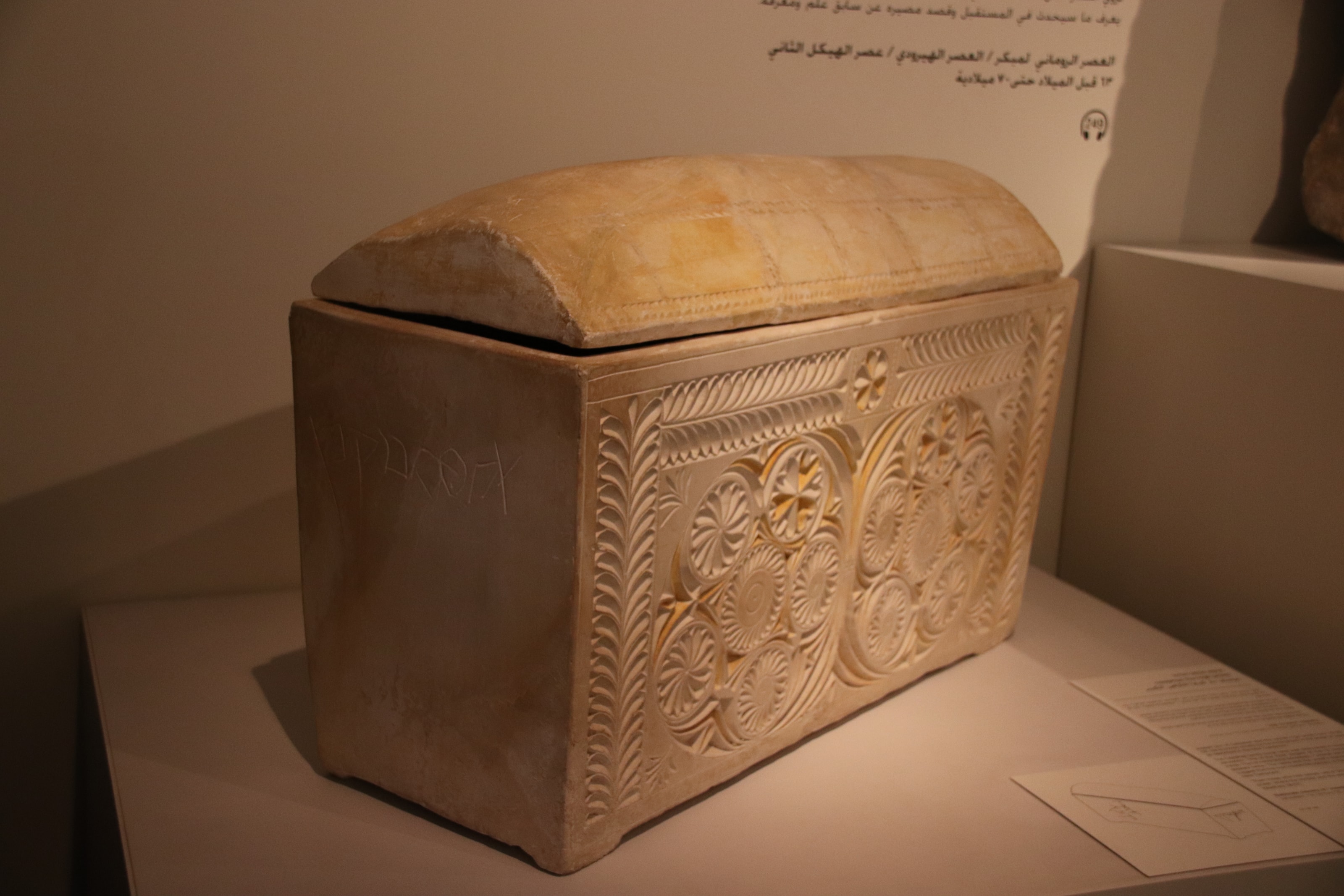
The ornate ossuary inscribed "Joseph son of Caiaphas," limestone, 1st century AD, found in Jerusalem's Peace Forest in 1990, now in the Israel Museum, Jerusalem. Image: CC0, via Wikimedia Commons.
The 30-second version:
Caiaphas was the high priest who led the case against Jesus. In John's Gospel he argues that "it is expedient for you that one man should die for the people," and at the trial he tears his robes and declares Jesus guilty of blasphemy. Josephus confirms that the Roman prefect Valerius Gratus appointed Joseph Caiaphas high priest and that the legate Vitellius removed him around AD 36 or 37. A family ossuary inscribed "Joseph son of Caiaphas" may hold his bones.
See this page's graph and discover linked topics
In full
Joseph Caiaphas (Greek Kaiaphas; Aramaic perhaps Qayafa) was appointed high priest by Valerius Gratus, prefect of Judea, around AD 18, after Gratus had deposed three high priests in quick succession (Jewish Antiquities 18.35). He served through the whole prefecture of Pontius Pilate (AD 26-36) and was removed by Lucius Vitellius, legate of Syria, around AD 36-37, shortly after Pilate was sent to Rome (Ant. 18.95). His long tenure suggests effective cooperation with the Roman administration. In the Gospels he convenes the council that plots Jesus' death (Matthew 26:3-5; John 11:47-53), presides at the night hearing (Matthew 26:57-66) and hands Jesus to Pilate; in Acts he sits with Annas when Peter and John are examined (Acts 4:6). His existence is secure from Josephus; the identification of the 1990 ossuary with him is widely accepted but debated.
In the Bible
- The plot (Matthew 26:3-5; John 11:47-53). The chief priests and elders gather "unto the court of the high priest, who was called Caiaphas" (Matthew 26:3, ASV). In John, after the raising of Lazarus, Caiaphas tells the council, "Ye know nothing at all, nor do ye take account that it is expedient for you that one man should die for the people, and that the whole nation perish not" (John 11:49-50, ASV). John comments that "being high priest that year, he prophesied that Jesus should die for the nation" (John 11:51, ASV).
- The trial (Matthew 26:57-68; Mark 14:53-65; John 18:24, 28). Jesus is brought to Caiaphas' house. When Jesus speaks of the Son of man "sitting at the right hand of Power," the high priest "rent his garments, saying, He hath spoken blasphemy" (Matthew 26:64-65, ASV). Mark and Luke call him only "the high priest"; Matthew and John name him.
- Luke 3:2. The dating of John the Baptist's ministry "in the high-priesthood of Annas and Caiaphas."
- Acts 4:6. Caiaphas is present with Annas at the hearing of Peter and John.
Family and lineage
- Father-in-law. Annas son of Seth, high priest AD 6-15 (John 18:13). See Annas.
- Brothers-in-law. Five sons of Annas served as high priest, including Jonathan, who succeeded Caiaphas in AD 36-37.
- Family name. "Caiaphas" appears to be a family or nickname; Josephus' phrase "Joseph, who was also called Caiaphas" shows Joseph was his personal name.
- Descendants. The 1990 tomb held a second ossuary inscribed Qafa. An unprovenanced ossuary published in 2011 by Boaz Zissu and Yuval Goren names "Miriam daughter of Yeshua son of Caiaphas, priests of Maaziah from Beth Imri," which, if genuine, shows a Caiaphas family belonged to the priestly course of Maaziah.
Historical and archaeological evidence
Josephus
- Appointment. Gratus deposed Ananus, then Ismael, Eleazar and Simon; "And when he had possessed that dignity no longer than a year, Joseph Caiaphas was made his successor" (Antiquities 18.35, Whiston).
- Removal. At Passover around AD 36-37, Vitellius "deprived Joseph, who was also called Caiaphas, of the High Priesthood; and appointed Jonathan, the son of Ananus, the former High Priest, to succeed him" (Ant. 18.95, Whiston).
What it confirms. Name, nickname, office, dates, his place in Annas' family network and his survival through Pilate's prefecture.
The Caiaphas Ossuary (1990)
Twelve ossuaries were found in a burial cave in the Peace Forest, North Talpiot, Jerusalem, and published by Zvi Greenhut and Ronny Reich in Atiqot 21 (1992). The most ornate is inscribed twice, read as Yehosef bar Qayafa and Yehosef bar Qafa, "Joseph son of Caiaphas," and held the bones of six people including a man of about sixty. It is now in the Israel Museum.
- For the identification. The name pair matches Josephus exactly; the family name is rare; the tomb is wealthy and of the right period; the ornate box suits a high priest.
- For caution. "Son of Caiaphas" is not the same as "called Caiaphas"; William Horbury (Palestine Exploration Quarterly, 1994) questioned whether the reading and the link to the high priest are as secure as first reported; neither inscription carries a priestly title; and the inscriptions are informal scratches. A coin of Herod Agrippa I found in one skull in the cave dates its use into the AD 40s.
- Mykytiuk's grade. He counts Caiaphas as confirmed on the strength of Josephus and grades the ossuary identification possible but inconclusive.
The full case on both sides is on the Caiaphas Ossuary page.
Grade. Very strong for the person (Josephus). The artifact identification is debated.
Scholarly consensus
- Historicity. Undisputed. Caiaphas' role as high priest under Pilate is a fixed point of first-century chronology.
- His role in Jesus' death. Historians across the spectrum, including E. P. Sanders and Raymond Brown (The Death of the Messiah, 1994), hold that the high priest and his circle initiated the proceedings that led to Jesus' execution by Pilate, likely after the temple incident. Debate continues over the legal character of the night hearing, whether it was a formal Sanhedrin trial or an informal inquiry, and how far the Gospels' accounts follow later Mishnaic rules that may not have applied in AD 30.
- Responsibility. Scholars and the churches alike reject any reading that blames the Jewish people as a whole. The Gospels name specific leaders acting with a Roman governor; Acts 4:27 lists "both Herod and Pontius Pilate, with the Gentiles and the peoples of Israel" together.
Theological significance
- An unwitting prophet. John presents Caiaphas' political calculation, that one man should die so the nation would not, as a true prophecy he did not understand: Jesus would die "not for the nation only, but that he might also gather together into one the children of God that are scattered abroad" (John 11:52, ASV). God's purpose runs through the plans of those who oppose it.
- The high priest condemns the true High Priest. Hebrews presents Jesus as the great High Priest who offers himself (Hebrews 7-10). The Gospels' scene of the serving high priest tearing his robes over Jesus is read by Christian interpreters as the old order judging the one who fulfills it.
- Jesus' confession. At Caiaphas' challenge Jesus claims the Son of man's seat "at the right hand of Power" (Matthew 26:64), joining Psalm 110:1 and Daniel 7:13. It is the clearest self-claim of the trial and the stated ground of the verdict.
Church Fathers
- Augustine, on John 11:51: "We are here taught that the Spirit of prophecy used the agency even of wicked men to foretell what was future; which, however, the evangelist attributes to the divine sacramental fact that he was pontiff, which is to say, the high priest" (Tractates on the Gospel of John 49.27, NPNF translation). He adds that Caiaphas "prophesied only of the Jewish nation," and the evangelist supplied the wider gathering of the children of God.
- Eusebius dates Christ's ministry between the high priesthoods of Annas and Caiaphas and lists Caiaphas' appointment from Josephus (Church History 1.10.2-5).
See also
- Annas, his father-in-law and the head of the priestly family
- Pontius Pilate, the prefect under whom he served and to whom he handed Jesus
- Caiaphas Ossuary, the inscribed bone box from the 1990 tomb
- Pilate Stone, the other inscription tied to the trial of Jesus
- The Passion of Christ, the arrest, trials and crucifixion
- Josephus, the historian who records his appointment and removal
- Biblical Figures Confirmed by Archaeology, where Caiaphas stands on Mykytiuk's list
- People of the Bible, every person on the list, by book of first mention
Common questions this page answers
Q: Who was Caiaphas?
Caiaphas was the Jewish high priest from about AD 18 to 36 or 37, son-in-law of Annas. He led the council that condemned Jesus and handed him over to Pontius Pilate (Matthew 26:57-66; John 18:24-28).
Q: Is there archaeological evidence for Caiaphas?
Josephus records his appointment and removal (Antiquities 18.35, 95), which confirms him as a historical person. In 1990 an ossuary inscribed "Joseph son of Caiaphas" was found in a Jerusalem tomb; many scholars identify it as his family's or his own, while others, including Lawrence Mykytiuk, rate the identification possible but inconclusive.
Q: What did Caiaphas mean when he said it was expedient that one man should die?
He meant that sacrificing Jesus would keep Rome from destroying the nation (John 11:49-50). John says he unknowingly prophesied that Jesus would die for the nation and for the scattered children of God.
Q: How long was Caiaphas high priest?
About eighteen years, from around AD 18 to 36 or 37, the longest tenure of any high priest under Roman rule. Valerius Gratus appointed him and Vitellius, legate of Syria, removed him.