Concept
Bombardier Beetle
bombardier beetle, Brachinus, bombardier beetle evolution, bombardier beetle design, exploding beetleIntro
The bombardier beetle defends itself by firing a boiling, caustic chemical spray out of a swivel-mounted nozzle at the tip of its abdomen. It stores two reactive chemicals apart from the enzymes that ignite them, then combines all of them inside a hardened chamber at the instant of attack. The mixture flashes to the boiling point of water and blasts out in a rapid, machine-gun pulse, aimed with precision at whatever is threatening it. This is not one clever trick but a complete weapons system: the right fuel, the catalysts that detonate it, a blast-proof chamber, a metering valve, and an aiming turret, each one useless or suicidal without the others. A system that only works when every part is already in place is the fingerprint of design.
See this page's graph and discover linked topics
In full
Brachinus and related genera combine stored hydroquinones and hydrogen peroxide with the enzymes catalase and peroxidase in a thick-walled reaction chamber. The catalase decomposes the peroxide into water and oxygen; the peroxidase oxidizes the hydroquinones into caustic p-benzoquinones. The reaction is strongly exothermic, reaching about 100 degrees Celsius, and the released oxygen pressurizes the chamber and expels the spray. Thomas Eisner and Daniel Aneshansley showed the discharge is a pulsed jet of roughly 300 to 1,000 pulses per second, driven by a passive combustion-and-refill cycle, and that the beetle swivels the abdominal turret to aim. The system is a textbook case of Irreducible Complexity: reactants, catalysts, a blast-resistant chamber, inlet valves, and an aiming mechanism are jointly required and individually useless or harmful. No graded path can build it, because every intermediate stage is either inert or self-destructive, and selection cannot favor a stage that does nothing useful or kills the animal.
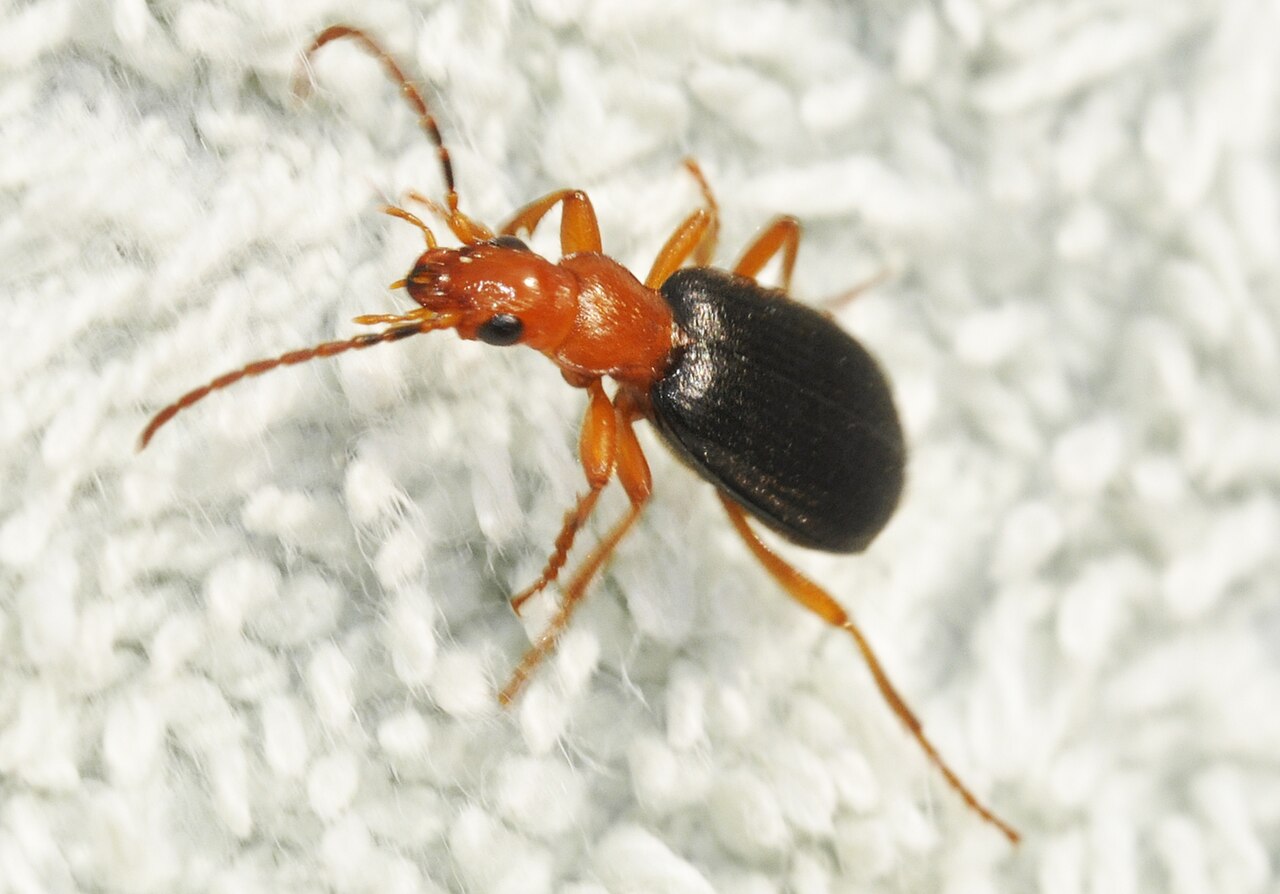
A bombardier beetle (Brachinus crepitans). Image: CC0, via Wikimedia Commons.
The mechanism
- Two-tank storage. The beetle keeps a reservoir of hydroquinones plus hydrogen peroxide, held stable and unreacted, separate from the enzymes.
- The reaction chamber. On threat, muscles squeeze a measured dose through a one-way valve into a hardened chamber lined with catalase and peroxidase.
- The blast. Catalase flashes the peroxide to oxygen and water; peroxidase converts hydroquinones to hot, irritant quinones. The mix reaches about 100 degrees Celsius and vaporizes.
- Pulsed firing. The pressure spike slams the inlet valve shut, fires a pulse, then the chamber refills and repeats hundreds of times a second, a natural pulse-jet that also protects the beetle's own tissue from the heat.
- Aiming. The abdominal tip is a rotatable turret; the beetle directs the spray forward over its back or to either side, hitting an attacking ant or frog with accuracy.
Why this points to design
Useful defense requires every component present at once: fuel chemicals stable in storage, enzymes to trigger the reaction, a chamber that survives boiling caustic chemistry, valves that meter and seal, and a nozzle that aims. Remove any one and you get nothing, no reaction, no spray, no aim, or a beetle that cooks its own abdomen. There is no gradual climb through advantageous halfway states, because the halfway states confer no benefit for selection to keep. A device whose function appears only when all the matched parts are assembled and timed together is exactly what intelligent agents produce and what unguided, step-by-step processes are unequipped to build. See Irreducible Complexity and Specified Complexity.
The evolutionary account, and why it falls short
The standard reply is co-option: quinones already serve many beetles for hardening the cuticle and as mild deterrents, hydrogen peroxide is a common metabolite, and catalase is a widespread enzyme, so the parts are said to have been recruited one at a time into a deepening gland that eventually warmed, pressurized, and pulsed the mix.
The reply names the raw ingredients but never delivers the thing that needs explaining. The bombardier beetle is not impressive because it contains quinones; it is impressive because it performs controlled, pulsed, aimed combustion using a metering valve, a blast-proof chamber, a several-hundred-per-second pulse cycle, and a steerable turret. Pointing to loose quinones in other beetles no more explains that system than pointing to gasoline explains a pulse-jet engine. A story that connects scattered chemicals to a finished weapon is not the same as showing the road exists: the selectable advantage of each intermediate, and the actual mutations and developmental changes that built the integrated apparatus, have never been demonstrated. The gap between available chemistry and a working, self-protecting, aimed explosive system is precisely the gap that points to design.
See also
- Animals That Defy Evolution, the hub this spoke belongs to
- Irreducible Complexity, the core pattern behind the beetle
- Edge of Evolution, the empirical reach of random mutation
- Specified Complexity, functional information as a design signature
- The pistol shrimp, another animal in this hub with a high-speed, high-energy weapon
Common questions this page answers
Q: Why is the bombardier beetle a problem for evolution?
Its defensive spray needs several matched parts at once: the fuel chemicals, the catalyzing enzymes, a blast-resistant reaction chamber, a metering valve, and an aiming turret. Each part is useless or dangerous without the others, which is the Irreducible Complexity pattern, so there is no gradual path of advantageous halfway stages for natural selection to climb. The integrated, self-protecting, aimed weapon looks engineered, and no stepwise account has ever demonstrated how unguided processes could assemble it.
Q: How does the bombardier beetle's spray actually work?
It stores hydroquinones and hydrogen peroxide in one reservoir and the enzymes catalase and peroxidase in a separate hardened chamber. On attack it forces the chemicals into the chamber, where the enzymes flash the peroxide to oxygen and convert the hydroquinones into hot, caustic quinones at about 100 degrees Celsius. The pressure fires the spray in hundreds of pulses per second through a swivel nozzle the beetle aims directly at the threat.
Q: Couldn't the beetle's chemicals have been borrowed from other beetles over time?
Many beetles do carry quinones, and peroxide and catalase are common, but that only supplies the raw ingredients, not the system. What demands explanation is the controlled, pulsed, aimed combustion: the metering valve, the heat-proof chamber, the rapid pulse cycle, and the steerable turret working together. Loose chemicals in other beetles no more explain that apparatus than gasoline explains a working engine, and the selectable intermediates and genetic changes that would build it have never been shown.
Q: Would the bombardier beetle explode if it were only half-formed?
A half-formed version would not detonate; it simply would not work. Without the enzymes there is no reaction, without the chamber and valve there is no controlled blast, and without the turret there is no aim. Each incomplete stage is inert or harmful rather than advantageous, which is exactly why a step-by-step path cannot build it: selection has nothing useful to preserve until the whole system is in place.