Argument
Bible Is the Claim Not the Evidence Objection Defeater
the Bible is the claim not the evidence, the bible is the claim, not the evidence, the Bible is not evidence, you can't use the Bible as evidence, the Bible is just a claim, the Bible cannot prove itself, is the Bible evidence, the Gospels are the claim not the evidence, you can't cite the Bible to prove JesusIntro
You will hear it in almost every debate about Jesus. "The Bible is the claim, not the evidence." The idea is simple. If the Bible says Jesus rose from the dead, you cannot point back to the Bible to prove it, any more than a man accused of a crime can prove his innocence by saying "I didn't do it." The book is what is being tested, so it cannot also be the test.
There is something right in that, and a Christian should say so. Calling a book holy does not make it true, and the Bible cannot prove that it is inspired by God just by saying so.
But the slogan goes too far. Every ancient document is both a claim and a piece of evidence. When the Roman historian Tacitus writes that a man named Christus was executed under Pontius Pilate, his sentence is a claim. It is also evidence: evidence that a Roman senator in the early second century believed it, and a historian then asks where he got it and whether other sources agree. That is how historians handle Tacitus, Josephus, Plato and every other ancient writer. Nobody throws out Tacitus because "Tacitus is the claim."
And "the Bible" is not one witness. The New Testament is 27 separate writings by different authors, written in different places and years, which were only later bound into one book. Paul's letters, Mark's Gospel and John's Gospel are separate sources that have to be weighed one by one, the way any historian weighs sources.
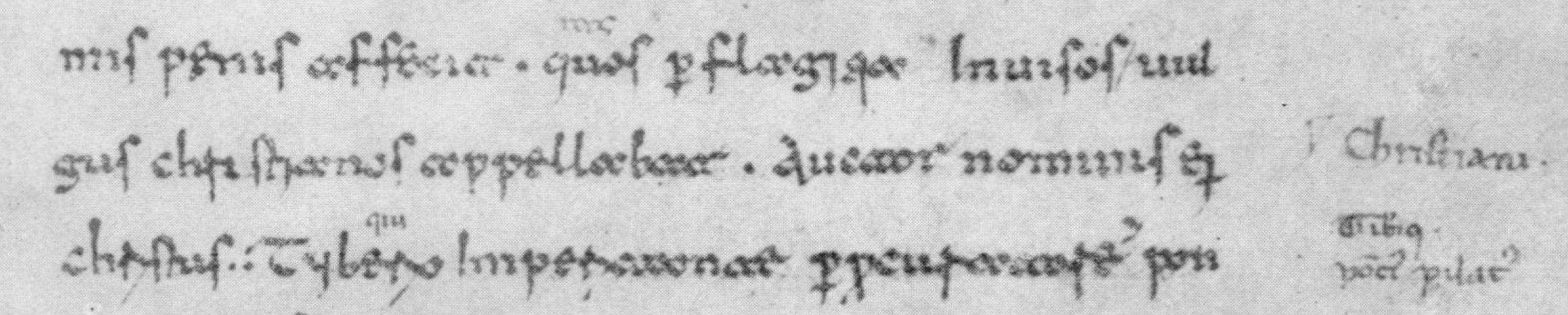
Annals 15.44 in the Codex Mediceus II (eleventh century), the only surviving manuscript of this part of Tacitus, now in the Laurentian Library, Florence. The lines name the Christians, Christus, and his execution under Tiberius by the procurator Pontius Pilate. Image: public domain, via Wikimedia Commons.
The 30-second version:
A document can contain a claim and still be evidence that the claim was made, and historians test every ancient text that way: when was it written, by whom, from what sources, and does anything independent agree? Tacitus, Josephus and Plato are handled exactly like that. The New Testament is 27 separate writings, not one source, and each gets weighed on its merits. The fair limits cut both ways: the Bible cannot prove its own inspiration by quoting itself, and proving that Jesus existed does not by itself prove that He rose.
See this page's graph and discover linked topics
In full
The objection treats "the Bible" as a single assertion awaiting outside confirmation, and so disqualifies every biblical text from counting as evidence for anything the Bible reports. In its strongest form it says: (1) a text cannot be independent evidence for its own claims; (2) the biblical texts were written by believers with an interest in the claims and selected by believers into a canon; (3) therefore biblical texts carry no evidential weight for biblical claims, and only outside sources can count.
The defeater runs in six moves:
- The dichotomy is false (P1). Testimony is the main form of historical evidence. Every written source is both a claim and evidence, first that the claim was made, and then, depending on its quality, that the claim is true. Philosophers of testimony such as C. A. J. Coady (Testimony, 1992) have shown how much of what anyone knows rests on testimony weighed in this way.
- Historians weigh texts; they do not exclude them (P2). The tests are date, provenance, the author's access to information, independence, corroboration, genre and bias. They are applied to Tacitus, Josephus, Arrian and Plato, and they apply to the New Testament writings in the same way.
- One canon is not one source (P3). The New Testament is 27 documents. Paul's undisputed letters, Mark, the material shared only by Matthew and Luke, and John are separate streams. Being bound together later does not merge them, any more than an anthology of Roman historians turns them into one witness. See Bible Circularity Objection.
- Corroboration exists where it can be checked (P4). Outside sources and archaeology confirm a good deal of the setting and some core events: Pilate (the Pilate Stone, Philo, Josephus, Tacitus), Caiaphas (the Caiaphas Ossuary), Gallio's proconsulship at Corinth (the Gallio Inscription), and Jesus' execution (Tacitus, Annals 15.44) and His brother James (Josephus, Antiquities 20.200).
- Consistency (P5). A rule that disqualifies the New Testament because its authors believed what they wrote would disqualify Plato on Socrates, Arrian on Alexander and Josephus on the Jewish War. Applied only to the Bible, it is Special Pleading.
- Honest limits (P6). Two concessions are owed and should be made freely. The Bible cannot establish its own divine inspiration by citing itself; that would be circular. And the historical case that Jesus existed and was crucified does not by itself establish that He rose; that needs further historical and philosophical argument. See Minimal Facts Argument and Argument from Miracles.
Argument structure
| Premise | Notes | |
|---|---|---|
| P1 | Every written source is both a claim and evidence that the claim was made; its value as evidence for the claim's truth is a further question | Coady 1992 |
| P2 | Historians weigh ancient texts by date, provenance, access, independence, corroboration, genre and bias, not by whether the author believed what he wrote | Applied to Tacitus, Josephus, Arrian, Plato |
| P3 | The New Testament is 27 documents from several independent streams, not one source | Paul, Mark, John, material unique to Matthew and Luke |
| P4 | Outside sources and archaeology corroborate much of the setting and some core events | Pilate Stone; Caiaphas Ossuary; Gallio inscription; Tacitus; Josephus |
| P5 | Applying the objection's rule consistently would gut ancient history, so applying it only to the Bible is special pleading | Special Pleading |
| P6 | The Bible cannot prove its inspiration by quoting itself, and Jesus' existence does not by itself prove the resurrection | Honest limits |
| C | The biblical texts are evidence to be weighed claim by claim, neither proved by being Scripture nor disqualified by it |
Form
Defensive, built on a false dichotomy and a consistency challenge, with deliberate concessions. The slogan works by sliding between two true statements (the Bible makes claims; a claim does not prove itself) and a false one (so the Bible is not evidence). The reply keeps the two true statements and removes the false one.
Cheatsheet
The 30-second reply (read aloud). You are right that a book does not become true by calling itself holy, and I am not asking you to accept anything because it is in the Bible. But "claim" and "evidence" are not opposites. When Tacitus writes that Christus was executed under Pilate, that is a claim, and every historian also treats it as evidence, then asks where Tacitus got it and who agrees. The New Testament gets the same treatment, except that it is not one source. It is 27 documents by different writers, and Paul was writing within about twenty-five years of the crucifixion about men he had met. So let's do what historians do: take the sources one at a time and weigh them. If you reject them, tell me which one, and why, using a rule you would also apply to Tacitus.
The 5 fast facts:
- All ancient history is built from texts that make claims. For Alexander the Great, the fullest surviving narrative is Arrian's, written about four centuries after Alexander's death in 323 BC, which tells us in its preface that it relies on the lost accounts of Ptolemy and Aristobulus, who served with him. Historians weigh Arrian; they do not reject him as "the claim."
- The New Testament is a collection. Twenty-seven documents. Paul's undisputed letters date to the AD 50s. Galatians 1:18-19 reports Paul's two-week visit with Cephas and his meeting with James, the Lord's brother.
- The only manuscript of Tacitus' account of Christus is a single eleventh-century copy. Historians still treat Annals 15.44 as evidence. The question is always quality, never whether the text makes claims.
- Outside confirmation exists. The Pilate Stone (found at Caesarea in 1961) names Pontius Pilate as prefect of Judea. The Gallio Inscription at Delphi dates Gallio's proconsulship, which fits Acts 18:12. Josephus calls James "the brother of Jesus, who was called Christ" (Antiquities 20.200).
- Skeptical scholars use the New Testament as evidence. Bart Ehrman, an agnostic, treats Paul and the Gospels as historical sources to be weighed, and in Did Jesus Exist? (2012) argues from them, among other sources, that Jesus certainly existed.
The 4 strongest counter-moves:
- "Is Tacitus the claim or the evidence?" If both, so is Mark. If only the claim, ask what we know about Nero's fire.
- "Which document are you rejecting, and why?" Push from "the Bible" to Galatians, Mark or 1 Corinthians, one at a time.
- "What would count as evidence for an event in first-century Judea?" If the answer is a document, the New Testament writings are documents. If the answer excludes all documents written by people who believed what they wrote, almost all ancient history goes.
- "Is that a historical judgment or a religious one?" Rejecting a source because it later became Scripture is a judgment about the canon, not about the source.
Reciprocal concessions (grant the small point, then collect a bigger one):
- Grant: the Bible cannot prove that it is inspired by God by quoting itself. Now collect: nor can its later inclusion in a canon prove that it is unreliable. Being Scripture neither establishes nor destroys a document's historical value.
- Grant: the authors believed what they wrote and wanted readers to believe it. Now collect: so did Tacitus, Josephus and Plato. Bias is a reason to test a source, not to throw it out, and some New Testament writers report details that cut against their own interests (Peter's denial, the women as first witnesses, the crucifixion itself).
- Grant: showing that Jesus existed does not show that He rose. Now collect: then the argument about the resurrection has to be had on the evidence, which is exactly the conversation the slogan was trying to avoid. See There Is No Evidence for the Resurrection Objection Defeater.
The closing line. Every ancient book is a claim. The question is never whether a source makes claims, but whether its claims hold up when you test them, and that is a test the New Testament is willing to take.
P1, Claim and evidence are not opposites
Affirmative case
- Testimony is evidence. Most of what anyone knows about the past, and much of what they know about the present, comes from testimony. A witness statement in court is a claim, and it is also evidence, weighed by cross-examination. C. A. J. Coady's Testimony: A Philosophical Study (1992) is the standard philosophical treatment of how testimony justifies belief.
- Two questions, not one. A document is first evidence that its author made a claim, at a certain time, in a certain setting. Whether it is good evidence that the claim is true is a second question, answered by testing. The slogan collapses these two questions into a single rejection.
- The New Testament invites testing. Luke says he "traced the course of all things accurately from the first" from those who "from the beginning were eyewitnesses and ministers of the word" (Luke 1:2-3, ASV). Paul lists witnesses to the risen Jesus, "of whom the greater part remain until now" (1 Corinthians 15:6, ASV). These are claims about method and witnesses that a historian can weigh, not appeals to authority.
Anticipated objections
- "A man's own statement is not evidence he is innocent."
Rebuttals
- It is evidence; it is just weak evidence on that question. Courts hear defendants. The statement is weighed against motive, consistency and corroboration. The analogy actually supports the method this page defends: weigh the testimony, do not refuse to hear it.
P2, Historians weigh texts by date, provenance, independence and corroboration
Affirmative case
- The standard questions. When was the source written? By whom, and what access did the author have? Did the author use earlier sources, and are they independent of each other? Does anything outside the source confirm it? What kind of writing is it, and what were the author's interests?
- The same questions for everyone. Plato and Xenophon wrote about Socrates as his admirers; historians use them and argue about how much of Plato's Socrates is the real man. Josephus wrote as a Jewish aristocrat with Roman patrons; historians use him and allow for that. Tacitus wrote with open contempt for Christians; historians use him and allow for that too.
- The New Testament scores well on some tests, less well on others. Paul's letters are early and give names and places. Some Gospel material is attested in more than one independent stream. Other details are attested only once, and some are disputed among historians. Taking the tests seriously means accepting the results claim by claim, which is what the slogan refuses to do.
Anticipated objections
- "Religious texts are a special case. They were written to convert, not to inform."
Rebuttals
- Purpose is a reason to test, not to dismiss. Most ancient historiography was written to persuade: to praise a patron, defend a people, or teach a moral. Livy, Tacitus and Josephus all wrote with purposes. A persuasive aim tells you to check the source; it does not tell you the source is false.
P3, The New Testament is a collection, not one source
Affirmative case
- Twenty-seven documents. The New Testament contains letters, Gospels, a history and an apocalypse, by several authors, written over several decades and in several places.
- Separate streams. Mainstream scholarship treats Paul's letters, Mark, the material common to Matthew and Luke but absent from Mark, the material unique to each of them, and John as distinct lines of tradition. Where they agree on a point, historians speak of multiple attestation.
- Paul's link to the eyewitnesses. "Then after three years I went up to Jerusalem to visit Cephas, and tarried with him fifteen days. But other of the apostles saw I none, save James the Lord's brother" (Galatians 1:18-19, ASV). Paul writes as someone who met Jesus' leading disciple and His brother.
Anticipated objections
- "The canon was chosen by believers. That is selection bias: the books that made it in are the ones that told the story the church wanted."
Rebuttals
- Selection does not change a document's date or origin. Whatever one thinks of how the canon formed, Galatians was written when it was written, by whom it was written. Gathering it into a collection later cannot make it later or less independent than it is. On how the collection actually formed, see Canon and The Canon Was Chosen Politically Objection Defeater.
P4, Corroboration exists where it can be checked
Affirmative case
- People and offices. Pontius Pilate is named as prefect of Judea on the Pilate Stone and described by Philo, Josephus and Tacitus. The high priest Caiaphas is very probably named on the Caiaphas Ossuary. Gallio's term as proconsul of Achaia is dated by the Gallio Inscription at Delphi, which fits Acts 18:12.
- Core events. Tacitus (Annals 15.44, c. AD 116) reports that Christus "suffered the extreme penalty" under Pontius Pilate in the reign of Tiberius. Josephus (Antiquities 20.200, c. AD 93-94) names James as "the brother of Jesus, who was called Christ." The longer passage at Antiquities 18.63-64 has a disputed textual history: most specialists judge that Josephus wrote something about Jesus there and that Christian copyists added to it. See Josephus and Tacitus.
- What corroboration does and does not show. Confirming Pilate does not confirm every word a Gospel puts in his mouth. Corroboration raises confidence in the sources' grasp of their setting and in particular events; each further claim is weighed in its turn.
Anticipated objections
- "Tacitus and Josephus were only repeating what Christians said."
Rebuttals
- That is a claim about their sources, which has to be argued. Tacitus' source is unknown, and historians differ about it. But neither writer was friendly to Christian claims, and Josephus' note on James comes in a passage about the high priest Ananus, not in any account of Christian teaching. See Extra-Biblical Case for Jesus, Objections and Responses.
P5, The consistency challenge
Affirmative case
- State the rule. If the rule is "a text written by people who believed its claims is not evidence for those claims," it removes Plato and Xenophon on Socrates, Arrian's sources on Alexander, Josephus on the Jewish War and the Roman historians on Rome.
- Ask the objector to apply it. Most will not, because they rightly do not believe that ancient history is unknowable. Then the rule is not really the reason for rejecting the New Testament.
- The fair version. A legitimate objection says: "I have weighed this particular source, and it fails these particular tests." That is a historical argument and deserves an answer on the evidence. The slogan is not that argument.
Anticipated objections
- "Ordinary claims about Socrates do not need the same evidence as claims about miracles."
Rebuttals
- That is a different objection, and a better one. It concedes that the texts are evidence and argues instead about how much evidence a miracle claim needs. That debate is real, and it belongs on Argument from Miracles and David Hume, not under the slogan that the texts are not evidence at all.
P6, Honest limits
Affirmative case
- Inspiration is not proved by citation. "The Bible says it is the word of God, so it is" is circular as a proof to someone who does not already accept it. Christians should concede this plainly. Citing a text to show what Christianity teaches is not circular; citing it as proof of its own divine authority is. See Bible Circularity Objection.
- Existence is not resurrection. Historians can distinguish levels of claim: that a person existed, what he did, what happened to him, and what it meant. The evidence that Jesus existed and was crucified under Pilate is strong. Whether God raised Him is a further question that needs further argument, historical (the Minimal Facts Argument) and philosophical (whether miracles can be known at all).
- Why the concessions strengthen the case. They show that the Christian is asking for the same method the skeptic would use anywhere else, and nothing more.
Anticipated objections
- "If you admit the Bible cannot prove its own inspiration, why should anyone accept it as Scripture?"
Rebuttals
- Because the case is cumulative and does not start with inspiration. The historical case concerns Jesus' life, death and resurrection, argued from the documents as historical sources. If Jesus rose, His own view of Scripture becomes the reason to receive it as God's word. The order is history first, authority second.
Master objections to the defeater
MO1: "Outside the Bible there is almost nothing about Jesus. That is suspicious."
- For a provincial teacher executed after a short career, the record is about what historians would expect, and it is more than exists for most people of his social standing. See Mythicism Refutation, which compares how historians establish Jesus, Socrates, Alexander and Pilate.
MO2: "The Gospels are anonymous, so we cannot weigh their provenance."
- The titles are not part of the original texts, but the attributions are early and consistent, and provenance is a matter of evidence, not of signatures. See NT Authorship and Eyewitness Apologetics and The Bible Is Just Second-Hand Sources Objection Defeater.
MO3: "Christians use the Bible as evidence only when it suits them."
- Then hold them to the method. The method this page defends applies to every claim and every source, including claims Christians would rather not examine.
Tactical notes
- Grant the true part first. The slogan is half right. Saying so early keeps the conversation honest.
- Move from "the Bible" to a document. The objection survives only at the level of the whole book. Galatians 1:18-19 is a good place to start.
- Use Tacitus as the mirror. Show the manuscript situation, then ask whether Annals 15.44 is "the claim or the evidence."
- What not to defend: that the New Testament is better documented than Alexander or Julius Caesar (it is not; both are attested by coins, inscriptions and many more kinds of evidence), that every Gospel detail is independently confirmed (it is not), or that the Bible's inspiration can be proved from its own statements (it cannot).
Tactical opening / closing
- Opening. "I agree with half of that. A book does not become true by calling itself holy. Can we talk about the other half?"
- Closing. "So let's not argue about whether the New Testament is evidence. Let's argue about what the evidence shows."
Connection to Scripture
- Luke 1:1-4, the author's own statement of sources and method.
- 1 Corinthians 15:3-8, an early list of named witnesses, many still alive when Paul wrote.
- Galatians 1:18-19, Paul's meeting with Cephas and James.
- Acts 26:26, "this hath not been done in a corner": the claims were public and checkable.
- 2 Peter 1:16, "we did not follow cunningly devised fables": the writers knew the difference between myth and testimony.
Live-cite kit
Scripture:
- "Then after three years I went up to Jerusalem to visit Cephas, and tarried with him fifteen days." (Galatians 1:18, ASV)
- "For we did not follow cunningly devised fables... but we were eyewitnesses of his majesty." (2 Peter 1:16, ASV)
Scholarly and historical:
- Tacitus, Annals 15.44 (c. AD 116)
- Josephus, Jewish Antiquities 20.200 and 18.63-64 (c. AD 93-94)
- Arrian, Anabasis of Alexander, preface, on Ptolemy and Aristobulus
- C. A. J. Coady, Testimony: A Philosophical Study (Oxford, 1992)
- Bart D. Ehrman, Did Jesus Exist? (2012)
Aphorism:
- "Every ancient source is a claim. The question is whether it survives the test."
- "Being Scripture does not make a document true, and it does not make it false."
- "If Tacitus is evidence, so is Mark. If Mark is not, neither is Tacitus."
Scholarship
Published academic works this page draws on, each matched to a publisher, index or library catalog record.
- Bart D. Ehrman, Did Jesus Exist? (2012). Open Library
See also
- Bible Circularity Objection, the related charge that citing the Bible for the Bible is circular
- Mythicism Refutation, how historians establish Jesus compared with Socrates, Alexander and Pilate
- The Bible Is Just Second-Hand Sources Objection Defeater, the hearsay form of the objection
- Historicity of Jesus, the broader historical case
- Extra-Biblical Case for Jesus, Objections and Responses, the non-Christian sources
- Minimal Facts Argument, the resurrection argued from facts most historians grant
- There Is No Evidence for the Resurrection Objection Defeater, the next question once the texts count as evidence
- Special Pleading, the fallacy the inconsistent rule commits
- Pilate Stone, archaeological confirmation of Pilate's office
- Atheism, master hub
Common questions this page answers
Q: Is the Bible the claim and not the evidence?
It is both. Every ancient document is a claim and also evidence, first that the claim was made, and then, depending on its quality, that it is true. Historians handle Tacitus, Josephus and Plato this way, testing each text by its date, author, sources and corroboration, and the New Testament writings can be tested the same way.
Q: Can you use the Bible as historical evidence?
Yes, as historians use any ancient text: weighed, not simply believed. The New Testament is 27 separate documents, and some of them, like Paul's letters from the AD 50s, are early and name people who knew Jesus. Even skeptical scholars such as Bart Ehrman use them as historical sources.
Q: Isn't using the Bible to prove the Bible circular?
Using the Bible to prove that it is inspired by God would be circular, and Christians should admit that. Using individual biblical documents as historical sources for events in first-century Judea is not, because they are separate writings that can be tested against each other and against outside evidence.
Q: What evidence outside the Bible confirms the New Testament?
The Pilate Stone names Pontius Pilate as prefect of Judea; Tacitus reports Christus' execution under Pilate; Josephus mentions James, "the brother of Jesus, who was called Christ"; and the Gallio inscription dates the proconsul named in Acts 18. These confirm the setting and some core events, not every detail.
Q: If Jesus existed, does that prove He rose from the dead?
No. The evidence that Jesus lived and was crucified under Pilate is strong, but whether God raised Him is a further question that needs its own historical and philosophical argument. That is why the resurrection is argued from the evidence, not assumed from the existence of Jesus.
Q: Is Jesus better documented than Alexander the Great or Julius Caesar?
No, and Christians should not claim it. Alexander and Caesar are attested by coins, inscriptions and many more kinds of evidence. The fair point is narrower: some New Testament writings are much closer in time to Jesus than the surviving narratives of Alexander are to him, and historians weigh both kinds of sources with the same tools.