Person
Bernice
Berenice, Queen Berenice, Julia Berenice, Berenice of Cilicia, Bernice sister of AgrippaIntro
Bernice was a princess of the Herod family and the sister of King Agrippa II. She sat beside him "with great pomp" when the apostle Paul made his defense at Caesarea.
Her life was full of royal marriages and scandal. She was married three times, lived for years in her brother's household, tried to stop the Roman governor's massacre in Jerusalem in AD 66, and later became the companion of the Roman general Titus, who nearly married her before he became emperor. A stone inscription in Beirut still names her as "Queen Berenice."
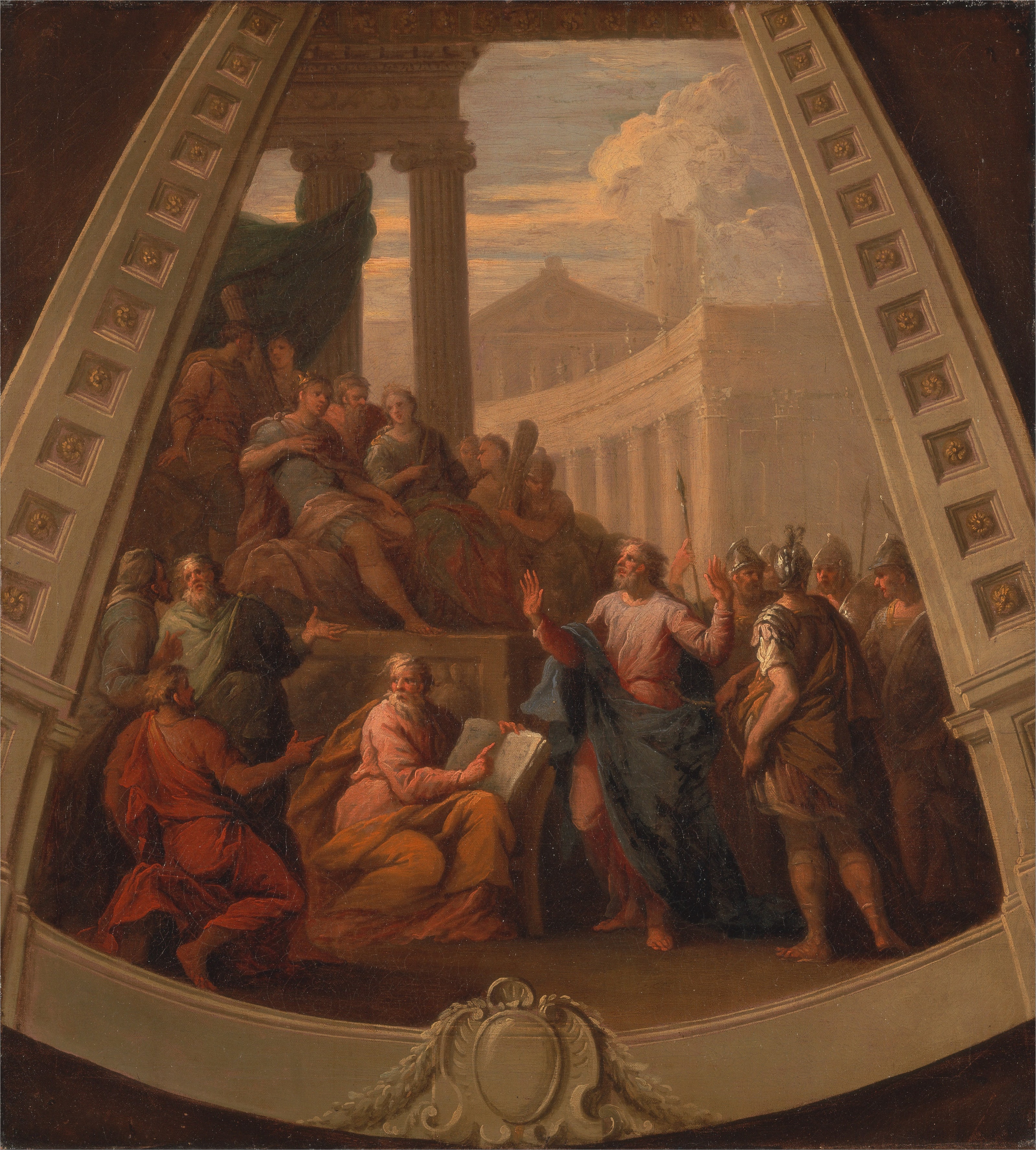
James Thornhill, St. Paul before Agrippa (early 18th century). Public domain, via Wikimedia Commons, resized.

See this page's graph and discover linked topics
In full
Bernice (Greek Berenikē) was the eldest daughter of Herod Agrippa I. She was sixteen when her father died in AD 44 (Josephus, Antiquities 19.354), so she was born about AD 28.
- First marriage. As a girl she was married to Marcus, son of Alexander the alabarch of Alexandria and nephew of the philosopher Philo (Antiquities 19.276-277).
- Second marriage. After Marcus died, her father married her to his own brother, Herod king of Chalcis, by whom she had two sons, Berenicianus and Hyrcanus (Antiquities 19.277; 20.104).
- With her brother. Widowed in AD 48, she lived for a long time with her brother Agrippa II. Josephus reports that "the report went that she had criminal conversation with her brother," and that to end the rumor she persuaded Polemo, king of Cilicia, to be circumcised and marry her. The marriage did not last, and she left him (Antiquities 20.145-146). The Roman satirist Juvenal repeats the rumor (Satires 6.156-160).
- AD 66. She was in Jerusalem "in order to perform a vow" when the governor Gessius Florus let his troops loose on the city. She sent officers to plead with him and herself "stood barefoot before Florus's tribunal, and besought him" to stop, at risk to her own life (Jewish War 2.309-314). Weeks later Agrippa made his speech against the war with Bernice placed in full view of the crowd (Jewish War 2.344). The rebels burned "the palaces of Agrippa and Bernice" (Jewish War 2.426).
- Titus. During the war she became the companion of Titus, son of Vespasian (Tacitus, Histories 2.2). She came to Rome with Agrippa around AD 75 and lived in the palace, and Titus was expected to marry her (Cassius Dio 66.15). When Titus became emperor in AD 79 he sent her away from Rome, according to Suetonius, "against his will and against hers" (Titus 7, invitus invitam). She is last heard of shortly after.
In the Bible
Bernice appears three times, all in Paul's hearing at Caesarea:
- "Now when certain days were passed, Agrippa the king and Bernice arrived at Cæsarea, and saluted Festus" (Acts 25:13, ASV).
- "So on the morrow, when Agrippa was come, and Bernice, with great pomp, and they were entered into the place of hearing with the chief captains and the principal men of the city, at the command of Festus Paul was brought in" (Acts 25:23, ASV).
- "And the king rose up, and the governor, and Bernice, and they that sat with them: and when they had withdrawn, they spake one to another, saying, This man doeth nothing worthy of death or of bonds" (Acts 26:30-31, ASV).
She is therefore one of the officials who heard Paul's whole defense and agreed that he was innocent.
Family and lineage
- Great-grandfather: Herod the Great.
- Father: Herod Agrippa I, king of Judea AD 41-44 (Acts 12:1).
- Mother: Cypros.
- Siblings: Herod Agrippa II; Mariamne; and Drusilla, wife of the governor Antonius Felix. Josephus says Drusilla suffered from Bernice's envy (Antiquities 20.143).
- Husbands: Marcus Julius Alexander; Herod of Chalcis (her uncle); Polemo of Cilicia.
- Sons: Berenicianus and Hyrcanus, by Herod of Chalcis.
Historical and archaeological evidence
| Source | What it says | Date | Where it is now | Grade |
|---|---|---|---|---|
| Latin dedication from Berytus (Beirut), AE 1928, 82 | "Queen Berenice" and "great King Agrippa" restore at their own expense a building that "King Herod, their great-grandfather" had built; the stone is broken and the building's identity is uncertain | later 1st century AD | National Museum of Beirut | direct epigraphic evidence |
| Josephus, Antiquities 18-20 and Jewish War 2 | Her marriages, the rumor about her brother, Polemo, her plea before Florus, her presence at Agrippa's speech, her palace | written c. AD 75-94 | manuscript tradition | contemporary witness, strong |
| Tacitus, Histories 2.2 and 2.81 | Titus's attachment to Queen Berenice; her support for Vespasian in AD 69 | early 2nd century | manuscript tradition | independent Roman witness |
| Suetonius, Titus 7; Cassius Dio 66.15 | Her stay in Rome and dismissal by Titus | 2nd and 3rd centuries | manuscript tradition | independent Roman witnesses |
| Quintilian, Institutio Oratoria 4.1.19 | He once pleaded a case before Queen Berenice in which she was herself involved | late 1st century | manuscript tradition | contemporary Roman witness |
Lawrence Mykytiuk counts Bernice as confirmed, citing Josephus and the Beirut inscription, which he documents from Laura Boffo's Iscrizioni greche e latine per lo studio della Bibbia (1994), no. 41 ("New Testament Political Figures Confirmed," Biblical Archaeology Review 43:5, 2017).
Scholarly consensus
- Identity. The Bernice of Acts is the daughter of Agrippa I and sister of Agrippa II. Every source places her at her brother's side in these years, as Acts does.
- The incest rumor. Josephus reports it as a rumor, and Juvenal uses it as satire. Historians treat it as unproven gossip; it shows how her long residence with her brother was seen in Rome and Judea.
- The Beirut inscription. Its reading of "Queen Berenice" and "great King Agrippa" is secure, though the broken text leaves the restored building uncertain (a bath, or marble work and columns, in different reconstructions).
- Her reputation. Ancient writers vary. Josephus shows her pleading for her people in 66; the Roman writers dwell on her affair with Titus.
Theological significance
- Royalty hears the gospel. Bernice is part of the audience Jesus foretold: "yea and before governors and kings shall ye be brought for my sake, for a testimony to them and to the Gentiles" (Matthew 10:18, ASV). Acts shows that word fulfilled in Paul's defense before Festus, Agrippa and Bernice.
- A witness to Paul's innocence. Luke includes her among those who agreed, "This man doeth nothing worthy of death or of bonds" (Acts 26:31).
- Accurate detail. Luke's mention of Bernice arriving with Agrippa "with great pomp" fits everything else known about the pair in the late 50s, a small detail that would be easy to get wrong.
Church Fathers
No patristic commentary on Bernice herself has been found beyond quotation of the Acts narrative.
Scholarship
Published academic works this page draws on, each matched to a publisher, index or library catalog record.
- Laura Boffo, Iscrizioni greche e latine per lo studio della Bibbia (1994). Open Library
See also
- Herod Agrippa II, her brother, the king at Paul's hearing
- Drusilla, her younger sister
- Porcius Festus, the governor who hosted the hearing
- Paul the Apostle, who made his defense before her
- Herod the Great, her great-grandfather
- Josephus and Tacitus, the historians who record her life
- Biblical Figures Confirmed by Archaeology, Mykytiuk's list of confirmed persons
- People of the Bible, the hub of attested biblical people by book
Common questions this page answers
Q: Who was Bernice in the Bible?
Bernice was the sister of King Herod Agrippa II and a great-granddaughter of Herod the Great. In Acts 25 and 26 she comes with Agrippa to Caesarea and hears Paul's defense before the governor Festus.
Q: Is Bernice mentioned outside the Bible?
Yes. Josephus tells much of her life, Roman writers including Tacitus, Suetonius, Quintilian and Cassius Dio mention her, and a Latin inscription in the National Museum of Beirut names "Queen Berenice" with King Agrippa.
Q: Was Bernice married to her brother Agrippa?
No. She lived with her brother for long periods after being widowed, and Josephus reports a rumor that their relationship was improper. To silence it she married Polemo, king of Cilicia. The rumor was never proven.
Q: What happened to Bernice after Acts?
In AD 66 she pleaded barefoot with the Roman governor Florus to stop the killing in Jerusalem. During and after the Jewish war she became the companion of Titus, who brought her to Rome but sent her away when he became emperor in AD 79.