Person
Ben-Hadad
Ben-hadad, Benhadad, Bar-Hadad, Bir-Hadad, Ben-hadad king of Syria, Ben-hadad son of Hazael, Ben-hadad son of Hadadezer, Ben-hadad son of Tabrimmon, Ben-hadad I, Ben-hadad II, Ben-hadad III, Mari of DamascusIntro
Ben-hadad, "son of Hadad" (Aramaic Bar-Hadad), is the name the Bible gives to several kings of Aram-Damascus, Israel's powerful neighbor to the north. One Ben-hadad attacked northern Israel for King Asa of Judah; one besieged Samaria in the days of Ahab and Elisha and was murdered by his officer Hazael; and Hazael's own son, another Ben-hadad, lost Israel's cities to King Jehoash. Because they share a name, scholars number them differently. The clearest outside witness is a stone monument from Syria, the Zakkur Stele, which names "Bar-Hadad son of Hazael, king of Aram."
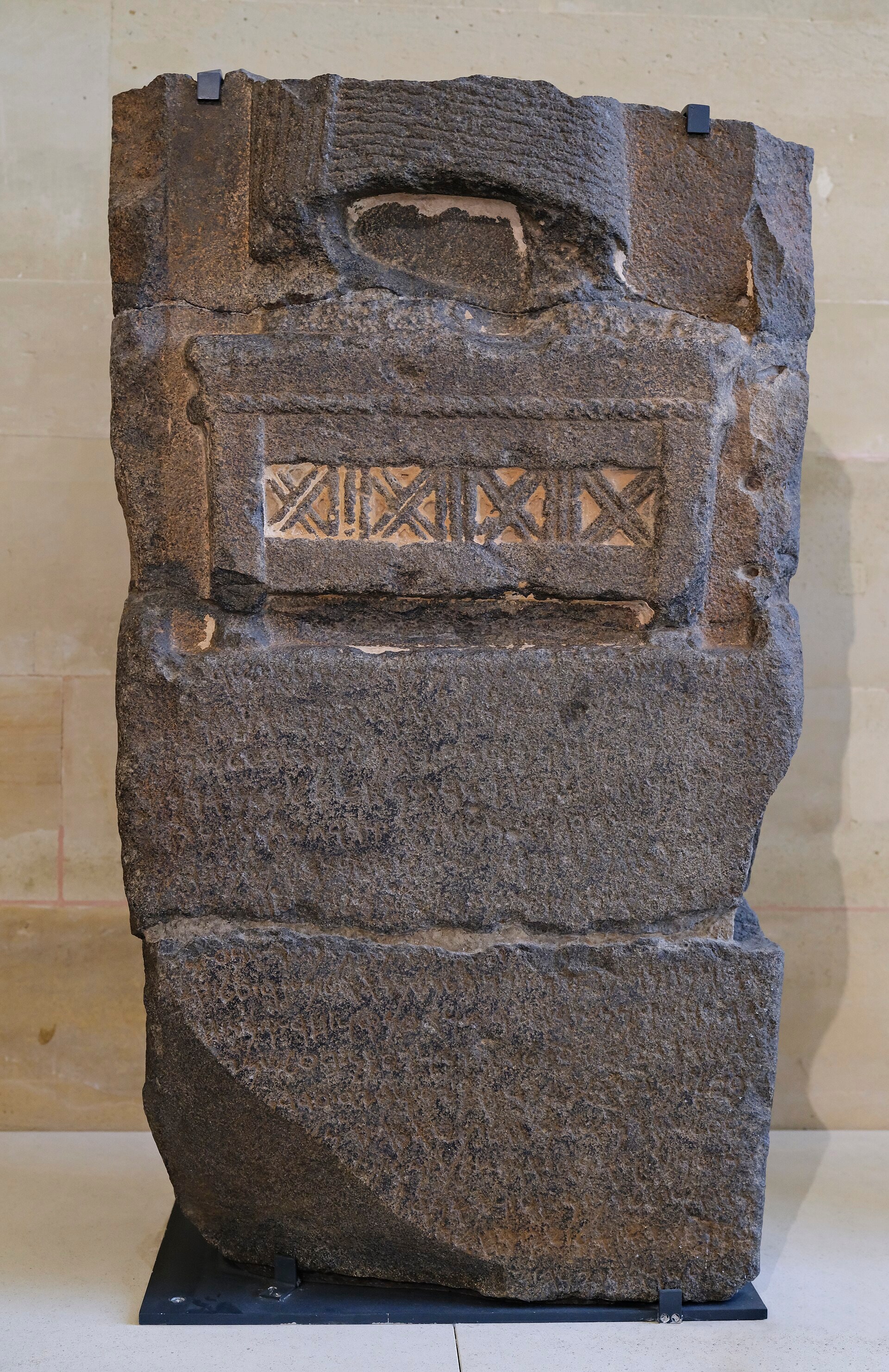
The Zakkur Stele, basalt, about 800 BC, from Tell Afis in Syria, Louvre AO 8185. Its Aramaic text names "Bar-Hadad son of Hazael, king of Aram," the Ben-hadad of 2 Kings 13. Photo: Shonagon, CC0, via Wikimedia Commons, resized.

The 30-second version:
Ben-hadad is a royal name meaning "son of Hadad," the storm god of Damascus, and the Bible uses it for at least two and probably three kings of Aram. The son of Hazael is firmly attested: the Zakkur Stele names "Bar-Hadad son of Hazael, king of Aram" leading seventeen kings against Hamath. The king Hazael murdered is probably named on the Melqart Stele, though its reading is disputed. The first Ben-hadad, son of Tabrimmon, has no secure inscription. How to number them depends on how one fits the Assyrian king Hadadezer into the list.
See this page's graph and discover linked topics
In full
The name Ben-hadad combines Hebrew ben, "son," with Hadad, the Aramean storm god; the Aramaic form is Bar-Hadad. It may have been a personal name, a throne name, or a dynastic title. The Bible applies it to kings of Damascus across roughly a century:
- Ben-hadad son of Tabrimmon, son of Hezion. King Asa of Judah, attacked by Baasha of Israel, sent him the temple and palace treasure and asked him to break his treaty with Baasha. He did, and struck Ijon, Dan, Abel-beth-maacah and the land of Naphtali (1 Kings 15:18-20; 2 Chronicles 16:2-4). Early 9th century BC.
- Ben-hadad of Ahab's and Elisha's time. He besieged Samaria with thirty-two kings, lost to Ahab at Samaria and again at Aphek, and was spared under a treaty (1 Kings 20). Later a Ben-hadad besieged Samaria in a terrible famine (2 Kings 6:24-7:20), and a Ben-hadad, sick, sent Hazael to Elisha and was smothered by him (2 Kings 8:7-15). Whether these are one king or two, and how they relate to Hadadezer of Damascus, is the central puzzle.
- Ben-hadad son of Hazael. He succeeded Hazael and continued to oppress Israel, but Jehoash of Israel defeated him three times and recovered the cities his father had taken (2 Kings 13:3, 13:24-25). Early 8th century BC.
The name also became a poetic emblem of Damascus itself. Amos warns, "I will send a fire into the house of Hazael, and it shall devour the palaces of Ben-hadad" (Amos 1:4, ASV), and Jeremiah repeats the line (Jeremiah 49:27).
In the Bible
- 1 Kings 15:18-20; 2 Chronicles 16:1-6, the son of Tabrimmon and Asa's bribe. "King Asa sent them to Ben-hadad, the son of Tabrimmon, the son of Hezion, king of Syria, that dwelt at Damascus" (1 Kings 15:18, ASV).
- 1 Kings 20, the wars with Ahab; the treaty: "The cities which my father took from thy father I will restore; and thou shalt make streets for thee in Damascus, as my father made in Samaria" (1 Kings 20:34, ASV).
- 2 Kings 6:24-7:20, the siege of Samaria and the flight of the Aramean army.
- 2 Kings 8:7-15, Ben-hadad's illness and murder by Hazael.
- 2 Kings 13:3, 13:24-25, Ben-hadad son of Hazael and his defeats by Jehoash.
- Amos 1:4; Jeremiah 49:27, "the palaces of Ben-hadad."
Family and lineage
- The early line. Hezion, Tabrimmon, Ben-hadad (1 Kings 15:18). Some scholars identify Hezion with Rezon son of Eliada, who seized Damascus in Solomon's day (1 Kings 11:23-24); the identification is uncertain.
- The middle line. On Lawrence Mykytiuk's reconstruction: Hadadezer of Damascus, then his son Ben-hadad, murdered by Hazael. On the older reconstruction, a single Ben-hadad (II) reigned through Ahab's and Joram's time.
- The new dynasty. Hazael, a usurper, and his son Ben-hadad, the Bar-Hadad of the Zakkur Stele.
- Josephus's report. Josephus quotes the historian Nicolaus of Damascus as saying that after the first Hadad, his posterity reigned ten generations, each receiving his father's name with the kingdom, and that the third was the most powerful, attacking Samaria in Ahab's time (Antiquities 7.5.2). He also says the people of Damascus in his own day honored Ben-hadad and Hazael as gods (Antiquities 9.4.6).
Historical and archaeological evidence
- The Zakkur Stele. Basalt stele of Zakkur king of Hamath and Lu'ash, found in 1903 at Tell Afis, south of Aleppo, published in 1907; Louvre, Paris (AO 8185); about 800 BC. Zakkur says that "Bar-Hadad son of Hazael, king of Aram" united seventeen kings against him and besieged Hazrach, and that his god Baalshamayn delivered him. Grade: direct. Lawrence Mykytiuk lists Ben-hadad son of Hazael as confirmed on lines 4-5.
- "Mari'" of Damascus. Inscriptions of the Assyrian king Adad-nirari III, including the Tell al-Rimah Stele, record heavy tribute from a king of Damascus called Mari', an Aramaic word meaning "my lord." Many scholars, Mykytiuk among them, suggest that Mari' was Ben-hadad son of Hazael. Grade: possible.
- The Melqart Stele. Basalt stele found in 1939 at Breij, north of Aleppo, kept in the National Museum of Aleppo, dedicated to Melqart by "Bar-Hadad son of..." William F. Albright read the patronym as Tabrimmon and attributed the stele to Ben-hadad I. Frank Moore Cross (1972) and Gotthard Reinhold (1986) read "son of Ezer," which they connect with Hadadezer, and Mykytiuk now accepts Ben-hadad son of Hadadezer as a strong identification on that basis. Wayne Pitard (1988) questioned the Damascus identification, and Jo Ann Hackett and Aren Wilson-Wright have read the father's name as Attar-sumki, which would make the dedicant a king of Arpad. Grade: debated.
- Ben-hadad son of Tabrimmon. No inscription securely names him; Albright's Melqart reading is now generally abandoned. Mykytiuk does not count him as confirmed.
Scholarly consensus
Every reconstruction agrees on the existence of a Bar-Hadad son of Hazael (from the Zakkur Stele) and on a king of Damascus killed by Hazael (from the Assyrian report of Hadadezer's death and Hazael's usurpation, and from 2 Kings 8). The disagreement is over the number and identity of the earlier Ben-hadads.
| Reconstruction | Son of Tabrimmon (1 Kings 15) | Ahab's foe (1 Kings 20) | Killed by Hazael (2 Kings 8) | Son of Hazael (2 Kings 13) |
|---|---|---|---|---|
| Traditional (common in older reference works) | Ben-hadad I | Ben-hadad II = Hadadezer of the Assyrian texts | Ben-hadad II | Ben-hadad III |
| One long early reign (Albright, from his Melqart reading) | Ben-hadad I, reigning into Ahab's time | Ben-hadad I | Ben-hadad I or a successor | Ben-hadad II |
| Mykytiuk, Cross, Reinhold | Ben-hadad, unconfirmed | Hadadezer, the unnamed "king of Syria" | Ben-hadad son of Hadadezer | Ben-hadad son of Hazael |
| Displaced narratives (J. Maxwell Miller, Wayne Pitard) | Ben-hadad I | stories originally about Ben-hadad son of Hazael | Hadadezer | Ben-hadad son of Hazael |
Because of these differences, the same king may be called Ben-hadad II in one book and Ben-hadad III in another. The codex refers to each by his father's name where the Bible gives it.
Theological significance
- A name from a rival god. "Son of Hadad" proclaims the king the god's son. Scripture repeatedly shows the "sons of Hadad" defeated at the word of the LORD's prophets (1 Kings 20:13, 20:28; 2 Kings 13:17), which the narrative frames as a contest over whose God rules the hills and the valleys (1 Kings 20:23, 20:28).
- Mercy misplaced. Ahab spared Ben-hadad with a treaty, and a prophet condemned him for letting go "the man whom I had devoted to destruction" (1 Kings 20:42, ASV). The text presents the treaty as a king preferring diplomacy to obedience.
- God's protection unseen. During Ben-hadad's siege of Samaria the city was rescued without a battle, when the LORD made the Aramean camp hear the noise of chariots and horses and flee (2 Kings 7:6-7), exactly as Elisha had said.
- Judgment on cruelty. Amos's oracle against "the palaces of Ben-hadad" is for threshing Gilead with iron sledges. The prophets hold foreign kings accountable for their treatment of people, not only Israel's own kings.
Church Fathers
No patristic commentary focused on the kings named Ben-hadad has been located with a verifiable locator.
See also
- People of the Bible, every attested person by the book that first names them
- Hazael, who murdered one Ben-hadad and fathered another
- Hadadezer of Damascus, the Assyrian-attested king at the center of the numbering debate
- Ahab, who defeated and spared Ben-hadad
- Jehoash of Israel, who defeated Ben-hadad son of Hazael three times
- Elisha, the prophet of the Aramean wars
- Biblical Figures Confirmed by Archaeology, where two Ben-hadads are listed
Common questions this page answers
Q: How many kings named Ben-hadad are in the Bible?
At least two, and probably three: Ben-hadad son of Tabrimmon (1 Kings 15), the Ben-hadad of Ahab's and Elisha's time who was murdered by Hazael, and Ben-hadad son of Hazael (2 Kings 13). Some scholars split the middle figure into two kings, and the numbering (I, II, III) differs between reference works.
Q: Is Ben-hadad confirmed by archaeology?
Yes, for at least one of them. The Zakkur Stele in the Louvre names "Bar-Hadad son of Hazael, king of Aram," matching Ben-hadad son of Hazael in 2 Kings 13. The Melqart Stele may name the Ben-hadad killed by Hazael, but its reading is disputed.
Q: What does the name Ben-hadad mean?
It means "son of Hadad." Hadad was the storm god worshipped in Damascus, and the name presented the king as the god's son. It may have served as a throne name or dynastic title.
Q: Was Ben-hadad the same person as Hadadezer?
Possibly. Assyrian records show a king Hadadezer ruling Damascus in 853 BC, when the Bible says Ahab fought Ben-hadad. Some scholars think Ben-hadad was Hadadezer's throne name; others, including Lawrence Mykytiuk, think the Bible's Ben-hadad of 2 Kings 8 was Hadadezer's son.