Person
Azariah son of Hilkiah
Azariah the high priest, Azaryahu son of Hilqiyahu, Azariah ben Hilkiah, Azariah the son of HilkiahIntro
Azariah son of Hilkiah was a high priest of Jerusalem in the last decades before the Babylonian exile. The Bible tells us little about him: he appears in the priestly family lists as the son of Hilkiah, the high priest who found the book of the law under King Josiah, and as the grandfather of Ezra the scribe.
What makes him notable is a thumbnail-sized lump of clay. In the City of David excavations of the 1980s, a house burned by the Babylonians in 586 BC yielded fifty-one seal impressions baked hard by the fire. One reads "belonging to Azariah son of Hilkiah." The name, the father's name, the city and the date all fit the high priest of 1 Chronicles.
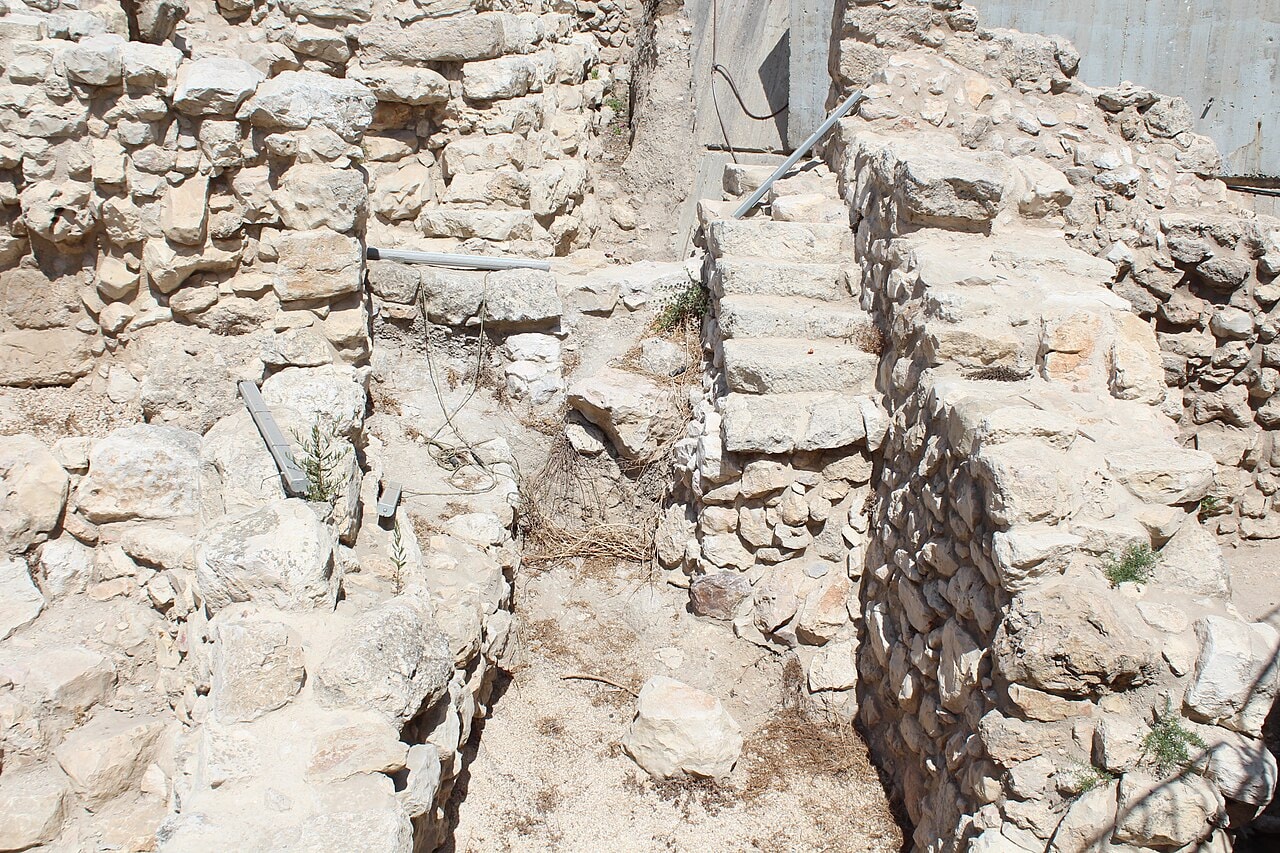
The House of the Bullae in the City of David, Jerusalem, where Yigal Shiloh's team found the seal impression of Azariah son of Hilkiah among 51 bullae baked by the fire of 586 BC. Photo: Deror_avi, CC BY-SA 3.0, via Wikimedia Commons, resized.

The 30-second version:
Azariah son of Hilkiah was high priest in Jerusalem late in the seventh century BC, son of the Hilkiah who found the book of the law and grandfather of Ezra (1 Chronicles 6:13; Ezra 7:1). A clay bulla reading "belonging to Azariah son of Hilkiah" was found in a house in the City of David burned in the Babylonian destruction of 586 BC. Lawrence Mykytiuk counts both father and son among the people of the Bible confirmed by archaeology.
See this page's graph and discover linked topics
In full
Azariah (Hebrew ʿĂzaryāhû, "YHWH has helped") son of Hilkiah son of Shallum appears in the high-priestly genealogy of 1 Chronicles 6:13-14 (5:39-40 in the Hebrew numbering), in the list of Jerusalem's priests in 1 Chronicles 9:11, where he is called "the ruler of the house of God," and in Ezra's pedigree (Ezra 7:1). His son Seraiah was chief priest when Jerusalem fell and was executed at Riblah (2 Kings 25:18-21). The bulla lʿzryhw bn ḥlqyhw, "belonging to Azariah son of Hilkiah," was excavated by Yigal Shiloh's City of David expedition in the House of the Bullae (Area G), a building destroyed by fire in 586 BC, and published by Yair Shoham (Qedem 41, 2000). Lawrence Mykytiuk, applying his criteria of authentic data, matching setting and identifying marks, counts both Azariah and Hilkiah as confirmed and dates the high priest within Josiah's reign (640/639-609 BC). The inscription carries no title, so the identification rests on the father-son pair, the Jerusalem setting and the date.
In the Bible
- 1 Chronicles 6:13-15. "and Shallum begat Hilkiah, and Hilkiah begat Azariah, and Azariah begat Seraiah, and Seraiah begat Jehozadak; And Jehozadak went into captivity, when Jehovah carried away Judah and Jerusalem by the hand of Nebuchadnezzar" (ASV).
- 1 Chronicles 9:11. "and Azariah the son of Hilkiah, the son of Meshullam, the son of Zadok, the son of Meraioth, the son of Ahitub, the ruler of the house of God" (ASV). The parallel in Nehemiah 11:11 reads "Seraiah the son of Hilkiah," omitting Azariah, an example of the telescoping common in biblical genealogies.
- Ezra 7:1. "Ezra the son of Seraiah, the son of Azariah, the son of Hilkiah" (ASV). Ezra was a descendant, not literally a grandson, since Seraiah died in 586 BC and Ezra came to Jerusalem in the reign of Artaxerxes.
- Other Azariahs. The name was among the commonest in priestly families. Earlier high priests named Azariah served under Solomon (1 Chronicles 6:10) and Hezekiah (2 Chronicles 31:10), and Daniel's companion Abed-nego was an Azariah (Daniel 1:6-7). These are different men.
Family and lineage
- Father: Hilkiah, high priest under Josiah.
- Grandfather: Shallum, also called Meshullam.
- Son: Seraiah, chief priest at the fall of Jerusalem, executed at Riblah by Nebuchadnezzar.
- Grandson: Jehozadak (Jozadak), deported to Babylon; father of Joshua (Jeshua), high priest of the return (Ezra 3:2; Haggai 1:1).
- Descendant: Ezra the priest and scribe (Ezra 7:1).
Historical and archaeological evidence
- The bulla of Azariah son of Hilkiah. One of 51 bullae found in 1982 in the House of the Bullae, a building on the eastern slope of the City of David built against the Stepped Stone Structure and destroyed in the Babylonian burning of 586 BC. Bullae sealed papyrus documents; the papyri burned, but the fire fired the clay and kept the impressions legible. The bulla reads in paleo-Hebrew script "belonging to Azariah son of Hilkiah." Published in Yair Shoham, "Hebrew Bullae," City of David Excavations Final Report VI (Qedem 41, 2000); catalogued in Avigad and Sass, Corpus of West Semitic Stamp Seals (1997), no. 596; discussed by Tsvi Schneider in "Six Biblical Signatures" (Biblical Archaeology Review, 1991) and by Mykytiuk, Identifying Biblical Persons (2004), pp. 151-152. Petrographic analysis by Eran Arie, Yuval Goren and Inbal Samet indicates the City of David bullae were made locally. Grade: strong; Mykytiuk's confirmed list.
- The same archive. The hoard also includes the bulla of "Gemariah son of Shaphan," the official of Jeremiah 36:10, which places the Azariah bulla among the documents of Jerusalem's leading families in Jeremiah's lifetime. See Shaphan and Jeremiah Bullae.
Scholarly consensus
- Strong identification. The bulla is excavated, not purchased, and its archaeological context dates it to the decades before 586 BC. Mykytiuk and most epigraphers accept that it belonged to the biblical Azariah son of Hilkiah. The main reservation is that the bulla lacks the title "priest," and both names were common; the identification depends on the combination of names in a Jerusalem elite archive of the right period.
- His tenure. The Bible gives no dates. Mykytiuk places him within Josiah's reign; others think he followed his father in the high priesthood toward its end or under Josiah's sons. Since his son Seraiah was chief priest in 586 BC, Azariah's office must fall between Hilkiah's in 622 BC and Seraiah's.
Theological significance
- Names that are real people. The priestly genealogies of Chronicles are often skimmed as lists of names. A seal impression from the right house in the right decades turns one of those names into a man who sealed documents in Jerusalem, and supports the Chronicler's access to genuine records.
- The line that survived the exile. Azariah stands between the reform of Josiah and the restoration of Ezra. His son died at Riblah, his grandson went into captivity, and his descendants led the worship of the returned community, a priestly thread through the judgment.
Scholarship
Published academic works this page draws on, each matched to a publisher, index or library catalog record.
- Nahman Avigad, Corpus of West Semitic stamp seals (1997). Open Library
See also
- Hilkiah, his father, the high priest who found the book of the law
- Shaphan and Gemariah son of Shaphan, whose bulla came from the same house
- Jeremiah Bullae, other seal impressions of Jeremiah's contemporaries
- Hezekiahs Bulla, a royal seal impression from Jerusalem
- Levitical Priesthood, the priestly order
- Biblical Figures Confirmed by Archaeology, Mykytiuk's list
- People of the Bible, every person on the hub, grouped by book of first mention
Common questions this page answers
Q: Who was Azariah son of Hilkiah?
He was a high priest of Jerusalem in the late seventh century BC, son of the high priest Hilkiah who found the book of the law under Josiah, father of Seraiah and ancestor of Ezra (1 Chronicles 6:13-14; Ezra 7:1).
Q: What is the Azariah son of Hilkiah bulla?
It is a clay seal impression reading "belonging to Azariah son of Hilkiah," found in 1982 in the House of the Bullae in the City of David, a building burned by the Babylonians in 586 BC. The fire baked the clay and preserved the inscription.
Q: How sure is the identification with the biblical high priest?
It is strong. The bulla comes from a controlled excavation in Jerusalem, dates to the right decades, and names the same father and son as 1 Chronicles. It lacks a priestly title, and the names were common, so the case rests on the combination of details. Lawrence Mykytiuk counts him as confirmed.