Concept
Aristotle's Four Causes
Four Causes, Aristotle's four causes, Aristotelian causes, material cause, formal cause, efficient cause, final cause, four causes of AristotleIntro
When we ask why something is the way it is, we can mean four different things. What is it made of? What makes it the kind of thing it is? What brought it about? What is it for? Aristotle called the answers to these four questions the four causes, and they became one of the main tools Christian thinkers used to talk about God and creation.
Take a wooden chair. It is made of wood (material cause). It has the shape and structure of a chair (formal cause). A carpenter made it (efficient cause). It exists to be sat on (final cause). Leave out any one of the four and you have not fully explained the chair.
One thing the four causes are not: a rule that every reality whatever needs four outside causes. They are four kinds of explanation for things that come to be and change. That point matters when someone asks "if everything has causes, what caused God?"
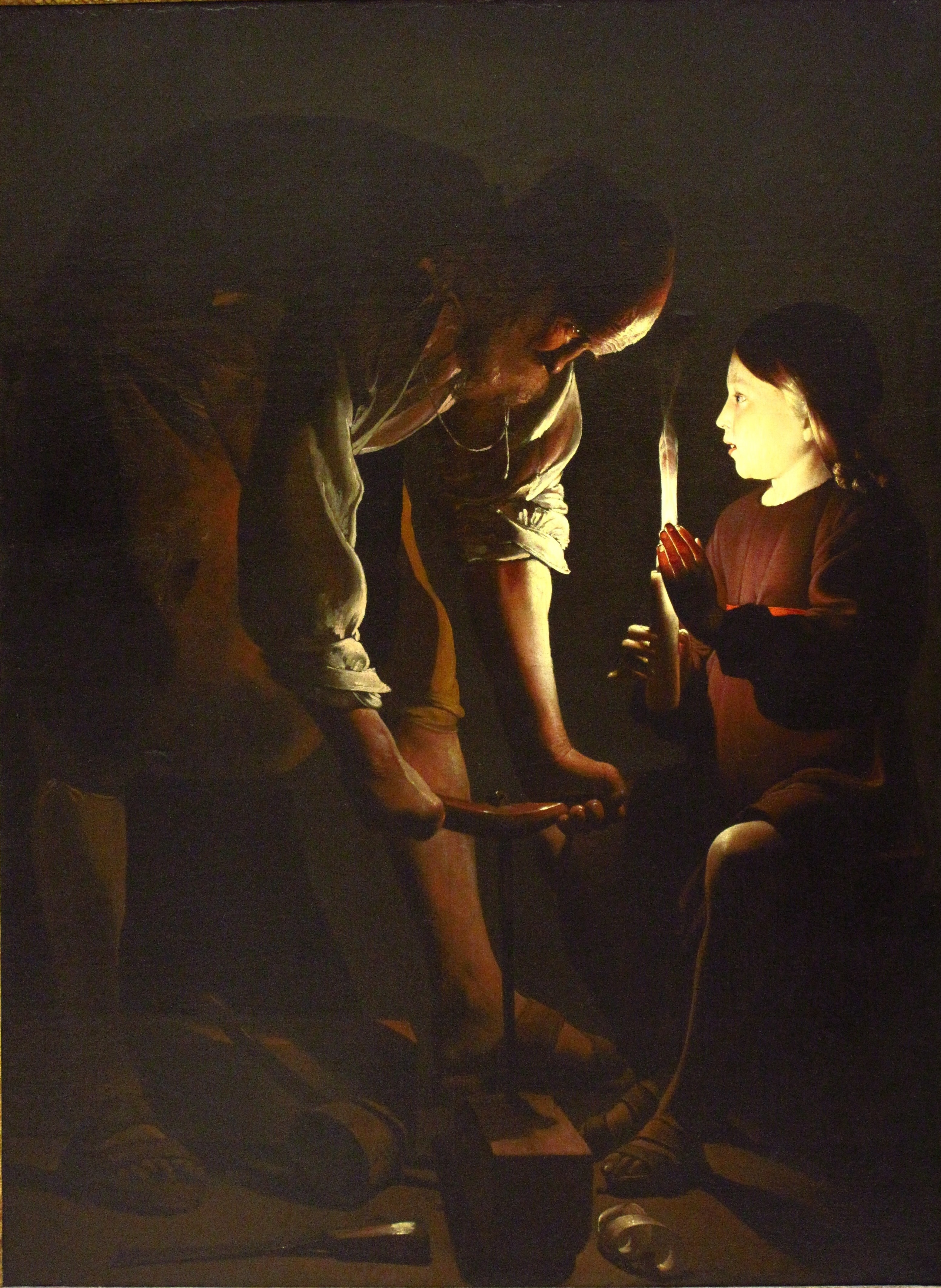
Georges de La Tour, Saint Joseph the Carpenter (c. 1642). The carpenter is the stock example of an efficient cause: he turns wood (material) into a beam of a certain shape (form) for a purpose (end). Musée du Louvre, Paris. Image: public domain, via Wikimedia Commons.
See this page's graph and discover linked topics
In full
Aristotle sets out the four causes in Physics II.3 and again in Metaphysics V.2. The Greek aitia is broader than the modern English "cause": it means a reason or explanation, anything that properly answers a "why?" question. The four are:
| Cause | Question it answers | A wooden chair | A house |
|---|---|---|---|
| Material | What is it made of? | The wood | Bricks, timber, concrete |
| Formal | What makes it this kind of thing? | The structure that makes it a chair | Its plan and arrangement |
| Efficient | What brought it into being? | The carpenter at work | The builders |
| Final | What is it for? | To be sat on | To give shelter |
Two features of the scheme carry most of its philosophical weight:
- The four are kinds of explanation, not four separate agents. The chair does not need four makers. It needs four kinds of answer.
- The scheme applies to things that come to be and change. Aristotle built it to explain natural things and artifacts. His own first principle, the unmoved mover of Metaphysics XII.7, has no efficient cause at all.
How Aquinas uses the four causes
Thomas Aquinas took the scheme over, explained it in his short treatise De Principiis Naturae (On the Principles of Nature), and used it to state the Christian doctrine of creation.
- God is not caused in any of the four ways. He has no matter, so no material cause. His nature is not received from a form outside Him. He has no efficient cause, since nothing brings Him into being. He is not ordered to an end beyond Himself.
- God is cause in three of the four ways for everything else. In Summa Theologiae I q.44 Aquinas argues that God is the efficient cause of all things (a.1), that even prime matter is created by Him (a.2), that He is the exemplar cause, the pattern in whose mind the forms of things exist (a.3), and that He is the final cause, the end to which all things are ordered (a.4).
- Final causes ground the Fifth Way. Aquinas argues that natural things without minds act regularly for an end, and that what lacks a mind can be directed to an end only by a mind. See Fifth Way - Teleology.
- Efficient causes ground the Second Way. An ordered series of efficient causes, each caused by another, requires a first efficient cause that is not caused. See Second Way - Efficient Causality.
Scripture says the same thing in its own terms: "For of him, and through him, and unto him, are all things" (Romans 11:36, ASV). Of him (source), through him (agent), unto him (end).
Common misuses
- "Everything has four causes, so God must too." The scheme explains things that come to be. Applying it to the uncaused source of all things is a Category Error. See Who Created God Objection Defeater.
- "Final causes are just human purposes read into nature." Aristotle's final causes include the natural end-directedness of things that have no minds: an acorn growing toward an oak, an eye ordered to seeing. Early modern thinkers such as Francis Bacon set final causes aside as fruitless for physics, and that methodological choice is often mistaken for a discovery that ends do not exist.
- "Modern science has replaced the four causes." Modern science concentrates on efficient and material causes, and on formal structure expressed in mathematics. It has not shown that the other questions are meaningless. Biology still speaks of what an organ is for.
- "The four causes prove the Christian God." They do not on their own. They provide the vocabulary in which the cosmological and teleological arguments are stated. The arguments still have to be made.
Why it matters apologetically
- It answers the most common objection to the cosmological argument, "who caused God?", by showing what the causal principle actually covers.
- It explains why classical theists say God is the source of the world rather than the first item in it.
- It gives the teleological argument its oldest form: purpose in nature points to a mind. See Teleological Arguments.
See also
- Aristotle, who set out the scheme
- Thomas Aquinas, who used it to state the doctrine of creation
- Who Created God Objection Defeater, the objection the scheme is most often misused in
- Category Error, the mistake of applying the scheme to God
- Second Way - Efficient Causality, the argument from efficient causes
- Fifth Way - Teleology, the argument from final causes
- Actus Purus, the first cause as pure actuality
- Necessary vs Contingent Being, the distinction behind the first cause
Common questions this page answers
Q: What are Aristotle's four causes?
They are four kinds of explanation for why a thing is as it is: the material cause (what it is made of), the formal cause (what makes it the kind of thing it is), the efficient cause (what brought it about), and the final cause (what it is for). A wooden chair is made of wood, shaped as a chair, built by a carpenter, and made for sitting.
Q: Does everything have four causes?
No. The four causes explain things that come to be and change. Aristotle's own first principle, the unmoved mover, has no efficient cause, and Aquinas held that God is caused in none of the four ways. Applying the scheme to God is a category error.
Q: How did Thomas Aquinas use the four causes?
Aquinas argued that God is the efficient cause, the exemplar (pattern) cause and the final cause of everything else, while nothing causes God. He also built two of his Five Ways on them: the Second Way on efficient causes and the Fifth Way on final causes.
Q: What is a final cause?
The end or purpose a thing is directed toward. For an artifact it is the use it was made for. For natural things it is the end they tend toward by nature, such as an acorn growing into an oak. Aquinas argued that things without minds acting regularly for ends point to a directing mind.