Argument
Argument from Objective Truth
Argument from Facts, Argument from Truth, Since facts exist God exists, Argument from Eternal Truths, Does truth require GodIntro
Everyone in a debate agrees on at least one thing: some things are true whether or not anyone believes them. The earth existed before there were people to notice it. Two plus two was four before anyone counted. A lie is a lie even if everyone believes it.
This argument starts there and asks a simple question: what is it that is true? Not the rocks or the planets themselves, but the truth about them. A truth is always about something, it can be stated, and it can be known. Those are the marks of a thought. Some truths were true before any human mind existed, and some could never have been false at all. A thought that has always been true, and could not have failed to be true, needs a mind that has always existed and could not have failed to exist. That is what Christians call God.
The argument does not say atheists cannot know true things. They obviously can. It asks what makes truth the kind of thing it is, and which worldview has room for it.
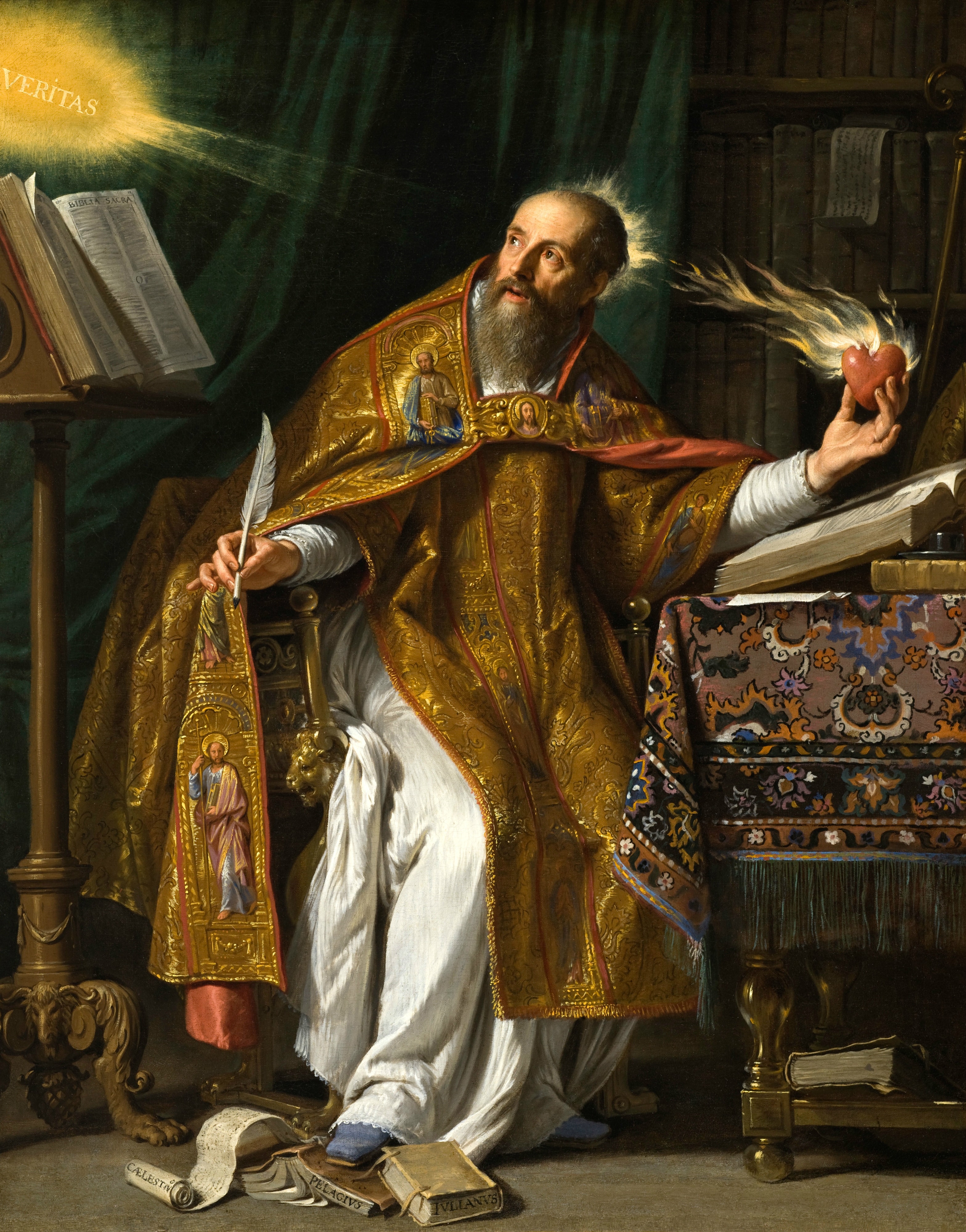
Philippe de Champaigne, Saint Augustine, c. 1645-1650, Los Angeles County Museum of Art. Augustine looks up to the light marked Veritas, "truth." Image: public domain, via Wikimedia Commons.
See this page's graph and discover linked topics
In full
Truth-bearers, the things that are true or false, are best understood as propositions: the shareable contents expressed by sentences in any language and grasped by many minds. Propositions have intentionality (they are about objects and states of affairs), they stand in logical relations (entailment, contradiction), and some of them are necessarily true. The argument runs: (1) there are objective truths; (2) some truths are necessary and some held before any human existed; (3) truth-bearers are propositions, and propositions have intentionality, which is a mark of the mental; (4) necessary, mind-independent-of-humans propositions therefore require a necessary, non-human mind whose thoughts they are; (5) such a mind is God. The tradition runs from Augustine, who argued in On Free Choice of the Will II that there is an unchangeable truth above our minds that is either God or something God is above, through Leibniz, who held that the reality of eternal truths "must be founded in something existent and actual," the divine understanding (Monadology 43-44), to Plantinga's argument from the nature of propositions and the theistic conceptual realism of Greg Welty.
The decisive distinction is between truthmakers and truth-bearers. The common objection, "facts are just the way reality is," answers what makes a truth true (the world). It does not answer what is true. The argument concerns the bearer. Rival accounts of bearers (human-mind psychologism, Platonic abstract objects, deflationism, Spinoza's impersonal substance) are compared below and shown to fail at the point the theistic account succeeds: explaining how something can be necessarily true, about the world, and knowable, all at once.
Even if successful, the argument establishes a necessary, rational mind, not yet the Trinity. The Christian identification comes in a second stage, through the Logos "in the beginning" (John 1:1-3) and the historical case for the resurrection. See Christian God is the Only True God.
Argument structure
| # | Premise |
|---|---|
| P1 | There are objective truths, true whether or not any human believes them. |
| P2 | Some truths are necessary (they could not have been false), and some contingent truths held before any human existed. |
| P3 | What is true or false is a proposition, and propositions are intentional: they are about things, which is a mark of thought. |
| P4 | Thoughts that exist necessarily, or before any human, require a mind that exists necessarily and is not human. |
| P5 | The rival grounds (human minds, Platonic abstract objects, deflationism, impersonal substance) cannot account for truths with all these features. |
| C | A necessary, eternal mind exists, whose thoughts are the truths. This is God. |
Form
Deductive core (P1-P4 entail a necessary mind) with an abductive guard (P5 compares rival grounds). The argument is a cousin of the Argument from Mathematical Truth, which runs the same reasoning on mathematics alone, and of the Transcendental Argument for God, which argues from the preconditions of reasoning. Its distinctive feature is that it starts from the existence of facts of any kind, which every opponent already grants.
P1, There are objective truths
Affirmative case (second-order arguments)
- Denial is self-refuting. "There are no objective truths" is offered as an objective truth.
- Science presupposes it. Every measurement aims at how things are, not how anyone feels.
- Moral and historical debate presupposes it. "That really happened" and "that was really wrong" are claims about more than opinion.
Anticipated objections
- "Truth is relative to cultures or perspectives."
Rebuttals
- The relativist thesis is itself non-relative. If it is only true for the relativist, nobody else need accept it. Most opponents in a formal debate concede P1 at once; take the concession and move on.
Tactical notes
- Get P1 conceded in the first minute. It is the premise the opponent most wants to grant.
P2, Some truths are necessary, and some held before any human
Affirmative case (second-order arguments)
- Necessary truths. "Nothing is both red all over and green all over at once"; "if A implies B and A, then B"; "2 + 2 = 4." These could not have been false.
- Truths before people. "The earth exists and no human exists" was true for a very long time. Its truth did not wait for a human to think it.
- Truths no human will ever think. There are facts about the far side of distant galaxies that no one will ever state. They are true anyway.
Anticipated objections
- "Necessary truths are just conventions of language."
- "Before people there were facts, but no 'truths,' since truth needs a language."
Rebuttals
- Conventions fix which words we use, not what they say. We could have used "four" for five, but the arithmetic fact expressed would be unchanged. The necessity attaches to the content, not the label.
- That concedes the point under a new name. If the earth existed before people, then it was the case that the earth existed. Calling that a "fact" rather than a "truth" does not change that something was so, and could be stated, before anyone stated it.
P3, Truth-bearers are propositions, and propositions are intentional
Affirmative case (second-order arguments)
- The same truth, many sentences. "Snow is white," "La neige est blanche" and "Der Schnee ist weiß" express one truth. What is true is the shared content, the proposition, not the ink.
- Aboutness. A proposition is about something and represents it as being a certain way. Rocks, stars and electrons are not about anything. Aboutness (intentionality) is the mark of the mental: thoughts, beliefs and statements have it.
- Logical relations. Propositions entail, contradict and support one another. Those are relations between contents, the kind of thing minds trade in.
Anticipated objections
- "Facts are just the way reality is. Why would their existence require a mind?" The strongest and most common objection.
- "Propositions are abstract objects, like numbers in Plato's sense. They are about things without being thoughts."
Rebuttals
- That answers a different question. "The way reality is" is the truthmaker: the world that makes a truth true. The argument is about the truth-bearer: the thing that is true. The fact that snow is white makes the proposition "snow is white" true, but the snow is not itself about anything. The objection explains why truths are true; it does not explain what truths are.
- Abstract objects cannot be about anything. A Platonic object is causally inert and non-mental. Saying it represents the world as being a certain way gives it the one property that only minds are known to have. Plato himself needed a divine craftsman to connect the forms to the world. See Argument from Mathematical Truth for the parallel case.
Live-cite kit
- Scholarly: Alvin Plantinga, "How to Be an Anti-Realist," Proceedings and Addresses of the American Philosophical Association 56 (1982).
- Aphorism: "The fact makes the truth true. It does not make the truth."
Tactical notes
- Use the snow example out loud. The truthmaker / truth-bearer distinction is the whole debate, and most opponents have never heard it.
P4, Necessary thoughts need a necessary mind
Affirmative case (second-order arguments)
- No thought without a thinker. Every thought we know of is someone's thought.
- Human minds are too late and too small. Human minds are contingent and recent; necessary truths held before them and hold where they never reach. Human thought cannot be what those truths are.
- So the mind must be necessary, eternal and omniscient in scope. A mind that thinks every truth, could not fail to exist, and has always existed. Leibniz drew exactly this conclusion: eternal truths are grounded in "the understanding of God."
Anticipated objections
- "Euthyphro for logic: does God make truths true by thinking them? Then God could have made 2 + 2 = 5."
- "Maybe the mind is impersonal, like Spinoza's God or Nature."
Rebuttals
- God's thoughts are grounded in His nature, not His whim. On theistic conceptual realism, necessary truths are God's necessary thoughts, flowing from His unchangeable nature. They are neither arbitrary nor independent of Him, so the dilemma's two horns are both refused. See Divine Simplicity.
- An impersonal mind is a contradiction. Thinking is something persons do. Spinoza grants God the attribute of thought but denies Him intellect and will in any personal sense. Thought without a thinker is the very gap the argument identifies. See Baruch Spinoza and Pantheism vs the Christian God.
P5, The rival grounds fail
| Rival ground | What it explains | Where it fails |
|---|---|---|
| Human minds (psychologism) | Truths we actually think | Truths before humans, truths no one thinks, necessary truths |
| Platonic abstract objects | Necessity, mind-independence | Aboutness; how inert objects relate to the world or to our minds |
| Deflationism ("true" adds nothing) | The grammar of "is true" | Leaves the bearer and its necessity unexplained |
| Spinoza's impersonal substance | Necessity, unity of reality | Thought with no thinker, intellect with no person |
| A necessary personal mind (God) | Necessity, aboutness, knowability, unity | (none of the above) |
Tactical notes
- Ask the decisive question: "On your worldview, what is the thing that is true, and how does it manage to be about the world and to have been true before any of us?"
- Do not get pulled into technical debates about deflationism. Its defenders grant that something is true; ask what.
Master objections to the whole argument
- "This only gets you a philosopher's God, not Jesus." Correct, and the argument does not claim more. It establishes a necessary, rational, personal mind. The identification of that mind with the God who speaks in Scripture and raised Jesus is a second stage. See Christian God is the Only True God.
- "It begs the question by assuming only minds can have aboutness." It infers it from every known case. The objector is free to name a non-mental thing that is about something. Pictures and sentences are about things only because minds made or read them.
- "Brute necessity: truths just exist necessarily, end of story." That treats the truths as necessary beings with no explanation of their aboutness. The theist also posits a necessary being, but one whose nature explains why the truths are true, about the world, and knowable by minds made in its image.
Tactical opening / closing
Opening line: "We both agree some things are true whether anybody believes them or not. I want to ask what those truths are, and why there were truths before there were people."
Closing line: "Facts make truths true, but they do not make truths. Something has always been thinking what is true. Christians have a name for that mind, and a reason to think it spoke: 'In the beginning was the Word.'"
Connection to Scripture
- John 1:1-3, the Logos (word, reason) who was in the beginning, through whom all things were made
- Colossians 1:17, "in him all things consist" (ASV)
- Hebrews 1:3, the Son "upholding all things by the word of his power" (ASV)
- John 14:6, "I am the way, and the truth, and the life" (ASV)
- Titus 1:2, God "who cannot lie" (ASV)
Biblical citations show how Christianity understands God as the ground of truth. They are not offered as premises to someone who rejects Scripture.
Live-cite kit
- Scripture: John 1:1-3; Colossians 1:17; John 14:6.
- Scholarly:
- Augustine, On Free Choice of the Will (De Libero Arbitrio) II
- Gottfried Wilhelm Leibniz, Monadology (1714), sections 43-44
- Alvin Plantinga, "How to Be an Anti-Realist" (1982)
- James N. Anderson and Greg Welty, "The Lord of Non-Contradiction: An Argument for God from Logic," Philosophia Christi 13.2 (2011)
- Aphorism: "No thought without a thinker. No eternal truth without an eternal mind."
Scholarship
Published academic works this page draws on, each matched to a publisher, index or library catalog record.
- James N. Anderson, Greg Welty and Evangelical Philosophical Society, "The Lord of Noncontradiction: An Argument for God from Logic," Philosophia Christi 13 (2011). doi:10.5840/pc201113229
- Alvin Plantinga, "How to be an Anti-Realist," Proceedings and Addresses of the American Philosophical Association 56 (1982). doi:10.2307/3131293
See also
- Argument from Mathematical Truth, the same reasoning applied to numbers
- Transcendental Argument for God, God as the precondition of reasoning
- Syllogisms for Logic Itself, the laws of logic as the special case
- Argument from Intelligibility, why the world is knowable by our minds
- Necessary Being is an Intelligent Mind, why the necessary being must be personal
- Baruch Spinoza, the strongest impersonal rival
- Anyone Who Affirms Universals Must Affirm God, the parallel argument from universals
- Christian God is the Only True God, the second stage from a necessary mind to the Christian God
Common questions this page answers
Q: Does the existence of facts prove that God exists?
Not by itself. The argument needs one further step: what is true is a proposition, and propositions are about things, which is a feature of thoughts. Some truths are necessary and some were true before any human existed, so they point to an eternal mind whose thoughts they are.
Q: Aren't facts just the way reality is, without any mind?
Facts are what make truths true. The argument is about the truths themselves, the statements that are true. Snow makes "snow is white" true, but snow is not about anything. Truths are about things, and aboutness belongs to thought.
Q: Could truths exist as abstract objects without God?
That is the Platonist answer. Its difficulty is that abstract objects are non-mental and causally inert, yet the theory needs them to represent the world and to be grasped by our minds. A necessary mind explains all of that at once.
Q: Does God decide what is true?
No. On the classical view, necessary truths are God's thoughts grounded in His unchanging nature. They are not arbitrary choices, and they are not independent of God either.
Q: Does the argument from truth prove the Christian God?
It establishes a necessary, eternal, rational mind. Christians identify that mind with the God of Scripture through a second step: the Word who was "in the beginning" (John 1:1) and the historical evidence for Jesus' resurrection.