Argument
Argument from Knowledge of Experience
Ghost Dragon Argument, Argument from Phenomenal Judgment, Self-Stultification Argument Against Naturalism, Argument from Knowledge of Subjective ExperienceIntro
Close your eyes and picture a green square. You can see it. You can tell it is green, not blue. You can tell it has four sides, not five. Nobody else can look inside and check, yet you know these things with total confidence.
Now ask a strange question: how do you know?
Here is the puzzle. Your brain is a network of nerve cells passing electrical signals. On the naturalist picture, those signals explain everything your body does: every movement of your hand, every word out of your mouth, including the words "I am picturing a green square." If the experience of green is something extra that floats on top of the signals, then the experience itself does no work. The signals do it all.
Picture an invisible ghost dragon that pops into being every time electricity moves. It passes through walls, it pushes nothing, it triggers no sensor. Could anyone ever find out it exists? No. Nothing in the world would be any different with it or without it, so there is no natural route from the dragon to anyone knowing about it.
On naturalism, your experience is in the same spot as the dragon. Yet you know your experience in fine detail. So either your experience really does reach into the physical world and move it, which means the physical world is not a closed system and naturalism is false, or something beyond nature matched what you say about your mind to what your mind is actually like. Either road leads away from naturalism, and the second leads straight to a Designer.
The 30-second reply:
If the brain's electrical signals explain everything you do, then your experience of red or pain causes nothing. Something that causes nothing can never be discovered by natural means, like an invisible ghost dragon that touches nothing. But you know your experiences in detail. So either experience pushes on the physical world, and naturalism's closed system breaks, or Someone beyond nature fitted your mind to know itself. Either way, naturalism loses.
See this page's graph and discover linked topics
In full
An argument from self-knowledge against naturalism. Naturalism holds that the physical world is causally closed: every physical event, including every bodily act and every spoken or written report, has a sufficient physical cause. If phenomenal consciousness (the felt quality of experience) is not itself one of those physical causes, it is epiphenomenal, caused by the brain but causing nothing in return. An epiphenomenal experience cannot cause, and so cannot be what our judgments about it track; any match between what we say about our experience and what it is actually like would be a coincidence. Yet we have extensive, reliable, fine-grained knowledge of our experience. The naturalist must therefore either identify experience with brain processes (which leaves the hard problem standing), deny that the felt quality exists (illusionism), or give up causal closure. The theist explains the match directly: we are made by a Mind, as minds whose judgments are fitted to, or caused by, their own experience.
The argument has a long pedigree. Thomas Huxley proposed in 1874 that animals are conscious automata whose feelings do nothing; William James answered in The Principles of Psychology (1890, ch. 5) that a consciousness with no effects could never have been shaped by natural selection. David Chalmers named the core difficulty the paradox of phenomenal judgment (The Conscious Mind, 1996, ch. 5) and later the meta-problem of consciousness (2018): why do physical systems like us say and believe that we have experiences at all? In the literature on epiphenomenalism the same point is the self-stultification objection, debated by William Robinson ("Knowing Epiphenomena", 2006) and defended by Felipe De Brigard (2014). The physicist Avshalom Elitzur argues from it to interactionist dualism ("Consciousness Makes a Difference", 2009). The YouTube creator Ponder Points gave it its sharpest popular form with the ghost-dragon test (2026). This page is structured as debate prep: each premise carries an affirmative case, anticipated objections, rebuttals, a live-cite kit and tactical notes.
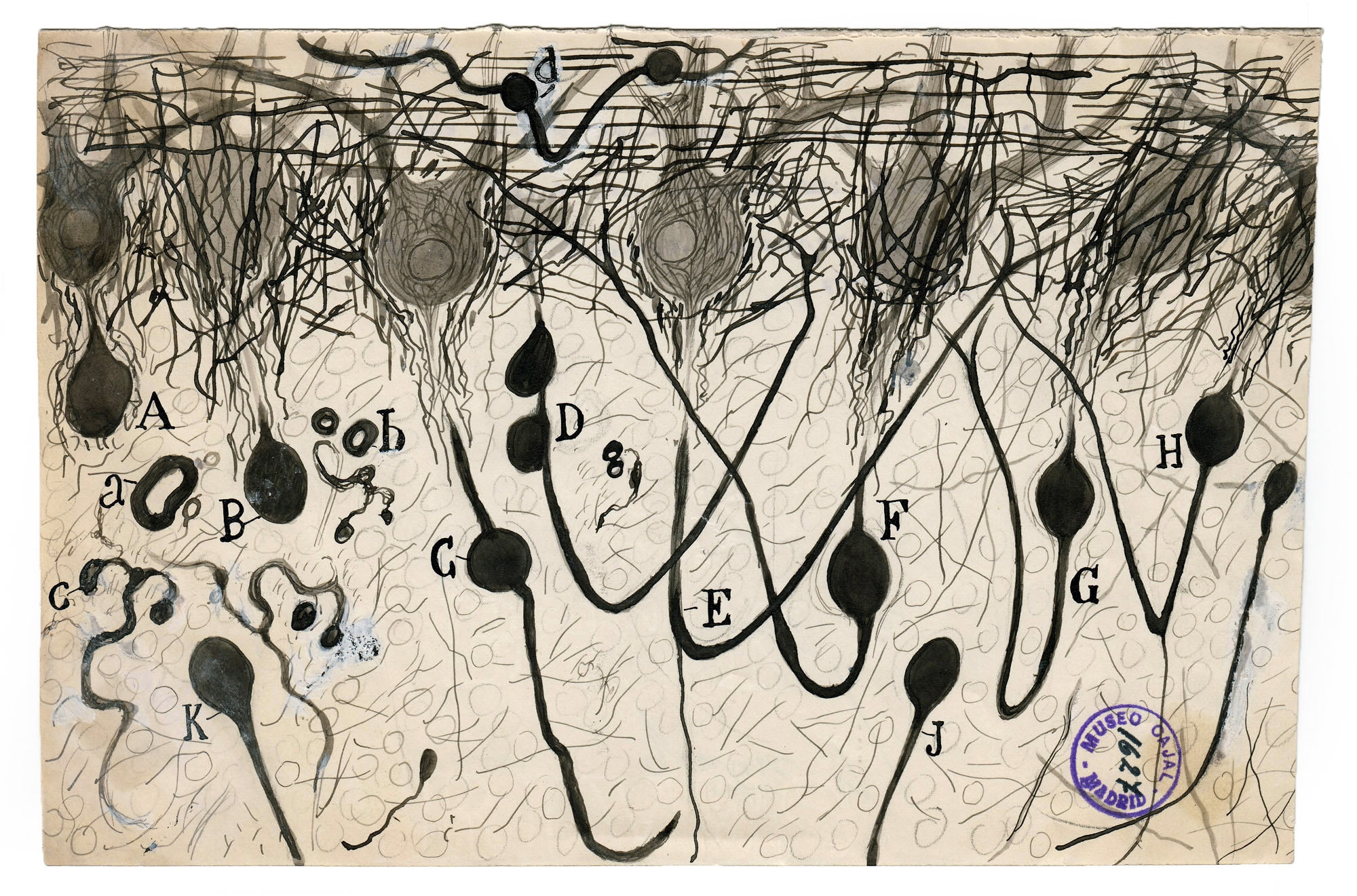
Nerve cells of the cerebellum, drawn in ink by the neuroscientist Santiago Ramón y Cajal around 1900. Image: public domain, via Wikimedia Commons.

Argument structure
| # | Premise |
|---|---|
| P1 | If naturalism is true, the physical world is causally closed: every bodily act, including every report about experience, has a sufficient physical cause. |
| P2 | If the physical world is causally closed, then either experience is identical to a physical process, or experience causes no physical event (it is epiphenomenal). |
| P3 | If experience causes no physical event, then our judgments about experience cannot track it by any natural process. |
| P4 | Our judgments about experience do track it, reliably and in detail. |
| P5 | Identifying experience with a physical process does not explain how our judgments track the felt quality of experience as felt. |
| C1 | Therefore, naturalism has no adequate account of our knowledge of experience. |
| C2 | Therefore, the best explanation is that a Mind beyond nature made us as minds able to know our own experience. |
Form
Two steps. (1) Disjunctive syllogism against naturalism (P1 to C1): under causal closure, experience is either identical to the physical or inert; the inert branch makes self-knowledge inexplicable (P3, P4), and the identity branch leaves the felt quality outside the causal story (P5). (2) Inference to the best explanation (C2): among the live options (interactionist dualism, a designed correlation between mind and brain, Russellian panpsychism, illusionism), the ones that explain self-knowledge are the ones that give up naturalism, and they are most at home in theism.
What the argument does not claim. It does not prove Christianity on its own, and it does not depend on any gap in current neuroscience. Its target is the conjunction of causal closure with real, felt experience. A naturalist who denies either one escapes the argument, but pays for it (see P2 and P5).
P1, If naturalism is true, the physical world is causally closed
Affirmative case (second-order arguments)
- Closure is naturalism's working creed. Naturalism says there is nothing beyond nature that acts on nature. In philosophy of mind that becomes the causal closure of the physical: every physical effect has a sufficient physical cause (see the Stanford Encyclopedia entry "Epiphenomenalism", W. S. Robinson).
- Naturalists use closure as their main argument. The standard case for physicalism (Papineau, Kim) runs: mental events cause behavior; behavior has sufficient physical causes; so mental events must be physical. Closure is the premise doing the work.
- Neuroscience is practiced on closure. Explanations of reaching, speaking and reporting run from stimulus through neural signals to muscles, with no step that requires a non-physical push.
Anticipated objections
- "Naturalism need not include strict closure; it only rejects the supernatural."
- "Quantum indeterminacy means physics is not closed."
Rebuttals
- Then the naturalist allows a non-physical cause of bodily acts, which is the dualist's core claim. Dropping closure is conceding the argument's conclusion against physicalism.
- Indeterminacy leaves outcomes to chance; chance is not experience. If felt experience settles which way an outcome goes, experience is a non-physical cause acting on the physical, again the interactionist's position, not the naturalist's.
Live-cite kit
- Scholarly: Jaegwon Kim, Mind in a Physical World (1998), the causal exclusion argument; David Papineau, Thinking About Consciousness (2002), closure as the case for physicalism.
- Aphorism: "If physics does all the pushing, the mind is a passenger."
Tactical notes
- Get closure granted early. Ask: "Does anything non-physical ever move your arm?" A naturalist will say no. That answer is P1.
P2, Under closure, experience is either physical or inert
Affirmative case (second-order arguments)
- Exclusion. If a bodily act already has a sufficient physical cause, a separate non-physical experience either adds a second sufficient cause (systematic overdetermination, which almost no one accepts) or causes nothing. This is Kim's exclusion argument, and it leaves two doors: identity or inertness.
- Emergence does not open a third door. Saying experience "emerges" from neurons names a relation, but if the emergent feeling is not itself the physical cause, the output signals still do all the work. Ponder Points puts it plainly: firing neurons yield two products, the experience and the output signals, and the output signals alone explain every action.
Anticipated objections
- "Experience and the signals are a package deal; you cannot have one without the other."
- "Higher-level causes are real; the mind causes things at its own level."
Rebuttals
- Constant pairing is not causal work. If ghost dragons always appeared with moving electrons, the pairing would still leave every effect explained by the electrons. A package deal is a correlation; P3 asks what causes our judgments.
- Either the higher-level cause is identical to its physical base (the identity branch) or it adds something the base does not (which breaks closure). The dilemma stands at every level.
Live-cite kit
- Scholarly: Kim, Physicalism, or Something Near Enough (2005); Chalmers, The Conscious Mind (1996), ch. 5.
- Aphorism: "Always showing up is not the same as doing anything."
Tactical notes
- Run the ghost-dragon test on every reply: give the dragon the same relation to matter the opponent gives experience, and ask whether that would let anyone discover the dragon.
P3, Inert experience cannot be what our judgments track
Affirmative case (second-order arguments)
- Knowledge needs a connection. On any naturalistic theory of knowledge (causal, reliabilist, evidential), a belief counts as knowledge only if the fact it is about plays some role in producing it. An inert experience plays no role.
- The zombie twin. Chalmers notes that a physical duplicate of you lacking experience would say exactly the same things about experience, for exactly the same physical reasons. So under closure your words about experience are produced in a way that never consults the experience.
- Evolution cannot help. William James (1890) argued that natural selection works only on what makes a difference to behavior. An inert feeling makes no difference, so selection cannot shape it or tune our beliefs to it. Ponder Points: would evolution ever teach us about ghost dragons? No, for the same reason.
Anticipated objections
- "The same brain state causes both the experience and the judgment, so they line up." (Robinson's reply)
- "Knowledge by acquaintance needs no causal route; we are simply aware of our experience."
Rebuttals
- A common cause yields correlation, not knowledge of the experience. On this picture the judgment would occur in exactly the same way if the experience were different or absent (the zombie twin), so the judgment is insensitive to the very thing it is about. De Brigard (2014) defends this point against Robinson.
- Acquaintance is a mental relation, not a physical one. If acquaintance is real and it shapes what we say, then experience is affecting speech, and closure has failed; if it shapes nothing we say, our spoken reports still float free of it.
Live-cite kit
- Scholarly: De Brigard, "In Defence of the Self-Stultification Objection", Journal of Consciousness Studies 21 (2014); Robinson, "Knowing Epiphenomena", JCS 13 (2006).
- Aphorism: "A belief that would be the same whatever the facts were is not tracking the facts."
Tactical notes
- Ask the zombie question directly: "Would your zombie twin say 'I see green'? Then what in your brain makes your saying it different from his?"
P4, We do know our experience, reliably and in detail
Affirmative case (second-order arguments)
- Detail. We know not only that we experience, but which quality: green not blue, four sides not five, a sharp pain not a dull ache. Ponder Points: that is like knowing how many scales the ghost dragon has.
- Self-defeat. Anyone who argues that we have no knowledge of experience is relying on his own experience of the evidence and of his reasoning. Denying P4 saws off the branch the denial sits on.
- The data of the debate. The hard problem exists only because we know experience is there and know what it is like. If we did not know that, there would be nothing to explain.
Anticipated objections
- "Introspection is unreliable; psychology shows we misjudge our own minds." (Schwitzgebel)
- "Illusionism: there is no felt quality, only a brain that represents itself as having one." (Frankish, Dennett)
Rebuttals
- Error about fine details (peripheral vision, the causes of our moods) assumes success at the basic level: that we see, that pain hurts. P4 needs only that basic level.
- An illusion is something that seems a certain way, and seeming is experience. Illusionism must either explain the seeming, which brings the felt quality back, or deny that anything seems, which no one can believe while feeling pain.
Live-cite kit
- Scholarly: Eric Schwitzgebel, Perplexities of Consciousness (2011); Keith Frankish (ed.), Illusionism as a Theory of Consciousness (2017); Chalmers, "The Meta-Problem of Consciousness" (2018).
- Aphorism: "You cannot be fooled about pain without something hurting."
Tactical notes
- Most opponents will concede P4 at once. Lock it in before P3, because it raises the cost of denying P3.
P5, The identity view does not explain knowledge of the felt quality
Affirmative case (second-order arguments)
- The causal story never mentions the feel. On the identity view, the brain state that is your experience of green causes your report, but it does so wholly by its electrical and chemical properties. The greenness as felt adds nothing to the explanation; any state with the same physical profile would cause the same report.
- The ghost-dragon test applies. Suppose electrons were ghost dragons. We would still learn only about electrons, because every effect runs through their electrical profile. Calling the signal "the green square" does not give us a route to know it as green.
- The hard problem returns. Identity claims cannot be checked against the felt quality without already knowing that quality from the inside, which is the knowledge the identity view was meant to explain.
Anticipated objections
- "If experience just is the brain state, the experience causes the report. Problem solved."
- "Phenomenal concepts: we refer to brain states in a special inner way, and that explains the appearance of a gap." (Loar, Papineau)
Rebuttals
- It causes the report under its physical description only. The question is how the report comes to be correct about the felt quality, and nothing in the physical description says what green is like. The identity theorist is now owed an explanation of why this physical state feels like this rather than like nothing.
- Phenomenal concepts are themselves either physical (then the zombie twin has them too, and they do not reach the feel) or they involve the feel (then the feel is doing work closure cannot allow). Chalmers presses this dilemma in "Phenomenal Concepts and the Explanatory Gap" (2007).
Live-cite kit
- Scholarly: Chalmers, "Phenomenal Concepts and the Explanatory Gap" (2007); Brian Loar, "Phenomenal States" (1990).
- Aphorism: "Renaming the signal does not teach the signal what green looks like."
Tactical notes
- Do not overclaim here. The identity view is the naturalist's strongest move; press it as an unexplained fact, not a contradiction.
C2, The best explanation is a Mind beyond nature
- Two theistic routes both explain P4. On interactionist dualism, the view of most Christian thinkers from Augustine to Moreland and Swinburne, the soul's experience really does act on the body, so our reports flow from our experience. On a design view, a Creator fitted our judgments to our experience, which is Ponder Points' conclusion. Either way the match between mind and report is no accident.
- Naturalism's escapes each cost a premise it needs. Breaking closure gives up physicalism; illusionism gives up the data; identity leaves the feel unexplained.
- Fit with Scripture. Humans are made in God's image as knowing persons (Genesis 1:27), and "the spirit of man is the lamp of the LORD, searching all the innermost parts of his being" (Proverbs 20:27, NASB95). A world made by a Knower is a world where knowers can know themselves.
Watch: the ghost-dragon argument
Ponder Points' video sets out the argument in thirteen minutes, from the green square to the ghost dragon and the reply to "package deal" objections.
Video: "The Argument for God You Haven't Heard" by Ponder Points, on YouTube (2026). Credit and thanks to its creator; watch it on YouTube.
Conclusion
Naturalism cannot explain how we know our own experience, and the best explanation is a Mind beyond nature who made us able to know ourselves. Under causal closure, felt experience is either inert, in which case our detailed knowledge of it is a coincidence, or identical to brain signals whose causal work never touches the feel. Theism explains the match between what we experience and what we say about it, whether through a soul that acts on the body or a Creator who designed the fit.
Master objections to the whole argument
- "This is a god of the gaps." Reply: the argument rests on the structure of naturalism (closure) and on what knowledge requires, not on something science has not found yet. No future discovery of more physical causes helps, because more physical causes is the problem.
- "Panpsychism explains it without God." Reply: Russellian panpsychism (Goff, Strawson) gives up physicalism and grants that the felt is fundamental. It then faces the combination problem and leaves open why tiny experiences combine into minds that know themselves; a personal Mind at the root explains that better. See Argument from Consciousness.
- "The argument proves too much: it would make all self-knowledge miraculous." Reply: it shows self-knowledge needs a cause or design beyond closed physics. On theism that is the ordinary way minds work, not a string of miracles.
- "Why the Christian God?" Reply: this argument establishes a mind-first reality and a Designer of minds. The case for the Christian God in particular comes from other arguments; see Cumulative Case for Christian Theism.
Tactical opening / closing lines
Opening line: "Picture a green square. You know it's green and you know it has four sides. Can I ask how naturalism explains that you know that?"
Closing landing strip: "Either your experience reaches out and moves the world, and the closed physical system breaks, or Someone made your mind to know itself. I think both are true, and both point past nature."
Connection to Scripture
- Genesis 1:27, humans made in the image of God as knowing persons
- Genesis 2:7, the breath of life making man a living soul
- Proverbs 20:27, "the spirit of man is the lamp of the LORD"
- 1 Corinthians 2:11, "who among men knows the thoughts of a man except the spirit of the man which is in him?"
- Psalm 139:14, "my soul knows it very well"
Patristic / scholarly note
Classical:
- Augustine (De Trinitate 10.10.14), the mind's certain knowledge of its own life, memory, understanding and will, even while it doubts
- Descartes (Meditations, 1641, II and VI), the certainty of thinking and interaction of mind and body
Modern:
- Thomas Huxley, "On the Hypothesis that Animals Are Automata" (1874), the classic epiphenomenalist proposal
- William James, The Principles of Psychology (1890), ch. 5, "The Automaton-Theory", the evolutionary reply
- David Chalmers, The Conscious Mind (1996), ch. 5, the paradox of phenomenal judgment; "The Meta-Problem of Consciousness", Journal of Consciousness Studies 25 (2018)
- William S. Robinson, "Knowing Epiphenomena", Journal of Consciousness Studies 13 (2006), the main reply to the self-stultification objection
- Felipe De Brigard, "In Defence of the Self-Stultification Objection", Journal of Consciousness Studies 21 (2014)
- Avshalom Elitzur, "Consciousness Makes a Difference: A Reluctant Dualist's Confession", in Batthyány and Elitzur (eds.), Irreducibly Conscious (2009)
- J. P. Moreland, Consciousness and the Existence of God (2008), the theistic abductive frame
- Ponder Points, "The Argument for God You Haven't Heard" (YouTube, 2026), the ghost-dragon formulation
Scholarship
Published academic works this page draws on, each matched to a publisher, index or library catalog record.
- Alexander Batthyany and Avshalom C. Elitzur, Irreducibly conscious (2009). Open Library
- David J. Chalmers, The Conscious Mind: In Search of a Fundamental Theory (Oxford University Press, 1996). Open Library
- David J. Chalmers, "Phenomenal Concepts and the Explanatory Gap," Phenomenal Concepts and Phenomenal Knowledge (2007). doi:10.1093/acprof:oso/9780195171655.003.0009
- William James, The principles of psychology (1890). Open Library
- Jaegwon Kim, Mind in a Physical World: An Essay on the Mind-Body Problem and Mental Causation (The MIT Press, 1998). doi:10.7551/mitpress/4629.001.0001
- Jaegwon Kim, Physicalism, or something near enough (2005). Open Library
- J. P. Moreland, Consciousness and the Existence of God (2008). Open Library
- David Papineau, Thinking about Consciousness (Oxford University Press, 2002). doi:10.1093/0199243824.001.0001
- Eric Schwitzgebel, Perplexities of Consciousness (The MIT Press, 2011). doi:10.7551/mitpress/8243.001.0001
See also
- Argument from Consciousness, the parent argument from the hard problem
- Consciousness Emerges from Neurons Objection Defeater, the emergence reply answered on its own
- Property Dualism, the view that makes experience inert under closure
- Substance Dualism, the interactionist route the argument favors
- Argument from Reason, the sister argument that reasoning cannot be merely caused
- Argument from the Reliability of Reason, Plantinga's parallel case about belief and truth
- Modal Argument from Mind, the zombie and conceivability cousin
- The Felt Ought Argument, the felt badness of pain as data naturalism must explain
- Naturalism, the target
- Arguments, master index
Common questions this page answers
Q: What is the ghost dragon argument for God?
It is Ponder Points' way of showing that naturalism cannot explain how we know our own experiences. An invisible dragon that touches nothing could never be discovered by natural means. If brain signals explain everything we do, experience is in the same spot as the dragon, yet we know it in detail, so our knowledge of it needs a cause beyond nature.
Q: What is the paradox of phenomenal judgment?
David Chalmers' name for the puzzle that, if physics explains all our behavior, it also explains everything we say about consciousness without ever appealing to consciousness itself. A physical duplicate with no experience would say the same things, so it is unclear how our words about experience are about it at all.
Q: What is the self-stultification objection to epiphenomenalism?
Epiphenomenalism says experiences are caused by the brain but cause nothing. The objection is that, if so, experiences could not cause our beliefs about them, so we could not know we have them; the theory undercuts the very knowledge its defenders rely on. Felipe De Brigard defended it in 2014 against William Robinson's reply.
Q: Can evolution explain how we know about our experiences?
Not if experience causes nothing. Natural selection only shapes what makes a difference to behavior, which was William James' point in 1890. An experience with no effects cannot be selected for, and cannot tune our beliefs to itself.
Q: Does this argument prove Christianity?
No. It argues against naturalism and for a Mind beyond nature, either a soul that acts on the body or a Creator who designed minds able to know themselves. The case for the Christian God in particular comes from other arguments, such as the resurrection and the cumulative case.
Q: What if consciousness just is the brain?
Then the brain state causes our reports, but only through its electrical and chemical properties. Nothing in that causal story explains why our reports are right about what the experience feels like, so the identity view leaves the felt quality unexplained.
Scripture quotations taken from the New American Standard Bible® (NASB), Copyright © 1960, 1971, 1977, 1995 by The Lockman Foundation. Used by permission. All rights reserved. www.lockman.org