Argument
Argument from Intentionality
argument from aboutness, intentionality argument, aboutness argument for God, can atheism ground aboutness, thoughts cannot be purely chemical, are thoughts just brain chemistry, how can a brain state be about somethingIntro
Your thoughts are about things. When you think of a tree, your thought points at the tree. When you believe two plus two is four, your belief is about numbers. You can even think about something that does not exist, like a unicorn, and you can be wrong, like when you mistake a wax apple for a real one.
Your brain works by electricity and chemistry. Neurons fire, ions cross membranes, chemical messengers jump between cells. All of that is real and important. Here is the puzzle: a full description of those electrical and chemical events tells you voltages, molecules and timing. It never tells you what any of it is about, and it never tells you whether it is true or false. Somewhere between "these neurons fired" and "I believe the tree is green" a new property shows up, and the physics does not mention it.
Christianity has a ready home for that property. God knows, and His knowing is not borrowed from anything. Human beings are made in His image, so our minds can be about things too. The argument says this explains aboutness better than a worldview where mind showed up late in a universe that, at bottom, is about nothing.
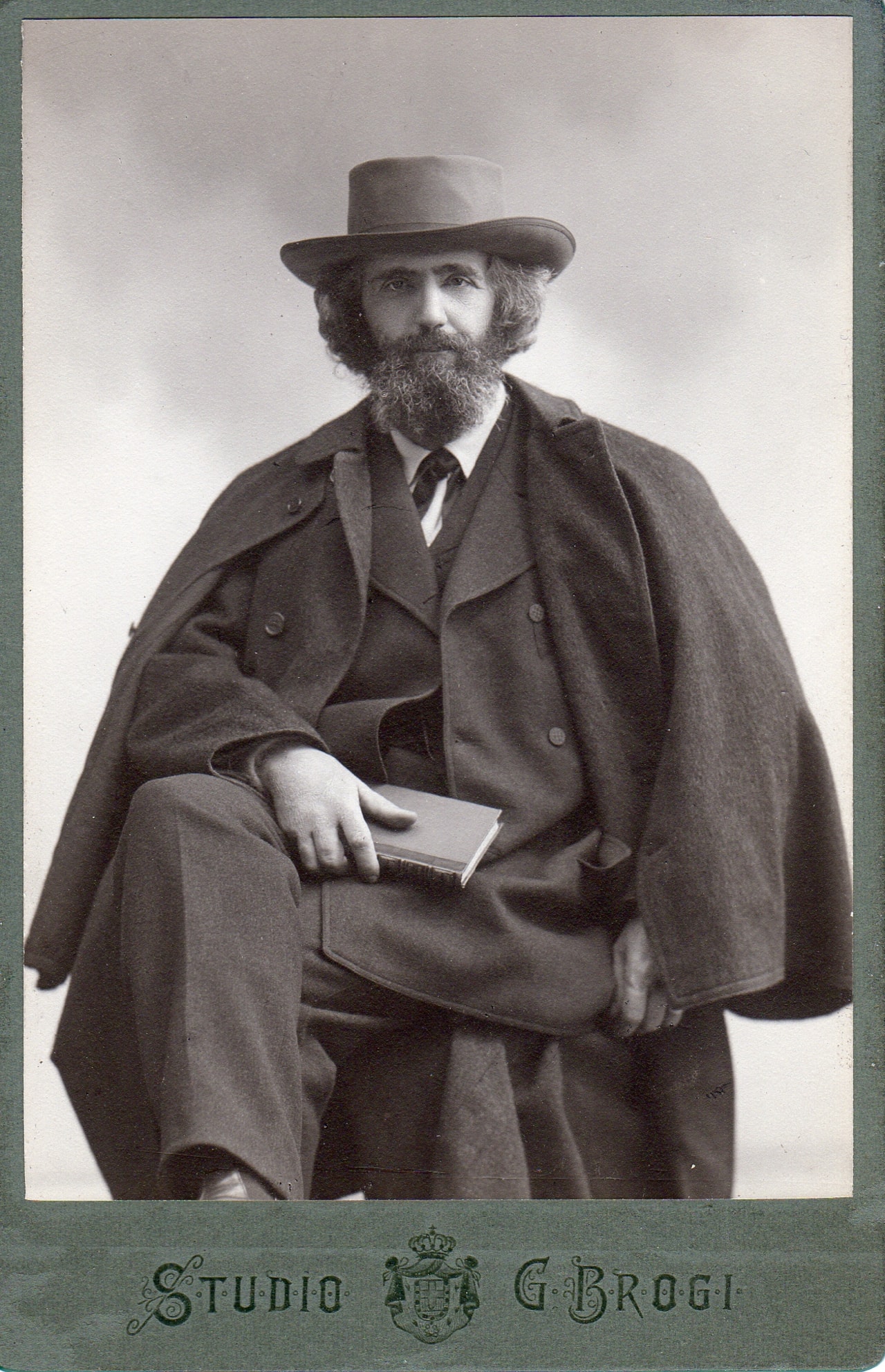
Franz Brentano in Florence, 1898. In 1874 he made aboutness the mark of the mental. Photo: Studio G. Brogi, public domain, via Wikimedia Commons.

The 30-second reply:
I agree the brain runs on electrical and chemical processes whenever we think. My question is what makes those processes about something. What fact makes one state about a tree rather than merely caused by a tree, and what makes it false when you are wrong? Physics describes charge, mass and motion, and none of those is "about" anything. Christianity says knowing is basic, because God knows and made us in His image. What is your account of aboutness that does not already assume it?
See this page's graph and discover linked topics
In full
The argument from intentionality is an inference to the best explanation from the existence of original intentionality, the intrinsic directedness of thought toward objects and states of affairs, to the conclusion that mind is ontologically basic, as theism holds. Brentano revived the scholastic notion in 1874, describing the mark of the mental as "the intentional (or mental) inexistence of an object." The contemporary argument has three moves. First, intentional states have determinate content and truth conditions, and so admit of misrepresentation. Second, the physical description of a neural state, however complete in its own vocabulary of charge, concentration and causal history, does not fix which content the state has: correlation and causation underdetermine content (Fodor's disjunction problem, Kripke's rule-following puzzle, Ross's argument from determinate formal thought), and formal symbol manipulation does not supply semantics (Searle). Third, the leading naturalization programmes (informational semantics, teleosemantics, functional-role semantics) each face an unsolved objection at exactly this point, while the eliminativist alternative, which denies that anything is about anything, undercuts its own assertion.
The theistic explanation locates original intentionality in a necessarily existent intellect and treats created minds as ontologically derived knowers made in the divine image (Imago Dei) and placed in a world made through the Logos (John 1:1-3). The argument is comparative and abductive. It does not claim theism supplies a neural mechanism, and it concedes that naturalists regard the problem as open. Its claim is that on theism aboutness belongs to the foundation of reality, while on naturalism it is an unexplained late arrival. The conceptual groundwork is laid out on Intentionality; this page is the debate-prep form.
Argument structure
| # | Premise |
|---|---|
| P1 | Some mental states have original intentionality: they are about objects or states of affairs, have determinate content, and can be true or false, including false by misrepresentation. |
| P2 | A description of a brain state in purely physical terms (electrical, chemical, causal) does not by itself fix what the state is about or whether it is true. |
| P3 | The leading naturalistic accounts have not supplied determinate, error-permitting, non-derived content from physical resources, and eliminating intentionality is self-defeating. |
| P4 | If original intentionality is real and is not fixed by physical facts alone, it is better explained if mind is basic to reality than if mind is a late by-product of mindless processes. |
| P5 | Classical theism holds that mind is basic: God is a necessarily existent knower, and human minds are made in His image. |
| C | Therefore the existence of thoughts that are about things is better explained by theism than by naturalism. |
Form
Abductive. P1 to P3 establish an explanandum and show that the physicalist reduction has not delivered it; P4 is the comparative explanatory principle; P5 identifies the rival that fits. The conclusion is "better explained", a comparative claim, and should be stated that way in debate. Embedded in P3 is a strict reductio against eliminativism, which is deductive and stronger than the surrounding argument. The weakest point is P3's "have not" rather than "cannot": a naturalist will say the problem is unsolved, not unsolvable. James Ross's version tries to upgrade P2 to an impossibility claim for determinate formal thought; it is disputed and should be deployed only by someone who has studied it.
P1, Thoughts are about things and can be false
Affirmative case (second-order arguments)
- Aboutness is the datum every debate presupposes. The opponent's sentence "your argument fails" is about the argument. Denying that any thought is about anything requires a thought about thoughts. P1 is the one premise the opponent cannot reject without using it.
- Thoughts can be about what does not exist. You can think about a unicorn, a future meeting, or a mistaken diagnosis. No physical relation holds between a brain and a nonexistent object, since a relation needs two relata. This feature is why Brentano treated aboutness as the mark of the mental and why it resists any analysis modeled on physical relations.
- Thoughts have truth conditions. "The tree is green" is true if and only if the tree is green. A chemical reaction has rates, energies and products; it has no truth conditions. Content is what gives a state something to be right or wrong about.
- Thoughts can misrepresent. You mistake a wax apple for an apple. The error is a real fact about your belief. Any account of thought must make room for error, and error is impossible without determinate content.
Anticipated objections
- "Aboutness is folk psychology, a pre-scientific theory neuroscience will replace." (Paul Churchland, 1981)
- "Thoughts are about things only in the way a thermostat is about temperature."
- "You are smuggling in a soul by describing thought this way."
Rebuttals
- Eliminativism cannot be asserted without refuting itself. To assert that no state is about anything is to produce a state about states. The eliminativist offers his theory as true and as better supported than its rival, both intentional notions. Lynne Rudder Baker named the problem "cognitive suicide" (Saving Belief, 1987). Alex Rosenberg embraces the consequence openly: chapter 8 of The Atheist's Guide to Reality (2011) is titled "The Brain Does Everything Without Thinking About Anything At All." That candor is useful, because it shows where strict physicalism leads when followed through. Failure mode: self-referential incoherence.
- A thermostat has derived aboutness only. The thermostat "represents" temperature because engineers designed it and users read it so. Remove every interpreter and it is a strip of metal bending. Your belief that the room is cold is about the room whether or not anyone interprets you. See Intentionality on original versus derived intentionality. Failure mode: treating borrowed meaning as intrinsic meaning.
- P1 describes the data and takes no position on dualism. Every theory of mind, physicalist or not, accepts that beliefs have contents and truth conditions. P1 assumes nothing about souls. The dispute begins at P2. Failure mode: rejecting a description because of where the argument goes later.
Live-cite kit
- Scripture: Psalm 94:9-10 ("He that formed the eye, shall he not see? ... Even he that teacheth man knowledge?", ASV); 1 Corinthians 2:11 (the spirit of a man knows the things of a man)
- Scholarly: Brentano, Psychology from an Empirical Standpoint (1874); Baker, Saving Belief (1987); Churchland, "Eliminative Materialism and the Propositional Attitudes" (Journal of Philosophy 78, 1981), for steelmanning the denial
- Aphorism: "You cannot deny that thoughts are about things without having a thought about thoughts."
Tactical notes
- Lead with an everyday case. "Think of your car. Your thought is about your car, and it would be false if you misremember the color." Abstract vocabulary loses the room.
- Force-commit: "Is your last sentence about anything? Could it be false?" A yes concedes P1.
- What NOT to defend live: a theory of what concepts are, or the details of Brentano exegesis.
P2, Electrochemistry does not fix content
Affirmative case (second-order arguments)
- The physical vocabulary is complete without content. Describe a neural state fully: membrane potentials, sodium and potassium ions moving in, chloride ions, neurotransmitters such as glutamate binding at receptors, timing, location, causal history. The description is finished, and the word "about" never appeared. Adding chemistry to electricity, a point physicalists sometimes press, changes the inventory of physical facts and leaves the gap where it was.
- Causation and representation come apart. A neural state may be caused by a tree. Smoke is also caused by fire, and a footprint by a foot. Causal connection is everywhere in nature; aboutness is rare. The question is what makes one state about a tree rather than merely caused by one.
- Correlation underdetermines content. If a state fires for cows, it also fires for dark shapes at dusk that look like cows. The physical facts fit "cow", "cow or cow-like shape" and "mid-sized mammal" equally. Jerry Fodor called this the disjunction problem, and it is the general shape of the difficulty.
- Syntax is not semantics. Searle's Chinese Room (1980): a person following rules for manipulating Chinese symbols by shape produces correct answers and understands nothing. Computation operates on the shapes of symbols; meaning is something further.
- Determinate formal thought. James Ross (1992): when you add, you perform addition and no other function, yet any finite physical process is consistent with infinitely many functions that agree on the cases actually computed. If thinking is determinate and physical processes are not, thinking is not purely physical. This is the strongest and most contested version.
Anticipated objections
- "The brain isn't just electrical, it's chemical. Once you include the chemistry, you have the full story."
- "Computers are physical and they process meaning. Thought is implemented in neurons the way software is implemented in hardware."
- "Neuroscience can already decode what people are looking at from brain scans. That shows content is physical."
- "A flat EEG means the brain is dead, so thought must be electrical."
Rebuttals
- Chemistry adds detail, and the gap survives the detail. Grant everything: the brain is an electrochemical system, chemistry depends on positive and negative charges, ion gradients drive signaling. Four levels need distinguishing: electrical activity, chemical activity, information processing, and intentionality. The question sits between the third and the fourth, and it is the same question whatever the inventory at the first two. Failure mode: answering a question about content with more facts about the medium.
- Computers have derived meaning. A computer's states mean what programmers and users assign. The implementation analogy borrows its meaning from the very minds it was supposed to explain. A physicalist can reply that brains have original content where computers have derived content, but then the analogy no longer does the work, and the account of what makes the difference is still owed. Failure mode: explaining original intentionality with a model of derived intentionality.
- Decoding is correlation interpreted by minds. Researchers correlate scan patterns with images or words that subjects report. The correlation is real and impressive. The meanings come from the subjects and the researchers who label the categories. Decoding shows that thought has neural correlates, which every party already accepts. Failure mode: correlation presented as constitution.
- The EEG inference is invalid as stated. An EEG records summed electrical potentials from large populations of cortical neurons. It does not measure neurotransmitters, metabolism or ion gradients directly. From "no detectable EEG signal" one cannot infer "no chemical activity", since that needs the extra premise that every relevant chemical process produces a detectable EEG signal, and that premise is false. Clinicians agree: the 2023 consensus guideline from the American Academy of Neurology and partner societies bases brain death determination on clinical examination and does not accept EEG as an ancillary test. The point cuts both ways and should be used honestly: the presence of electrochemical activity does not establish thought either. Neither direction settles what thought is. Failure mode: inferring not-C from not-E without showing that C requires E.
Live-cite kit
- Scripture: Genesis 1:27 (created in the image of God); Psalm 139:2 ("Thou understandest my thought afar off", ASV)
- Scholarly: Searle, "Minds, Brains, and Programs" (Behavioral and Brain Sciences 3, 1980); Fodor, "Semantics, Wisconsin Style" (Synthese 59, 1984) and A Theory of Content (1990); Ross, "Immaterial Aspects of Thought" (Journal of Philosophy 89, 1992); Kripke, Wittgenstein on Rules and Private Language (1982); Greer et al., brain death consensus guideline (Neurology, 2023)
- Aphorism: "Explaining what causes a brain state and explaining what it is about are two different jobs."
Tactical notes
- Concede the neuroscience first and fully. "Yes, electrical and chemical, and I'm glad we agree." The argument is strongest when it asks for something neuroscience never claimed to supply.
- The question that does the work: "What determines that this electrochemical state represents a tree, rather than simply being caused by one? And what makes it false when you're wrong?"
- Find out which physicalism you face. Ask: "Are thoughts identical to brain states, do they emerge from brain states, or are they realized by brain states?" Identity owes an account of how a state's physical properties are its content; emergence owes an account of what emerges and how it acts; realization owes an account of what is realized and what makes the realizer realize that content rather than another.
- What NOT to defend live: that thought can occur with no brain activity at all in embodied humans. That is a separate empirical claim (see NDEs (Near Death Experiences)) and needs its own evidence.
P3, Naturalistic accounts have not closed the gap
Affirmative case (second-order arguments)
- Informational semantics struggles with error. On Dretske's approach a state means what it reliably indicates. A state that fires for a wax apple then reliably indicates "apple or wax apple" and is correct, which erases the misrepresentation the theory most needed to explain.
- Teleosemantics inherits the indeterminacy. On Millikan's approach a state means what it was selected to track. Selection favored the frog snapping at small dark moving things that were usually flies; "fly", "food" and "small dark moving thing" fit the selection history equally.
- Functional-role semantics makes content holistic. If a state's content is fixed by its role in the whole network, two people never share a belief and every belief changes when anything changes.
- Prominent naturalists concede the difficulty. Thomas Nagel, an atheist, argues in Mind and Cosmos (2012) that the materialist account of nature cannot accommodate mind, including intentionality. The problem is recognized across the worldview divide.
Anticipated objections
- "Unsolved isn't unsolvable. You're arguing from a gap in current science."
- "Philosophers have refined these theories for decades. Asymmetric dependence or a hybrid view handles your cases."
- "Your God-based account isn't any more detailed. You've just named the problem."
Rebuttals
- The gap is conceptual, and the argument is comparative. A God-of-the-gaps argument infers God from ignorance about a mechanism. Here the difficulty is the same at every level of physical detail, because physical vocabulary lacks content terms. Even granting it may one day be solved, the comparative question stands: which worldview predicts aboutness, and which treats it as an anomaly to be explained away? Failure mode: calling a conceptual objection an empirical gap.
- Every refinement trades one problem for another. Fodor's asymmetric dependence answers the disjunction problem by stipulating which dependence is basic, and critics ask what physical fact makes it so. The naturalist is entitled to keep working. The honest current verdict is that no account commands consensus. Failure mode: treating an active research programme as a delivered result.
- Theism offers an ontology of mind, and that is a different kind of explanation from a mechanism. The theist does not explain how neurons produce content. The claim is that in a reality whose foundation is a knowing God, intentionality is basic and created minds share it by design. That gives an explanatory stopping point, and the critic is right to ask why God's intentionality needs no explanation. The answer is that a necessary being's essential attributes do not arise from anything more basic, as with every ultimate explanation, including the naturalist's brute physical laws. Failure mode: demanding a mechanism for what is claimed to be fundamental.
Live-cite kit
- Scripture: Hebrews 4:13 (all things laid open before His eyes); Psalm 147:5 ("His understanding is infinite", ASV)
- Scholarly: Dretske (1981); Millikan (1984); Fodor (1990); Nagel, Mind and Cosmos (2012)
- Aphorism: "If the foundation of reality is about nothing, aboutness is a stranger in the house. If the foundation is a Mind, it is family."
Tactical notes
- Steel-man before you press. Name teleosemantics yourself and state it well; then ask the misrepresentation question.
- Force-commit: "Which theory of content do you hold? Then let's test it on the wax apple."
- What NOT to defend live: that every naturalist theory is refuted. Claim that none has delivered determinate, error-permitting, non-derived content, which is true and harder to dispute.
P4 and P5, Mind first explains mind
Affirmative case (second-order arguments)
- Like explains like. Where an effect has a property, an explanation whose foundation already includes that kind of property is more natural than one that must generate it from what wholly lacks it. A world grounded in a knowing God predicts minds that know.
- Original intentionality in God, created intentionality in us. God's knowing is underived. Human knowing is a created capacity, real and our own, given by a God who made us in His image (Genesis 1:27). Our thoughts are about things because the kind of being we image is a knower.
- The Logos and an intelligible world. "All things were made through him" (John 1:3, ASV). The world was made through reason and minds were made to grasp it, so the fit between thought and world is expected. See Argument from Intelligibility.
- Coherence with the wider case. The same foundation explains the normativity of reasoning (Argument from Epistemic Normativity), the reliability of reason (Argument from Reason) and the necessity of logic (Syllogisms for Logic Itself).
Anticipated objections
- "Mind first is just as mysterious. How does an immaterial mind have content?"
- "Why the Christian God? Any idealism or panpsychism also puts mind at the base."
Rebuttals
- Every worldview has a basic level, and the question is what belongs there. The naturalist's base level has no content and must produce it. The theist's base level has content essentially and needs no production step. Mystery at the foundation is shared; the explanatory burden of getting content from contentless stuff falls on naturalism alone. Failure mode: tu quoque that ignores where the explanatory burden actually sits.
- The argument's first stage concludes that mind is basic; the identification is a second stage. Panpsychism spreads proto-mentality across matter and then faces the combination problem; idealism makes finite minds basic and cannot explain their shared world. A single necessary knower who creates finite knowers avoids both. Identifying that knower with the God of Scripture is the work of the cumulative case: see Christian God is the Only True God and Who Created God Objection Defeater. Failure mode: demanding that one argument do the work of the whole case.
Live-cite kit
- Scripture: John 1:1-3; Genesis 1:26-27; Psalm 94:9-10
- Scholarly: C. S. Lewis, Miracles (1947), ch. 3, "The Cardinal Difficulty of Naturalism"; Plantinga, Warrant and Proper Function (1993); Nagel, Mind and Cosmos (2012)
- Aphorism: "He that formed the eye, shall he not see?"
Tactical notes
- Keep the conclusion comparative. "Better explained", never "proved".
- What NOT to defend live: a particular theory of the soul. Substance dualism and hylomorphism are both live Christian options and explain the mind-body relation differently; see Substance Dualism and Mind, Soul, Consciousness.
Conclusion
Thoughts are about things and can be true or false. A description of the brain's electrical and chemical life, however complete, does not say what any state is about, and the theories built to close that gap remain contested, while denying aboutness undercuts itself. A worldview whose foundation is a knowing God expects minds that know. The existence of aboutness is better explained by theism than by naturalism.
Master objections to the whole argument
- "This is an argument from ignorance." Reply: the argument names a positive explanandum (determinate, error-permitting content) and a positive explanation (mind as basic). It would be defeated by a naturalistic theory that delivers that content without presupposing it.
- "Atheism does not entail materialism." Correct. Atheism is the denial of God, and an atheist could hold that mind is basic without God. The argument targets naturalism and reductive physicalism. Against a non-physicalist atheist, the question becomes why a basic mental reality should exist without a necessary mind behind it; see Godless Normative Realism for the parallel debate about moral facts.
- "Your appeal to God's intrinsic knowledge just relocates the problem." Reply: it locates aboutness at the foundation instead of deriving it from what lacks it. Every worldview stops somewhere; the argument compares stopping points.
Tactical opening and closing
Opening: "I'm not going to argue about whether the brain is electrical or chemical. It's both. I want to ask about one thing your thoughts do that electricity and chemistry don't: be about something, and be wrong."
Closing: "If the bottom of reality is charge and mass, aboutness is a stranger nobody invited. If the bottom of reality is a God who knows, your ability to think about this debate is exactly what we should expect. 'He that formed the eye, shall he not see?'"
Scholarship
Published academic works this page draws on, each matched to a publisher, index or library catalog record.
- Lynne Rudder Baker, Saving belief (1987). Open Library
- J. A. Fodor, "Semantics, Wisconsin style," Synthese 59 (1984). doi:10.1007/bf00869335
- Saul A. Kripke, Wittgenstein on Rules and Private Language (1982). Open Library
- Thomas Nagel, Mind and Cosmos: Why the Materialist Neo-Darwinian Conception of Nature is Almost Certainly False (Oxford University Press, 2012). doi:10.1093/acprof:oso/9780199919758.001.0001
- Alvin Plantinga, Warrant and Proper Function (Oxford University Press, 1993). doi:10.1093/0195078640.001.0001
- Alexander Rosenberg, The atheist's guide to reality (2011). Open Library
- James Ross, "Immaterial Aspects of Thought," The Journal of Philosophy 89 (1992). doi:10.2307/2026790
- John R. Searle, "Minds, brains, and programs," Behavioral and Brain Sciences 3 (1980). doi:10.1017/s0140525x00005756
See also
- Intentionality, the concept hub: original and derived aboutness, the Chinese Room, indeterminacy, and naturalist theories steel-manned
- Argument from Reason, the sister argument from rational inference
- Argument from Epistemic Normativity, why reasoning carries binding norms
- Argument from Consciousness, the neighboring argument from felt experience
- Consciousness Emerges from Neurons Objection Defeater, the reply to emergence claims
- God Cannot Be Conscious Without a Brain Objection Defeater, the reverse objection
- Materialism, the position the argument presses against
- Self-refutation, the structure that catches eliminativism
- Imago Dei, the doctrine that grounds created intentionality
- The Living God, God's life as knowing and loving
- Syllogisms for Logic Itself, the companion argument from the laws of logic
- Arguments, master index
Common questions this page answers
Q: What is the argument from intentionality?
It argues from the fact that thoughts are about things, and can be true or false, to the conclusion that mind is basic to reality. Physical descriptions of the brain never fix what a state is about, naturalistic theories of content remain contested, and theism already holds that a knowing God is fundamental, so it explains aboutness better.
Q: Are thoughts just brain chemistry?
Thinking involves electrical and chemical processes in the brain, and no one in the debate denies it. The question is whether those processes, described only physically, account for what a thought is about and whether it is true. A complete chemical description lists molecules and reactions and never mentions content, which is why many philosophers hold that something more is needed.
Q: If the brain is electrical and chemical, doesn't that explain thinking?
It explains the medium through which human thinking happens. It does not by itself explain what makes one brain state about a tree rather than merely caused by a tree, or what makes a belief false. Adding chemistry to electricity adds physical detail, and the question about content remains.
Q: Does a flat EEG prove there is no chemical activity in the brain?
No. An EEG records summed electrical potentials from large groups of cortical neurons and does not measure brain chemistry directly, so the inference from no EEG signal to no chemical activity is invalid. Current brain death guidelines rely on clinical examination and do not accept EEG as an ancillary test.
Q: Can atheists explain aboutness?
Atheist philosophers have proposed several theories, including informational semantics, teleosemantics and functional-role semantics, and each faces a well-known unsolved objection about error and determinacy. Some, like Alex Rosenberg, conclude that nothing is really about anything, which undercuts the claim itself. Atheism does not entail materialism, but the problem is sharpest for materialists.
Q: How does Christianity explain intentionality?
God knows, and His knowledge is underived. Human beings are made in His image and live in a world made through the Logos, so our minds are created knowers fitted to an intelligible world. Aboutness belongs to the foundation of reality instead of being a late accident.