Person
Antony the Great
Antony, Anthony the Great, Antony of Egypt, Anthony of Egypt, Saint Antony, Saint Anthony the Great, Abba Antony, Anthony the Abbot, Antony the HermitIntro
Antony was an Egyptian farmer's son who, around the age of twenty, heard a Gospel verse read in church and took it literally. He sold his family's land, gave the money to the poor, and went to live alone in the desert to pray. He stayed there for most of eighty years.
He did not invent the hermit life, but he became its model. Thousands followed him into the Egyptian desert, and a short biography of him written by Athanasius of Alexandria spread his example across the Roman world. Through that book an African peasant became the father of Christian monasticism and helped bring about the conversion of Augustine.
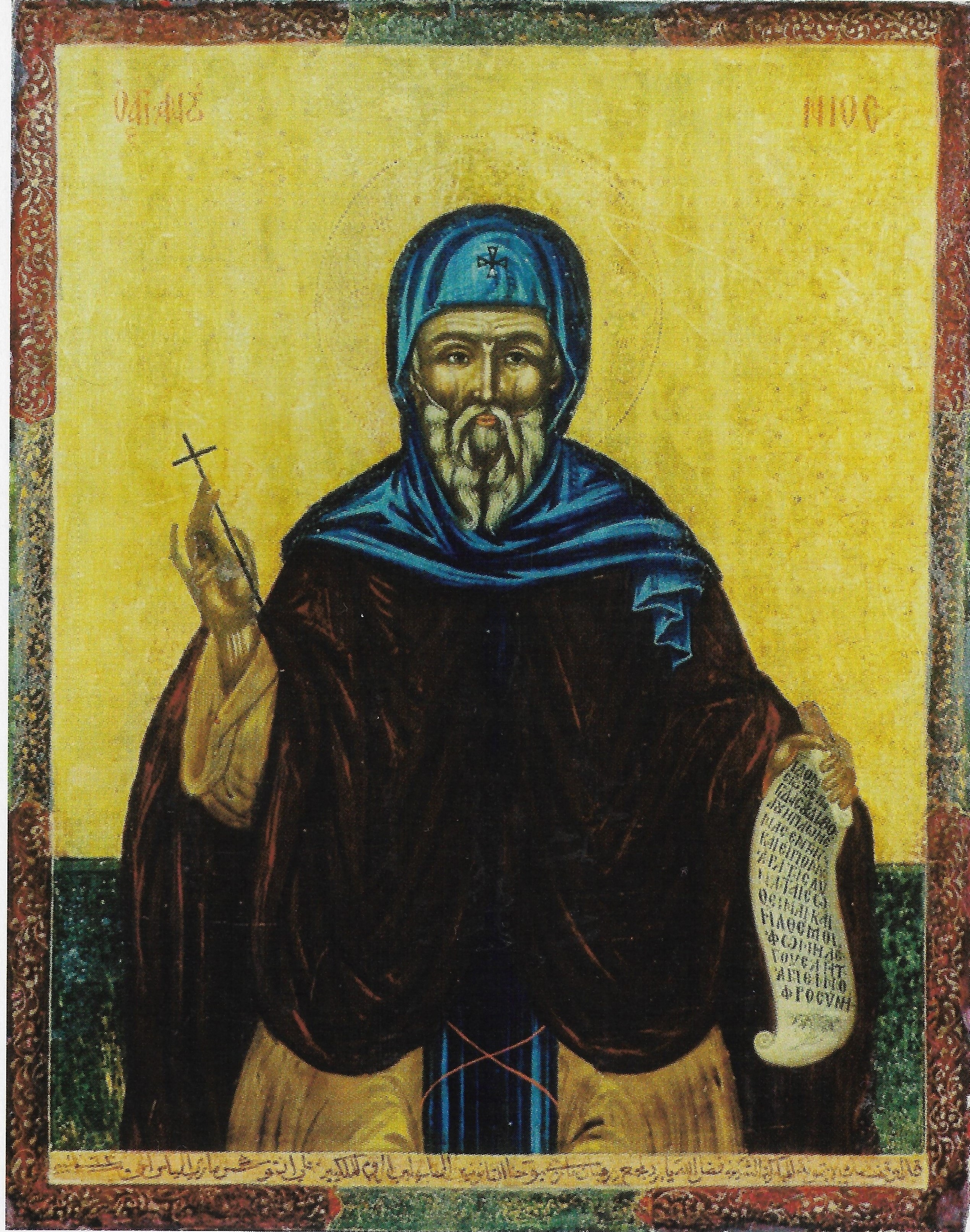 Icon of Antony the Great, from Lebanon. Public domain (Wikimedia Commons), resized.

See this page's graph and discover linked topics
In full
Antony (Greek Antōnios, c. 251-356) was a Coptic Christian of Middle Egypt whose withdrawal into progressively remoter desert, first to the village outskirts, then the tombs, then an abandoned fort at Pispir on the Nile (the "Outer Mountain"), and finally a spring near the Red Sea (the "Inner Mountain", Mount Colzim), made him the paradigmatic Christian hermit. His fame rests chiefly on the Life of Antony (Vita Antonii), written by Athanasius of Alexandria soon after his death, c. 356-362, translated into Latin within a generation and among the most widely read books of late antiquity. Seven letters attributed to him survive, chiefly in Coptic, Syriac, Georgian, Arabic and Latin versions; their authenticity, long doubted, was defended by Samuel Rubenson (The Letters of St. Antony, 1990), whose work has persuaded many scholars that Antony was more theologically literate than the Life suggests. He is venerated as "the father of monks" in every ancient Christian tradition. The Monastery of Saint Antony near the Red Sea, founded at the site of his last retreat, has been inhabited for most of the centuries since.
Life, according to the Life of Antony
- Birth and upbringing. Born to well-off Christian parents in the village of Coma in Middle Egypt. Athanasius says he refused to learn letters as a boy, which later readers took to mean he was unschooled (see Tensions).
- The call (c. 270). His parents died when he was about eighteen or twenty. Less than six months later he entered church as the Gospel was read: "If thou wilt be perfect, go and sell that thou hast, and give to the poor, and thou shalt have treasure in heaven: and come and follow me" (Matthew 19:21, KJV). He took it as addressed to him, sold his land, gave the proceeds to the villagers and the poor, and placed his younger sister with a community of consecrated virgins.
- Apprenticeship. He lived near his village, learning from older ascetics, working with his hands, praying constantly, and memorizing Scripture.
- The tombs. He shut himself in a tomb some distance away, where the Life records fierce assaults by demons, the source of the later "Temptation of Saint Antony" in Western art.
- Pispir, about twenty years (c. 285-305). He sealed himself inside a ruined fort across the Nile. When friends finally broke down the door, they found him, Athanasius says, neither wasted nor bloated, but balanced in body and soul. Disciples settled around him, and the desert "became a city" of monks.
- Alexandria in persecution (311). During the persecution under Maximinus Daia he went to Alexandria to serve imprisoned confessors, openly hoping for martyrdom, which did not come.
- The Inner Mountain. Seeking solitude again, he travelled with a caravan of Saracens (Arab nomads) to a mountain near the Red Sea, where he farmed a small garden and received visitors.
- Against the Arians (c. 338). He came down to Alexandria once more to denounce the teaching that the Son of God is a creature, siding publicly with Athanasius. See Arianism.
- Death (356). He died at about 105, asking to be buried secretly. He left one sheepskin and a cloak to Athanasius, and another sheepskin to Serapion of Thmuis.
Teaching
- Scripture first. The Life and the sayings present Antony as a man saturated in the Bible; the desert was a school of obedience to it.
- Spiritual warfare. The demons are real but defeated; the sign of the cross, prayer and the name of Christ disarm them. Fear of them is the monk's real enemy.
- Discernment. A long sermon in the Life (chapters 16 to 43) teaches monks to test thoughts and visions and to distinguish the peace that comes from God from the agitation that comes from evil.
- Humility and perseverance. The sayings attributed to him in the Apophthegmata Patrum stress daily new beginnings, self-knowledge, and love of neighbor: life and death, he is reported to have said, are with our neighbor.
Influence
- The pattern of monasticism. Antony became the model for the eremitic (solitary) life, alongside Pachomius's communal (cenobitic) model. See Desert Fathers and Mothers and Monasticism.
- The conversion of Augustine. In Confessions 8.6.14-15, Augustine's friend Ponticianus tells how two imperial officials at Trier read the Life of Antony and resolved on the spot to give up their careers for Christ. The story shook Augustine; days later, in the garden at Milan, he heard the child's voice saying "take up and read" and, remembering that Antony had been converted by a Gospel reading, opened Paul's letter and was converted (Confessions 8.12.29).
- A popular Christian classic. Translated into Latin by Evagrius of Antioch, the Life became the prototype of Christian hagiography and carried the Egyptian desert into Gaul, Italy and beyond.
- African origins of a global institution. Every later monastic tradition, Benedictine, Basilian, Ethiopian, Athonite, traces itself back through the Egyptian desert to Antony. Thomas Oden counts monasticism among the main ways Africa shaped the Christian mind. See How Africa Shaped the Christian Mind.
Tensions
- Was Antony illiterate? Athanasius presents an unlettered holy man whose wisdom came from God, not schooling. Rubenson argues that the seven letters are authentic and show a teacher familiar with Alexandrian, Origen-influenced theology; on that reading Athanasius shaped his portrait to fit his own anti-Arian and anti-intellectualist aims. Others consider the letters' attribution unproven.
- How much of the Life is history? Scholars treat it as a theologically purposeful biography, written by a bishop with a cause, but grounded in a real figure whom Athanasius claims to have known. The miracles and demon battles are the parts critical historians weigh most cautiously; the outline of his life is generally accepted.
- "First" monk? Antony himself learned from older ascetics, and Jerome wrote a Life of Paul of Thebes claiming Paul preceded him in the desert. Antony is the best-documented early hermit, not the first.
See also
- Desert Fathers and Mothers, the movement Antony came to represent
- Pachomius, founder of communal monasticism
- Moses the Black, a later desert father of Scetis
- Athanasius, his friend and biographer
- Augustine, whose conversion the Life of Antony helped bring about
- Monasticism, the wider history of the monastic life
- Coptic Orthodox Church, the church of Antony's Egypt today
- Africa and Christianity, the master hub
Common questions this page answers
Q: Who was Saint Antony the Great?
An Egyptian Christian (c. 251-356) who gave away his inheritance around 270 and spent the rest of his long life as a hermit in the desert. He is honored as the father of Christian monasticism.
Q: Was Saint Antony African?
Yes. He was a Coptic Egyptian born in Middle Egypt who lived his whole life in Egypt's deserts. Christian monasticism, which spread worldwide, began with him and his fellow Africans.
Q: What Bible verse made Antony go into the desert?
Matthew 19:21, where Jesus tells the rich young man to sell what he has, give to the poor, and follow him. Antony heard it read in church and obeyed it literally.
Q: Who wrote the Life of Antony?
Athanasius, bishop of Alexandria, wrote it shortly after Antony's death in 356. It was quickly translated into Latin and became one of the most influential books of the early church.
Q: How did Saint Antony influence Augustine's conversion?
In Confessions Book 8, Augustine hears how two officials were converted by reading the Life of Antony. Remembering that Antony was converted through a Gospel reading, Augustine opened Paul's letters in the garden at Milan and surrendered to Christ.
Q: Was Antony the first Christian monk?
No. He learned from older ascetics, and Jerome claimed Paul of Thebes went to the desert earlier. Antony is the most influential early hermit, not the first.
Q: Where is the Monastery of Saint Antony?
In Egypt's Eastern Desert near the Red Sea, below the mountain where Antony spent his last decades. It is among the oldest continuously used Christian monasteries in the world.